Wich or which is a common spelling question for English learners and even native speakers. Many people type wich by mistake when they mean which. This small error can affect your writing, school work, emails, and even your website’s SEO.
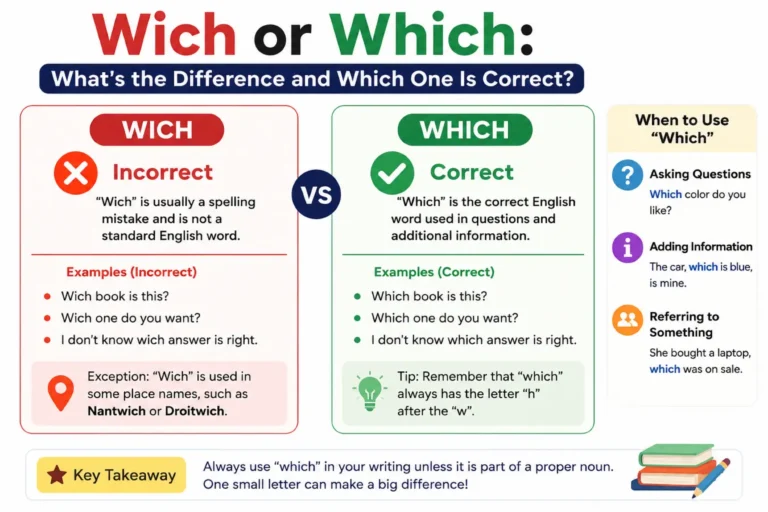
The good news is that the answer is simple. Which is the correct English word. Wich is usually a spelling mistake unless it appears in a proper name or place.
In this guide, you will learn the meaning of which, why people confuse it with wich, and how to use it correctly. You will also see real-life examples, grammar tips, and common mistakes to avoid.
Quick Summary Box
- Which is the correct English word.
- Wich is usually a spelling mistake.
- Use which when asking questions or adding extra information.
- Remember that which always includes the letter h.
- Correct spelling improves writing, communication, and SEO.
What Does Wich or Which Mean?
Many people search for wich or which because they are unsure about the correct spelling.
The answer is easy.
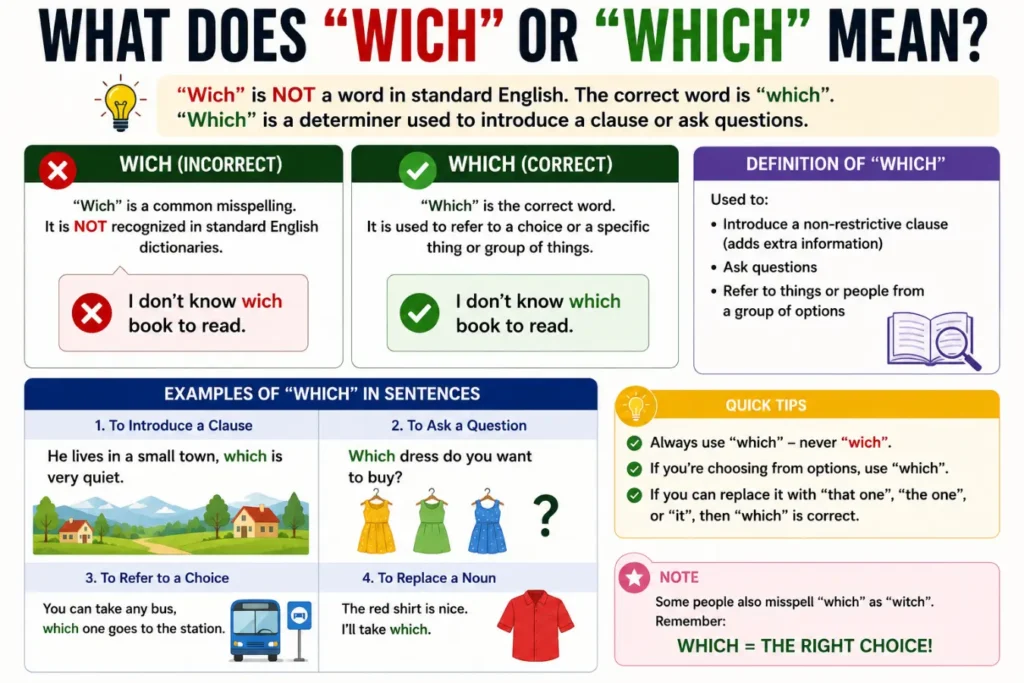
Which is the correct English word.
Wich is almost always a typo or spelling mistake.
English contains many words that look similar. Because of this, people often leave out one letter when typing quickly. The missing h changes the spelling and makes the word incorrect.
If you write:
❌ Wich book do you like?
It should be:
✅ Which book do you like?
Learning this simple rule helps you write more clearly and confidently.
Is Wich a Real Word?
In modern English, wich is not a standard dictionary word.
However, there are a few exceptions.
The word appears in the names of some towns and places.
Examples include:
- Droitwich
- Nantwich
- Northwich
In these names, wich comes from an old English word related to salt production.
Outside these proper names, you should not use wich in normal writing.
Key Point
If you are writing an essay, email, blog post, or message, always choose which.
What Does Which Mean?
Which is a very common English word.
It has several uses.
1. Asking Questions
Use which when choosing between people or things.
Examples:
- Which color do you like?
- Which movie should we watch?
- Which road is faster?
- Which phone is yours?
In each sentence, the speaker wants to choose from two or more options.
2. Introducing Extra Information
Which can also add more details about something.
Example:
The car, which is blue, belongs to my brother.
The phrase which is blue gives extra information.
3. Referring to Something Already Mentione
Example:
She bought a laptop, which was on sale.
Here, which refers back to the laptop.
Simple Definition
Which is a pronoun and determiner used to ask about choices or give extra information.
Why Do People Confuse Wich and Which
Many people make this spelling mistake for several reasons.
Fast Typing
People often forget to type the letter h.
Example:
❌ wich laptop
✅ which laptop
Autocorrect Problems
Some keyboards fail to fix the mistake immediately.
Always proofread your writing before publishing.
English Learners
Many learners hear the word before they learn its spelling.
Since the h is silent, they may forget to include it.
Keyboard Errors
The letters h and i sit close together on many keyboards.
Typing quickly increases the chance of mistakes.
Why This Matters
A small spelling error can make your writing look less professional.
Correct spelling also improves:
- Readability
- Grammar
- Trust
- Search engine optimization (SEO)
Search engines understand user intent, but readers notice spelling mistakes quickly.
Wich vs Which: Comparison Table
| Feature | Wich | Which |
|---|---|---|
| Correct English word | ❌ No | ✅ Yes |
| Dictionary word | Usually No | Yes |
| Used in grammar | No | Yes |
| Used in questions | No | Yes |
| Used in relative clauses | No | Yes |
| Appears in place names | Yes | Sometimes |
| Suitable for formal writing | No | Yes |
When Should You Use Which?
Use which whenever you are talking about choices.
Examples:
- Which dress looks better?
- Which train leaves first?
- Which answer is correct?
- Which hotel should we book?
You should also use which when adding extra information.
Examples:
- The book, which I borrowed yesterday, is excellent.
- The cake, which was homemade, tasted amazing.
- My phone, which I bought last year, still works perfectly.
Quick Tip
If you can replace the word with “what one” or “what option,” then which is probably the correct choice.
Example:
Which shirt do you want?
↓
What shirt do you want?
The sentence still makes sense.
That shows which is the correct wor
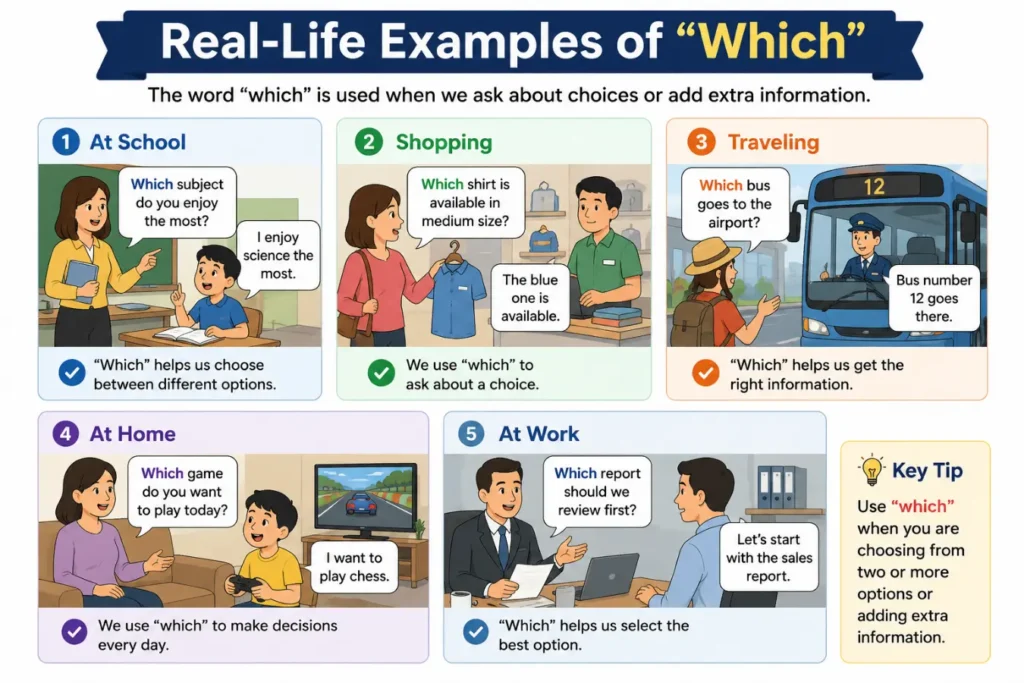
Real-Life Examples of “Which”
Learning with examples makes grammar easier. Below are common situations where you should use which.
Example 1: At School
Teacher: Which subject do you enjoy the most?
Student: I enjoy science the most.
Example 2: Shopping
Customer: Which shirt is available in medium size?
Shopkeeper: The blue one is available.
Example 3: Traveling
Tourist: Which bus goes to the airport?
Driver: Bus number 12 goes there.
Example 4: At Home
Parent: Which game do you want to play today?
Child: I want to play chess.
Example 5: At Work
Manager: Which report should we review first?
Employee: Let’s start with the sales report.
These examples show that which helps people choose between two or more options.
Common Mistakes People Make
Many writers accidentally type wich instead of which. Here are the most common mistakes and how to fix them.
| Incorrect | Correct |
|---|---|
| Wich book is yours? | Which book is yours? |
| Wich one should I buy? | Which one should I buy? |
| Tell me wich road to take. | Tell me which road to take. |
| Wich color do you like? | Which color do you like? |
| I don’t know wich answer is right. | I don’t know which answer is right. |
Why These Mistakes Happen
- Typing too fast.
- Forgetting the silent h.
- Not proofreading.
- Relying too much on autocorrect.
How to Avoid Them
- Read your writing before sending it.
- Use a spell checker.
- Practice writing which every day.
- Remember that which always includes the letter h.
Tips to Remember the Correct Spelling
You don’t need to memorize difficult grammar rules. These simple tricks can help.
Tip 1: Remember the “H”
Think of which as the word that always needs an H.
Without the H, the spelling is usually wrong.
Tip 2: Read Your Writing Slowly
Many spelling mistakes happen because people read too quickly.
Reading each sentence slowly helps you catch errors.
Tip 3: Practice with Questions
Write simple questions every day.
Examples:
- Which movie do you like?
- Which city is bigger?
- Which cake tastes better?
The more you practice, the easier it becomes.
Tip 4: Use Grammar Tools
Writing tools can highlight spelling mistakes before you publish your content.
They also improve grammar and readability.
Using “Which” in Everyday Life
The word which appears in daily conversations, emails, websites, books, and social media.
Here are some everyday examples.
In School
- Which chapter is today’s homework?
- Which answer is correct?
At the Office
- Which meeting starts first?
- Which document should I print?
While Shopping
- Which laptop has better battery life?
- Which shoes fit you best?
During Travel
- Which hotel is closest to the beach?
- Which flight arrives earlier?
At Home
- Which TV show should we watch?
- Which recipe do you want to try?
You can see that which is one of the most useful words in English.
Synonyms and Related Words
Depending on the sentence, these words may have a similar meaning.
Synonyms
- What
- Whichever
- Whichever one
- That (in some sentences)
- Who (for people in certain contexts)
Remember that these words do not always replace which. Always check the meaning before changing your sentence.
(FAQs)
1. Is “wich” or “which” correct?
Which is the correct English spelling. Wich is usually a spelling mistake unless it appears in the name of a place, such as Nantwich or Droitwich.
2. Why do people spell “which” as “wich”?
Most people make this mistake because they type quickly or forget the silent h. The pronunciation is the same, which makes the error easy to overlook.
3. Can I use “wich” in formal writing?
No. You should never use wich in essays, emails, reports, or blog posts unless it is part of an official place or business name.
4. How do I remember the correct spelling of “which”?
A simple trick is to remember that which always has the letter H after the W. If the H is missing, the spelling is usually incorrect.
5. Is “which” a question word?
Yes. Which is a question word used when choosing between two or more people, places, or things.
Example:
- Which phone do you want?
- Which restaurant should we visit?
6. Can “which” be used in the middle of a sentence?
Yes. It often introduces extra information.
Example:
The book, which I borrowed yesterday, is very interesting.
7. Does using the correct spelling help SEO
Yes. Correct spelling improves readability, user trust, and content quality. Search engines also prefer well-written, error-free content that provides value to readers.
8. What is the difference between “which” and “what”?
Use which when choosing from a known or limited number of options.
Example:
- Which shirt do you like?
Use what when the number of choices is unknown or unlimited.
Example:
- What is your favorite hobby?
Why Correct Spelling Matters
Correct spelling is important for many reasons.
Better Communication
People understand your message quickly.
Professional Writing
Correct spelling makes your writing look trustworthy.
Better Grades
Students earn better marks when they avoid spelling mistakes.
Improved SEO
Search engines prefer high-quality, error-free content. Clean writing also improves user experience and encourages readers to stay longer on your page.
Strong First Impression
Whether you are writing a blog, email, or business proposal, correct spelling creates confidence.
Conclusion
Many people search for wich or which because the two spellings look similar. However, the correct word in standard English is which. The spelling wich is usually a typing mistake, except when it appears in certain place names.
Knowing the difference helps you write with confidence. It also makes your emails, school assignments, blog posts, and business documents look more professional. Correct spelling improves readability and creates a better experience for your readers.
Whenever you need to ask about choices or add extra information to a sentence, remember to use which. A single letter can make a big difference in clear communication. With regular practice and careful proofreading, you can avoid this common mistake and improve your English writing skills every day.