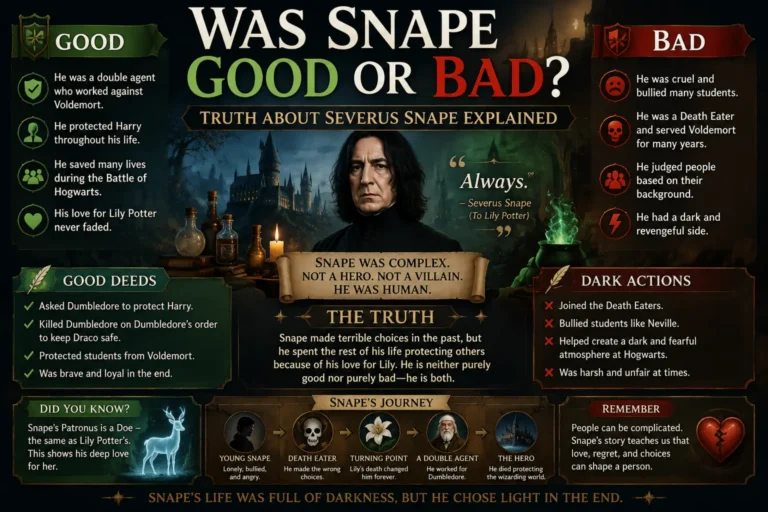
Was Snape good or bad? The answer is not as simple as calling him a hero or a villain. Severus Snape is one of the most complex characters in the Harry Potter series. He makes cruel choices and often treats others badly. Yet, he also risks his life to protect Harry and fight Voldemort. His story shows that people can have both good and bad sides. Snape joins the Death Eaters when he is young. Later, he regrets his choices and works as a secret agent for Dumbledore. His actions often look selfish or cruel. However, his final choices reveal a deeper purpose. This article explains Snape’s morality in simple terms. We will look at his actions, motives, mistakes, and sacrifice. We will also compare Snape with true villains and heroes.
Quick Summary: Was Snape Good or Bad?
- Snape was morally complicated, not purely good or evil.
- He made serious mistakes when he was young.
- He joined Voldemort’s Death Eaters.
- He later became a spy against Voldemort.
- He protected Harry for reasons linked to Lily.
- He treated Harry and other students cruelly.
- He showed courage by risking his life.
- His final actions helped defeat Voldemort.
- Snape was best described as a flawed antihero.
- His story proves that good actions do not erase past mistakes.
What Does “Was Snape Good or Bad?” Mean?
The question asks whether Snape should be viewed as a hero or a villain.
A simple answer does not fully explain his character.
Snape did both good and bad things throughout his life. His motives also changed over time.
As a young wizard, Snape made dangerous choices. He joined the Death Eaters and supported Voldemort.
Later, Snape turned against Voldemort. He secretly worked with Dumbledore.
Therefore, Snape fits better between “good” and “bad.”
He becomes an antihero, rather than a traditional hero.
Was Snape a Villain?
Snape acted like a villain in several parts of the story.
He bullied students and showed favoritism toward Slytherins. He often treated Harry unfairly.
He also had a long history with dark magic.
Most importantly, Snape once served Voldemort.
His actions indirectly helped place Lily Potter and her family in danger. Snape later regretted this choice deeply.
However, Snape did not remain loyal to Voldemort.
He became a double agent and helped Dumbledore oppose him.
So, calling Snape a villain ignores an important part of his story.
Was Snape Actually Good?
Snape performed many brave and important actions.
He protected students during the war. He also protected Harry while hiding his true role.
Snape had to convince Voldemort that he remained loyal. One mistake could have exposed him.
He accepted enormous personal risk.
His greatest act came when he continued Dumbledore’s plan after Dumbledore’s death.
Snape also helped guide Harry toward the sword of Gryffindor.
These actions show courage and loyalty.
Still, good actions do not make every part of Snape’s behavior good.
His treatment of children remained cruel and unfair.
Why Did Snape Hate Harry?
Snape’s hatred for Harry connects strongly to Harry’s father, James Potter.
James bullied Snape during their school years. Snape never fully escaped that resentment.
Harry also looked very much like James.
Because of this, Snape often treated Harry as if he carried his father’s faults.
Yet Harry also had Lily’s eyes.
Lily was the person Snape loved most.
This creates a major conflict inside Snape.
He protects Harry because Harry is Lily’s son. At the same time, Harry reminds him of James.
That conflict helps explain Snape’s harsh behavior.
It does not excuse it.
Why Did Snape Join Voldemort?
Snape joined Voldemort because he became attracted to dark magic and power.
He also lived in a difficult social environment at Hogwarts.
Snape wanted acceptance and status.
His friendship with Lily became strained as he moved deeper into dark magic.
Eventually, Snape became part of Voldemort’s Death Eaters.
This decision became one of his biggest mistakes.
He later heard part of a prophecy about a child who could defeat Voldemort.
Snape passed information to Voldemort.
He then realized that Lily could become a target.
That moment changed his life.
Why Did Snape Protect Harry?
Snape protected Harry because of his love for Lily Potter.
He felt responsible for helping cause Lily’s death.
Snape then promised to protect her son.
Dumbledore helped Snape turn that promise into a larger mission.
Snape’s protection was rarely warm or friendly.
Instead, it often appeared through secret actions.
He saved Harry from danger several times.
He also worked behind the scenes during the fight against Voldemort.
This makes his protection meaningful, but also complicated.
Snape did not protect Harry because he suddenly became a loving father figure.
His motivation came from guilt, love, and responsibility.
Snape vs. Voldemort: Good or Evil?
The difference between Snape and Voldemort becomes clearer when we compare their choices.
| Trait | Severus Snape | Lord Voldemort |
|---|---|---|
| Served Voldemort | Yes | Yes |
| Used dark magic | Yes | Yes |
| Felt regret | Yes | Rarely |
| Protected others | Yes | No |
| Loved someone deeply | Yes | No healthy love |
| Accepted personal sacrifice | Yes | No |
| Wanted immortality | No | Yes |
| Changed sides | Yes | No |
| Put others before himself | Sometimes | Rarely |
This comparison shows why Snape cannot fit neatly into the villain category.
Voldemort consistently chooses power and control.
Snape eventually chooses protection and sacrifice.
That difference matters.
Snape vs. Harry: Who Was More Good?
Harry and Snape also provide an interesting moral comparison.
Harry makes mistakes, but he usually tries to protect others.
Snape makes mistakes and often hides his feelings.
Harry values friendship and trust.
Snape usually works alone.
Harry also receives support from many people.
Snape carries much of his mission alone.
However, both characters show courage.
Both face Voldemort despite serious danger.
The biggest difference comes from their emotional choices.
Harry learns to forgive and understand others.
Snape struggles to let go of anger and resentment.
Therefore, Harry represents a healthier form of heroism.
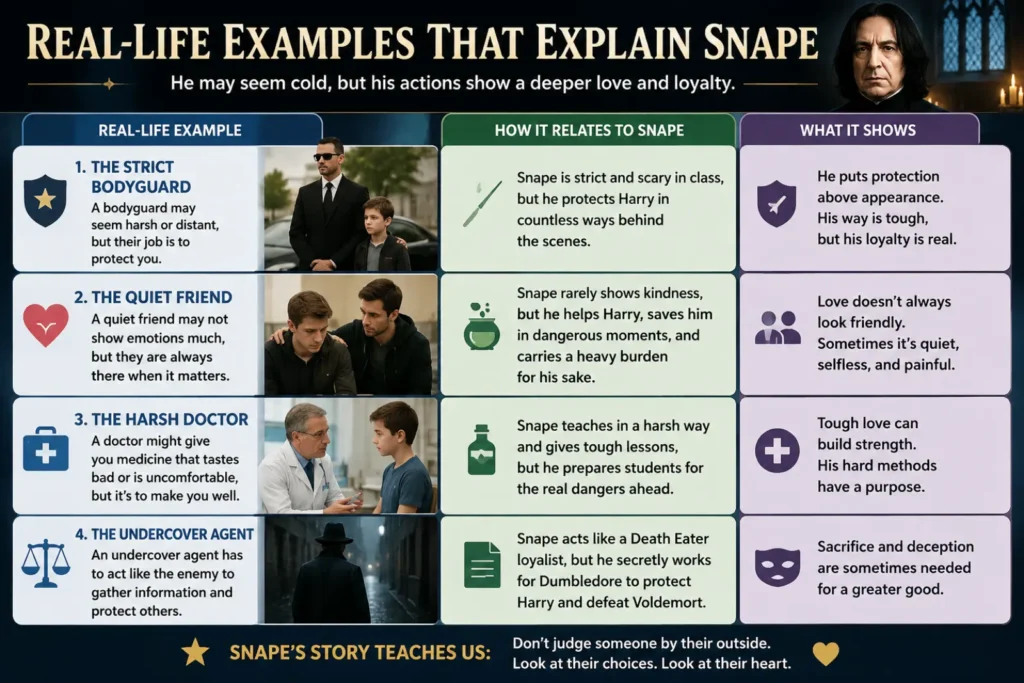
Real-Life Examples That Explain Snape
Snape’s character becomes easier to understand through real-life situations.
Imagine someone makes a terrible mistake during childhood.
Years later, that person regrets the mistake and spends years repairing the damage.
Their later actions may deserve respect.
But the original harm still matters.
Another example involves someone who acts rude while secretly helping others.
Their help may be valuable.
Their rude behavior still hurts people.
Snape works in a similar way.
His sacrifice deserves recognition.
His cruelty deserves criticism.
Both facts can exist together.
Common Mistakes People Make About Snape
Mistake 1: Calling Snape Completely Evil
Snape clearly does good things.
His secret work against Voldemort proves this.
Mistake 2: Calling Snape Completely Good
Snape hurts people emotionally.
He also made serious choices that helped Voldemort.
Mistake 3: Saying “Always” Makes Everything Forgivable
Snape’s famous memory shows his lasting love for Lily.
However, love does not erase harmful behavior.
Mistake 4: Ignoring His Youth
Young Snape made terrible decisions.
His later life shows that people can change.
Mistake 5: Ignoring His Cruelty
Snape’s sacrifice does not excuse bullying.
Both sides deserve attention.
Was Snape a Hero, Antihero, or Villain?
The best label for Snape is antihero.
An antihero lacks the usual qualities of a traditional hero.
Snape is bitter, secretive, harsh, and sometimes cruel.
Yet he performs heroic actions.
He risks his life for a cause greater than himself.
He protects people who may never understand his choices.
He also accepts a mission that offers little personal reward.
That combination makes him a classic morally gray character.
Expert Insight: Why Snape’s Character Matters
Snape matters because Harry Potter does not present morality as simple.
His story raises an important question:
Can someone become better without becoming a completely good person?
The answer appears to be yes.
Snape never becomes a cheerful or kind person.
Instead, he changes the direction of his life.
He moves from serving Voldemort to opposing him.
His story also shows the difference between redemption and perfection.
Redemption does not mean forgetting past mistakes.
It means taking responsibility and choosing differently.
This makes Snape’s character powerful for readers and viewers.
His story encourages people to judge actions carefully.
It also reminds us that motives can matter, but they do not erase consequences.
Synonyms and LSI Keywords for “Was Snape Good or Bad?”
Use these related terms naturally when researching Snape:
- Was Severus Snape good or evil?
- Was Snape a hero?
- Was Snape a villain?
- Snape morality explained
- Severus Snape character analysis
- Snape’s true intentions
- Why did Snape protect Harry?
- Why did Snape hate Harry?
- Snape redemption
- Snape and Lily
- Snape and Dumbledore
- Snape’s sacrifice
- Snape’s role in Harry Potter
- morally gray Harry Potter characters
- Snape antihero
- Snape Death Eater history
These terms support topical relevance without repeating the main keyword too often.
How to Understand Snape’s Character Better
Use these simple tips when analyzing Snape.
Look at actions, not just words.
Snape often says cruel things while secretly doing helpful things.
Consider the full timeline.
His childhood, Hogwarts years, Death Eater period, and later life all matter.
Separate motive from behavior.
A good reason does not automatically make an action good.
Compare him with other characters.
Voldemort, Harry, Dumbledore, and Draco reveal different parts of Snape.
Notice his sacrifices.
Snape repeatedly accepts danger without public praise.
These methods create a more balanced character analysis.
Why Snape’s Story Still Matters
Snape remains popular because his character creates debate.
People can disagree about his morality.
Some readers see him as a tragic hero.
Others see him as a cruel man who did some heroic things.
Both views contain valid points.
His story also teaches a broader lesson about human behavior.
People rarely fit perfectly into “good” or “bad” categories.
Someone can make harmful choices and still change later.
Someone can perform heroic acts while treating others badly.
Snape represents this moral complexity very well.
That is why his character continues to attract discussion years after the books ended.
FAQs About Whether Snape Was Good or Bad
Was Snape good or bad?
Snape was morally gray. He did serious wrongs but later performed major acts of courage.
Was Snape secretly a good guy?
Snape eventually fought against Voldemort. However, he still behaved cruelly toward many people.
Why did Snape protect Harry?
Snape protected Harry because Harry was Lily Potter’s son. Snape also felt responsible for Lily’s death.
Did Snape love Lily?
Yes. Lily remained deeply important to Snape throughout his life.
Was Snape a Death Eater?
Yes. Snape joined Voldemort’s Death Eaters when he was young.
Did Snape betray Voldemort?
Yes. Snape secretly worked against Voldemort and served as a double agent.
Was Snape a hero?
Snape performed heroic acts, especially through his secret work and sacrifice. However, he was not a traditional hero.
Did Snape deserve forgiveness?
That depends on the reader. His redemption matters, but it does not erase the harm he caused.
Conclusion: Was Snape Good or Bad?
So, was Snape good or bad?
The best answer is that Snape was neither completely good nor completely bad.
He made serious mistakes and supported Voldemort when he was young.
He also treated Harry and other students unfairly.
However, Snape later changed his path.
He became a spy against Voldemort and accepted enormous personal risks.
His love for Lily motivated much of his redemption.
His final actions helped protect Harry and defeat Voldemort.
Still, his heroic sacrifice does not erase his cruel behavior.
That balance makes Snape one of the most morally complex characters in Harry Potter.
He was not a perfect hero.
He was a flawed man who made terrible choices and later chose to do something better.