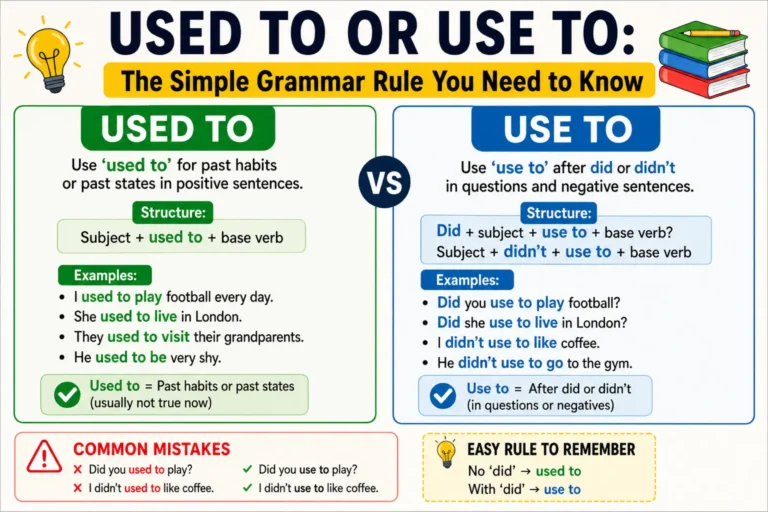
Used to or use to can confuse many English learners. Both forms look almost the same. However, they have different grammar roles. The correct choice depends on the sentence around them. Used to often talks about past habits or past states. Use to usually appears after did or didn’t. Many learners mix these forms because the final d can sound unclear. This guide explains the difference in simple English. You will learn the rules, examples, common mistakes, and useful memory tips. You will also see how native speakers use these phrases in daily conversation. By the end, you will know exactly when to write used to and when to write use to.
Quick Summary
- Use used to + base verb for past habits or past states.
- Example: I used to play tennis.
- Use use to after did or didn’t.
- Example: Did you use to play tennis?
- Example: I didn’t use to like coffee.
- Do not write Did you used to…?
- The word did already shows the past tense.
- Used to can also mean “accustomed to” in some sentences.
- Always check the helping verb before choosing the form.
What Does “Used to” Mean?
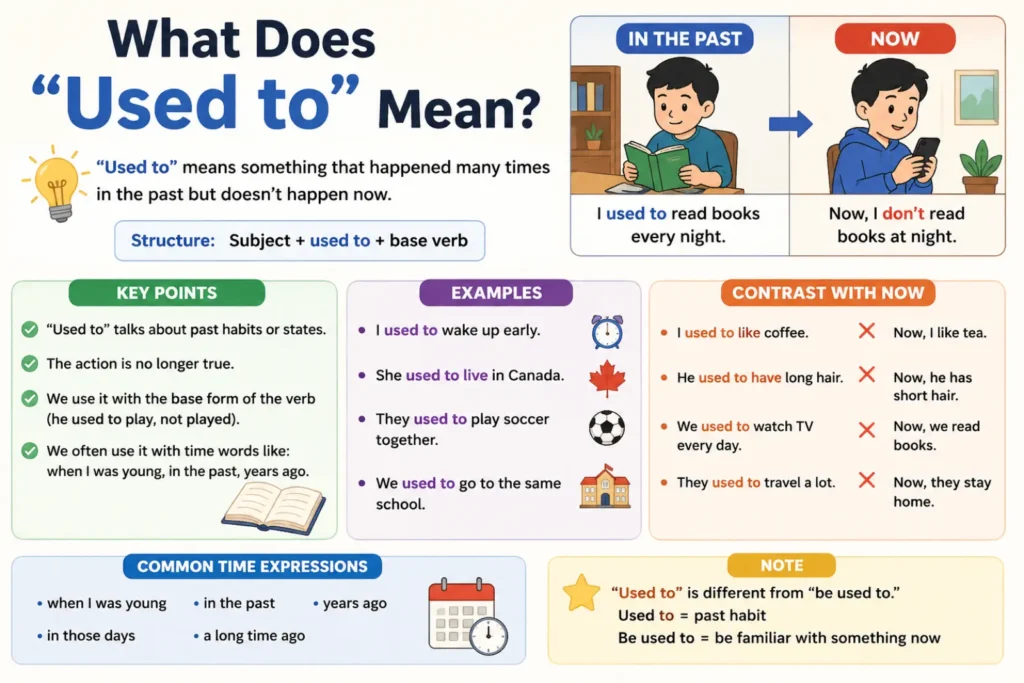
Used to describes something that happened regularly in the past.
It can also describe a past situation.
The action or situation usually does not happen now.
Examples
- I used to live in Lahore.
- She used to play basketball.
- We used to visit our grandparents every summer.
- He used to have long hair.
These sentences describe the past.
They often suggest a change in the present.
For example:
I used to play football.
This usually means:
I played football before, but I do not play now.
Therefore, used to often shows a contrast between the past and present.
What Does “Use to” Mean?
Use to usually appears after did or didn’t.
The word did already shows the past tense.
Therefore, the main verb returns to its base form.
Correct Examples
- Did you use to live here?
- Did she use to work with you?
- I didn’t use to drink tea.
- He didn’t use to exercise regularly.
Incorrect Examples
- Did you used to live here?
- I didn’t used to drink tea.
These forms are common mistakes.
The correct forms are:
- Did you use to live here?
- I didn’t use to drink tea.
Used to vs Use to: The Main Difference
The easiest rule is simple.
Use “used to” in positive statements
Subject + used to + base verb
Examples:
- I used to walk to school.
- She used to sing in a choir.
- They used to live near the beach.
Use “use to” after “did” or “didn’t”
Did + subject + use to + base verb?
Examples:
- Did you use to play chess?
- Did he use to work here?
Subject + didn’t + use to + base verb
Examples:
- I didn’t use to enjoy reading.
- She didn’t use to eat spicy food.
Easy rule
No “did” → used to
With “did” → use to
This rule helps in most everyday situations.
Used to or Use to: Comparison Table
| Sentence Type | Correct Form | Example |
|---|---|---|
| Positive statement | used to | I used to swim. |
| Negative statement | didn’t use to | I didn’t use to swim. |
| Question | Did…use to | Did you use to swim? |
| After “did” | use to | Did she use to work here? |
| Past habit | used to | He used to run daily. |
| Past state | used to | We used to live there. |
The key difference comes from the word did.
How to Use “Used to” for Past Habits
Use used to when someone did something regularly in the past.
The habit may have stopped now.
Examples
- I used to read before bed.
- My father used to walk every morning.
- We used to visit our cousins often.
- She used to bake cakes on weekends.
These sentences describe repeated past actions.
They do not describe one single event.
Compare These Sentences
I used to play cricket.
This describes a past habit.
I played cricket yesterday.
This describes one past event.
So, used to often gives a wider view of the past.
How to Use “Used to” for Past States
You can also use used to with verbs that describe situations.
These situations existed in the past.
They may no longer exist today.
Examples
- I used to be shy.
- She used to have a small apartment.
- They used to live in Karachi.
- He used to know my brother.
These examples do not always describe repeated actions.
Instead, they describe past conditions or situations.
Used to or Use to in Questions
Questions usually use did.
Therefore, write use to, not used to.
Correct Questions
- Did you use to play football?
- Did she use to live here?
- Did they use to work together?
- Did he use to visit this café?
Why?
The word did carries the past tense.
The main verb stays in its basic form.
So:
Did + use
Not:
Did + used
Memory Tip
Think of did as the past-tense marker.
Once did appears, remove the d from used.
Used to or Use to in Negative Sentences
Negative sentences usually use didn’t.
Therefore, use use to after didn’t.
Correct Examples
- I didn’t use to like vegetables.
- She didn’t use to wake up early.
- We didn’t use to have internet access.
- He didn’t use to travel often.
Common Mistake
❌ I didn’t used to like vegetables.
Correct Version
✅ I didn’t use to like vegetables.
The same grammar rule applies.
Didn’t already shows the past.
Real-Life Examples of “Used to”
Here are natural examples from everyday life.
About Childhood
- I used to play outside after school.
- My brother used to collect toy cars.
- We used to visit our grandparents every Sunday.
Talking About Old Routines
- I used to drink coffee every morning.
- She used to walk to work.
- They used to watch movies together.
Talking About Past Places
- I used to live in a small town.
- He used to work at a bank.
- We used to study in the same classroom.
Each example describes something connected to the past.
Real-Life Examples of “Use to”
The form use to appears mainly after did or didn’t.
Questions
- Did you use to play video games?
- Did your family use to live here?
- Did she use to work at that company?
Negative Statements
- I didn’t use to enjoy cooking.
- He didn’t use to travel much.
- We didn’t use to own a car.
Notice the pattern.
Did + use
Didn’t + use
This makes the grammar easier to remember.
Common Mistakes With Used to and Use to
Many learners make the same errors.
Here are the most common mistakes.
Mistake 1: Using “used” After “Did”
❌ Did you used to play tennis?
✅ Did you use to play tennis?
The word did already shows the past.
Mistake 2: Using “used” After “Didn’t”
❌ I didn’t used to eat breakfast.
✅ I didn’t use to eat breakfast.
Again, didn’t already carries the past tense.
Mistake 3: Using “use to” in Positive Statements
❌ I use to play football.
✅ I used to play football.
Positive past statements usually use used to.
Mistake 4: Confusing “Used to” With “Be Used To”
These phrases have different meanings.
I used to wake up early.
This means I woke up early in the past.
I am used to waking up early.
This means waking up early feels normal to me now.
The grammar also changes.
Used to vs Be Used To
This difference deserves special attention.
Used to + base verb
This describes a past habit or state.
Example:
I used to work at night.
This means I worked at night in the past.
Be used to + noun or -ing verb
This means something feels familiar or normal.
Examples:
- I am used to working at night.
- She is used to the noise.
- They are used to living in a busy city.
Compare
| Phrase | Meaning | Example |
|---|---|---|
| used to + verb | Past habit | I used to run. |
| be used to + noun | Familiar with something | I am used to noise. |
| be used to + -ing | Familiar with an activity | I am used to running. |
This distinction prevents many grammar mistakes.
Used to vs Would for Past Habits
Sometimes would can replace used to.
However, they do not work in exactly the same way.
Used to
You can use it for habits and past states.
- I used to visit my aunt.
- I used to be shy.
Would
You can use it for repeated past actions.
- Every summer, we would visit our aunt.
- My grandfather would tell us stories.
However, would usually does not describe a past state.
For example:
❌ I would be shy.
This does not normally mean the same thing as:
✅ I used to be shy.
Therefore, used to has wider use.
Tips to Remember Used to or Use to
Here are simple memory tricks.
Tip 1: Look for “Did”
If you see did, use use to.
Did you use to live here?
Tip 2: Look for “Didn’t”
If you see didn’t, use use to.
I didn’t use to like tea.
Tip 3: Positive Statements Use “Used to”
I used to play football.
Tip 4: Ask Yourself About the Past
Does the sentence describe an old habit or situation?
If yes, used to may fit.
Tip 5: Read the Sentence Aloud
Sometimes the difference sounds unclear.
Look at the grammar structure.
Do not rely only on pronunciation.
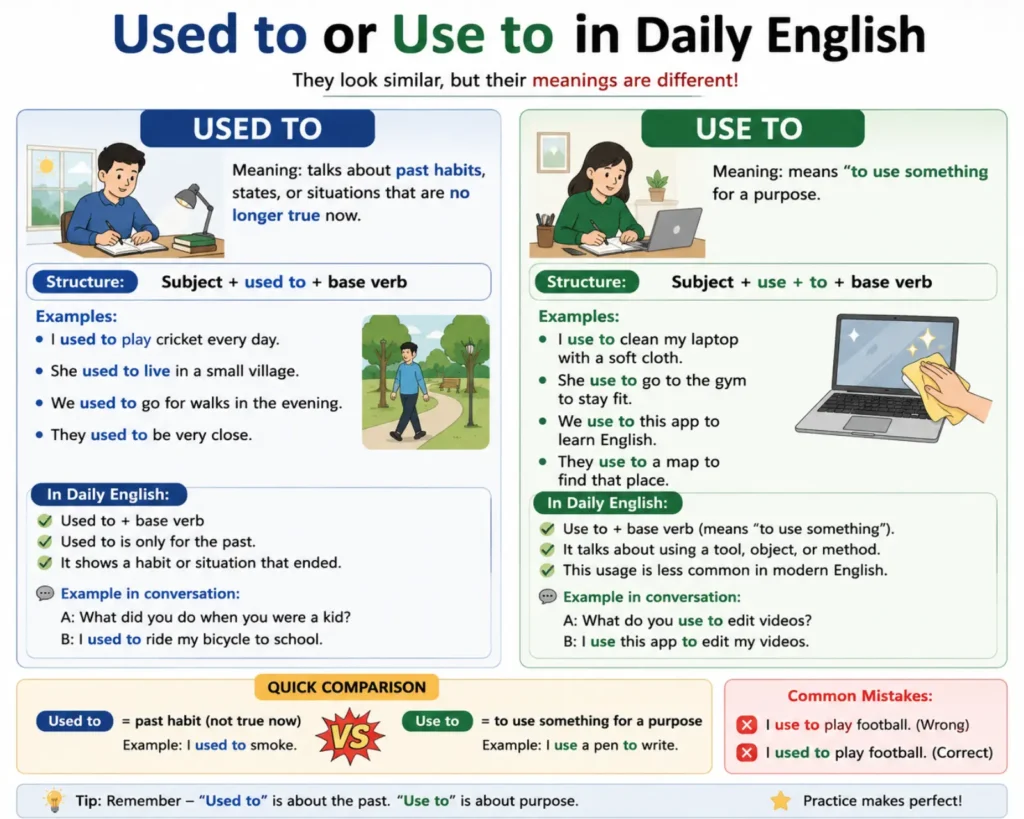
Used to or Use to in Daily English
Native speakers use these structures often.
They appear in conversations about change.
People use them when discussing childhood, work, travel, hobbies, and routines.
Daily Conversation Examples
A: Did you use to live in Islamabad?
B: Yes, I used to live there.
A: Did you use to play sports?
B: Yes, I used to play cricket.
A: Why did you stop?
B: I didn’t use to have enough free time.
These examples show the pattern clearly.
Questions use use to.
Positive answers use used to.
Negative answers use didn’t use to.
Synonyms and Related Keywords
The phrase used to has several related expressions.
These phrases can help you express similar ideas.
Common Synonyms
- formerly
- once
- in the past
- previously
- at one time
- before
- back then
Example
I used to live there.
Similar meanings include:
- I lived there in the past.
- I formerly lived there.
- I lived there once.
However, these alternatives may change the sentence structure.
Therefore, used to remains the most natural choice for past habits.
Related Grammar Keywords
- past habits
- past states
- English grammar rules
- used to grammar
- use to after did
- did you use to
- didn’t use to
- used to vs be used to
- used to vs would
These terms relate closely to the main topic.
Expert Insight
Strong grammar improves clarity.
Small errors can change how natural your English sounds.
The used to rule also teaches a wider grammar principle.
When a helping verb shows tense, the main verb often returns to its base form.
For example:
- Did you go?
- Did she eat?
- Did they work?
We do not write:
- Did you went?
- Did she ate?
- Did they worked?
The same idea explains:
- Did you use to…?
This pattern helps learners understand many other English grammar rules.
Expert Tip
Do not memorize only one phrase.
Study the complete sentence pattern.
That method improves both writing and speaking accuracy.
Frequently Asked Questions
1. Is it “used to” or “use to”?
Use used to in positive statements.
Use use to after did or didn’t.
2. Is “Did you used to?” correct?
No.
The correct form is:
Did you use to…?
The word did already shows the past tense.
3. Is “I didn’t used to” correct?
No.
The correct form is:
I didn’t use to…
4. What is the meaning of “used to”?
Used to describes a past habit or past situation.
The habit or situation often changed later.
5. Can “used to” describe past states?
Yes.
Examples include:
- I used to be shy.
- She used to live here.
- He used to have a dog.
6. What is the difference between “used to” and “be used to”?
Used to + verb describes the past.
Be used to + noun or -ing means something feels familiar.
Example:
- I used to wake early.
- I am used to waking early.
7. Can I use “would” instead of “used to”?
Sometimes.
Would can describe repeated past actions.
However, used to can also describe past states.
8. What is the easiest way to remember the rule?
Remember this:
Positive: used to. After did: use to.
This simple rule works in most everyday sentences.
Conclusion
The difference between used to or use to becomes simple once you understand the pattern. Use used to for positive statements about past habits or past states. Use use to after did or didn’t. For example, write I used to play football. However, write Did you use to play football? Also write I didn’t use to play football. The word did already shows the past tense. Therefore, the main verb stays in its base form. Remember this simple rule: positive statements use “used to,” while questions and negatives with “did” use “use to.” This small grammar tip can make your English writing much clearer.