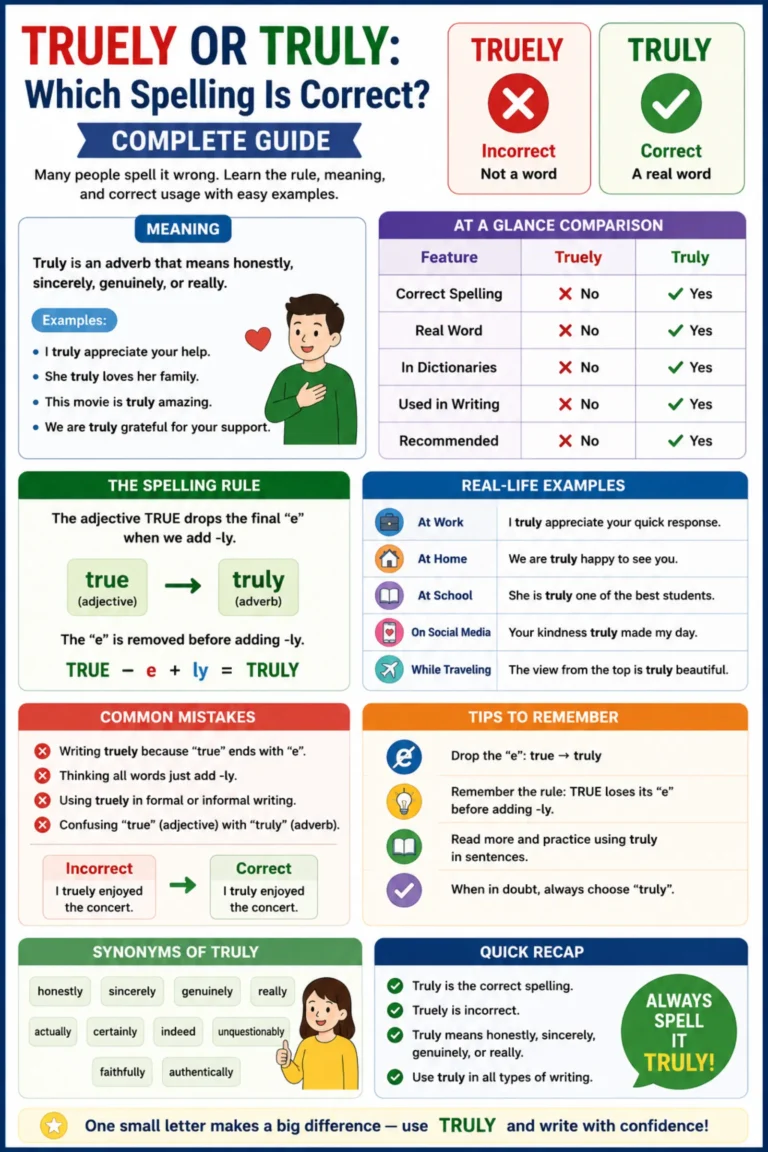
Truely or truly is a common spelling question in English. Many people accidentally write truely, but only one spelling is correct. This mistake appears in emails, school assignments, social media posts, and even professional documents.
The correct spelling is truly. It comes from the adjective true, but English drops the letter e before adding -ly. Because this spelling rule is unusual, many writers mistakenly add the extra e and write truely.
Learning the difference is simple. Once you understand the spelling rule, you will avoid this mistake forever. This guide explains the meaning of truly, why truely is incorrect, real-life examples, grammar rules, common mistakes, and easy memory tricks. By the end, you will know exactly which spelling to use in every situation.
Quick Summary Box
- ✅ Truly is the correct spelling.
- ❌ Truely is incorrect in standard English.
- Truly means honestly, sincerely, genuinely, or really.
- The word true drops the letter e before adding -ly.
- Use truly in formal and informal writing.
- Dictionaries recognize truly only.
- If you are unsure, always write truly.
What Does “Truly” Mean?
Truly is an adverb. It describes how something happens or emphasizes that something is genuine or honest.
Simple Definition
Truly means:
- honestly
- sincerely
- genuinely
- really
- in a truthful way
It often describes feelings, opinions, promises, or facts.
Examples
- I truly appreciate your help.
- She truly loves her family.
- This movie is truly amazing.
- We are truly grateful for your support.
- He truly believes in his idea.
In every example, truly adds emphasis and shows honesty or sincerity.
What Does “Truely” Mean?
The short answer is simple.
Truely is not a correct English word.
Many people think it should be spelled this way because the adjective true ends with the letter e.
However, English follows a special spelling rule.
Instead of writing:
❌ truely
You should write:
✅ truly
Modern dictionaries, grammar books, and style guides all recognize truly as the only correct spelling.
If you use truely, spell-check software will usually mark it as an error.
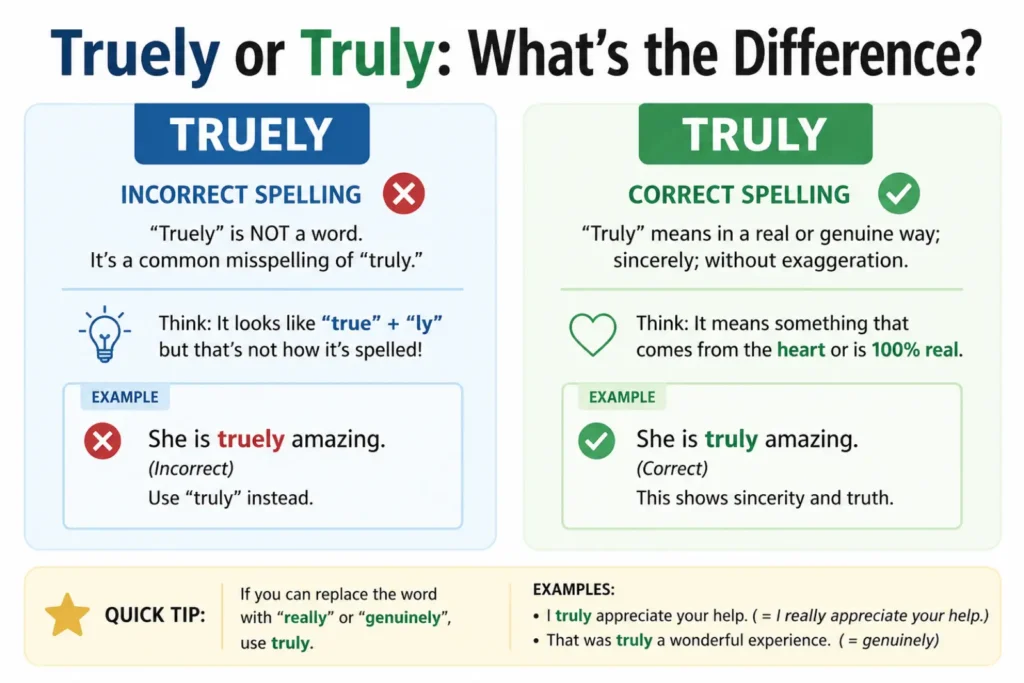
Truely or Truly: What’s the Difference?
Although these words look similar, only one is correct.
| Feature | Truly | Truely |
|---|---|---|
| Correct English spelling | ✅ Yes | ❌ No |
| Found in dictionaries | ✅ Yes | ❌ No |
| Accepted in formal writing | ✅ Yes | ❌ No |
| Used in books and newspapers | ✅ Yes | ❌ No |
| Recommended by grammar experts | ✅ Yes | ❌ Never |
The Easy Answer
If you want to write correctly, always choose truly.
Avoid truely because it is a spelling mistake.
Why Is “Truly” Spelled Without the “E”?
This is one of the most confusing spelling rules in English.
Normally, many words simply add -ly.
Examples include:
- quick → quickly
- slow → slowly
- careful → carefully
However, true follows a different rule.
The final e disappears.
Correct
- true → truly
Incorrect
- true → truely
This spelling has been part of standard English for many years.
Although it may seem unusual, it is the accepted form everywhere.
The Grammar Rule Explained
Most adjectives become adverbs by adding -ly.
Examples:
| Adjective | Adverb |
|---|---|
| happy | happily |
| kind | kindly |
| quiet | quietly |
| easy | easily |
The adjective true is a special exception.
Instead of keeping the final e, it drops it.
| Adjective | Correct Adverb |
|---|---|
| true | truly |
This is similar to several other English spelling changes.
Once you remember this exception, the correct spelling becomes much easier.
Why Do So Many People Write “Truely”?
There are several reasons why this mistake is so common.
1. People Follow the Wrong Pattern
Most words simply add -ly.
Examples:
- safe → safely
- complete → completely
- polite → politely
Because of this, writers assume:
true → truely
Unfortunately, that rule does not apply here.
2. Pronunciation Sounds the Same
Both spellings sound identical when spoken.
Because there is no pronunciation difference, many people never realize the spelling is wrong.
3. Typing Quickly
Many spelling mistakes happen while typing fast.
Autocorrect usually fixes truely, but sometimes it does not.
4. Lack of Grammar Knowledge
Many English learners have never learned this special spelling rule.
Once they understand it, they rarely make the mistake again.
Is “Truely” Ever Correct?
No.
In modern English, truely is considered a spelling error.
It does not appear as the standard spelling in dictionaries or grammar guides.
Whether you are writing:
- an email
- a school essay
- a business report
- a blog post
- a social media caption
always use truly.
Real-Life Examples of Truly
The word truly appears in everyday conversations, books, movies, emails, advertisements, and business writing. It helps express honesty, sincerity, or strong feelings.
Here are some real-life examples that show how to use truly correctly.
At School
Students and teachers often use truly when expressing appreciation or giving feedback.
Examples
- I truly enjoyed today’s science lesson.
- Our teacher truly cares about our success.
- She is truly one of the best students in the class.
- We are truly thankful for your guidance.
At Work
Professional emails and meetings often include truly because it sounds polite and sincere.
Examples
- I truly appreciate your quick response.
- We truly value our customers.
- Our company is truly committed to quality.
- Thank you for your support. It is truly appreciated.
At Home
Families use truly to express genuine emotions.
Examples
- I truly love spending time with my family.
- We are truly happy to see you.
- Mom truly makes the best cookies.
- Dad is truly proud of your achievements.
While Traveling
Travel blogs and conversations often use truly to describe memorable experiences.
Examples
- Paris is truly a beautiful city.
- The beach was truly breathtaking.
- We had a truly unforgettable vacation.
- This mountain view is truly amazing.
On Social Media
People frequently use truly to share feelings and opinions online.
Examples
- This sunset is truly incredible.
- I am truly grateful for everyone who supported me.
- Your kind words truly made my day.
- That performance was truly inspiring.
In Business
Businesses use truly to build trust and show sincerity.
Examples
- We truly appreciate your business.
- Our team is truly dedicated to customer satisfaction.
- Thank you for choosing our services. We are truly honored.
- We truly believe in providing excellent support.
In Everyday Conversation
Here are simple examples you may hear every day.
- She is truly kind.
- He truly understands the problem.
- I truly believe you.
- They are truly excited about the trip.
- This meal is truly delicious.
How to Use Truly in Daily Life
The word truly is useful in many everyday situations. It makes your message sound more honest and meaningful.
Expressing Gratitude
- I truly appreciate your help.
- We truly thank everyone for their support.
Showing Strong Feelings
- I truly miss my friends.
- She truly loves reading books.
Giving Compliments
- You truly did an excellent job.
- This artwork is truly beautiful.
- He is truly talented.
Making Promises
- I truly promise to do my best.
- We truly care about your success.
Writing Emails
Professional emails often include truly.
Example
Thank you for your time. I truly appreciate your assistance.
Writing Articles
Writers use truly to emphasize important ideas.
Example
Learning English can truly improve your communication skills.
Common Mistakes People Make
Many writers make the same spelling mistakes. Learning them now will help you avoid them.
Mistake 1: Writing “Truely”
❌ I truely enjoyed the movie.
✅ I truly enjoyed the movie.
Mistake 2: Adding an Extra “E”
Some people think every adjective ending in e keeps that letter before -ly.
That is not true for true.
❌ truely
✅ truly
Mistake 3: Confusing “True” and “Truly”
Remember:
True is an adjective.
Truly is an adverb.
Examples
Correct:
- The story is true.
- She truly believes the story.
Mistake 4: Using “Truly” in the Wrong Place
Place truly close to the word it describes.
Correct:
- I truly appreciate your kindness.
Less natural:
- Truly I appreciate your kindness.
Tips to Remember the Correct Spelling
Here are a few easy tricks that make the spelling easy to remember.
1. Drop the Final “E”
Remember this simple formula:
True → Truly
The e disappears.
2. Think of Similar Words
Many words change slightly when adding -ly.
Learning these spelling patterns makes writing easier.
3. Trust Your Spell Checker
Most writing programs automatically correct truely to truly.
Still, it helps to know the rule yourself.
4. Read the Word Often
The more often you see truly, the easier it becomes to remember.
Reading books, articles, and newspapers helps build good spelling habits.
5. Practice Writing It
Write a few sentences every day.
Examples:
- I truly enjoyed the concert.
- We truly appreciate your kindness.
- She truly deserves this award.
Practice helps the correct spelling become natural.
Truly vs Really
Many people wonder whether truly and really mean the same thing.
Although both add emphasis, they are not always interchangeable.
| Feature | Truly | Really |
|---|---|---|
| Shows sincerity | ✅ Yes | Sometimes |
| Shows honesty | ✅ Yes | Rarely |
| Adds emphasis | ✅ Yes | ✅ Yes |
| Common in formal writing | ✅ Yes | Less common |
| Casual conversations | Yes | ✅ Very common |
Examples
Truly
- I truly appreciate your support.
- She is truly grateful.
Really
- I really like this song.
- That movie was really funny.
Tip: Use truly when you want to sound sincere or formal. Use really in casual conversations to add emphasis.
Quick Practice Quiz
Choose the correct spelling.
- I _____ enjoyed your presentation.
- A. truely
- B. truly ✅
- She _____ believes in hard work.
- A. truly ✅
- B. truely
- We _____ appreciate your support.
- A. truly ✅
- B. truely
If you chose truly every time, you got them all correct!
Synonyms of Truly
Sometimes you can replace truly with another word that has a similar meaning. Choosing the right synonym makes your writing more natural and engaging.
Here are some common synonyms for truly.
- honestly
- sincerely
- genuinely
- really
- actually
- certainly
- indeed
- unquestionably
- faithfully
- authentically
Examples
- I truly appreciate your help.
- I sincerely appreciate your help.
- She is truly happy.
- She is genuinely happy.
- We are truly grateful.
- We are honestly grateful.
Choose the synonym that best matches the tone of your sentence.
Related Keywords (LSI & Semantic Keywords)
Using related keywords naturally helps search engines understand your content. It also improves your chances of ranking for multiple search queries.
Primary Keyword
- truely or truly
Secondary Keywords
- truly meaning
- truely meaning
- truly definition
- how to spell truly
- truly spelling
- truely vs truly
- correct spelling of truly
- is truely a word
- grammar rules for truly
- English spelling mistakes
- common spelling errors
- adverbs ending in ly
- true vs truly
- when to use truly
- truly examples
Use these keywords naturally throughout your article instead of repeating the primary keyword too often.
Expert Insight
Professional editors, English teachers, and major dictionaries all agree that truly is the only correct spelling in modern English. Although truely looks logical because it comes from the word true, English follows a special spelling rule that drops the final e before adding -ly.
Learning common spelling exceptions like this improves both your writing and your confidence. It also helps you create professional emails, essays, blog posts, and business documents without distracting spelling mistakes.
If you are ever unsure, remember this simple rule:
True loses its final “e” before becoming “truly.”
Using the correct spelling shows attention to detail and builds trust with your readers.
(FAQs)
1. Which is correct: truely or truly?
Truly is the correct spelling. Truely is a spelling mistake and should not be used in standard English.
2. Is “truely” a real word?
No. Modern dictionaries do not recognize truely as the correct spelling.
3. Why is “truly” spelled without the letter “e”?
The adjective true follows a special spelling rule. It drops the final e before adding -ly, forming truly.
4. What does “truly” mean?
Truly means honestly, sincerely, genuinely, or really.
5. Can I use “really” instead of “truly”?
Sometimes, yes. Both words add emphasis, but truly often sounds more sincere and formal.
6. Is “truly” an adverb?
Yes. Truly is an adverb because it describes verbs, adjectives, or other adverbs.
7. How can I remember the correct spelling?
Remember this simple rule:
True → Truly
Drop the e, then add -ly.
8. Is “truly” used in formal writing?
Yes. Truly is common in academic writing, business emails, professional reports, and formal letters.
Conclusion
Understanding the difference between truely or truly is easier once you know the spelling rule. Truly is the only correct spelling and is accepted in dictionaries, grammar books, academic writing, and professional communication. The spelling truely is a common mistake caused by assuming the word true keeps its final e before adding -ly. In reality, English drops the e, creating truly. Whether you are writing an email, a blog post, a school assignment, or a business report, using truly makes your writing more accurate and professional. By remembering this simple rule and practicing it in everyday writing, you can avoid one of the most common English spelling mistakes. Whenever you are in doubt, choose truly—it is always the correct and trusted spelling.