Anytime or any time is a common grammar question that confuses many English learners and native speakers. These two expressions look almost the same, but they are not always interchangeable. Choosing the correct one can make your writing clearer and more professional.
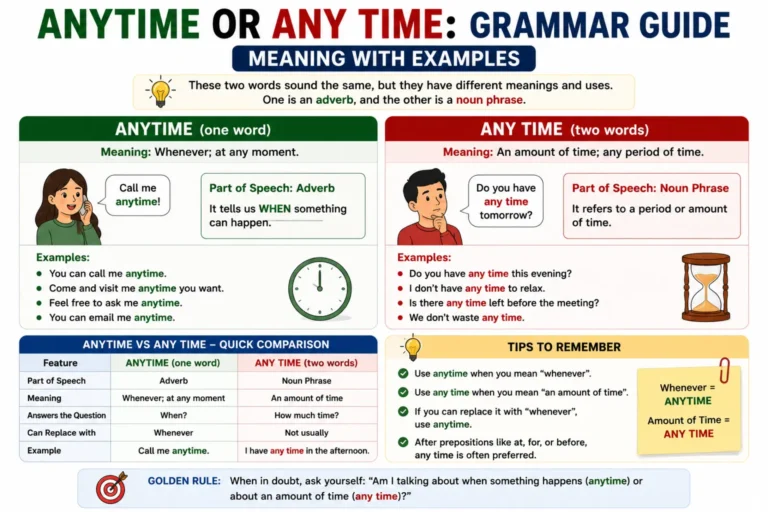
In simple terms, anytime is usually an adverb that means whenever. Any time is a two-word noun phrase that refers to an amount of time or a period of time. Although people often use them interchangeably in casual conversation, grammar rules explain when each form is correct.
This guide breaks down the difference in simple English. You’ll learn the meaning of each term, grammar rules, comparison tables, real-life examples, and easy tips to remember the correct usage. By the end, you’ll know exactly when to use anytime and when any time is the better choice.
Quick Summary Box
- Anytime is one word and usually works as an adverb.
- Any time is two words and works as a noun phrase.
- Use anytime to mean whenever.
- Use any time when referring to an amount or period of time.
- In formal writing, any time is often preferred after prepositions such as at.
- Example: You can call me anytime.
- Example: Do you have any time to talk?
What Does “Anytime” Mean?
Anytime is an adverb that means whenever, at any moment, or whenever it is convenient.
It tells when something can happen.
Simple Definition
Anytime means:
- Whenever
- At any moment
- Whenever you like
Examples
- You can visit anytime.
- Call me anytime if you need help.
- Feel free to stop by anytime.
- You may contact us anytime during the week.
- Come back anytime.
In these sentences, anytime answers the question “When?”

What Does “Any Time” Mean?
Any time is a noun phrase.
It refers to an amount of time, a period of time, or free time.
Simple Definition
Any time means:
- Any amount of time
- Any period of time
- Some available time
Examples
- Do you have any time this afternoon?
- I don’t have any time to exercise today.
- She spent hardly any time preparing.
- We didn’t waste any time.
- Is there any time left before the meeting?
Here, time is the noun, and any describes it.
Anytime or Any Time: What’s the Difference?
Although the spellings are similar, their grammar functions are different.
| Feature | Anytime | Any Time |
|---|---|---|
| Number of words | One | Two |
| Part of speech | Adverb | Noun phrase |
| Meaning | Whenever | An amount of time |
| Answers | When? | How much time? |
| Common in casual writing | ✅ Yes | ✅ Yes |
| Common in formal writing | Sometimes | ✅ More common |
The Easy Rule
Ask yourself this question:
Can I replace it with “whenever”?
If the answer is yes, use anytime.
Examples
- Call me anytime.
- Call me whenever.
Both sentences have the same meaning.
Now ask another question:
Am I talking about a period or amount of time?
If yes, use any time.
Example
- Do you have any time tomorrow?
You cannot replace this with:
- ❌ Do you have whenever tomorrow?
So the correct form is any time.
Why Do People Confuse Anytime and Any Time?
These words sound exactly alike when spoken.
Because of this, many writers assume they always mean the same thing.
They don’t.
Modern English has gradually accepted anytime as one word, especially in informal writing. However, any time still has its own grammar role and remains correct in many situations.
Understanding the difference helps you write more naturally and avoid grammar mistakes.
Grammar Rule: When to Use “Anytime”
Use anytime when it functions as an adverb.
It tells when something can happen.
Correct Examples
- Visit us anytime.
- You can email me anytime.
- Come over anytime you want.
- I’ll help you anytime.
- They’re welcome anytime.
In every sentence, anytime could be replaced with whenever.
Grammar Rule: When to Use “Any Time”
Use any time when time is the noun in the sentence.
Correct Examples
- Do you have any time available?
- She doesn’t have any time today.
- We didn’t waste any time.
- Is there any time left?
- They spent very little time, but I still had some any time? (Better: They didn’t have any time to spare.)
Another common situation is after prepositions.
Examples
- At any time
- For any time
- Without any time
- Before any time limit
Examples in sentences:
- You may leave at any time.
- The rules can change at any time.
- He finished without wasting any time.
Anytime vs Any Time in American and British English
Both American and British English recognize anytime and any time.
However, there is a small difference in style.
- American English accepts anytime more freely in casual writing.
- British English often prefers any time, especially in formal writing.
Even so, both forms follow the same basic grammar rules.
If you’re writing for school, business, or publication, following the grammar rule is more important than choosing one variety of English over the other..
Real-Life Examples of Anytime
The easiest way to understand anytime is to see how people use it in everyday conversations. Remember, anytime means whenever or at any moment.
At Home
Family members often use anytime when offering help or inviting someone.
Examples
- You can borrow my laptop anytime.
- Come to my room anytime you need help.
- Feel free to ask questions anytime.
- You can watch TV anytime after dinner.
At School
Teachers and students use anytime in friendly conversations.
Examples
- Visit my office anytime during school hours.
- You can ask me anytime if you don’t understand the lesson.
- Stop by anytime before the exam.
- Email me anytime with your questions.
At Work
Employees and managers use anytime to show availability.
Examples
- Call me anytime if the project needs changes.
- You can reach our support team anytime.
- Feel free to schedule a meeting anytime next week.
- Contact the manager anytime for assistance.
In Customer Service
Businesses often use anytime because it sounds welcoming.
Examples
- Shop with us anytime.
- Our website is available anytime.
- Chat with our support team anytime.
- Visit our store anytime during business hours.
While Traveling
Travel companies also use anytime.
Examples
- You can book your tickets anytime.
- Travelers may contact customer support anytime.
- Visit the tourist center anytime for information.

Real-Life Examples of Any Time
Now let’s look at situations where any time is the correct choice.
Here, time is a noun that refers to an amount or period of time.
At School
- Do you have any time after class?
- I don’t have any time to finish my homework.
- Is there any time left before the exam starts?
At Work
- We don’t have any time to delay the project.
- Do you have any time for a quick meeting?
- She spent very little time, but I didn’t have any time to help.
At Home
- I hardly have any time to relax.
- Do you have any time this weekend?
- We don’t waste any time getting ready.
During Travel
- We didn’t have any time to visit the museum.
- Is there any time before our flight?
- We don’t have any time for shopping today.
Everyday Conversations
- Do you have any time tomorrow?
- I don’t have any time this evening.
- We spent hardly any time waiting.
Anytime vs Any Time in Everyday Writing
The following examples show the difference more clearly.
| Correct Sentence | Why It’s Correct |
|---|---|
| Call me anytime. | Means whenever. |
| Visit us anytime. | Refers to any moment. |
| Do you have any time? | Refers to available time. |
| We don’t have any time left. | Talks about an amount of time. |
| You may leave at any time. | Follows the preposition at. |
| Stop by anytime. | Means whenever you like. |
A simple question helps you choose:
- When? → Anytime
- How much time? → Any time
Common Mistakes People Make
Many English learners mix these two expressions because they sound the same.
Here are the most common mistakes.
Mistake 1: Using Anytime as a Noun
❌ Do you have anytime tomorrow?
✅ Do you have any time tomorrow?
The sentence asks about available time, so use two words.
Mistake 2: Using Any Time Instead of Anytime
❌ Call me any time.
✅ Call me anytime.
Here, anytime means whenever, so one word is correct.
Mistake 3: Forgetting the Preposition Rule
Many style guides prefer any time after prepositions like at.
✅ You may leave at any time.
Although anytime appears more often in casual writing, at any time remains the preferred form in formal English.
Mistake 4: Mixing Formal and Informal Writing
Informal writing often accepts anytime.
Formal writing usually follows stricter grammar rules.
Informal
- Text me anytime.
Formal
- Please contact us at any time if you require assistance.
How to Remember the Difference
These simple memory tricks make the rule easier.
Trick 1: Replace It with “Whenever”
If whenever fits, use anytime.
Example
- Visit us anytime.
- Visit us whenever.
Both sentences have the same meaning.
Trick 2: Look for the Word “Time”
If you’re talking about available or measurable time, use any time.
Examples
- Do you have any time today?
- We don’t have any time left.
Trick 3: Watch for Prepositions
Words like at, for, before, and without often pair naturally with any time.
Examples
- At any time
- Before any time limit
- Without any time to prepare
Trick 4: Ask Yourself One Question
Ask:
Am I talking about “when” or “how much time”?
- When? → Anytime
- How much time? → Any time
This simple test works in almost every sentence.
Synonyms and Related Keywords
Using related words improves both vocabulary and SEO.
Synonyms for Anytime
- whenever
- at any moment
- at any point
- whenever convenient
- whenever needed
Related (LSI) Keywords
Include these naturally throughout your article:
- anytime meaning
- any time meaning
- anytime vs any time
- when to use anytime
- when to use any time
- anytime grammar rule
- any time examples
- anytime examples
- English grammar tips
- common grammar mistakes
- adverb vs noun phrase
- anytime or anytime grammar
- formal vs informal English
- writing tips for English learners
These semantic keywords help search engines understand the topic without keyword stuffing.
Expert Insight
Professional editors and grammar experts agree that understanding the difference between anytime and any time improves both clarity and credibility. While many people use the two forms interchangeably in casual conversations, following the correct grammar rule makes your writing more polished.
Most modern style guides recommend using anytime as an adverb meaning “whenever.” Meanwhile, any time remains the correct choice when referring to an amount or period of time. It is also preferred in many formal expressions, such as “at any time.”
If you are writing school assignments, business emails, blog posts, or professional documents, using the correct form shows attention to detail. A small grammar choice can leave a strong impression on readers.
Expert Writing Tip
Remember this simple rule:
If you can replace it with “whenever,” use “anytime.” If you’re talking about a period or amount of time, use “any time.”
Following this rule will help you write naturally and confidently.
(FAQs)
1. Is it anytime or any time?
Both are correct, but they have different meanings. Anytime means whenever, while any time refers to an amount or period of time.
2. When should I use “anytime”?
Use anytime when it means whenever or at any moment.
Example:
- You can call me anytime.
3. When should I use “any time”?
Use any time when talking about available time or a period of time.
Example:
- Do you have any time this afternoon?
4. Can I always replace “anytime” with “whenever”?
In most cases, yes. If whenever fits naturally, anytime is usually the correct choice.
Example:
- Visit us anytime.
- Visit us whenever.
5. Is “at anytime” correct?
In formal writing, at any time is preferred.
Correct:
- You may leave at any time.
Although at anytime appears in casual writing, many grammar experts recommend at any time.
6. Is “anytime” formal?
Anytime is acceptable in modern English, especially in casual writing. However, formal writing may favor any time in certain contexts, particularly after prepositions.
7. Do American and British English use both forms?
Yes. Both American and British English recognize anytime and any time. American English uses anytime more often in everyday writing, while British English is slightly more conservative in formal contexts.
8. How can I remember the difference?
Use this easy trick:
- Whenever → Anytime
- Amount of time → Any time
This simple test works for most sentences.
Common Grammar Checklist
Before you finish writing, ask yourself these questions:
- Can I replace the word with whenever?
- Am I talking about available time?
- Does the sentence include at any time?
- Am I writing something formal?
- Does time act as a noun?
If you answer yes to the first question, choose anytime.
If you answer yes to the other questions, any time is probably correct.
Conclusion
Understanding anytime or any time is easier once you know the grammar rule. Although the two forms look similar, they have different functions. Anytime is an adverb that means “whenever,” while any time is a noun phrase that refers to an amount or period of time. Remember the simple replacement test: if whenever fits, use anytime. If you’re talking about available time or using phrases like “at any time,” choose any time. Following these rules will make your writing clearer, more natural, and more professional. Whether you’re writing an email, an essay, a blog post, or a business document, choosing the correct form shows strong grammar skills and builds confidence in your communication.