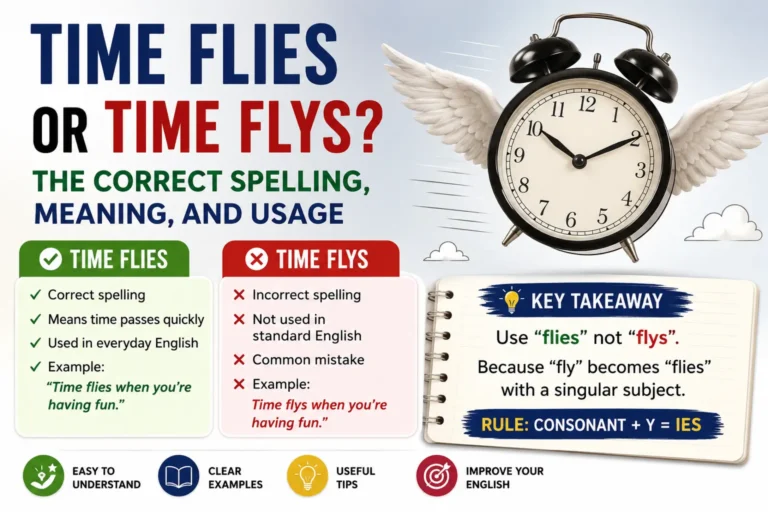
Time flies or time flys? The correct phrase is “time flies.” Many English learners confuse flies and flys because both words sound similar. However, only one spelling works in standard English.
The phrase “time flies” means that time passes quickly. People often use it when they feel surprised by how fast days, months, or years pass. For example, you may say, “Time flies when you are having fun.”
This guide explains the correct spelling, grammar rule, meaning, examples, and common mistakes. You will also learn when to use time flies in daily English. By the end, you will know exactly why “time flys” is incorrect.
Quick Summary
- Time flies is the correct phrase.
- Time flys is incorrect in standard English.
- Flies is the correct third-person form of fly.
- Time flies means time passes quickly.
- The phrase often describes happy, busy, or memorable moments.
- Example: “Time flies when you are having fun.”
- What Does “Time Flies” Mean?
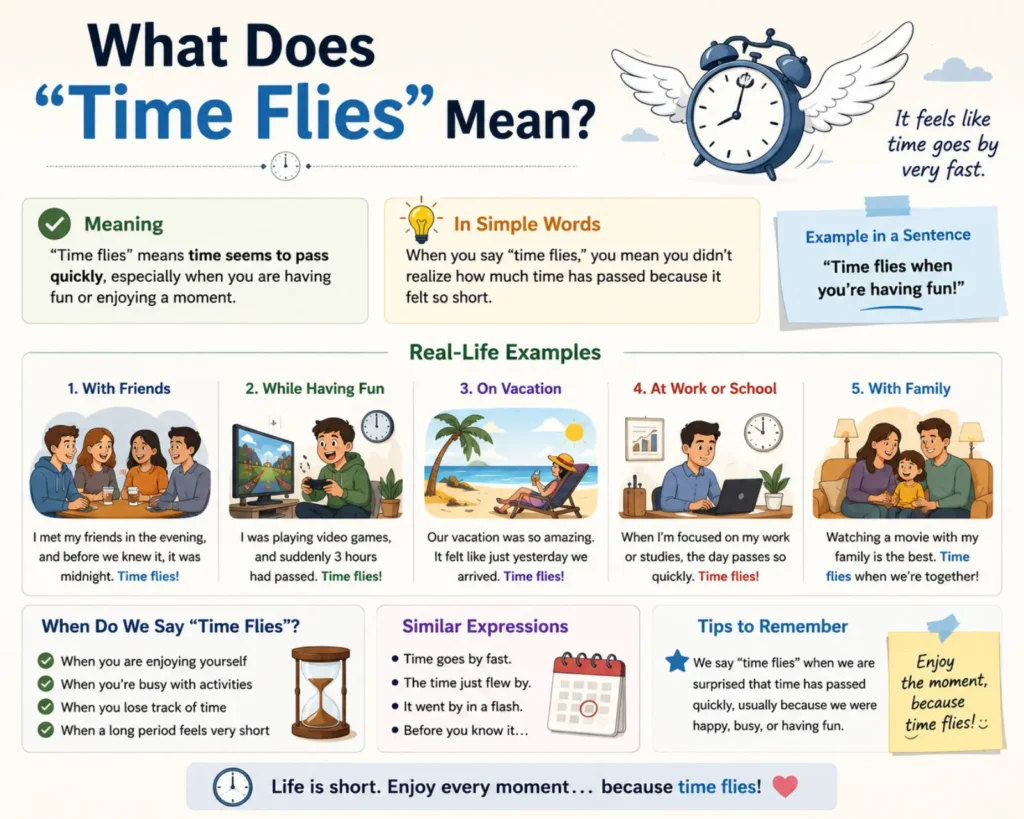
Time flies means that time passes very quickly.
People use this phrase when they feel surprised by the speed of time. It often describes moments that feel short but pass quickly.
Example:
“I cannot believe it is already Friday. Time flies!”
The speaker feels that the week passed faster than expected.
The phrase can describe:
- Days
- Weeks
- Months
- Years
- Childhood
- Holidays
- School years
- Special memories
Is It “Time Flies” or “Time Flys”?
The correct spelling is “time flies.”
The spelling “time flys” is incorrect.
The word flies comes from the verb fly. When a verb ends in a consonant followed by y, the y changes to ies.
Grammar rule:
fly → flies
This rule applies when the subject is singular.
Examples:
- The bird flies.
- Time flies.
- She flies to London.
- The plane flies every day.
Therefore, the correct phrase is:
Time flies.
Why Is “Time Flys” Incorrect?
The spelling “flys” does not follow the standard English spelling rule.
For many verbs ending in consonant + y, English changes y to ies.
Examples:
| Base Verb | Correct Third-Person Form |
|---|---|
| fly | flies |
| try | tries |
| cry | cries |
| study | studies |
| carry | carries |
So, we write:
- Time flies.
- She tries hard.
- He studies daily.
We do not write:
- Time flys.
- She trys hard.
- He studys daily.
The Grammar Behind “Time Flies”
The phrase uses the simple present tense.
The subject is time. The word time is singular. Therefore, the verb needs the third-person singular form.
Basic structure:
Singular subject + verb ending in -s or -ies
So:
Time + flies = Time flies
The verb fly changes to flies because the subject is singular.
More examples:
- The bird flies high.
- The eagle flies quickly.
- Time flies during holidays.
- The year flies by.
“Time Flies” Meaning in Simple English
In simple English, time flies means:
Time passes quickly.
You may use this phrase when a period feels shorter than expected.
Example:
You start a new job. Suddenly, six months have passed.
You can say:
“Time flies!”
The phrase shows surprise about the passage of time.
“Time Flies When You’re Having Fun”
One of the most popular expressions is:
“Time flies when you’re having fun.”
This means enjoyable activities make time feel faster.
Real-life examples:
- You play games with friends for three hours.
- You watch an exciting movie.
- You spend time with family.
- You enjoy a holiday.
- You work on a hobby.
Afterward, you may feel surprised.
You might say:
“I thought only one hour passed. Time flies when you are having fun!”
This expression is common in everyday conversation.
Time Flies vs Time Flys: Comparison Table
| Phrase | Correct? | Meaning | Example |
|---|---|---|---|
| Time flies | Yes | Time passes quickly | Time flies when you are busy. |
| Time flys | No | Incorrect spelling | Do not use this form. |
| Time fly | Usually no | Incorrect with singular “time” | Time fly is incorrect here. |
| Times fly | Different meaning | Multiple periods may pass quickly | The times fly by. |
The main answer is simple:
Use “time flies,” not “time flys.”
Real-Life Examples of “Time Flies”
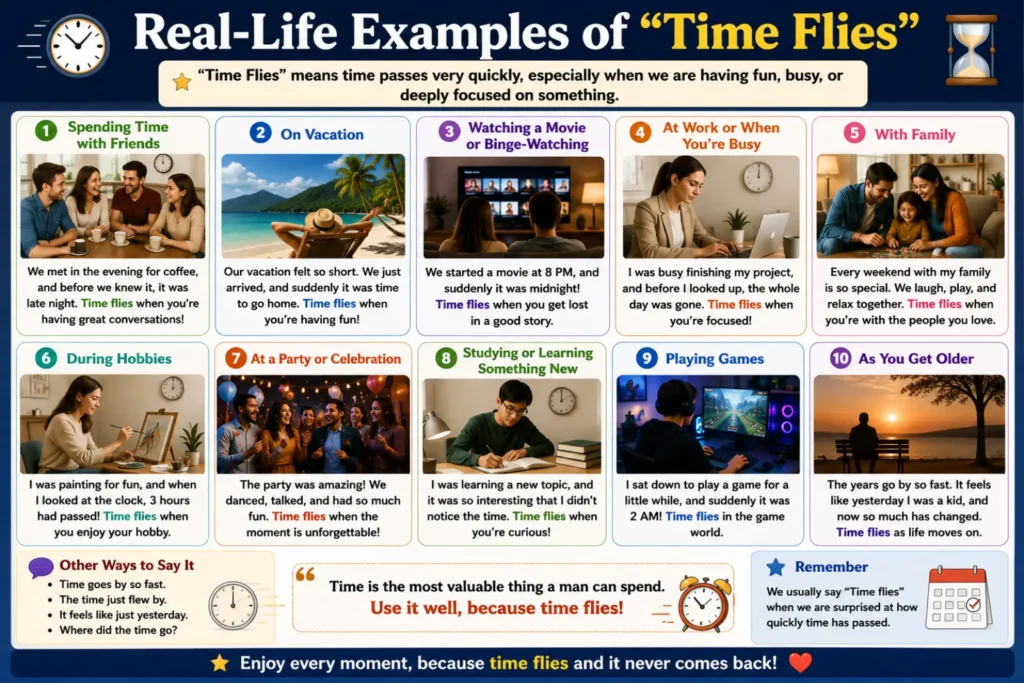
Here are natural examples from daily life.
Example 1: School
“Time flies. I cannot believe graduation is next month.”
Example 2: Work
“Time flies when I am busy at work.”
Example 3: Family
“Time flies when you watch your children grow.”
Example 4: Holidays
“Our vacation ended already. Time flies!”
Example 5: Friendship
“We have been friends for ten years. Time flies.”
Example 6: Childhood
“Time flies when you look back at childhood memories.
Common Mistakes with “Time Flies”
Many learners make spelling mistakes with this phrase.
Mistake 1: Writing “Time Flys”
Incorrect:
Time flys so fast.
Correct:
Time flies so fast.
Mistake 2: Forgetting the “-ies” Ending
Incorrect:
Time fly quickly.
Correct:
Time flies quickly.
The subject time is singular.
Therefore, the verb needs flies.
Mistake 3: Using “Fly” After “Time”
Incorrect:
Time fly when you have fun.
Correct:
Time flies when you have fun.
Mistake 4: Confusing “Flies” With the Noun
The word flies can have two meanings.
As a verb:
Time flies.
Here, flies means passes quickly.
As a noun:
Flies are insects.
Here, flies means small flying insects.
The sentence context shows the meaning.
How to Remember the Correct Spelling
Use this simple memory trick:
Fly + singular subject = flies
Examples:
- He flies.
- She flies.
- The bird flies.
- Time flies.
Remember:
Consonant + Y changes to IES.
So:
fly → flies
This rule helps you avoid the common mistake “time flys.”
When Should You Use “Time Flies”?
Use time flies when time seems to pass quickly.
You can use it in:
- Casual conversations
- Social media posts
- Emails
- Personal writing
- Speeches
- Stories
- Everyday English
Example in conversation:
“How is your new job going?”
“Great! I have already worked here for six months. Time flies!”
The phrase sounds natural and friendly.
“Time Flies” in Daily English
Native English speakers often use time flies in casual situations.
Here are some common patterns:
when…
flies when you are having fun.
flies by…
Time flies by when you are busy.
I cannot believe…
I cannot believe it is already December. Time flies!
Looking back…
Time flies when you look back at old memories.
These structures help you use the phrase naturally.
Synonyms and Related Expressions
Several expressions have a similar meaning to time flies.
Time passes quickly
This phrase has a direct meaning.
“Time passes quickly during summer.”
Time goes by quickly
This phrase sounds natural in everyday English.
“Time goes by quickly when you are busy.”
Time flies by
This phrase adds extra emphasis.
“The years fly by.”
Where did the time go?
This expression shows surprise.
“The party is over already? Where did the time go?”
The years pass quickly
This phrase often describes aging or memories.
“The years pass quickly when you have a family.”
“Time Flies” and “Time Goes By” Difference
Both expressions describe the quick passage of time.
However, they have slightly different styles.
| Expression | Style | Example |
|---|---|---|
| Time flies | More expressive | Time flies when you are having fun. |
| Time goes by quickly | More direct | Time goes by quickly during busy weeks. |
| The years fly by | Emotional | The years fly by when children grow up. |
| Where did the time go? | Surprised | Where did the time go? It is midnight! |
All these expressions can work in different situations.
Expert Insight: Why This Phrase Matters
Correct spelling improves clarity and trust.
A small spelling mistake can make writing look less professional. The phrase “time flies” appears often in conversations and online content.
The key grammar rule is simple.
When fly follows a singular subject, it becomes flies.
This pattern also appears in other verbs.
- Try → tries
- Cry → cries
- Study → studies
- Fly → flies
Learning this pattern helps improve overall English grammar.
writing Tip: Use “Time Flies” Naturally
If you write online content about time, memories, travel, or life, use the phrase naturally.
Avoid repeating the keyword too often.
Instead, use related expressions such as:
- Time passes quickly
- Time goes by
- The years fly by
- Time moves fast
- How quickly time passes
- The passage of time
Natural language improves readability.
It also creates a better experience for readers.
Frequently Asked Questions
Is “time flies” correct?
Yes. “Time flies” is the correct phrase and spelling.
Is “time flys” correct?
No. “Time flys” is incorrect in standard English.
What does “time flies” mean?
“Time flies” means that time passes quickly.
Why does fly become flies?
The verb fly changes to flies after a singular subject. This follows the consonant-plus-y spelling rule.
Is it “time fly” or “time flies”?
The correct phrase is “time flies.”
What is an example of “time flies”?
“Time flies when you are having fun.”
What is another way to say “time flies”?
You can say “time goes by quickly” or “time passes quickly.”
Can I use “time flies” in formal writing?
Yes. However, choose the phrase based on your writing style and audience.
s.
This approach helps readers discover related content.
Conclusion
The correct phrase is “time flies.” The spelling “time flys” is incorrect.
The phrase “time flies” means that time passes quickly. People often use it when they feel surprised by how fast time moves.
The grammar is simple. The subject time is singular. Therefore, the verb fly changes to flies.
You can use this phrase in daily conversations, writing, social media, and many other situations. The popular expression “time flies when you are having fun” is one common example.
So, remember this simple rule:
Fly + singular subject = flies.
Therefore, the correct answer is:
Time flies.