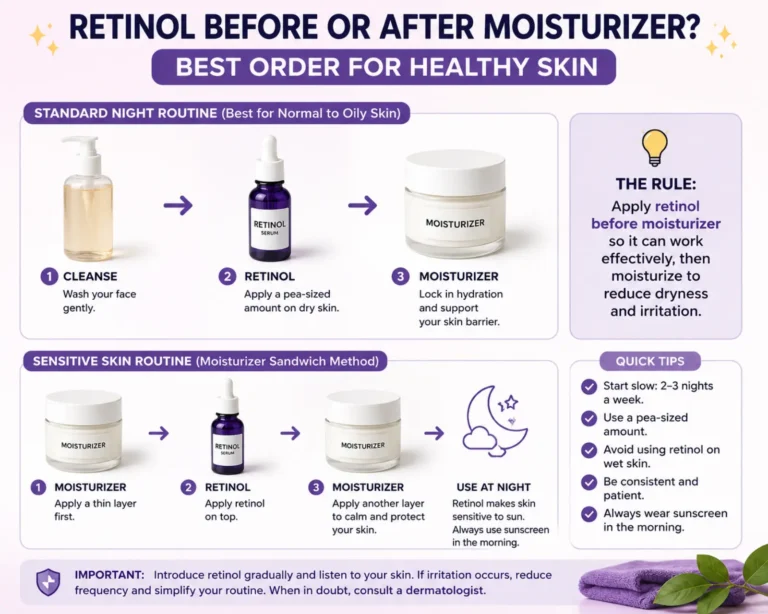
Retinol before or after moisturizer depends on your skin type and tolerance. Most people apply retinol after cleansing and before moisturizer. However, sensitive skin may benefit from moisturizer first. This method can reduce dryness and irritation. Retinol works best when you use it slowly and consistently. Your skincare order also affects comfort and results. Many beginners use too much retinol or apply it to damp skin. These mistakes can increase irritation. In this guide, you will learn the best order for your routine. You will also learn how to use retinol safely. Plus, you will see real-life examples and common mistakes. Let’s make your nighttime skincare routine simple.
Note: This article offers general skincare information. Follow your product label and ask a qualified healthcare professional for personal advice.
Quick Summary
- Apply retinol before moisturizer for the standard skincare routine.
- Apply moisturizer before retinol if your skin feels sensitive.
- Use retinol at night after cleansing.
- Apply retinol only to completely dry skin.
- Start with a small, pea-sized amount.
- Use sunscreen every morning when using retinol.
- Avoid using too many irritating products together.
- Consistency matters more than using a strong product.
What Does “Retinol Before or After Moisturizer” Mean?
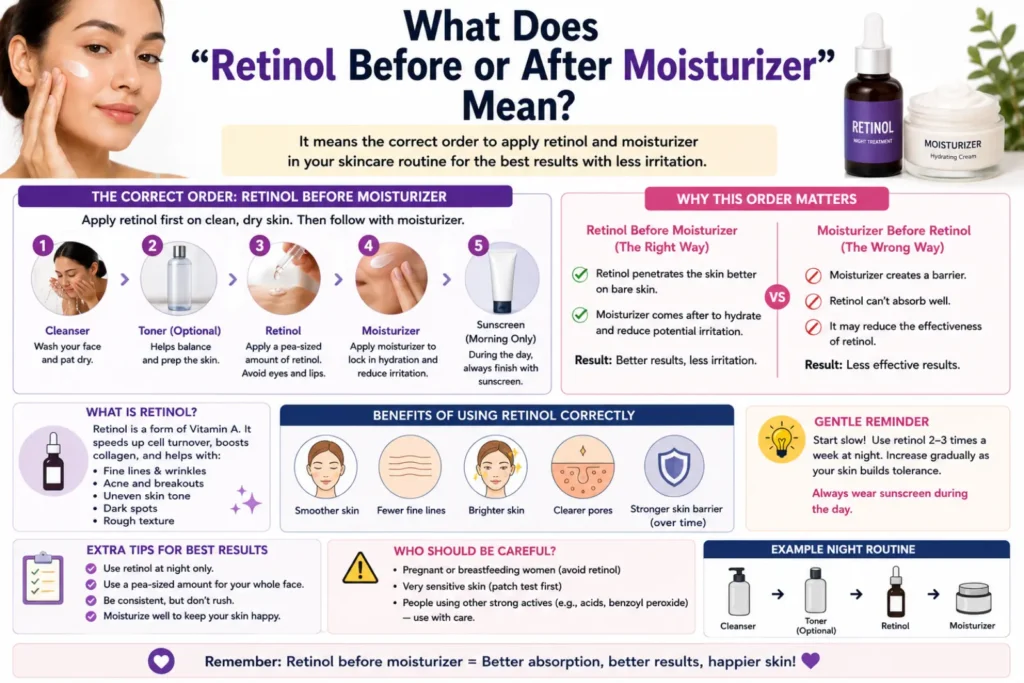
This question asks about the correct order for two skincare products.
Retinol is a vitamin A derivative. It supports skin renewal and can improve several common skin concerns.
Moisturizer helps reduce dryness and supports the skin barrier.
The usual order is:
Cleanser → Retinol → Moisturizer
However, sensitive skin may need:
Cleanser → Moisturizer → Retinol → Moisturizer
This second method is often called the moisturizer sandwich method.
The best choice depends on your skin’s comfort and tolerance.
Should You Apply Retinol Before or After Moisturizer?
For most people, apply retinol before moisturizer.
First, cleanse your face gently. Then dry your skin completely. Next, apply a pea-sized amount of retinol. Finally, apply moisturizer.
This order lets retinol contact the skin directly.
However, direct application may feel too strong for beginners. Sensitive skin may experience dryness, redness, or peeling.
In that case, apply moisturizer first.
The moisturizer creates a gentle buffer. This may help reduce irritation.
Standard method
- Cleanse your face.
- Dry your skin fully.
- Apply a small amount of retinol.
- Wait briefly if needed.
- Apply moisturizer.
Gentle method
Why Does Skincare Order Matter?
Skincare products work best when you apply them in a logical order.
Thin products usually go before thicker products.
Retinol usually goes before moisturizer because moisturizer forms a protective layer.
However, skincare does not follow one rule for everyone.
skin type matters.
product strength also matters.
Your current routine matters too.
For example, a beginner may need more protection from dryness. An experienced user may tolerate direct retinol application better.
Therefore, comfort should guide your routine
Retinol Before Moisturizer: Best for Normal and Oily Skin
Many people with normal or oily skin prefer retinol before moisturizer.
This method provides direct contact with the skin.
It can also make your nighttime routine simple.
Use a pea-sized amount for your entire face.
Do not apply more product for faster results.
More retinol does not always produce better results.
Instead, it may cause more irritation.
If your skin becomes uncomfortable, reduce your usage frequency.
You can also switch to the moisturizer sandwich method.
Retinol After Moisturizer: Best for Sensitive Skin
Sensitive skin may benefit from applying moisturizer before retinol.
This method creates a buffer between your skin and the active ingredient.
It can make retinol feel gentler.
Some beginners also use this approach during their first few weeks.
However, moisturizer does not remove all irritation risks.
You should still start slowly.
Use retinol on fewer nights at first.
Then increase use only if your skin tolerates it well.
Stop and seek professional advice if you experience severe or persistent irritation
The Moisturizer Sandwich Method Explained
The moisturizer sandwich method places retinol between two moisturizer layers.
The routine looks like this:
Cleanser → Moisturizer → Retinol → Moisturizer
This method may suit beginners and sensitive skin.
The first moisturizer layer creates a buffer.
The retinol provides the active ingredient.
The final moisturizer layer adds extra comfort.
Keep both moisturizer layers thin.
A heavy layer may feel uncomfortable.
This method can also help when your skin feels dry during colder weather.
Retinol Before or After Moisturizer: Comparison Table
| Method | Best For | Main Benefit | Possible Drawback |
|---|---|---|---|
| Retinol before moisturizer | Normal or oily skin | Direct application | May cause more irritation |
| Moisturizer before retinol | Sensitive or dry skin | Gentler application | May feel less direct |
| Moisturizer sandwich | Beginners | Extra comfort | Adds more routine steps |
Your skin does not need to follow someone else’s routine.
Choose the method that your skin tolerates consistently.
Real-Life Examples: Which Method Should You Choose?
Example 1: A beginner with dry skin
You recently started retinol.
Your skin feels tight after cleansing.
Start with moisturizer before retinol.
Use a gentle moisturizer afterward too.
This approach may help your skin adjust.
Example 2: Someone with normal skin
Your skin tolerates skincare products well.
You experience little dryness.
Apply retinol before moisturizer.
Start with a low frequency.
Increase use gradually if your skin remains comfortable.
Example 3: Someone experiencing irritation
Your skin feels red or uncomfortable after retinol.
Reduce how often you use it.
Consider the moisturizer sandwich method.
Avoid adding more strong products.
Seek professional advice if irritation continues.
How to Use Retinol in Your Nighttime Routine
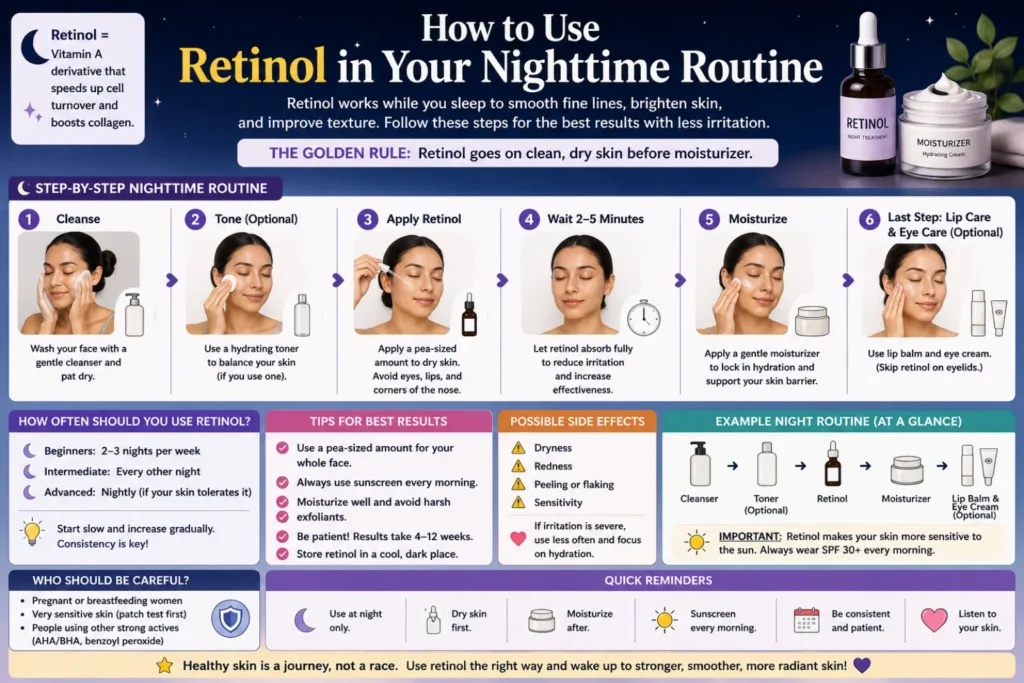
A simple nighttime routine can look like this:
Step 1: Cleanse gently
Remove makeup, sunscreen, and daily buildup.
Avoid harsh scrubbing.
Step 2: Dry your skin
Wait until your skin feels completely dry.
Damp skin may increase irritation for some people.
Step 3: Apply retinol
Use a small, pea-sized amount.
Spread it evenly across your face.
Avoid the eye area unless your product label says otherwise.
Step 4: Apply moisturizer
Use a comfortable moisturizer.
Focus on supporting your skin barrier.
Step 5: Keep the routine simple
Avoid using many strong products on the same night.
Simple routines often improve consistency.
How Often Should You Use Retinol?
Beginners should usually start slowly.
Try using retinol on limited nights each week.
Watch how your skin responds.
If your skin remains comfortable, you may slowly increase use.
Do not rush the process.
Retinol results take time.
Your skin may need several weeks to adjust.
Always follow your product instructions.
Different products contain different strengths.
A healthcare professional can provide personalized guidance
Common Retinol Mistakes to Avoid
1. Applying too much retinol
A larger amount does not mean faster results.
Use only the amount recommended by the product instructions.
2. Using retinol every night immediately
Your skin may need time to adjust.
Start slowly instead.
3. Applying retinol to damp skin
Damp skin may increase irritation for some users.
Let your skin dry first.
4. Skipping moisturizer
Retinol may cause dryness.
A moisturizer helps support comfortable skin.
5. Forgetting sunscreen
Retinol users should pay close attention to daytime sun protection.
Use broad-spectrum sunscreen every morning.
6. Mixing too many active ingredients
Several strong products may irritate your skin.
Keep your routine simple while your skin adjusts.
7. Expecting overnight results
Retinol needs consistent use.
Give your routine time
Tips for Using Retinol More Comfortably
- Start with a lower frequency.
- Use a small amount.
- Apply retinol to dry skin.
- Use moisturizer regularly.
- Avoid harsh scrubs.
- Keep other active products simple.
- Wear sunscreen during the day.
- Listen to your skin.
- Change one product at a time.
- Follow the product label.
These habits can make your routine easier to maintain.
Consistency usually matters more than complexity.
Retinol and Moisturizer: What Products Work Together?
Retinol often works well with gentle skincare products.
Look for simple moisturizers that support the skin barrier.
Many people choose products with ingredients such as:
- Ceramides
- Glycerin
- Hyaluronic acid
- Squalane
- Panthenol
Your skin may respond differently to each ingredient.
Therefore, patch testing can help you introduce new products carefully.
Avoid assuming that every “gentle” product suits everyone.
Read the product label.
Follow the recommended usage instructions.
What Ingredients Should You Avoid Using With Retinol?
Some skincare combinations may increase irritation.
Examples can include multiple strong exfoliating products.
These include certain acids and other powerful active ingredients.
The exact risk depends on the products and your skin.
Do not automatically combine several active products in one routine.
Instead, keep your routine simple.
You can use different products on different nights.
When unsure, ask a qualified skincare professional.
Retinol Synonyms, LSI Keywords, and Related Search Terms
Search engines understand related phrases around the main keyword.
Useful semantic keywords include:
- Retinol skincare order
- Retinol and moisturizer routine
- Should moisturizer go before retinol
- Can I apply moisturizer after retinol
- Retinol sandwich method
- How to use retinol at night
- Retinol for beginners
- Nighttime skincare routine with retinol
- Retinol application order
- Moisturizer before retinol
- Retinol after moisturizer
- How to layer retinol
- Retinol skincare steps
- Beginner retinol routine
Use these terms naturally.
Avoid repeating the same keyword too often.
Helpful content matters more than keyword density.
Expert Insights
Skincare professionals often focus on tolerance and consistency.
A strong routine does not need many products.
The best routine is one you can follow safely.
Retinol can feel irritating when users start too quickly.
Therefore, gradual use often makes sense.
Moisturizer can also support a comfortable skincare routine.
However, it cannot guarantee that irritation will never happen.
Your skin may react differently from someone else’s skin.
Product strength also affects your experience.
That is why personalized professional advice can help.
Frequently Asked Questions
Should I put moisturizer on before or after retinol?
Most people apply retinol before moisturizer.
Sensitive skin may benefit from moisturizer first.
Can I use retinol and moisturizer together?
Yes, many people use both products in the same nighttime routine.
Apply them according to your skin’s tolerance.
Is it better to apply retinol directly to skin?
Direct application may suit people who tolerate retinol well.
Sensitive skin may prefer a moisturizer buffer.
Can I use moisturizer after retinol?
Yes.
Moisturizer often follows retinol in a standard nighttime routine.
Should I use retinol every night?
Not necessarily.
Beginners often start slowly.
Increase use only when their skin tolerates it well.
Should I apply retinol to wet or dry skin?
Apply retinol to dry skin.
This approach may help reduce irritation for some people.
Can I use retinol during the day?
Many people use retinol at night.
Follow your product instructions.
Use sunscreen every morning.
What should I do if retinol irritates my skin?
Reduce use and simplify your routine.
Stop using it if irritation becomes severe.
Seek professional advice for persistent problems.
conclusion
So, should you apply retinol before or after moisturizer?
For most people, apply retinol before moisturizer.
This follows the standard nighttime skincare order.
However, sensitive skin may need a gentler approach.
Apply moisturizer first or try the moisturizer sandwich method.
Start slowly and use a small amount.
Always apply retinol to dry skin.
Keep your routine simple while your skin adjusts.
Most importantly, use sunscreen during the day.
Retinol works best as part of a consistent routine.
Your skin does not need the most complicated routine.
It needs a routine that feels comfortable and fits your needs.