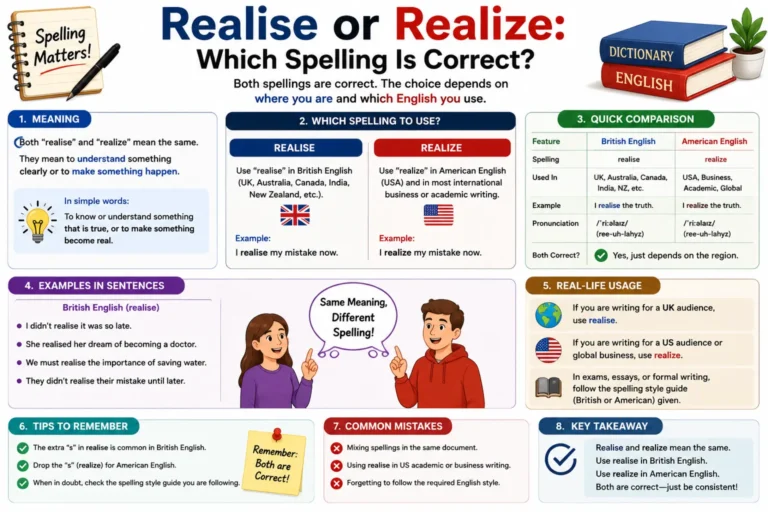
Realise or realize can both be correct. The right spelling depends on the type of English you use. Realise is the standard spelling in British English. Realize is the standard spelling in American English. Both words have the same meaning and pronunciation. They mean to become aware of something or to understand something clearly. The difference comes from spelling rules, not meaning. This small difference can confuse English learners and writers. It also matters when writing for a specific country. In this guide, you will learn when to use realise and realize. You will also see clear examples and common mistakes. By the end, choosing the right spelling will feel easy.
Quick Summary: Realise vs Realize
- Realise is common in British English.
- Realize is common in American English.
- Both words have the same meaning.
- Both spellings are grammatically correct.
- The pronunciation is usually the same.
- Use one spelling consistently in your writing.
- Choose the spelling that matches your target audience.
What Does Realise or Realize Mean?
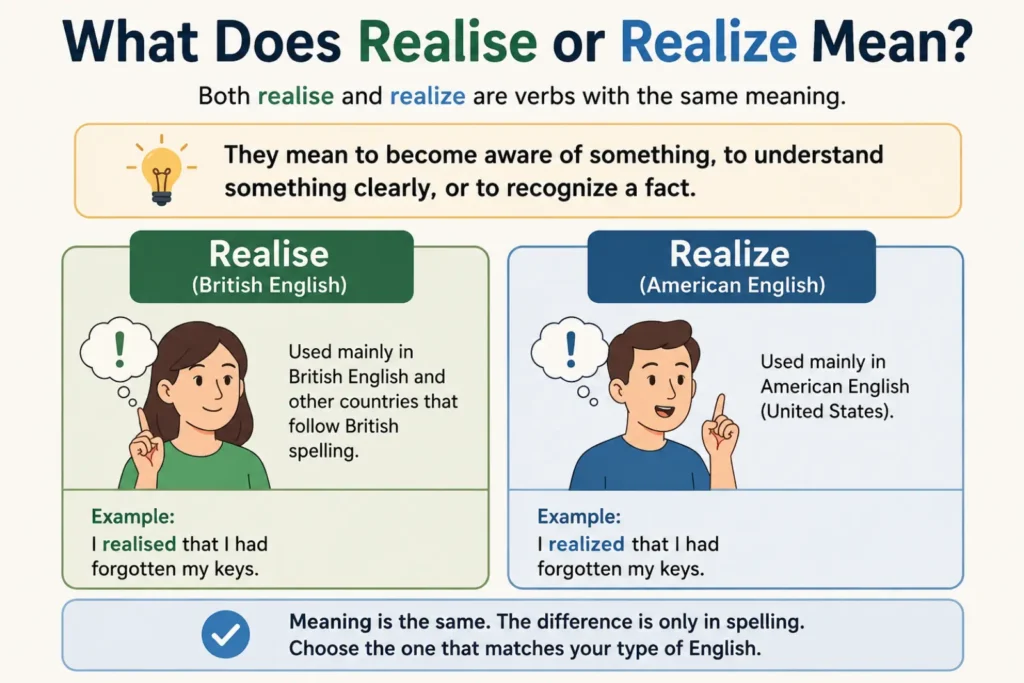
Realise and realize are verbs with the same meaning.
They can mean becoming aware of something. They can also mean understanding a fact.
For example:
- I realised that I had forgotten my keys.
- I realized that I had forgotten my keys.
Both sentences have the same meaning.
The only difference is the spelling.
The word can also mean making something real or achieving something.
For example:
- The team realised its goal.
- The team realized its goal.
This use is less common in everyday speech.
Is Realise or Realize Correct?
Both realise and realize are correct spellings.
However, their use depends on the English variety.
Realise follows British English spelling.
Realize follows American English spelling.
British English is common in the United Kingdom, Australia, and many other countries.
American English is common in the United States.
Some dictionaries also accept -ize spellings in British English. However, -ise remains very common in British usage.
Therefore, always check your style guide before publishing formal content.
Realise vs Realize: The Main Difference
The main difference is regional spelling.
| Word | British English | American English | Meaning |
|---|---|---|---|
| Realise | ✅ Common | Less common | Become aware |
| Realize | Accepted in some British styles | ✅ Common | Become aware |
| Realised | ✅ Common | Less common | Became aware |
| Realized | Accepted in some British styles | ✅ Common | Became aware |
| Realising | ✅ Common | Less common | Becoming aware |
| Realizing | Accepted in some British styles | ✅ Common | Becoming aware |
The meaning does not change.
Only the spelling changes.
Why Does Realise Have an “S”?
The spelling realise follows a common British spelling pattern.
Many British writers use -ise endings in words such as:
- realise
- organise
- apologise
- recognise
- specialise
American English often uses -ize instead:
- realize
- organize
- apologize
- recognize
- specialize
This pattern helps explain the difference.
However, British spelling can vary by publisher and style guide.
Why Does Realize Have a “Z”?
American English commonly uses -ize endings.
For example:
- realize
- organize
- recognize
- apologize
- summarize
The z spelling follows a broader American spelling preference.
It does not change the pronunciation.
It also does not change the meaning.
This makes realize the safest choice for most American audiences.
Realise or Realize in British English
British English commonly uses realise.
For example:
I suddenly realised that my phone was missing.
Another example is:
She realised that she had made a mistake.
You will often see -ise in British newspapers, websites, and everyday writing.
However, realize is also a valid spelling under some British style systems.
The Oxford style tradition, for example, commonly prefers -ize forms.
So, British English does not always mean that realise is the only possible form.
Realise or Realize in American English
American English normally uses realize.
For example:
I realized that the store was closed.
Another example is:
He realized how important the decision was.
For American readers, realize is the natural choice.
Use this spelling for American-focused websites, school work, and business content.
Realise or Realize: Pronunciation
Both words normally have the same pronunciation.
They sound like “REE-uh-lyze.”
The spelling does not usually affect the pronunciation.
The same applies to related forms.
For example:
- realise / realize
- realised / realized
- realising / realizing
The spelling changes based on regional preference.
The spoken word stays essentially the same.
Realise or Realize in Real-Life Examples
Here are some simple examples.
Example 1: Understanding a mistake
British:
I realised my mistake too late.
American:
I realized my mistake too late.
Example 2: Discovering a fact
British:
She realised that she was wrong.
American:
She realized that she was wrong.
Example 3: Becoming aware
British:
We realised the meeting had already started.
American:
We realized the meeting had already started.
Example 4: Achieving a goal
British:
The company realised its long-term plan.
American:
The company realized its long-term plan.
The meaning stays the same in every example.
Only the spelling changes.
Realise or Realize in Daily Life
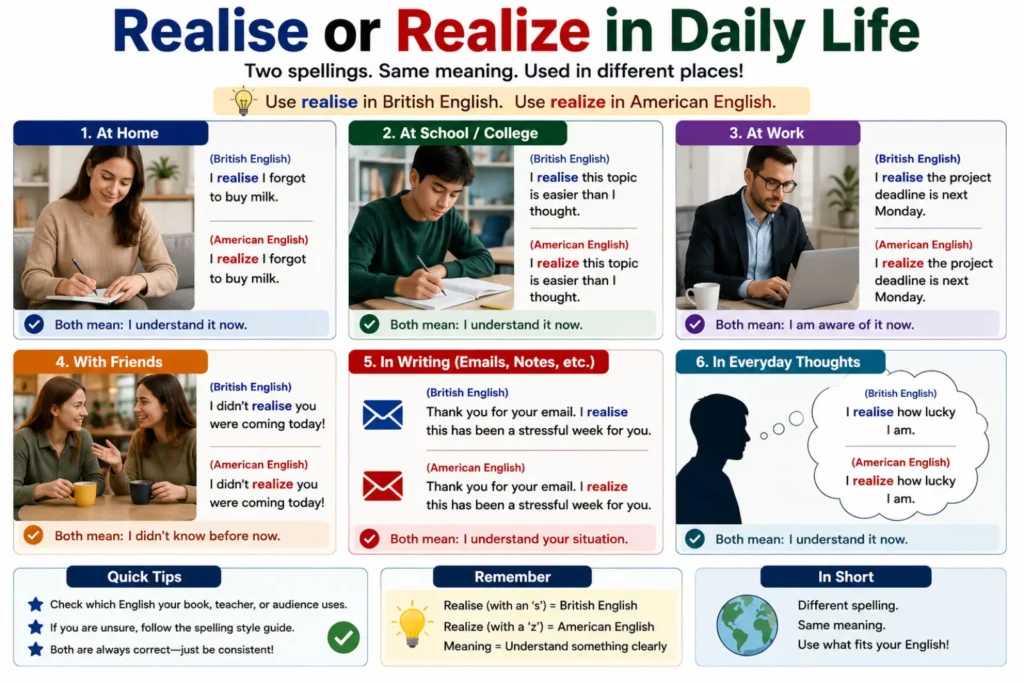
You may use this word in many everyday situations.
might realise that you left your bag at home.
You might realize that you need more time.
could realise that someone needs help.
realize that a decision was important.
Students often use the word when discussing lessons.
For example:
I realized why the answer was wrong.
Workers may use it when discussing business decisions.
For example:
We realized that the plan needed changes.
Therefore, this word is useful in both formal and casual English.
Common Mistakes With Realise and Realize
Writers often make a few simple mistakes.
Mistake 1: Mixing spelling styles
Avoid switching between realise and realize without reason.
For example, a British article should usually follow one consistent style.
Consistency makes writing look more professional.
Mistake 2: Thinking one spelling is always wrong
Neither spelling is universally wrong.
The audience determines the best choice.
Mistake 3: Changing the meaning
Some learners think the two words have different meanings.
They do not.
Both words usually mean the same thing.
Mistake 4: Confusing spelling with pronunciation
The spelling differs.
The pronunciation usually does not.
Mistake 5: Ignoring your style guide
Professional websites often follow a specific style guide.
Always check the required spelling before publishing.
Tips for Choosing Realise or Realize
Use these simple tips.
Choose “realise” when:
- You write mainly for British readers.
- Your organization follows British English.
- Your style guide prefers -ise spellings.
- Your website uses British spelling throughout.
Choose “realize” when:
- You write mainly for American readers.
- Your organization follows American English.
- Your style guide uses American spelling.
- Your website targets the United States.
Most importantly, stay consistent.
Realise or Realize: Which One Should You Use?
The answer depends on your audience.
If readers are mainly American, choose realize.
your readers are mainly British, realise is a natural choice.
If you write for a global audience, either spelling can work.
However, consistency matters more than the choice itself.
Do not use realise in one paragraph and realize in another without a reason.
Your content should follow one clear spelling system.
Synonyms and Related Words
Several words have similar meanings to realise and realize.
Useful synonyms include:
- understand
- discover
- recognize
- notice
- learn
- become aware
- comprehend
- perceive
- see
- grasp
The best synonym depends on the sentence.
For example, notice often describes seeing something.
Understand focuses more on knowing what something means.
Recognize can describe identifying something familiar.
These related words can also help create natural semantic variety in SEO content.
Realise or Realize: SEO and Content Writing Tips
Writers sometimes wonder which spelling Google prefers.
Google does not require you to use one regional spelling.
Instead, write naturally for your target audience.
If your website targets the United States, realize may fit your content better.
If your website targets the United Kingdom, realise may be more appropriate.
Your overall spelling style should also match.
For example, avoid mixing:
- British colour with American organize
- British centre with American realize
- British travelling with American traveling
Regional consistency improves readability.
It also creates a stronger sense of editorial quality.
Expert Insight: Why This Small Difference Matters
Regional spelling matters because language changes across countries.
Professional writers understand these differences.
A spelling choice can signal the intended audience.
For example, an American reader expects realize more often.
A British reader may expect realise.
Neither audience needs a completely different word.
They simply follow different spelling conventions.
For SEO, focus on user intent rather than repeating the keyword.
Answer the question clearly.
Use related terms naturally.
Keep the article useful and easy to scan.
That approach creates stronger content than keyword stuffing.
FAQs About Realise or Realize
Is “realise” or “realize” correct?
Both are correct. Realise is common in British English, while realize is standard in American English.
Is “realise” British or American?
Realise is mainly associated with British English and other varieties that follow British spelling.
Is “realize” British or American?
Realize is standard in American English. Some British style guides also use the -ize spelling.
Do realise and realize mean the same thing?
Yes. They have the same meaning and normally the same pronunciation.
Which spelling should I use in an American essay?
Use realize unless your teacher or style guide requires another spelling.
Which spelling should I use in British English?
Realise is a common British spelling. However, some British publishers prefer realize.
Is “realized” American spelling?
Yes. Realized is the standard American form of the past tense.
Is “realised” British spelling?
Yes. Realised is a common British spelling of the past tense.
Conclusion
When choosing between realise or realize, remember that both spellings are correct. The main difference is the variety of English you are using. Realise is widely used in British English, while realize is the standard spelling in American English. Some British style guides also accept or prefer the -ize form.
Both words have the same meaning. They can describe becoming aware of something, understanding a fact, or recognizing an important idea. Their pronunciation is also generally the same. The spelling simply changes according to regional and editorial preferences.
If you are writing for readers in the United States, realize is usually the best choice. If you are writing for a British audience, realise is a natural choice. The same rule applies to related forms, such as realised and realized.
Most importantly, keep your spelling consistent throughout your article, website, essay, or business document. Do not switch between British and American spelling without a clear reason.
So, realise or realize? Both are correct. Choose the form that matches your audience, country, and preferred style guide. Once you understand this simple difference, you can use the word confidently in both everyday and professional English.