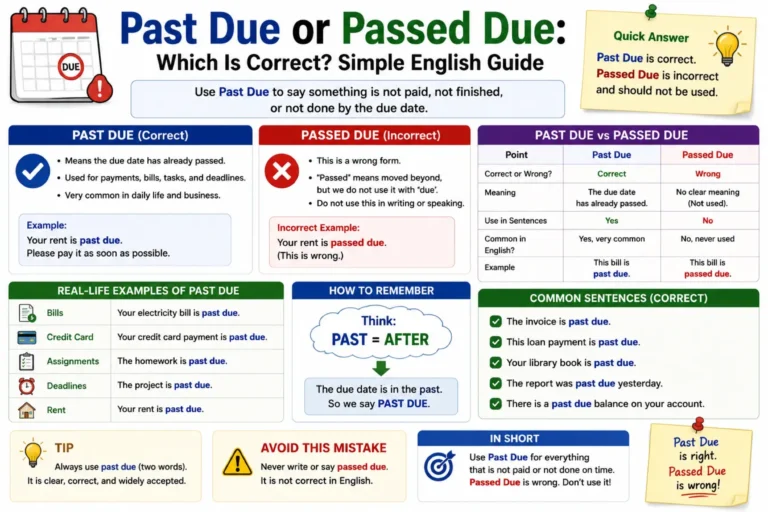
Past due or passed due? Many English speakers use these phrases interchangeably. However, “past due” is usually the correct choice when you mean something is late or overdue. “Passed due” often appears because people confuse the word past with the verb passed. The two words sound similar, but they have different meanings. Understanding this difference can improve your writing at work, school, and home. It can also help you avoid common grammar mistakes. In this guide, you will learn the meaning of past due, why passed due is usually incorrect, and when to use each word. You will also see simple examples, comparisons, and useful tips. By the end, choosing the right phrase should feel easy.
Quick Summary
- Past due means something is late or overdue.
- Passed due is usually incorrect when you mean “overdue.”
- Use past due for bills, payments, deadlines, and tasks.
- Past can describe time that has gone beyond a point.
- Passed is the past tense of the verb pass.
- “The payment is past due” is correct.
- “The payment is passed due” is usually incorrect.
- Remember: past = beyond; passed = moved or went by.
What Does “Past Due” Mean?
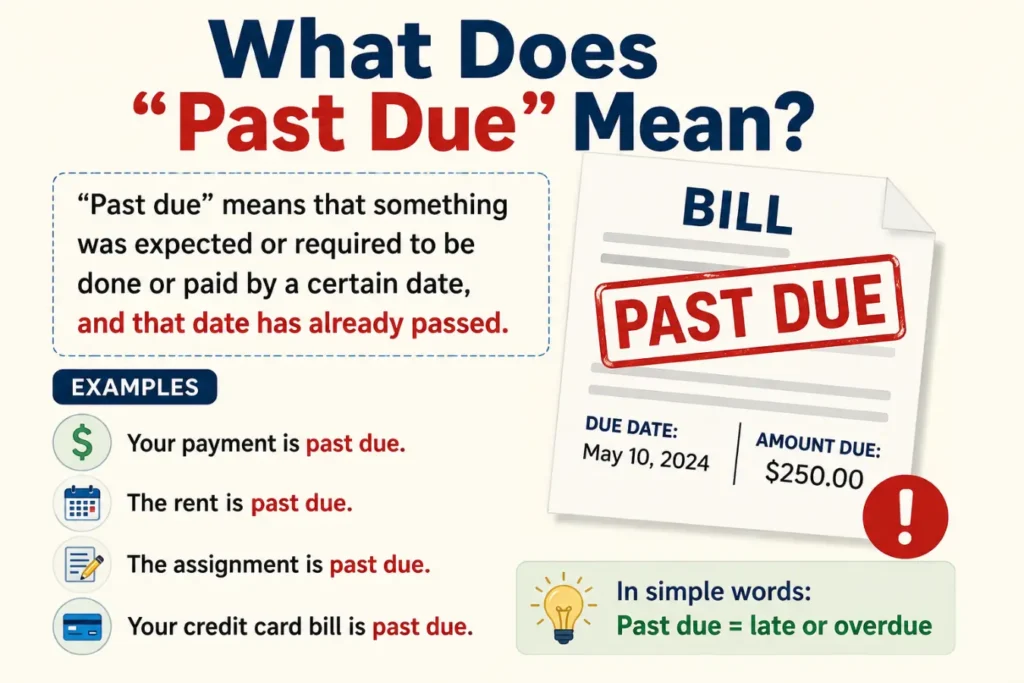
Past due means that something has gone beyond its required or expected date.
People often use it when a payment, bill, deadline, or task should have been completed already.
For example:
- The rent is past due.
- My credit card payment is past due.
- The assignment is past due.
- Your invoice is now past due.
In each example, the required date has already gone by.
The phrase often has a serious or formal tone. Businesses commonly use it when discussing unpaid bills or overdue accounts.
Simple definition
Past due = late because the due date has already passed.
What Does “Passed Due” Mean?
Passed due is generally not the standard phrase when you mean something is overdue.
The confusion comes from past and passed.
Passed is the past tense of the verb pass.
For example:
- She passed the test.
- He passed the store.
- Time passed quickly.
- The car passed us on the road.
In these sentences, passed describes an action.
However, when you say that a payment or deadline is late, you normally need past due.
Therefore:
❌ The bill is passed due.
✅ The bill is past due.
Past Due vs. Passed Due: The Key Difference
The easiest way to remember the difference is to focus on grammar.
| Phrase | Meaning | Typical Use | Correct for “overdue”? |
|---|---|---|---|
| Past due | Beyond the due date | Bills, payments, deadlines | ✅ Yes |
| Passed due | Usually a mistaken form | Rare or nonstandard usage | ❌ Usually no |
| Past | Beyond a point in time | Time, dates, locations | ✅ |
| Passed | Moved, went by, or completed an action | Verbs | Depends on context |
Here is a simple rule:
If you mean overdue, use past due.
Why Do People Say “Passed Due”?
English contains many words that sound alike.
Past and passed are a good example.
They sound almost identical in many accents. Yet their grammar differs.
Past can act as a preposition, adjective, noun, or adverb.
Passed is usually the past-tense form of pass.
This creates confusion in phrases such as:
- past due
- past the deadline
- passed the deadline
- passed the test
Compare these sentences:
The payment is past due.
payment is late.
The payment date passed.
The date went by.
Both sentences can describe the same situation. But they use different grammar.
Real-Life Examples of “Past Due”
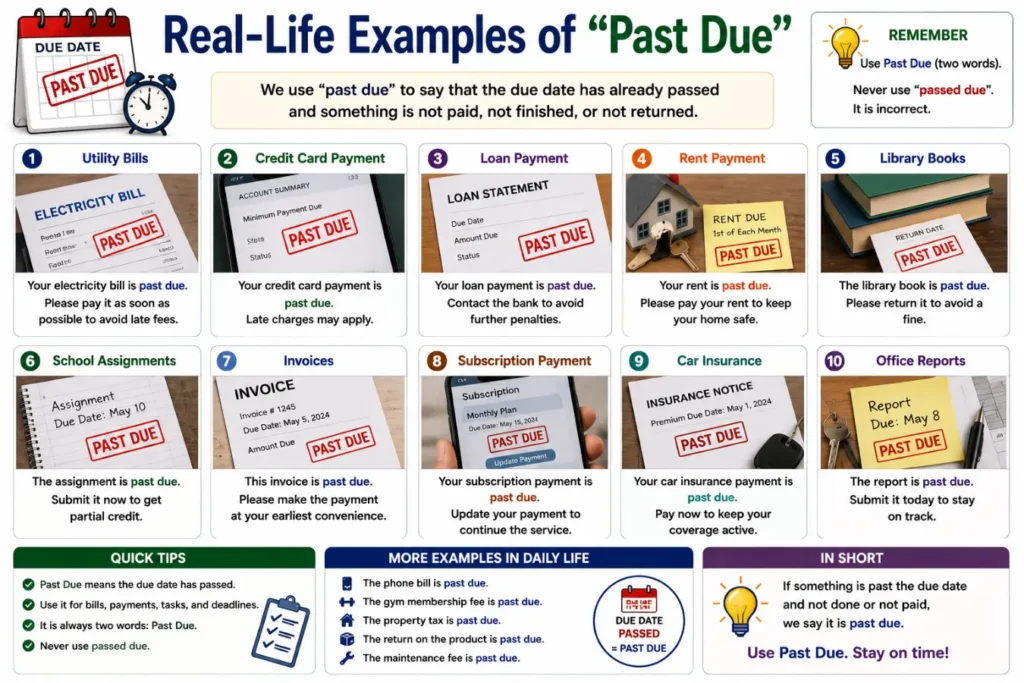
You will often see past due in everyday and professional writing.
Bills and payments
- Your electricity bill is past due.
- The loan payment became past due yesterday.
- Please pay the past-due balance.
Work deadlines
- The report is past due.
- This project is now past due.
- Several tasks remain past due.
School
- Your homework is past due.
- The essay became past due after Friday.
- Please submit all past-due assignments.
Business
- The invoice is past due.
- We have several past-due accounts.
- The customer received a notice about the past-due payment.
These examples show why past due is the standard choice.
When Should You Use “Passed”?
Use passed when someone or something performs the action of passing.
For example:
- The deadline passed yesterday.
- She passed the exam.
- The bus passed our house.
- Two weeks passed quickly.
- He passed the message to his manager.
Notice the difference.
Past due describes a status.
Passed describes an action.
This distinction makes the correct choice much easier.
“The Due Date Passed” vs. “Past Due”
Both expressions can be correct.
However, they have different sentence structures.
The due date passed
This tells us that the date has gone by.
The due date passed last Friday.
Here, passed works as a verb.
The payment is past due
This tells us that the payment is late.
The payment is past due.
Here, past due works as an adjective phrase describing the payment.
So you can remember:
The date passed.
The payment is past due.
Past Due or Overdue: Which Is Better?
Past due and overdue often have the same basic meaning.
Both can describe something that should have happened already.
For example:
- The bill is past due.
- The bill is overdue.
Both sentences are correct.
However, past due appears very often in financial and business contexts.
You may see it on:
- invoices
- loan statements
- credit accounts
- utility bills
- payment reminders
- business notices
Overdue has a broader everyday use.
For example:
- The library book is overdue.
- The payment is overdue.
- The project is overdue.
Common Mistakes With “Past Due”
Mistake 1: Using “passed due”
❌ Your payment is passed due.
✅ Your payment is past due.
The first sentence confuses the adjective past with the verb passed.
Mistake 2: Using “past” as a verb
❌ The deadline past yesterday.
✅ The deadline passed yesterday.
Here, you need a verb.
Mistake 3: Confusing “past due” with “past”
❌ The bill is past.
This sentence does not clearly express that the bill is late.
✅ The bill is past due.
The phrase past due gives the intended meaning.
Mistake 4: Adding unnecessary words
❌ The payment is past its due date and is past due.
This repeats the same idea.
Better:
✅ The payment is past due.
Keep the sentence simple when the meaning is clear.
How to Remember the Difference
Try this simple memory trick:
Past = beyond.
Think:
- past the house
- past midnight
- past the deadline
- past due
Passed = an action.
Think:
- passed the test
- passed the house
- passed the deadline
- passed the message
Ask yourself:
Am I describing a status or an action?
If you describe something as late, choose past due.
If someone or something performed the action of passing, choose passed.
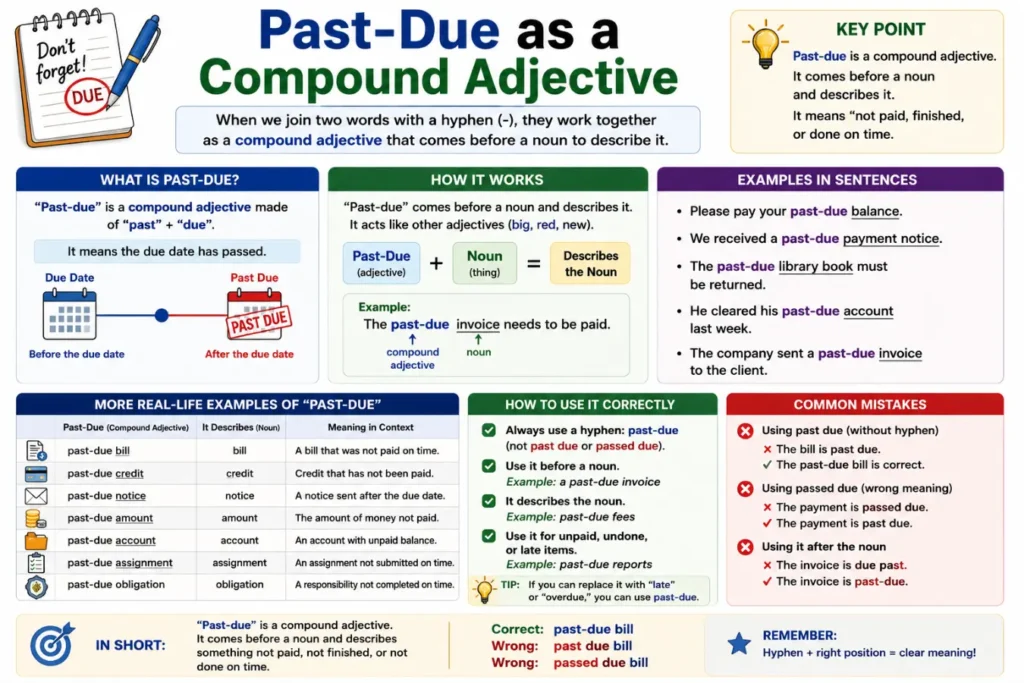
Past-Due as a Compound Adjective
You may also see past-due with a hyphen.
For example:
The company sent a reminder about the past-due payment.
Here, past-due directly describes the noun payment.
You can also write:
The payment is past due.
No hyphen usually appears when the phrase comes after a linking verb.
So:
- The account is past due.
- The company contacted us about the past-due account.
This follows a common English pattern for compound modifiers.
Past Due in Daily Life
You may encounter past due in many situations.
Imagine you forget to pay your phone bill by the tenth of the month.
On the eleventh, the company may say:
Your account is past due.
Now imagine your manager gives you a report deadline on Monday.
If you submit it on Wednesday, the report is past due.
The phrase works because the required time has already ended.
It does not matter whether the deadline involves money, work, school, or another obligation.
Synonyms and Related Search Terms
Several words and phrases connect closely with past due.
Useful semantic variations include:
- overdue
- late
- late payment
- unpaid
- delinquent
- overdue payment
- overdue bill
- missed deadline
- expired deadline
- payment deadline
- due date
- past-due balance
- past-due account
- late payment notice
However, these terms do not always have exactly the same meaning.
For example, delinquent can sound more formal and serious.
Late is simpler and more general.
Overdue is a common everyday alternative.
Expert Insights: Why the Difference Matters
Good grammar improves clarity.
The difference between past and passed may seem small. Yet it can affect professional writing.
Financial notices especially need precise wording.
A customer should understand whether a payment is late or whether a deadline has ended.
For clear business writing, use familiar terms whenever possible.
Choose past due when you mean overdue.
Choose passed when you need the past-tense verb pass.
This simple distinction keeps your writing accurate and easy to understand.
FAQs About Past Due or Passed Due
Is “past due” grammatically correct?
Yes. Past due is a standard phrase that means something is overdue or late.
Is “passed due” correct English?
Usually, no. Passed due is normally a mistaken version of past due when describing something that is overdue.
Should I say “past due” or “overdue”?
Both can work. Past due is especially common for bills, payments, and accounts.
Is “the due date passed” correct?
Yes. Passed is correct because it functions as the past tense of the verb pass.
Is “past due payment” correct?
Yes. You can write past-due payment when the phrase directly modifies the noun.
What is the difference between past and passed?
Past refers to something beyond a point or time. Passed usually describes the action of moving beyond something.
Is “past due date” correct?
It can be correct in some sentence structures. However, past due is usually the clearer phrase when you mean “overdue.”
What is the easiest way to remember “past due”?
Remember this rule: past due = overdue. Use passed when describing an action.
Conclusion: Past Due or Passed Due?
When choosing between past due or passed due, the correct phrase is usually past due. Use it when something has not happened by its required date. This includes bills, payments, assignments, tasks, and deadlines.
Use passed when you need the past tense of the verb pass. For example, you can say, “The due date passed.” You can then say, “The payment is past due.”
The difference becomes simple once you focus on grammar. Past describes something beyond a point. Passed describes an action that happened.
The easiest takeaway is this: If you mean “overdue,” write “past due.” That rule will help you avoid one of the most common mistakes with these similar-sounding words.