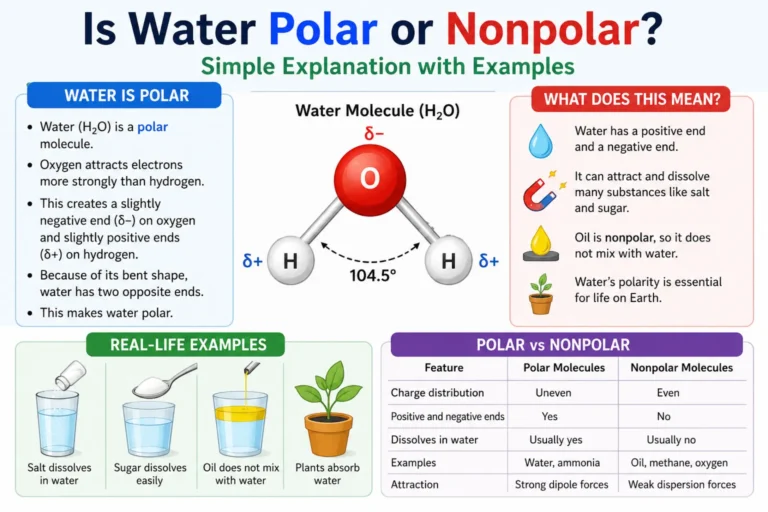
Is water polar or nonpolar? Water is a polar molecule. This means it has a positive end and a negative end. These tiny charges help water do many amazing things. Water can dissolve salt, help plants grow, and support life on Earth.
Many students ask this question because water looks simple. However, its structure makes it very special. Learning why water is polar helps you understand chemistry more easily. It also explains why oil and water do not mix.
In this guide, you will learn what makes water polar. You will also see real-life examples, common mistakes, comparison tables, and expert tips. Everything is explained in simple English.
Quick Summary Box
- Water is a polar molecule.
- Oxygen attracts electrons more strongly than hydrogen.
- Water has one slightly negative end and one slightly positive end.
- Its bent shape creates an uneven charge.
- Polar water dissolves many substances like salt and sugar.
- Oil is nonpolar, so it does not mix with water.
- Water’s polarity supports life on Earth.
What Is Water?
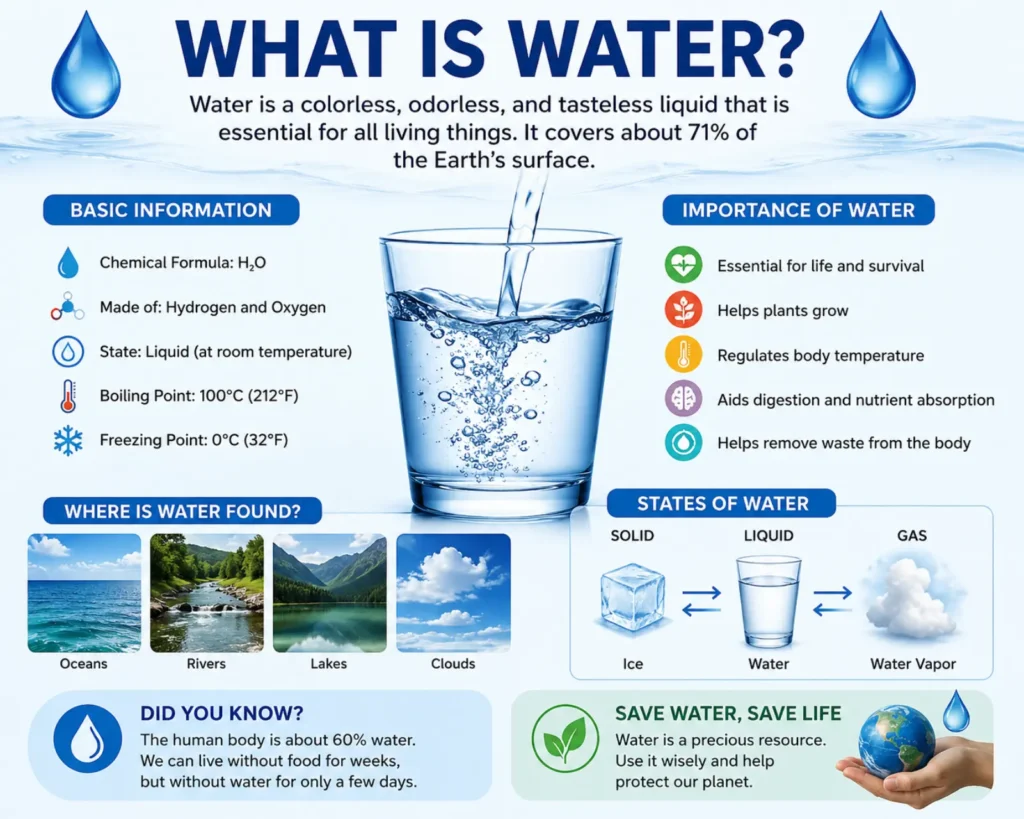
Water is a chemical compound made of:
- Two hydrogen atoms (H)
- One oxygen atom (O)
Its chemical formula is H₂O.
Although water is a tiny molecule, it has unique properties because of its polarity.
Is Water Polar or Nonpolar?
Yes, water is polar.
The oxygen atom pulls shared electrons closer to itself. This creates:
- A slightly negative charge (δ−) on oxygen
- Slightly positive charges (δ+) on both hydrogen atoms
Because water has a bent shape, these charges do not cancel each other.
That makes water a polar molecule.
What Does Polar Mean?
A polar molecule has:
- One positive side
- One negative side
The electrons are not shared equally between atoms.
Think of it like a tiny magnet.
One end attracts positive charges.
The other end attracts negative charges.
Water behaves this way because oxygen attracts electrons much more strongly than hydrogen.
Why Is Water Polar?
Water becomes polar because of two important reasons.
1. Oxygen Is More Electronegative
Oxygen pulls electrons more strongly than hydrogen.
As a result:
- Oxygen becomes slightly negative.
- Hydrogen becomes slightly positive.
2. Water Has a Bent Shape
The angle between hydrogen atoms is about 104.5°.
If water were straight, the charges could cancel.
Since it is bent, the charges stay uneven.
This creates polarity.
What Makes a Molecule Nonpolar?
A nonpolar molecule shares electrons equally.
It has:
- No positive side
- No negative side
- Even charge distribution
Examples include:
- Oxygen (O₂)
- Nitrogen (N₂)
- Methane (CH₄)
- Carbon dioxide (overall nonpolar)
Polar vs Nonpolar Molecules
| Feature | Polar Molecules | Nonpolar Molecules |
|---|---|---|
| Charge distribution | Uneven | Even |
| Positive and negative ends | Yes | No |
| Dissolves in water | Usually yes | Usually no |
| Examples | Water, ammonia | Oil, methane, oxygen |
| Attraction | Strong dipole forces | Weak dispersion forces |
How Does Water’s Polarity Affect Daily Life?
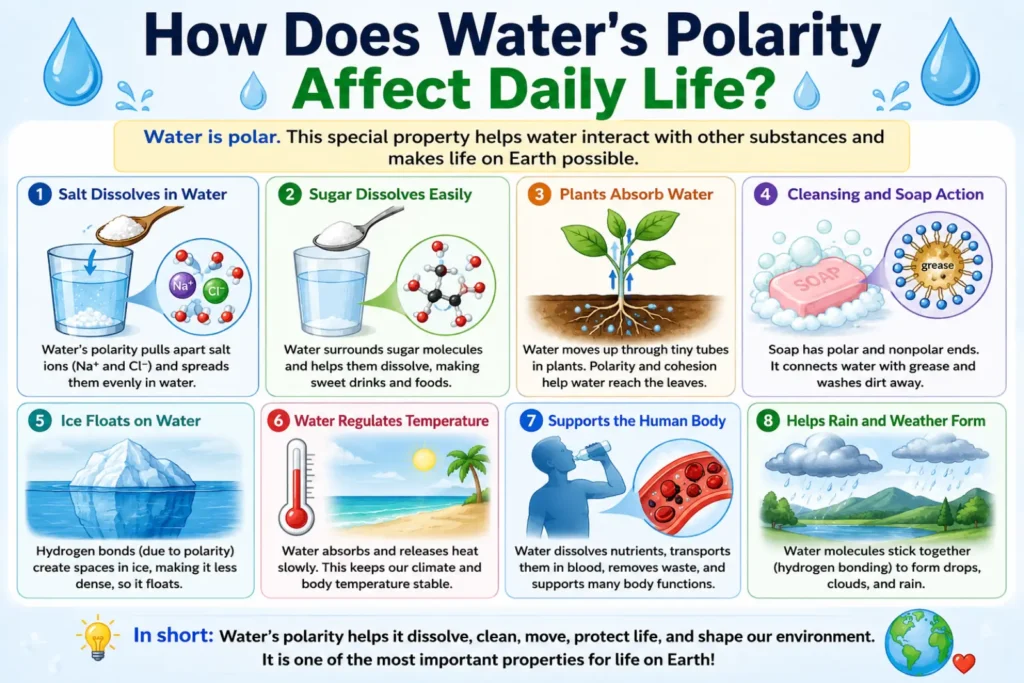
Water’s polarity explains many everyday events.
Salt Dissolves in Water
Water molecules surround salt ions.
This pulls the salt apart.
Sugar Dissolves Easily
Water attracts sugar molecules.
The sugar spreads throughout the water.
Plants Absorb Water
Water moves through tiny tubes inside plants.
Polarity helps water stick together.
Cleaning Clothes
Soap has polar and nonpolar ends.
It connects water with grease.
This removes dirt.
Real-Life Examples of Water Being Polar
Here are simple examples.
Ice Floats
Hydrogen bonds create spaces between water molecules.
Ice becomes less dense.
Rain Forms
Water molecules stick together.
Tiny droplets become clouds.
Human Body
Your blood is mostly water.
It carries nutrients because water dissolves many substances.
Cooking
Water helps mix ingredients.
It also transfers heat well.
Why Oil Does Not Mix with Water
Oil is nonpolar.
Water is polar.
Polar molecules attract other polar molecules.
Nonpolar molecules attract nonpolar molecules.
Because they are different, oil and water separate into layers.
This follows the rule:
Like dissolves like.
Hydrogen Bonds and Water Polarity
Water molecules attract each other.
This attraction forms hydrogen bonds.
Hydrogen bonds give water many special properties.
They help water:
- Stay liquid over a wide temperature range
- Have high boiling and melting points
- Move through plants
- Create surface tension
Without hydrogen bonds, life would be very different.
Common Mistakes About Water Polarity
Many learners make these mistakes.
Mistake 1
Thinking water is nonpolar because it has no overall charge.
Truth: Water is neutral overall but still polar.
Mistake 2
Believing every molecule with oxygen is polar.
Truth: Shape also matters.
Mistake 3
Confusing polar bonds with polar molecules.
A molecule may contain polar bonds but still be nonpolar if the charges cancel.
Mistake 4
Thinking oil dissolves in water.
Oil remains separate because it is nonpolar.
Tips to Remember Why Water Is Polar
Use these easy tricks.
- Remember H₂O has a bent shape.
- Oxygen pulls electrons more strongly.
- Think of water as a tiny magnet.
- Remember the rule: Like dissolves like.
- Polar molecules mix with polar substances.
Synonyms and Related Terms
Synonyms
- Polar molecule
- Polar compound
- Dipole molecule
Related Search Terms
- Why is water polar?
- Is H₂O polar?
- Water polarity explained
- Polar vs nonpolar molecules
- Water molecule structure
- Hydrogen bonding
- Molecular polarity
- Electronegativity in water
- Bent molecular geometry
- Why oil and water do not mix
Expert Insights
Chemistry experts agree that water’s polarity is one of the most important properties in science.
Without polarity:
- Cells could not function properly.
- Nutrients would not move easily.
- Plants would struggle to survive.
- Many chemical reactions would stop.
Understanding water’s polarity builds a strong foundation for chemistry, biology, medicine, and environmental science.
(FAQs)
Is water polar or nonpolar?
Water is polar because oxygen pulls electrons more strongly than hydrogen.
Why is water considered polar?
Its bent shape creates an uneven distribution of electrical charge.
Is H₂O a polar molecule?
Yes. H₂O has a permanent dipole.
Why doesn’t oil mix with water?
Oil is nonpolar, while water is polar. Different types do not mix well.
What makes water different from nonpolar molecules?
Water has positive and negative ends. Nonpolar molecules do not.
Does water dissolve everything?
No. Water dissolves many polar and ionic substances but not most nonpolar materials.
Is carbon dioxide polar?
No. Carbon dioxide has polar bonds, but its linear shape makes the molecule nonpolar overall.
Why is water important for living things?
Its polarity allows it to transport nutrients, dissolve minerals, and support countless biological processes.
Featured Snippet Answer
Water is a polar molecule because oxygen attracts electrons more strongly than hydrogen. Its bent shape creates a positive end and a negative end. This uneven charge allows water to dissolve many substances and form hydrogen bonds.
Conclusion
So, is water polar or nonpolar? The answer is simple. Water is polar. Oxygen pulls electrons closer to itself, while the bent shape keeps the charges uneven. These features give water a positive side and a negative side. Because of this polarity, water dissolves many substances, supports living organisms, and displays unique properties such as surface tension and hydrogen bonding. Understanding water’s polarity also helps explain why oil and water do not mix and why water plays such an important role in chemistry and biology. Once you understand this concept, many other science topics become much easier to learn.