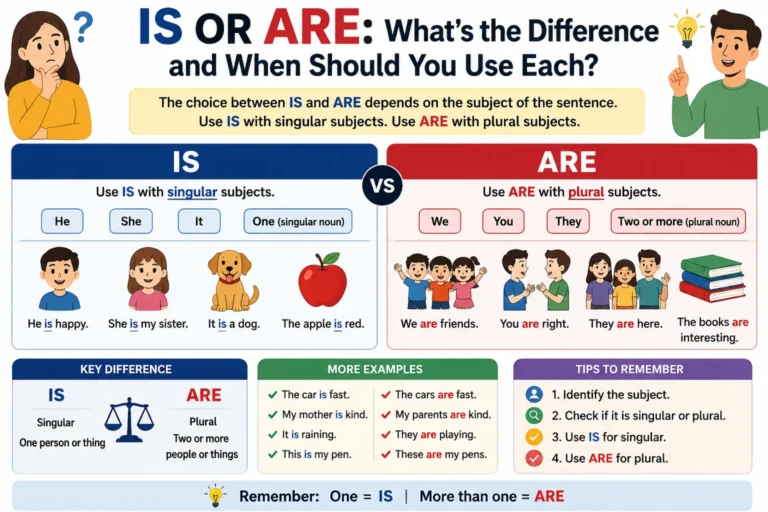
Is or are is one of the most common grammar questions in English. Many learners wonder which word is correct in different sentences. The answer depends on the subject of the sentence. If the subject is singular, you usually use is. If the subject is plural, you usually use are.
Using the correct verb makes your writing clear and easy to understand. It also helps you sound more confident when speaking English. In this guide, you will learn the meaning of is and are, their key differences, simple grammar rules, real-life examples, common mistakes, and expert tips. By the end, you will know exactly when to use each one.
Quick Summary Box
- Is and are are forms of the verb to be.
- Use is with singular nouns and singular pronouns.
- Use are with plural nouns and plural pronouns.
- Is works with he, she, it, and singular names.
- Are works with we, you, they, and plural nouns.
- Correct usage improves grammar and communication.
- Learning the subject helps you choose the right verb.
Featured Snippet: Is or Are?
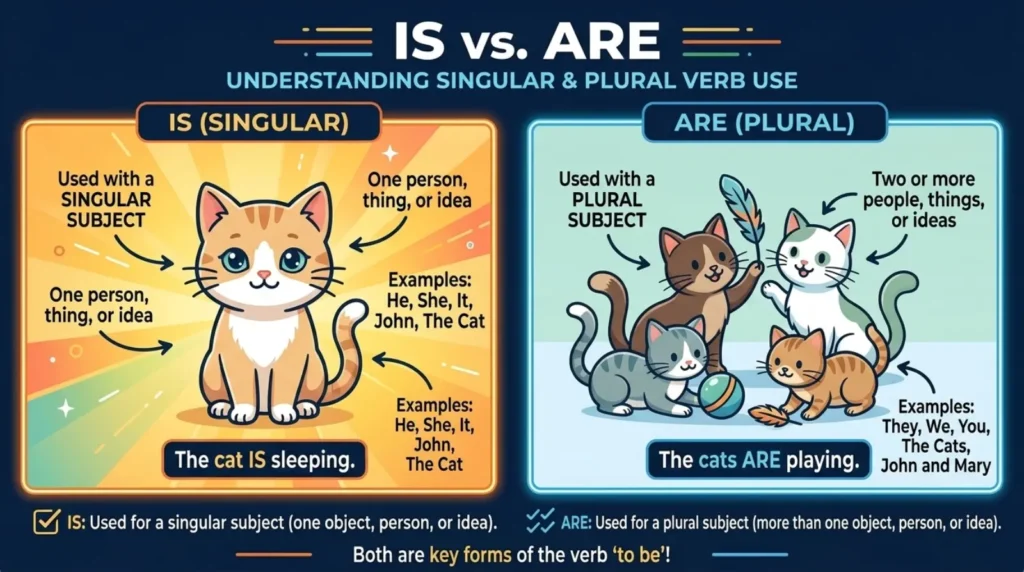
Use “is” with singular subjects and “are” with plural subjects. For example, say “The cat is sleeping” because “cat” is singular. Say “The cats are sleeping” because “cats” is plural. The correct choice depends on the subject of the sentence.
What Does “Is” and “Are” Mean?
Is and are are present tense forms of the verb to be.
They describe:
- A person
- A thing
- A place
- A condition
- An action in progress
Examples:
- She is happy.
- They are ready.
- The sky is blue.
- We are students.
These verbs help complete a sentence.
What Is the Difference Between Is and Are?
The main difference is the number of the subject.
- Is goes with one person or thing.
- Are goes with more than one person or thing.
Simple Rule
- One = Is
- More than one = Are
Examples:
- The dog is friendly.
- The dogs are friendly.
Is vs Are Comparison Table
| Feature | Is | Are |
|---|---|---|
| Verb Type | Present form of “to be” | Present form of “to be” |
| Subject | Singular | Plural |
| Pronouns | He, She, It | We, You, They |
| Example | The book is new. | The books are new. |
| Common Use | One person or object | More than one person or object |
When to Use “Is”
Use is with singular nouns and pronouns.
Singular Nouns
- The car is fast.
- My phone is new.
Singular Pronouns
- He is tall.
- She is kind.
- It is raining.
Names
- Emma is a teacher.
- John is busy.
When to Use “Are”
Use are with plural nouns and pronouns.
Plural Nouns
- The cars are fast.
- The books are interesting.
Plural Pronouns
- We are happy.
- They are friends.
- You are welcome.
Remember, you always takes are, even when talking to one person.
Grammar Rules for Is and Are
Follow these simple rules.
Rule 1: Count the Subject
One item → Use is
Many items → Use are
Rule 2: Look at the Pronoun
- He → is
- She → is
- It → is
- We → are
- You → are
- They → are
Rule 3: Ignore Extra Words
Example:
The box of chocolates is delicious.
The subject is box, not chocolates.
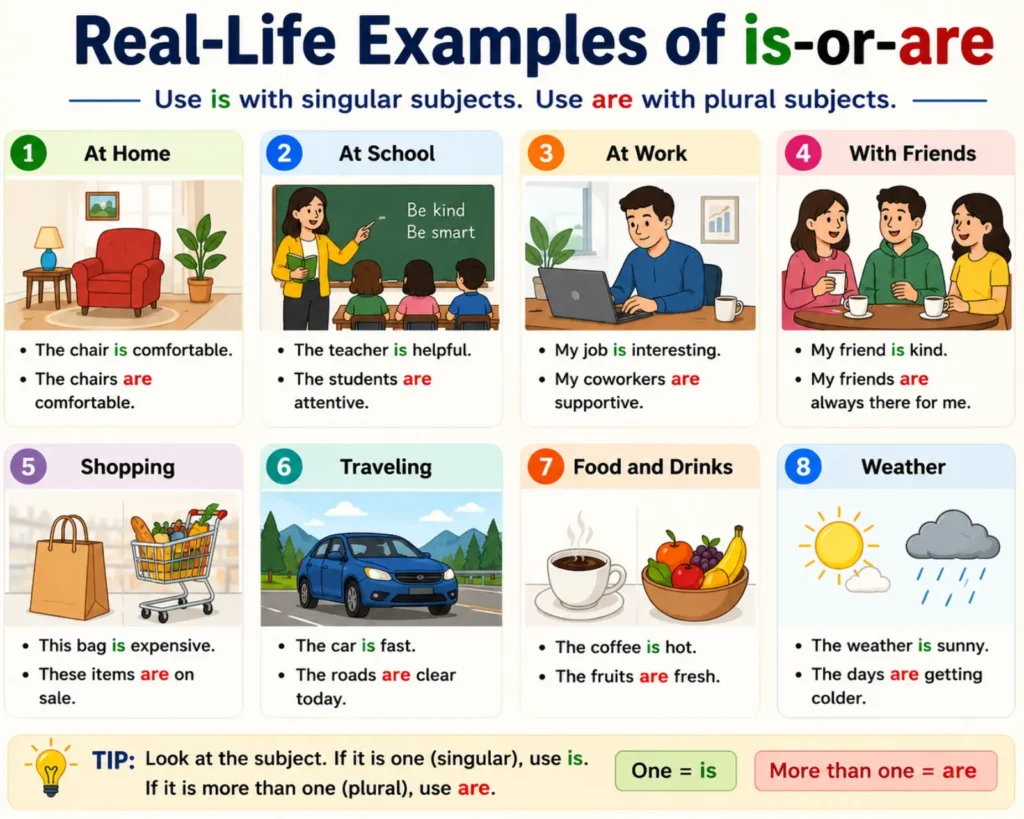
Real-Life Examples
Here are everyday examples.
Home
- The dinner is ready.
- The children are hungry.
School
- The teacher is helpful.
- The students are quiet.
At Work
- My manager is busy.
- My coworkers are friendly.
While Traveling
- The hotel is clean.
- The buses are late.
Common Mistakes to Avoid
Many learners make these mistakes.
Mistake 1
❌ The books is on the table.
✅ The books are on the table.
Mistake 2
❌ She are my friend.
✅ She is my friend.
Mistake 3
❌ They is waiting.
✅ They are waiting.
Mistake 4
❌ You is welcome.
✅ You are welcome.
Tips to Remember Is or Are
These tricks make grammar easier.
- Count the subject first.
- Find the main noun.
- Ignore extra phrases.
- Practice every day.
- Read English books.
- Listen to native speakers.
- Check your writing before sending it.
The more you practice, the faster you improve.
Is and Are in Questions
Questions often begin with is or are.
Examples:
- Is he coming?
- Is the movie good?
- Are they ready?
- Are we late?
- Are you busy?
The verb comes before the subject.
Is and Are in Daily Life
You use these words every day.
Examples include:
- Talking with friends
- Writing emails
- School assignments
- Office communication
- Social media posts
- Customer service
- Job interviews
Correct grammar creates a better impression.
Related Grammar Topics
Learning these topics will also improve your English.
- Am, Is, Are
- Was vs Were
- Has vs Have
- Do vs Does
- There Is vs There Are
- Subject-Verb Agreement
- Singular and Plural Nouns
- Present Continuous Tense
Synonyms and LSI Keywords
Although is and are have no direct synonyms, these related grammar terms help search engines understand the topic.
Related Search Terms
- is vs are
- when to use is or are
- is and are grammar
- subject verb agreement
- English grammar rules
- singular and plural verbs
- present tense verbs
- be verb examples
- grammar for beginners
- English sentence structure
Long-Tail Keywords
- when to use is and are in English
- difference between is and are
- is or are grammar rules with examples
- easy guide to is and are
- subject verb agreement examples
Expert Insights
Grammar experts agree that subject-verb agreement is one of the first skills every English learner should master.
Small grammar mistakes can confuse readers. They can also reduce confidence during conversations.
Instead of memorizing every rule, focus on identifying the subject first. Once you know if it is singular or plural, choosing is or are becomes much easier.
Daily reading and writing help build this habit naturally.
(FAQs)
What is the difference between is and are?
Is is for singular subjects. Are is for plural subjects.
When should I use is?
Use is with one person, animal, place, or thing.
When should I use are?
Use are with two or more people, animals, places, or things.
Is “you is” correct?
No. The correct form is you are.
Can I use is with they?
No. They always takes are.
Why do we say “there are”?
Use there are when talking about more than one object.
Example:
There are five apples.
Why do we say “there is”?
Use there is for one object.
Example:
There is one apple.
How can I remember is or are?
Look at the subject. If it is singular, use is. If it is plural, use are.
Conclusion
Choosing is or are becomes simple when you understand the subject of the sentence. Use is with singular nouns and pronouns such as he, she, it, or one object. Use are with plural nouns and pronouns such as we, you, and they. This small grammar rule makes a big difference in writing and speaking. It helps your sentences sound natural and correct. Practice with everyday examples, read English often, and review your work before sharing it. Over time, selecting the right verb will become automatic. With regular practice, you can improve your grammar skills and communicate with greater confidence.