
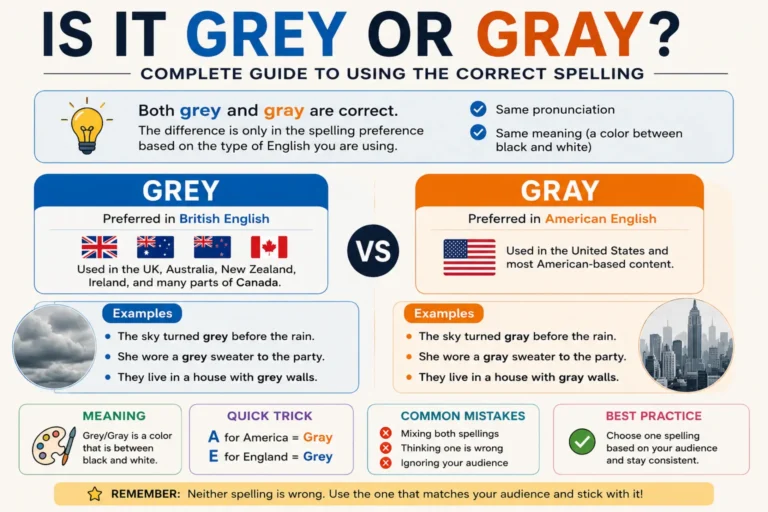
Is it grey or gray? This question confuses many English learners and even native speakers. You may see grey in one book and gray in another. So, which spelling is correct?
The simple answer is that both spellings are correct. The difference depends on where you use English. American English usually prefers gray, while British English and many other countries prefer grey.
Knowing the correct spelling helps you write clearly and professionally. It also keeps your writing consistent. Whether you are writing a blog post, school assignment, email, or business document, choosing the right spelling matters.
This guide explains everything you need to know about grey vs gray. You will learn their meaning, the differences between them, when to use each spelling, common mistakes to avoid, and helpful tips for remembering the correct version. By the end of this article, you will know exactly which spelling fits your audience.
Quick Summary
- Grey and gray mean the same color.
- Both spellings are correct in English.
- Gray is the standard spelling in American English.
- Grey is the preferred spelling in British English.
- The pronunciation is exactly the same.
- The meaning never changes.
- Choose one spelling and use it consistently throughout your writing.
What Does Grey or Gray Mean?
Both grey and gray describe the same neutral color. It is the color that sits between black and white on the color spectrum.
You can use either spelling to describe objects, weather, clothing, animals, hair, buildings, or anything else that has this color. The only difference is the preferred spelling in different regions.
Simple Definition
Grey/Gray: A neutral color between black and white.
This color often represents balance, maturity, simplicity, and calmness. Designers also use it because it matches many other colors.
Examples
- The sky turned gray before the storm.
- My grandfather has grey hair.
- She painted her bedroom light gray.
- He bought a stylish grey jacket.
- The old stone wall looked dark gray.
Each sentence has the same meaning. Only the spelling changes.
Is Grey or Gray Correct?
Yes. Both spellings are correct.
Many people believe one spelling is wrong. That is not true. Dictionaries accept both versions because they are standard English spellings.
The main difference is regional preference.
- Gray is the standard spelling in the United States.
- Grey is the preferred spelling in the United Kingdom.
- Australia usually uses grey.
- New Zealand also prefers grey.
- Canada often uses grey, although gray also appears.
If you write for an American audience, use gray. If your audience is mainly British, Australian, or Irish, choose grey.
The most important rule is consistency. Once you choose one spelling, keep using it throughout your article or document.
Grey vs Gray: What’s the Difference?
People often search for grey vs gray because they expect a difference in meaning. In reality, there is no difference in definition, pronunciation, or usage.
The only difference is spelling.
| Feature | Grey | Gray |
|---|---|---|
| Meaning | Color between black and white | Color between black and white |
| Pronunciation | Same | Same |
| British English | Preferred | Less common |
| American English | Less common | Preferred |
| Correct Spelling | Yes | Yes |
As you can see, both words describe the exact same color. The spelling simply depends on the variety of English you use.
For example, an American newspaper would normally write:
“The sky became dark gray before sunset.”
A British newspaper would write:
“The sky became dark grey before sunset.”
Both sentences are correct.
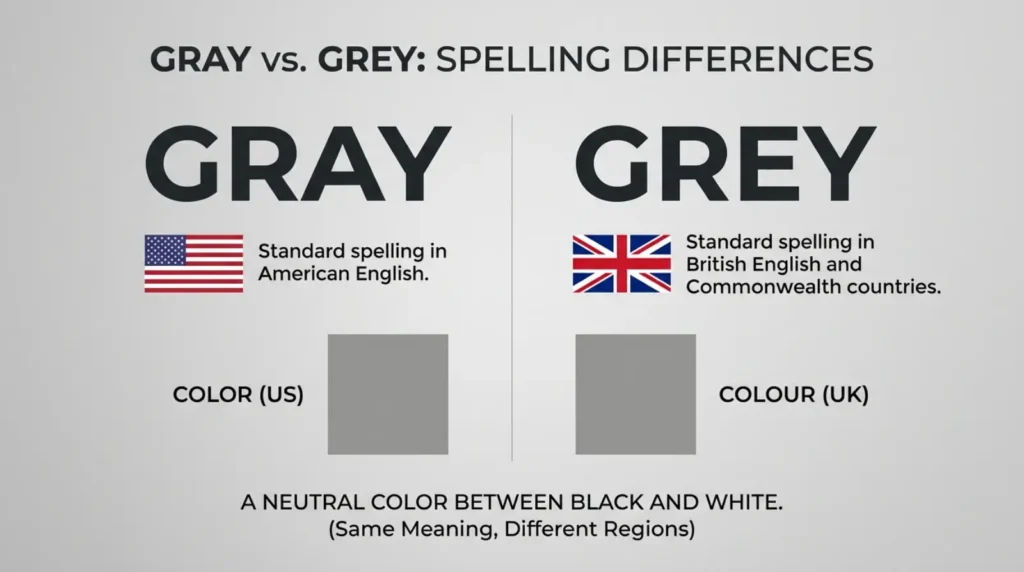
Why Are There Two Different Spellings?
English has changed over hundreds of years. As the language spread across different countries, spelling rules developed in different ways.
British English kept many traditional spellings that were already common in England.
Later, American English adopted several simplified spellings. These changes became widely accepted in the United States. That is why Americans usually write gray, while British writers continue using grey.
This pattern appears in many other English words.
| American English | British English |
| Color | Colour |
| Favorite | Favourite |
| Center | Centre |
| Theater | Theatre |
| Gray | Grey |
These differences do not change the meaning of the words. They only reflect regional spelling preferences.
If you are writing for an international audience, check your website’s style guide before choosing one spelling. Consistent spelling makes your content look more professional and improves the reading experience.
When Should You Use Gray?
Use gray whenever you write in American English.
This spelling is the standard choice for:
- American blogs
- US business documents
- School assignments in the United States
- American newspapers
- US-based websites
- Marketing content for American readers
Examples
- The living room has light gray walls.
- She bought a gray sweater for winter.
- Dark gray clouds covered the city.
- The company painted its office gray to create a modern look.
If your audience lives in the United States, gray is usually the best choice.
When Should You Use Grey?
Use grey when writing in British English or for readers in countries that follow British spelling conventions.
You will commonly see grey in:
- UK newspapers
- British books
- Australian websites
- Irish publications
- New Zealand content
- Many Canadian publications
If your audience expects British English, grey is the natural choice. Using the preferred spelling helps your writing look professional and familiar.
Examples
- She wore a beautiful grey coat.
- The old castle was built with grey stone.
- His grey hair made him look wise.
- We watched grey clouds move across the sky.
Each sentence uses the British spelling, but the meaning remains exactly the same.
American English vs British English
The biggest reason people ask, “Is it grey or gray?”, is because English has different spelling standards around the world.
American English and British English share the same language, but they use different spellings for many common words.
Here are a few examples:
| American English | British English |
|---|---|
| Gray | Grey |
| Color | Colour |
| Favorite | Favourite |
| Organize | Organise |
| Analyze | Analyse |
| Traveling | Travelling |
| Center | Centre |
| Theater | Theatre |
These spelling differences developed over time. They do not change the meaning of the words.
Which Countries Prefer “Gray”?
Most American writers use gray.
This includes:
- United States
- American companies
- US government documents
- American schools
- Most US publishers
Which Countries Prefer “Grey”?
Most countries that follow British English prefer grey.
These include:
- United Kingdom
- Australia
- New Zealand
- Ireland
- Many Canadian organizations
If you are unsure which spelling to use, think about your audience first.
Real-Life Examples of Grey and Gray
Understanding real-life situations makes the difference much easier to remember.
Example 1: School Assignment
Imagine you study in the United States.
Your teacher expects American spelling.
Correct:
The elephant has gray skin.
Now imagine you study in England.
Correct:
The elephant has grey skin.
Both answers are correct because they match the local spelling style.
Example 2: Blog Writing
Suppose you own an American home improvement blog.
You would write:
- Gray paint ideas
- Light gray kitchen cabinets
- Gray living room walls
A British blog would instead use:
- Grey paint ideas
- Light grey kitchen cabinets
- Grey living room walls
The content stays the same. Only the spelling changes.
Example 3: Product Descriptions
Many online stores change the spelling based on their customers.
American store:
Men’s Gray Hoodie
British store:
Men’s Grey Hoodie
This small change makes the product feel more natural to local shoppers.
Example 4: Weather Reports
American weather report:
Gray skies are expected throughout the afternoon.
British weather report:
Grey skies are expected throughout the afternoon.
Again, both are correct.
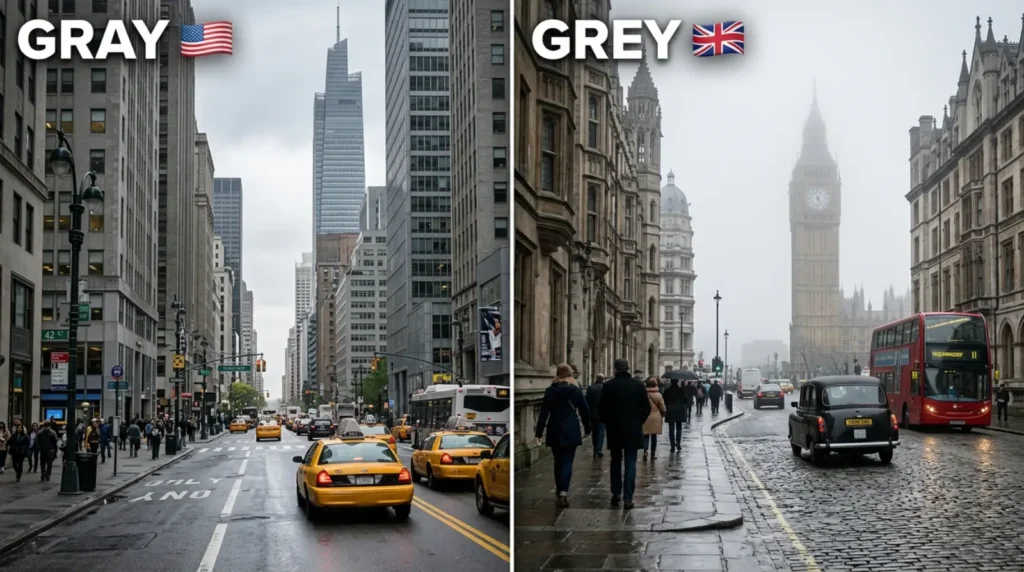
Common Mistakes People Make
Even experienced writers sometimes make mistakes with grey and gray.
Here are the most common ones.
1. Mixing Both Spellings
This is the biggest mistake.
Incorrect:
The grey sofa matched the gray carpet.
Correct:
The grey sofa matched the grey carpet.
OR
The gray sofa matched the gray carpet.
Choose one spelling and use it throughout the document.
2. Thinking One Spelling Is Wrong
Many people believe only gray is correct.
Others believe only grey is correct.
Neither idea is true.
Both spellings appear in major dictionaries and style guides.
3. Ignoring Your Target Audience
Your readers expect familiar spelling.
American readers usually expect gray.
British readers usually expect grey.
Matching your audience improves readability and builds trust.
4. Changing Spellings During Editing
Sometimes writers copy information from different websites.
One paragraph may use gray.
Another may use grey.
Always proofread your article before publishing.
Consistency is important.
Easy Tips to Remember the Difference
You do not need to memorize complicated grammar rules.
These simple tricks work well.
Tip 1: A for America
Both words contain the letter A.
- America
- Gray
This helps you remember that gray is the American spelling.
Tip 2: E for England
Both words contain the letter E.
- England
- Grey
This reminds you that grey is the British spelling.
Tip 3: Follow Your Style Guide
If your school, company, or client follows American English, always write gray.
If they follow British English, always write grey.
Never switch between the two.
Tip 4: Use Spell Check
Most word processors can detect language settings.
If your document is set to American English, it will usually suggest gray.
If it is set to British English, it will usually suggest grey.
Spell check helps keep your writing consistent.
Using Grey and Gray in Everyday Life
You probably see these words every day without noticing.
They appear in many places, including:
- Paint color charts
- Clothing catalogs
- Interior design magazines
- Weather forecasts
- Home decoration websites
- Fashion blogs
- School textbooks
- Online shopping stores
- Car color descriptions
Whether you are describing a shirt, a cloudy sky, or a modern office, the meaning stays the same.
The only question is which audience you are writing for.
If your readers are American, choose gray.
If your readers use British English, choose grey.
That simple rule will help you avoid almost every spelling mistake.
Synonyms and Related Words for Grey and Gray
Sometimes, you may want to use a different word instead of grey or gray. This makes your writing more interesting and avoids repetition.
Here are some common synonyms and closely related words.
| Word | Meaning |
|---|---|
| Ash | A pale gray color |
| Charcoal | A very dark gray |
| Slate | A gray with a slight blue tone |
| Silver | A shiny light gray |
| Steel | A cool metallic gray |
| Smoky | A soft gray with a hazy look |
| Neutral | A balanced color that works with many others |
These words do not always mean the exact same shade, but they are often related to gray tones.
Related Search Terms (LSI Keywords)
Using related keywords helps search engines understand your content. It also answers more user questions naturally.
Some useful related search terms include:
- grey vs gray
- gray vs grey
- is it gray or grey
- grey or gray spelling
- American vs British English
- gray color spelling
- grey colour spelling
- gray meaning
- grey meaning
- British and American spelling differences
- English spelling guide
- color vs colour
- common English spelling differences
Use these naturally in your content. Do not repeat them too often.
Expert Insights
Professional editors and language experts agree on one important rule.
Always match your audience.
There is no universal “correct” spelling because both grey and gray are accepted in modern English.
For example:
- A website for American readers should use gray throughout the article.
- A website for readers in the UK should use grey consistently.
Search engines do not rank one spelling higher than the other. Instead, they value high-quality, helpful, and consistent content.
If you suddenly switch between grey and gray, readers may think the article was copied from different sources or edited poorly. Consistent spelling creates a better user experience and improves your site’s credibility.
Expert Writing Tips
- Choose your target audience before writing.
- Follow one style guide throughout the article.
- Keep spelling consistent in headings and body text.
- Check your work before publishing.
- Use simple language that readers can understand easily.
Following these practices helps build trust with readers and supports strong SEO performance.
(FAQs)
Is it grey or gray?
Both spellings are correct. Gray is the preferred spelling in American English, while grey is more common in British English.
Is gray American or British?
Gray is the standard spelling in American English.
Is grey used in England?
Yes. Grey is the preferred spelling in England and most countries that follow British English.
Do grey and gray mean different colors?
No. They both describe the same color between black and white.
Which spelling should I use in school?
Use the spelling required by your teacher or your school’s writing style. American schools usually prefer gray, while British schools usually prefer grey.
Can I use both grey and gray in one article?
It is better not to.
Choose one spelling and use it consistently from beginning to end.
Why do dictionaries include both spellings?
Major dictionaries recognize both spellings because they are accepted in different varieties of English.
Which spelling is better for SEO?
Neither spelling is better by itself.
Choose the version your target audience uses. Consistency is more important than the spelling you choose.
Conclusion
If you’ve ever wondered, “Is it grey or gray?”, the answer is simple. Both spellings are correct. The only real difference is where they are commonly used. Gray is the standard spelling in American English, while grey is preferred in British English and many other English-speaking countries.
The most important rule is consistency. Once you choose one spelling, use it throughout your writing. This makes your work look professional and easier to read.
Whether you are writing a blog post, school assignment, business document, or social media content, selecting the correct spelling for your audience helps you communicate more effectively.
Now that you understand the difference between grey and gray, you can write with confidence. Remember the simple rule: A for America and Gray, E for England and Grey. That easy trick will help you choose the right spelling every time.

