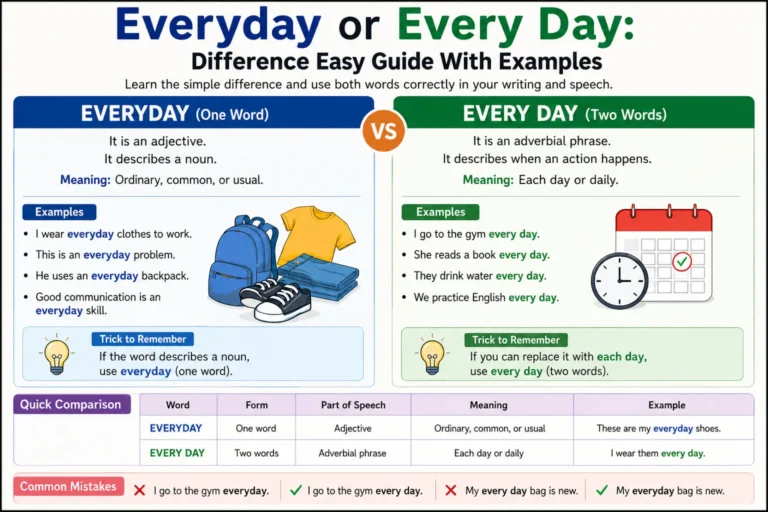
Everyday or every day is one of the most confusing grammar questions in English. These two terms look almost the same, but they have different meanings and uses. Using the wrong one can make your writing less clear. The good news is that the difference is easy to learn. Once you know one simple grammar rule, you can choose the correct form every time.
This guide explains everything in plain English. You will learn the meaning of everyday and every day, see real-life examples, discover common mistakes, and learn an easy trick to remember the difference. Whether you are a student, writer, or English learner, this article will help you use both forms correctly and confidently.
Quick Summary Box
- Everyday is one word.
- Everyday is an adjective.
- It means ordinary, common, or normal.
- Every day is two words.
- Every day means each day or daily.
- If you can replace it with each day, use every day.
- If the word describes a noun, use everyday.
What Does Everyday Mean?
Everyday is written as one word.
It is an adjective, which means it describes a noun. tells us that something is ordinary, common, or used regularly in daily life. It does not describe an action.
Think of everyday as a word that describes things people normally use or experience.
Simple Definition
Everyday means:
- Ordinary
- Common
- Regular
- Typical
- Normal
Everyday Examples
Here are some simple examples:
- She wears everyday clothes to work.
- This is an everyday problem for many families.
- I need an everyday backpack for school.
- Good manners are an everyday habit.
- These shoes are perfect for everyday use.
- He carries an everyday notebook in his bag.
Notice that everyday always comes before a noun. It describes the noun just like words such as blue, small, or comfortable.
More Examples in Daily Life
Imagine these situations:
- You buy shoes for work. They are not for special events. They are your everyday shoes.
- You use the same coffee mug every morning. It becomes your everyday mug.
- You wear simple clothes while relaxing at home. Those are your everyday clothes.
In each example, everyday tells us the item is ordinary and used often.
What Does Every Day Mean?
Every day is written as two separate words.
It is not an adjective. Instead, it is an adverbial phrase that tells us how often something happens.
It simply means:
- Each day
- Daily
You can usually replace every day with each day without changing the meaning.
Every Day Examples
- I exercise every day.
- She drinks water every day.
- They study English every day.
- We walk our dog every day.
- He calls his parents every day.
- My sister practices piano every day.
Now replace every day with each day.
- I exercise each day.
- She drinks water each day.
Both sentences still make sense. That tells you every day is the correct choice.
Everyday vs Every Day in Context
Compare these sentences:
✅ My everyday backpack is heavy.
Here, everyday describes the backpack.
✅ I carry my backpack every day.
Here, every day tells us when the action happens.
Although the words look similar, they perform completely different jobs in a sentence.
Everyday vs Every Day: Comparison Table
| Feature | Everyday | Every Day |
|---|---|---|
| Number of words | One | Two |
| Part of speech | Adjective | Adverbial phrase |
| Meaning | Ordinary or common | Each day |
| Describes | A noun | An action |
| Replace with “each day”? | No | Yes |
| Example | Everyday clothes | I study every day. |
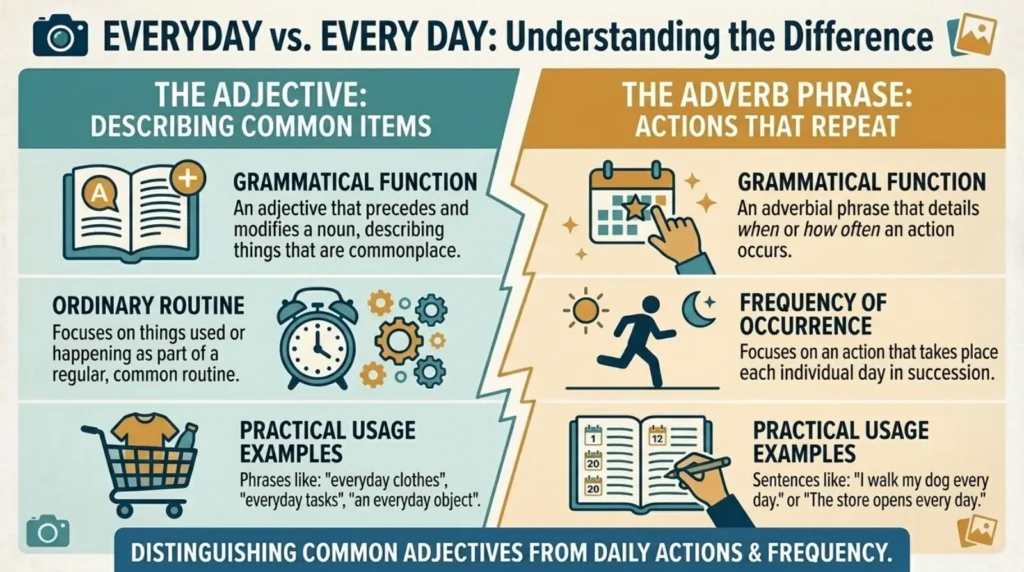
The Easiest Trick to Remember the Difference
Many students struggle with these words. Luckily, one simple test works almost every time.
Ask yourself this question:
Can I replace the words with “each day”?
If the answer is yes, write every day as two words.
Example
- I read every day.
Now test it.
- I read each day.
The sentence still sounds correct.
So every day is the right choice.
Now try another sentence.
- These are my everyday shoes.
Replace it.
- These are my each day shoes.
That sounds wrong.
So everyday is correct because it describes the noun shoes.
This simple test helps writers avoid one of the most common grammar mistakes in English.
Real-Life Examples
Learning grammar becomes easier when you see it in real situations.
At School
Correct:
- I complete my homework every day.
- My everyday backpack carries all my books.
- Reading is part of my routine every day.
At Home
Correct:
- We cook dinner every day.
- Washing dishes is an everyday chore.
- My mother prepares breakfast every day.
At Work
Correct:
- She checks emails every day.
- Team meetings are an everyday part of the job.
- He uses an everyday planner to organize tasks.
While Shopping
Correct:
- These are comfortable everyday sneakers.
- I wear these sneakers every day.
Notice how the first sentence describes the sneakers, while the second explains how often they are worn.
Common Mistakes People Make
Many English learners confuse everyday and every day because the words look almost identical. However, they have different meanings. Understanding the most common mistakes will help you avoid them in your own writing.
Mistake 1: Using “Everyday” Instead of “Every Day”
❌ I go to the gym everyday.
✅ I go to the gym every day.
Why?
The sentence tells us how often you go to the gym. It means each day, so you need two words.
Mistake 2: Using “Every Day” Before a Noun
❌ My every day shoes are comfortable.
✅ My everyday shoes are comfortable.
Why?
The word describes the noun shoes, so it must be the adjective everyday.
Mistake 3: Forgetting the “Each Day” Test
Many writers guess instead of checking.
Example:
❌ She drinks coffee everyday.
Try replacing it:
- She drinks coffee each day.
The sentence still works.
✅ She drinks coffee every day.
Mistake 4: Mixing Both Forms in One Sentence
Sometimes both forms appear in the same sentence.
Example:
✅ I wear my everyday jacket every day.
The first word describes the jacket.
The second phrase tells how often you wear it.
Grammar Rule Explained Simply
The easiest way to remember these words is to understand their grammar.
Everyday Is an Adjective
An adjective describes a noun.
Examples:
- everyday clothes
- everyday routine
- everyday activities
- everyday problems
- everyday language
In each example, everyday gives more information about the noun.
Think of it like these adjectives:
- blue car
- heavy bag
- clean room
- everyday backpack
Every Day Is an Adverbial Phrase
An adverbial phrase tells when something happens.
Examples:
- I study every day.
- We cook every day.
- She practices every day.
- They exercise every day.
It answers the question:
When?
Answer:
Every day.
How to Use Everyday in Daily Life
The adjective everyday appears in many common expressions.
Here are some examples.
Everyday Life
Example:
- Stress is part of everyday life.
Everyday Clothes
Example:
- I prefer comfortable everyday clothes.
Everyday Language
Example:
- Teachers use everyday language for beginners.
Everyday Routine
Example:
- Exercise is part of my everyday routine.
Everyday Items
Example:
- A phone is an everyday item for most people.
These examples show that everyday describes something normal or commonly used.

How to Use Every Day in Daily Conversations
The phrase every day appears when talking about habits and routines.
Examples include:
- I drink eight glasses of water every day.
- My brother walks to school every day.
- She reads before bed every day.
- We practice speaking English every day.
- They clean the office every day.
- He checks his email every day.
These sentences explain how often an action happens.
Synonyms and Related Keywords
Using related words naturally helps readers and supports SEO.
Synonyms for Everyday
- ordinary
- common
- regular
- routine
- normal
- typical
- familiar
- standard
Example
Instead of saying:
“This is an everyday problem.”
You could say:
“This is a common problem.”
Synonyms for Every Day
- daily
- each day
- day after day
- regularly
- every single day
Example:
- She studies daily.
- She studies every day.
Both sentences have almost the same meaning.
(LSI Keywords)
Search engines also understand related phrases.
Include these naturally in your writing:
- everyday meaning
- every day meaning
- everyday vs every day
- grammar difference
- English grammar tips
- adjective vs adverb phrase
- common grammar mistakes
- writing correctly
- daily English usage
- when to use everyday
- when to use every day
- English writing guide
- grammar rules
- improve English writing
These terms help cover the topic more completely without repeating the main keyword too often.
Tips to Never Get Confused Again
Remember these simple tips whenever you write.
1. Use the “Each Day” Test
Replace the words with each day.
If the sentence still works, write every day.
2. Look for the Noun
If the word describes a noun, choose everyday.
Example:
- everyday bag
- everyday routine
- everyday clothing
3. Read the Sentence Out Loud
Reading aloud often makes grammar mistakes easier to notice.
4. Check Before Publishing
Many grammar mistakes happen because writers type too quickly.
Take a few seconds to review your work.
5. Practice With Simple Sentences
The more examples you read, the easier the rule becomes.
Practice writing your own sentences every day.
Soon, choosing the correct form will become a habit.
Expert Insights
Professional writers know that small grammar mistakes can reduce clarity and credibility.
Using everyday and every day correctly helps readers understand your message without confusion. It also creates a polished and professional writing style.
Editors often recommend the “each day” test because it is quick, reliable, and easy to remember. Whether you write blog posts, emails, school assignments, or business documents, applying this simple rule will improve your grammar and make your writing more effective.
Good grammar also supports user trust. Readers stay longer on pages that are easy to read and free from obvious language mistakes. That can improve engagement and contribute to better SEO performance over time.
(FAQs)
Is it “everyday” or “every day”?
Both are correct, but they have different meanings.
Everyday means ordinary or common.
Every day means each day or daily.
Is “I work everyday” grammatically correct?
No.
The correct sentence is:
I work every day.
The phrase tells us how often you work.
What is the difference between everyday and every day?
Everyday is an adjective that describes a noun.
Every day is an adverbial phrase that tells when something happens.
Example:
- These are my everyday shoes.
- I wear them every day.
Can I replace “every day” with “each day”?
Yes.
If each day fits naturally in the sentence, then every day is the correct choice.
Example:
- She studies every day.
- She studies each day.
Both sentences have the same meaning.
Is “everyday” one word?
Yes.
When it means ordinary, common, or typical, everyday is always one word.
Example:
- We face everyday challenges.
Is “everyday” an adjective?
Yes.
It describes a noun.
Examples:
- everyday clothes
- everyday life
- everyday routine
- everyday activities
Is “every day” the same as “daily”?
In most situations, yes.
Both mean that something happens each day.
Example:
- I exercise daily.
- I exercise every day.
Why do people confuse everyday and every day?
The words look almost identical. The only difference is a space, but their grammar and meanings are different. That is why this is one of the most common English grammar mistakes.
Featured Snippet: Everyday vs Every Day
Quick Answer
- Everyday (one word) is an adjective that means ordinary, common, or typical.
- Every day (two words) is a phrase that means each day or daily.
Quick Comparison
| Word | Meaning | Example |
|---|---|---|
| Everyday | Ordinary or common | She wears everyday clothes. |
| Every day | Each day or daily | She walks every day. |
Easy Rule: If you can replace it with each day, use every day. Otherwise, use everyday.
Why This Grammar Rule Matters
Using everyday and every day correctly makes your writing clearer and more professional. Small grammar mistakes can confuse readers and reduce your credibility.
Whether you write emails, blog posts, school assignments, or business documents, using the correct form helps your message sound polished and accurate.
If you create online content, clear grammar also improves the reading experience. Readers are more likely to trust and share content that is easy to understand.
Conclusion
Understanding the difference between everyday and every day is easier than it first appears. Although the two expressions look almost identical, they serve different purposes in English. Everyday describes something ordinary, common, or typical, while every day tells us that an action happens each day.
A simple way to remember the rule is to use the “each day” test. If replacing the words with each day keeps the sentence correct, then every day is the right choice. If the words describe a noun, use everyday instead.
With regular practice, this grammar rule will become second nature. Using the correct form will improve your writing, strengthen your communication, and help you avoid one of the most common mistakes in English.