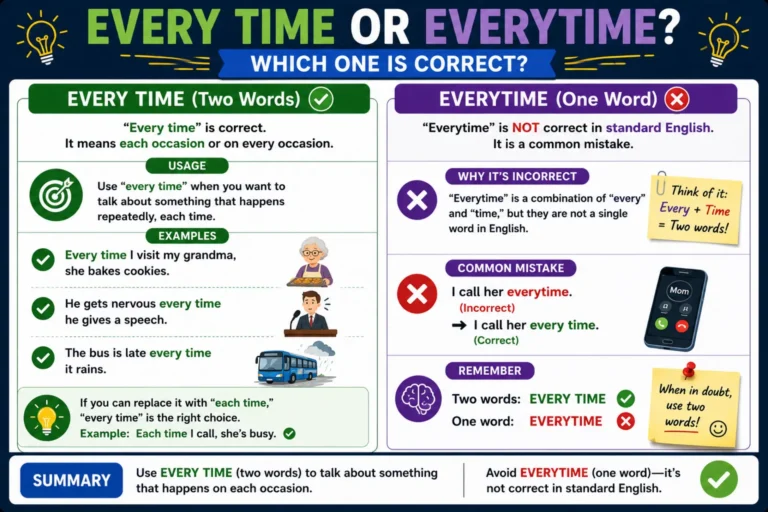
Every time or everytime is a common grammar question. Many English learners and native speakers wonder which spelling is correct. The good news is that the answer is simple. In standard English, every time is the correct form. The single word everytime is not accepted in formal writing or most dictionaries.
Knowing the correct form helps you write better emails, school assignments, and professional documents. It also improves your grammar and makes your writing look more polished. In this guide, you will learn the meaning of every time, why everytime is incorrect, and how to use the phrase with confidence. You’ll also see easy examples, common mistakes, and helpful tips to remember the rule.
Quick Summary
Every Time or Everytime?
- Every time is the correct spelling.
- Everytime is considered incorrect in standard English.
- Use every time to mean “on each occasion.”
- Write it as two separate words.
- Most dictionaries do not recognize everytime as a standard word.
- Always use every time in formal writing.
What Does “Every Time” Mean?
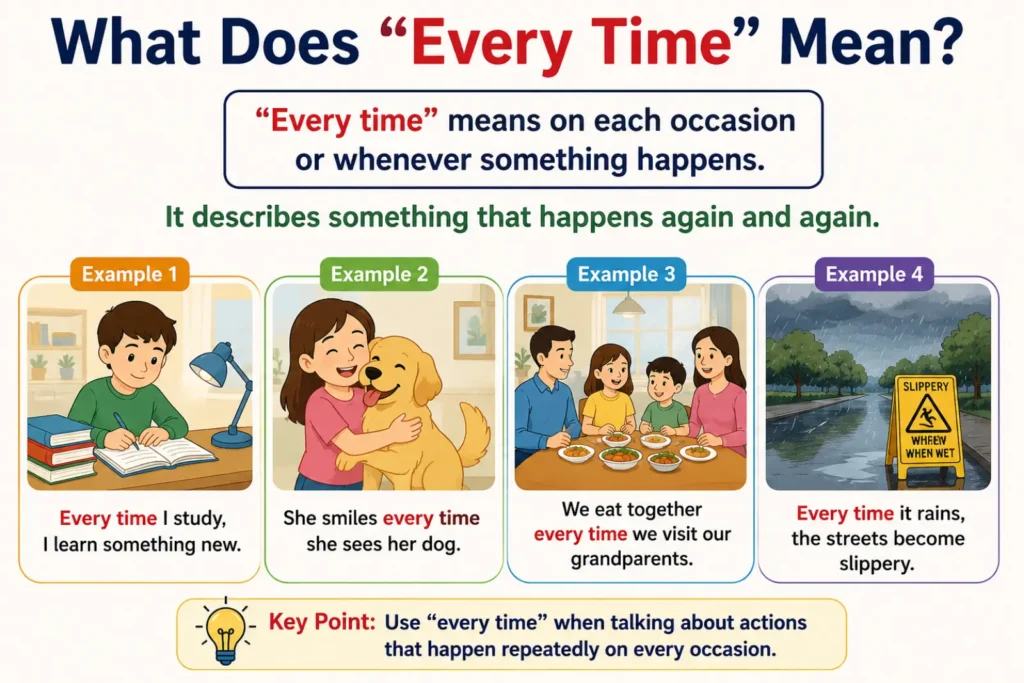
Every time means on each occasion or whenever something happens.
It describes something that repeats regularly.
Examples
- Every time I study, I learn something new.
- She smiles every time she sees her dog.
- We eat together every time we visit our grandparents.
- Every time it rains, the streets become slippery.
In each sentence, the action happens again and again.
Is “Everytime” a Real Word?
No.
Everytime is not accepted as a standard English word.
Most major dictionaries list only every time as the correct form.
Many people write everytime by mistake because other words like everyone, everything, and everywhere are written as one word.
However, every time follows a different grammar rule.
Always separate the two words.
Why Is “Every Time” Correct?
The phrase combines:
- Every (an adjective)
- Time (a noun)
Together, they mean each occasion.
Because “time” remains a noun, the phrase stays as two separate words.
Simple Formula
Every + Time = Every Time ✅
Not:
Everytime ❌
Every Time vs Everytime Comparison
| Feature | Every Time | Everytime |
|---|---|---|
| Correct spelling | ✅ Yes | ❌ No |
| Standard English | ✅ Yes | ❌ No |
| Used in formal writing | ✅ Yes | ❌ No |
| Found in dictionaries | ✅ Yes | ❌ Rare or not accepted |
| Meaning | On each occasion | Misspelling of “every time” |
Winner
Every time is the only correct choice in modern English.
Real-Life Examples
Understanding grammar becomes easier with everyday examples.
School
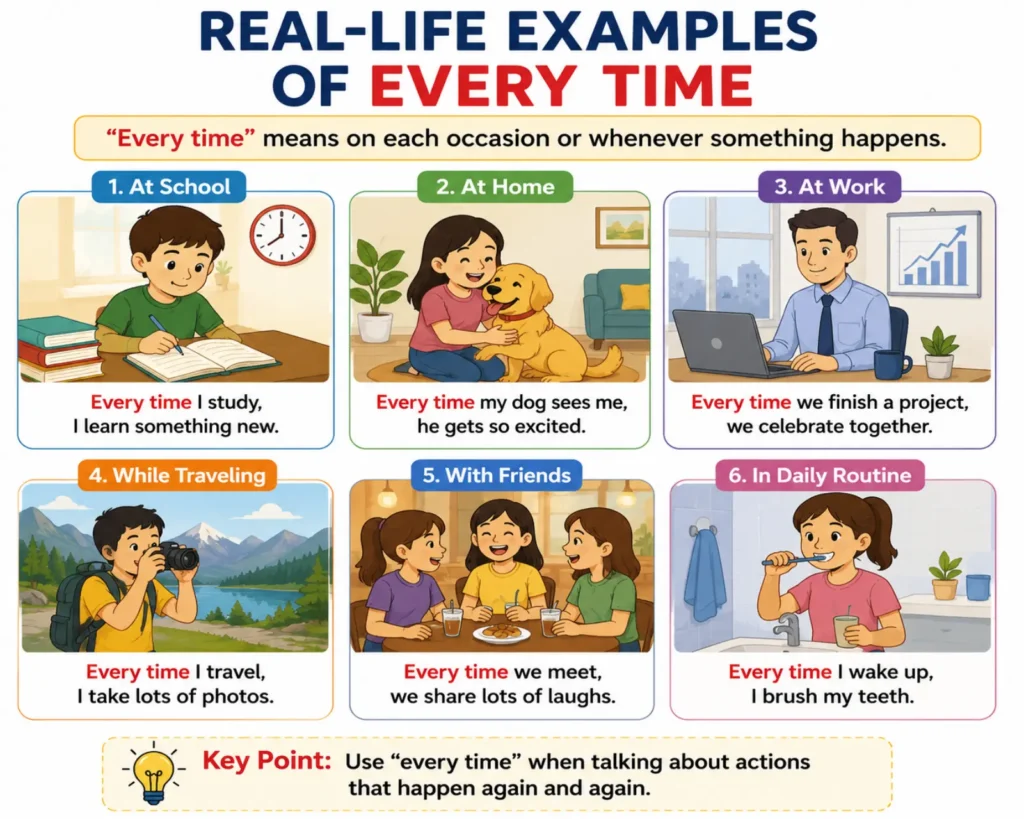
- Every time I answer correctly, I gain confidence.
- The teacher smiles every time students participate.
Work
- Every time we finish a project, we celebrate.
- I save my files every time I finish editing.
At Home
- Every time my phone rings, my dog barks.
- We clean the kitchen every time we cook.
While Traveling
- Every time I visit the beach, I collect shells.
- We take photos every time we travel.
These examples show that the phrase refers to repeated events.
When Should You Use “Every Time”?
Use every time whenever you mean each time something happens.
It fits many kinds of writing.
Everyday Conversation
“I laugh every time I watch that movie.”
Academic Writing
“Every time the experiment was repeated, the results stayed consistent.”
Business Writing
“Every time a customer places an order, the system sends a confirmation email.”
Creative Writing
“Every time the old clock chimed, the house grew quieter.”
Because the phrase works in many situations, it is useful for both spoken and written English.
Grammar Rule Behind “Every Time”
The rule is simple.
Every modifies the noun time.
Together, they create a noun phrase.
Unlike compound words such as everyone or everything, the word time does not combine with every into one standard word.
Remember this simple pattern:
- Every day ✅
- Every week ✅
- Every month ✅
- Every year ✅
- Every time ✅
Notice that all these expressions remain two separate words.
This pattern makes the rule easy to remember.
Common Mistakes When Using “Every Time”
Many people make small grammar mistakes with every time. These errors are easy to avoid once you know the rule.
Mistake 1: Writing “Everytime”
❌ Everytime I call, she is busy.
✅ Every time I call, she is busy.
Always write every time as two separate words.
Mistake 2: Confusing It with “Everyday”
Many writers confuse every time with everyday.
- Every time means on each occasion.
- Everyday means common or used daily.
Examples
- Every time I exercise, I feel stronger.
- These are my everyday shoes.
Mistake 3: Using It Without a Repeated Action
The phrase every time describes something that happens repeatedly.
Correct:
- Every time I visit my grandparents, we bake cookies.
Less natural:
- Every time I graduated from college.
Graduation usually happens once, so the phrase does not fit.
Tips to Remember the Correct Form
You can remember the rule with a few simple tricks.
Think of “Each Time”
If you can replace the phrase with each time, use every time.
Example:
- Every time I read this book, I learn something new.
- Each time I read this book, I learn something new.
Both sentences have the same meaning.
Remember Similar Expressions
These phrases also use two words:
- Every day
- Every week
- Every month
- Every year
- Every morning
- Every evening
- Every time
This pattern makes the grammar easier to remember.
Use Grammar Checkers
Most writing tools highlight everytime as a spelling mistake.
Still, understanding the rule helps you write confidently without relying on software.
Using “Every Time” in Daily Life
You will use every time in many conversations and writing tasks.
Speaking
- Every time we meet, we have fun.
- Every time you smile, you brighten my day.
School
- Every time I review my notes, I remember more.
- Every time the teacher asks a question, I participate.
Workplace
- Every time we complete a project, we review our results.
- Every time a customer contacts us, we respond quickly.
Social Media
- Every time this video appears, I watch it again.
- Every time I see this meme, I laugh.
The phrase sounds natural because it describes repeated actions.

Synonyms and Related Terms
Using related words improves your vocabulary and helps search engines understand the topic.
Synonyms
- Each time
- Whenever
- On every occasion
- Repeatedly
- Again and again
- On each occurrence
Related Keywords (LSI)
- every time meaning
- every time grammar
- everytime or every time
- correct spelling of every time
- English grammar rules
- common grammar mistakes
- every time examples
- grammar tips
- word usage
- English writing guide
Use these naturally when writing about the topic.
Expert Insight
Professional editors, teachers, and style guides agree on one rule.
Every time is the correct expression in standard English.
Although you may see everytime online or in informal posts, it is still considered a spelling mistake in academic, business, and professional writing.
Learning small grammar rules like this improves your writing quality. It also makes your work more credible and easier to understand.
Strong grammar helps readers trust your content, whether you write emails, blog posts, reports, or essays.
Frequently Asked Questions
Is it every time or everytime?
Every time is correct. Everytime is a misspelling in standard English.
Is “everytime” one word?
No. Standard English uses every time as two separate words.
Why is “everytime” incorrect?
Because major dictionaries and grammar guides recognize only every time.
Can I use “everytime” in informal writing?
It is better to avoid it. Readers may see it as a spelling error.
What does “every time” mean?
It means on each occasion or whenever something happens.
Is “every time” an adverb?
No. It is a noun phrase made from the adjective every and the noun time.
What is another way to say “every time”?
You can use:
- Each time
- Whenever
- On every occasion
How do I remember the correct spelling?
Think of similar expressions such as every day, every week, and every year. They all use two words.
Conclusion
If you have ever wondered about every time or everytime, the answer is clear. Every time is the correct spelling in standard English. It always appears as two separate words and means on each occasion or whenever something happens. The single-word form everytime is considered incorrect in formal writing and should be avoided.
Remember the simple rule: if you can replace the phrase with each time, then every time is the right choice. Using the correct form improves your grammar, strengthens your writing, and helps you communicate clearly. Whether you are writing an email, an essay, or a blog post, choosing every time will always keep your English accurate and professional.