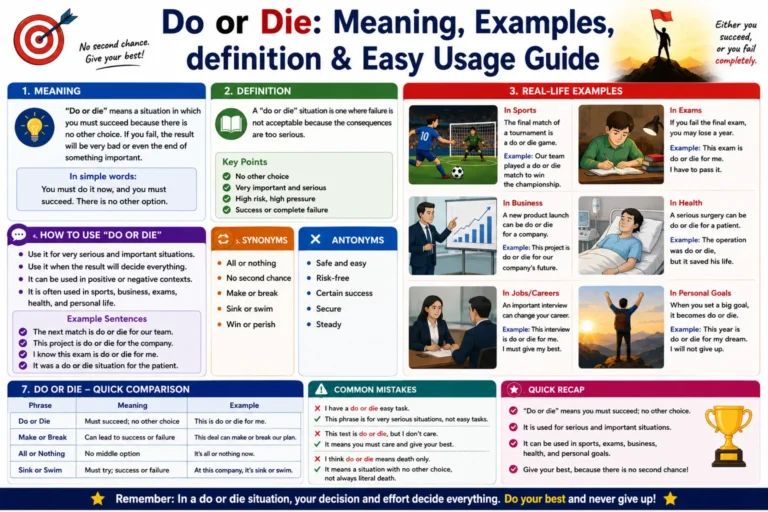
Do or die means you must act now or face failure. This phrase shows a situation with no easy second chance. People use it when success depends on one final effort. You may hear it in sports, work, school, and daily life. For example, a team may face a do-or-die match. A student may make a do-or-die effort before an exam. The phrase sounds strong and urgent. It can also show courage, pressure, and determination. In this guide, you will learn the meaning of do or die. You will also see simple examples, common mistakes, synonyms, and usage tips. By the end, you will know how to use this popular English idiom correctly.
Quick Summary:
- Do or die means success or failure depends on immediate action.
- It describes a situation with very high pressure.
- It suggests that someone must make a final, serious effort.
- The phrase often means “succeed or fail.”
- It can describe sports, exams, business, work, and personal goals.
- Common synonyms include now or never, make or break, and sink or swim.
- Example: This is a do-or-die moment for the team.
What Does “Do or Die” Mean?
The phrase do or die describes a very serious situation. Someone must succeed, act, or make a strong effort.
The phrase suggests two possible results:
- Do means succeed through action.
- Die means fail completely.
However, people usually use “die” figuratively. It does not normally mean literal death.
Simple definition
Do or die means a final chance to succeed or face failure.
For example:
“This is a do-or-die match.”
This means the team must win or lose its important opportunity.
The phrase often creates a sense of urgency. It tells people that the situation needs immediate action.
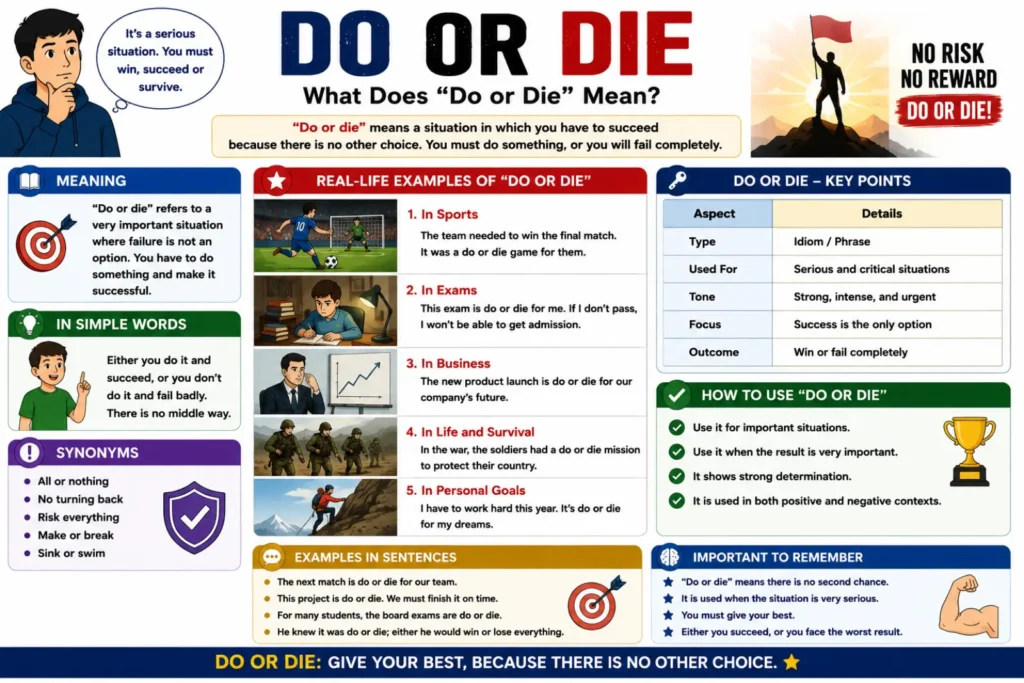
Do or Die: Explanation in Simple Words
Imagine a student who has one final exam. Passing the exam allows the student to graduate. Failing means the student must wait another year.
That exam becomes a do-or-die situation.
The phrase highlights:
- High pressure
- Strong determination
- A final opportunity
- Serious consequences
- A need for immediate action
People often use the phrase when they feel they cannot afford to fail.
Simple example
We must finish this project today. It is do or die.
This means the project must succeed today.
What Is the Origin of “Do or Die”?
The phrase do or die comes from the idea of taking action despite great danger or pressure.
It has appeared in English for centuries. Over time, people began using it as an idiom.
Today, the phrase usually has a figurative meaning. It often describes a crucial moment rather than a literal life-or-death situation.
For example:
- A sports final may become a do-or-die game.
- A business deal may become a do-or-die opportunity.
- A final exam may feel like a do-or-die challenge.
The phrase remains popular because it expresses urgency in only three words.
How to Use “Do or Die” in a Sentence
You can use do or die in several sentence patterns.
1. “It is do or die.”
This structure shows a critical situation.
Example:
It is do or die for the company this year.
2. “A do-or-die moment”
This phrase describes a crucial moment.
Example:
The final question created a do-or-die moment.
3. “A do-or-die situation”
This structure describes a high-pressure situation.
Example:
The team faced a do-or-die situation.
4. “A do-or-die effort”
This phrase describes an extremely strong effort.
Example:
She made a do-or-die effort to finish the race.
Grammar tip
When do-or-die comes before a noun, writers often use hyphens.
Correct:
It was a do-or-die match.
When the phrase stands alone, you may write:
We must win. It is do or die.
Do or Die Examples in Real Life
The phrase appears in many everyday situations.
Sports example
The team must win tonight. It is a do-or-die match.
The team faces a crucial game.
School example
This final exam feels like a do-or-die moment.
The exam carries major importance.
Business example
The company needs new customers. This launch is do or die.
The launch may determine the company’s future.
Career example
She treated the interview as a do-or-die opportunity.
She believed the interview could change her career.
Personal goal example
He made a do-or-die effort to complete the marathon.
He used every possible effort to reach his goal.
Daily life example
We had one hour to catch the train. It was do or die.
The situation required immediate action.

Do or Die vs. Make or Break
Do or die and make or break have similar meanings.
Both phrases describe a critical situation.
| Phrase | Meaning | Example |
|---|---|---|
| Do or die | Succeed or face failure | This is a do-or-die match. |
| Make or break | Determine success or failure | This deal could make or break the company. |
| Now or never | Act immediately | It is now or never. |
| Sink or swim | Succeed independently or fail | You must sink or swim. |
Main difference
Do or die sounds more dramatic and urgent.
Make or break focuses on the result.
Now or never focuses on timing.
Sink or swim focuses on survival through personal effort.
Do or Die vs. Now or Never
These expressions often appear in similar situations.
Do or die
This means you must succeed or face serious failure.
This is a do-or-die situation.
Now or never
This means you must act immediately.
If you want to apply, it is now or never.
Key difference
Do or die focuses on the result.
Now or never focuses on the time available.
Both expressions create urgency.
Do or Die vs. Sink or Swim
Sink or swim means you must succeed through your own ability.
For example:
The new job gave him no training. He had to sink or swim.
This means he had to succeed independently.
Do or die sounds more intense.
The final match was do or die.
This means the match carried serious consequences.
Both phrases can describe pressure. However, they do not always mean exactly the same thing.
Common Mistakes When Using “Do or Die”
Many learners understand the phrase but use it incorrectly.
Mistake 1: Taking “die” literally
The phrase usually does not mean actual death.
Incorrect understanding:
I will literally die if I fail the test.
Better understanding:
This exam is a do-or-die situation.
The second sentence shows serious pressure.
Mistake 2: Using “do or die” for small problems
The phrase sounds strong.
Avoid using it for ordinary situations.
Weak use:
Choosing between tea and coffee is do or die.
That situation does not have serious consequences.
Mistake 3: Forgetting hyphens before nouns
Use do-or-die when the phrase describes a noun.
Correct:
It was a do-or-die decision.
Also correct:
It was do or die.
Mistake 4: Overusing the phrase
Using the phrase too often reduces its impact.
Use it when the situation truly feels urgent.
Mistake 5: Confusing it with “do and die”
The correct expression is:
Do or die
The word or shows two possible outcomes.
Tips for Using “Do or Die Correctly”
Follow these simple tips.
Use it for high-pressure situations
The phrase works best when failure has serious consequences.
Use it to show urgency
The phrase can show that someone must act immediately.
Use hyphens before nouns
Write do-or-die effort and do-or-die moment.
Consider your audience
The phrase works well in casual and dramatic writing.
However, formal reports may prefer clearer language.
For example:
The project has reached a critical stage.
This may sound more professional than:
The project is do or die.
Avoid literal confusion
Remember that the phrase usually has a figurative meaning.
How “Do or Die” Appears in Daily Life
People use this phrase in many common situations.
At work
A major project may affect a company’s future.
The next quarter could be do or die for the business.
In education
A final test may determine graduation.
The final exam became a do-or-die challenge.
In sports
A team may need one final win.
Tonight’s game is do or die.
In competitions
A contestant may face a final round.
The next round is a do-or-die opportunity.
In personal goals
Someone may make a final effort.
She made a do-or-die attempt to reach her goal.
The phrase works because it quickly communicates pressure and determination.
Synonyms and Related Expressions for “Do or Die”
Here are useful alternatives.
Now or never
Use this when immediate action matters.
It is now or never.
Make or break
Use this when something may determine success.
This decision could make or break the project.
Sink or swim
Use this when someone must succeed independently.
He had to sink or swim in his new role.
All or nothing
Use this when only total success matters.
The competition became all or nothing.
Last chance
Use this when no further opportunity exists.
This is our last chance to qualify.
Critical moment
Use this in more formal writing.
The team faced a critical moment.
Final opportunity
Use this when one final chance remains.
This was her final opportunity to succeed.
These expressions work as semantic keywords around do or die.
Expert Insight: Why “Do or Die” Matters
Strong idioms make writing more vivid.
The phrase do or die creates an emotional reaction. It helps readers understand pressure quickly.
However, good writers use idioms with care.
SEO writing tip
Use the exact phrase naturally in important areas.
These areas may include:
- The title
- The introduction
- One or two H2 headings
- The summary box
- A relevant FAQ
- The conclusion
Avoid repeating the keyword in every paragraph.
Language tip
Use do or die when you want strong emotion.
Use critical situation when you want a formal tone.
This choice helps you match the phrase to your audience.
EEAT tip
Clear explanations build trust.
Real examples also help readers understand idioms faster.
A strong article should explain both meaning and practical use.
Frequently Asked Questions About “Do or Die”
What is the simple meaning of “do or die”?
Do or die means you must succeed or face serious failure. It describes a very important situation.
Is “do or die” an idiom?
Yes. Do or die is a common English idiom. People usually use it figuratively.
Does “do or die” mean literal death?
Usually, no. The phrase normally means extreme pressure or a final chance.
What is another word for “do or die”?
Common alternatives include now or never, make or break, all or nothing, and sink or swim.
How do you use “do or die” in a sentence?
You can say:
This is a do-or-die moment for the team.
You can also say:
We must succeed. It is do or die.
Should “do or die” have hyphens?
Use do-or-die before a noun.
Example:
It was a do-or-die decision.
Use do or die when the phrase stands alone.
Is “do or die” formal English?
It is standard English, but it sounds dramatic. Formal writing may use phrases like critical situation or final opportunity.
What is the difference between “do or die” and “now or never”?
Do or die focuses on success or failure. Now or never focuses on the limited time available.
Conclusion
Do or die describes a situation with extreme pressure. It means someone must succeed or face serious failure. People use this phrase in sports, education, business, work, and daily life. The expression usually has a figurative meaning. It does not normally refer to literal death. Use do-or-die before nouns, such as do-or-die match or do-or-die effort. You can also use do or die as a standalone phrase. Similar expressions include now or never, make or break, and all or nothing. The best takeaway is simple: use do or die when a situation demands a final, serious effort and success matters greatly.