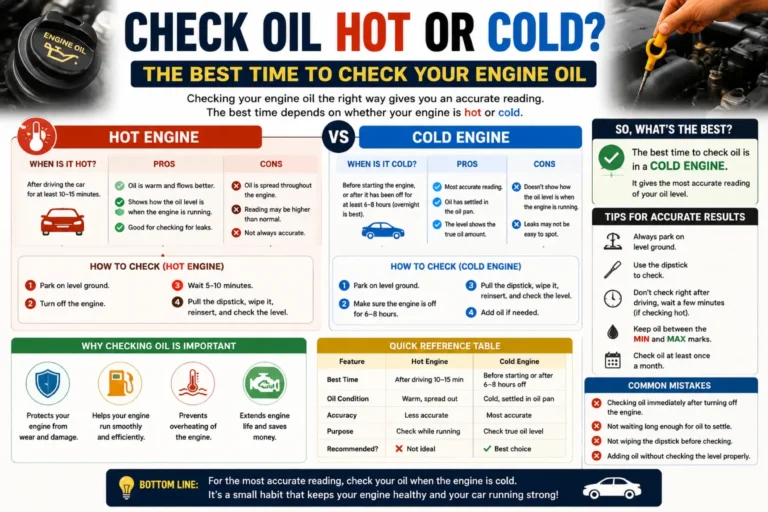
Check oil hot or cold? The best time depends on your vehicle and its owner’s manual. In most cars, check engine oil on a level surface with the engine off. Many manufacturers recommend waiting several minutes after shutting the engine down. This lets oil drain back into the oil pan. A cold engine can also give a reliable reading. However, some vehicles require a warm engine for an accurate check. Always follow the procedure in your owner’s manual. Checking oil at the wrong time can give a false reading. Too much or too little oil can harm your engine. This guide explains when to check engine oil, how to check it, and common mistakes. You will also learn how hot and cold checks differ. By the end, you will know the safest way to check your oil level.
Quick Summary: Should You Check Oil Hot or Cold?
- Check oil on a level surface.
- Turn the engine off before checking the oil.
- Wait several minutes after driving.
- A cold engine usually gives an easy reading.
- Some vehicles require a warm oil check.
- Always follow your vehicle’s owner’s manual.
- Keep the oil level between the dipstick marks.
- Never overfill the engine with oil.
- Check the oil regularly for safer engine operation.
What Does “Check Oil Hot or Cold” Mean?
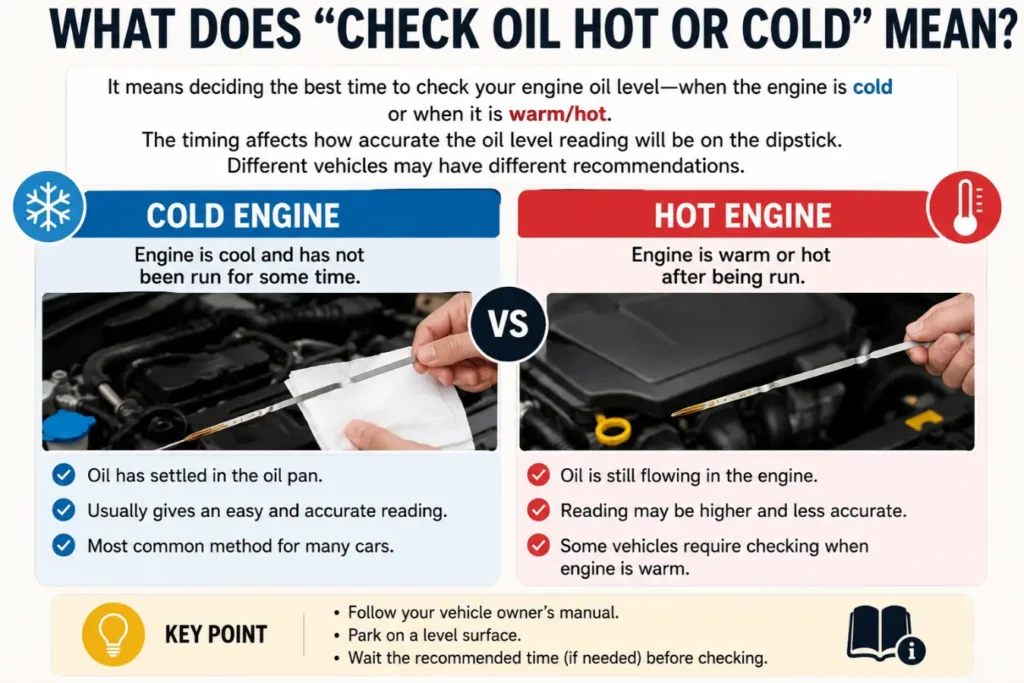
“Check oil hot or cold” asks when you should measure engine oil.
Engine oil moves around the engine while it runs. After you stop the engine, the oil slowly returns to the oil pan.
The dipstick measures the oil sitting in the pan.
That means timing can affect the reading.
A cold engine usually has most of its oil settled in the pan. A warm engine may have oil throughout the engine.
For many vehicles, checking after a short wait gives a good reading.
However, manufacturers use different procedures. Therefore, your owner’s manual should always come first.
Is It Better to Check Engine Oil Hot or Cold?
For most cars, checking oil after the engine has been off for several minutes works well.
This gives the oil time to drain into the oil pan.
Some manufacturers recommend checking oil when the engine is warm. Others recommend checking it when the engine is cold.
So, there is no single rule for every vehicle.
If your manual says to check the oil cold, follow that instruction.
If it says to warm the engine first, follow that procedure instead.
Simple rule
Check engine oil exactly as your vehicle manufacturer recommends.
If you do not have the manual, check the manufacturer’s official service information for your model.
Why Does Engine Oil Temperature Matter?
Engine oil changes slightly as its temperature changes.
Warm oil becomes thinner and flows more easily.
Cold oil becomes thicker and moves more slowly.
This difference can affect how quickly oil returns to the oil pan.
The engine’s design also affects the correct checking method.
Some vehicles have electronic oil-level systems instead of traditional dipsticks.
Others use special dipstick procedures.
For this reason, temperature alone does not determine the correct method.
The vehicle’s recommended procedure matters most.
How to Check Engine Oil When the Engine Is Cold
A cold oil check can be simple.
Follow these basic steps:
- Park the car on level ground.
- Turn off the engine.
- Open the hood.
- Find the engine oil dipstick.
- Pull the dipstick out.
- Wipe it clean with a lint-free cloth.
- Put the dipstick fully back in.
- Remove it again.
- Check the oil level.
- Compare it with the marked range.
- Add the correct oil if needed.
- Recheck the level.
The oil should normally sit between the dipstick’s minimum and maximum marks.
Do not add a large amount at once.
Add a small amount, then check again.
How to Check Engine Oil When the Engine Is Warm
Some vehicles require a warm engine check.
First, park the vehicle on a level surface.
Let the engine reach its normal operating temperature if the manual requires it.
Then turn the engine off.
Wait for the period specified by the manufacturer.
This waiting period lets oil return to the oil pan.
Next, check the oil using the recommended dipstick procedure.
Do not touch hot engine parts.
The engine bay can become extremely hot after driving.
If you are unsure about the procedure, let the vehicle cool before working near the engine.
Check Oil Hot vs Cold: Comparison Table
| Check Method | Main Benefit | Possible Issue | Best Approach |
|---|---|---|---|
| Cold engine | Oil has settled | Some vehicles require warm checks | Follow the manual |
| Warm engine | Matches some manufacturer procedures | Oil may still circulate | Wait as instructed |
| Immediately after driving | Convenient | Reading may be inaccurate | Avoid unless instructed |
| After several minutes | Oil can settle | Waiting time varies | Often a good method |
| Electronic oil check | No dipstick needed | System-specific procedure | Follow vehicle instructions |
The key point is simple.
Hot or cold depends on the vehicle manufacturer’s instructions.
What Is the Best Time to Check Engine Oil?
The best time depends on your vehicle.
For many cars, checking the oil before driving can make the process easier.
The engine remains cool, and the oil has had plenty of time to settle.
However, some vehicles need a warm engine and a specific waiting period.
Therefore, do not rely only on general advice.
Check your owner’s manual first.
If your vehicle uses an electronic oil-level system, follow the dashboard instructions.
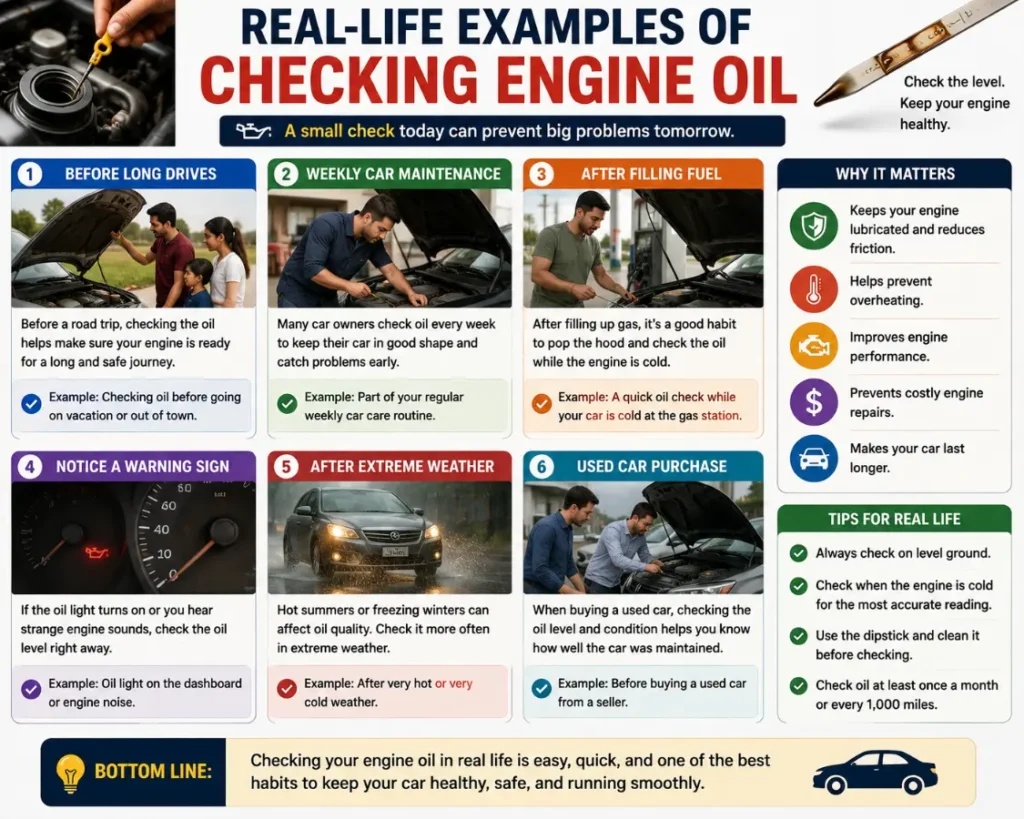
Real-Life Examples of Checking Engine Oil
Example 1: Morning oil check
You park your car overnight.
In the morning, the engine is cold.
You park on level ground and check the dipstick.
This often gives a clear reading.
However, your vehicle manual still determines the correct procedure.
Example 2: Checking after a long drive
You arrive home after driving for an hour.
The engine is hot.
You should not immediately pull the dipstick and touch hot engine parts.
Instead, follow the manufacturer’s recommended waiting time.
Then check the oil level.
Example 3: Low oil reading
You check the dipstick and the oil sits below the minimum mark.
Do not ignore the reading.
Use the correct engine oil specified for your vehicle.
Add oil gradually and check the level again.
Avoid filling above the maximum mark.
Common Mistakes When Checking Engine Oil
Many drivers make simple mistakes during an oil check.
1. Checking on a slope
A sloped surface can affect the oil level reading.
Always use level ground whenever possible.
2. Checking immediately after driving
Oil may still be moving around the engine.
Wait for the period recommended by the manufacturer.
3. Not cleaning the dipstick
Oil from the previous reading can confuse the result.
Wipe the dipstick before taking the final reading.
4. Adding too much oil
More oil does not mean better lubrication.
Overfilling can cause serious engine problems.
5. Using the wrong oil
Different engines require different oil grades and specifications.
Check your owner’s manual before buying oil.
6. Ignoring a low oil level
A low oil level can reduce engine protection.
Investigate repeated oil loss instead of simply adding oil forever.
7. Touching hot engine components
Engine parts can remain very hot after driving.
Use care and avoid unnecessary contact.
How Often Should You Check Engine Oil?
There is no universal checking schedule for every vehicle.
Many drivers check their oil regularly as part of basic car care.
You should check it more often if your vehicle uses oil between services.
Older engines may also need closer monitoring.
A good habit is to check the oil before long road trips.
You should also check it if the oil warning light appears.
Remember that an oil warning light can indicate a serious problem.
Do not treat the warning as a routine reminder to add oil.
What Should Engine Oil Look Like?
Fresh engine oil often looks clean and transparent.
Used oil becomes darker as it collects contaminants.
Dark oil does not automatically mean the engine has a problem.
The oil’s condition depends on the engine, oil type, driving conditions, and service interval.
Look for unusual signs such as:
- Very low oil level
- Milky or creamy oil
- Metal particles
- Strong fuel smell
- Sudden oil loss
- Thick sludge
- Repeated warning lights
If you notice unusual oil condition or major oil loss, seek professional inspection.
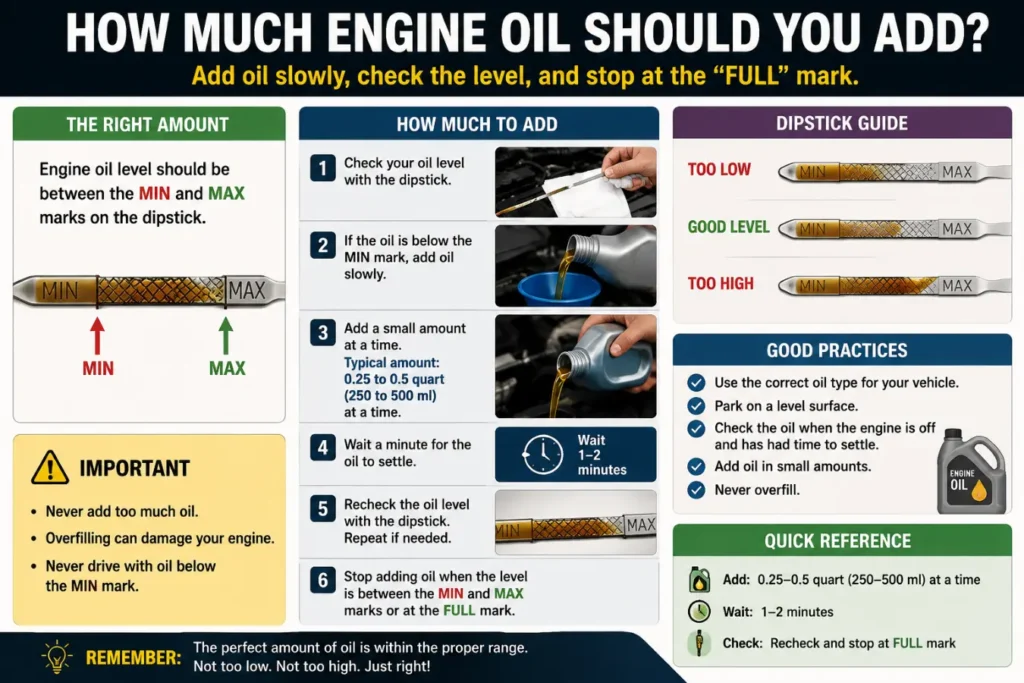
How Much Engine Oil Should You Add?
Never guess the amount.
Check the owner’s manual for the correct oil capacity and specification.
If the dipstick shows a low level, add oil slowly.
Then wait briefly and check again according to your vehicle’s procedure.
Do not automatically add a full bottle.
The difference between the minimum and maximum marks varies by vehicle.
Overfilling can be just as problematic as running with too little oil.
Tips for Getting an Accurate Oil Reading
Use these simple tips:
- Park on level ground.
- Follow the manufacturer’s checking procedure.
- Use the correct dipstick.
- Wipe the dipstick before measuring.
- Insert the dipstick completely.
- Read the level carefully.
- Check twice if the result looks unusual.
- Add oil slowly.
- Use the correct oil specification.
- Never exceed the maximum mark.
- Keep records of oil checks when needed.
These small habits can make your oil checks more reliable.
Checking Oil in Daily Life
Regular oil checks can become part of your normal car routine.
You can check the oil before a long trip.
You can also check it when you inspect your tires or windshield washer fluid.
A quick inspection can help you notice changes early.
For example, you may discover that the oil level keeps dropping.
That could point to an oil leak or engine oil consumption.
Early attention can help prevent a small problem from becoming expensive.
Check Oil Hot or Cold for Different Vehicles
Different vehicles can use different oil-checking procedures.
Cars
Most cars use either a dipstick or electronic oil measurement.
Follow the model-specific instructions.
Trucks
Trucks may have larger engines and different oil capacities.
Always use the correct procedure and oil specification.
Motorcycles
Motorcycles often use unique oil-level checking methods.
Some require the bike to remain upright.
Others require a specific engine temperature.
Use the motorcycle owner’s manual.
Modern vehicles
Some newer vehicles do not have a traditional dipstick.
The dashboard may display the oil level electronically.
Follow the vehicle’s instructions carefully.
Synonyms and Related SEO Keywords
Search engines understand related terms and topic meaning.
Useful semantic keywords for this topic include:
- check engine oil hot or cold
- should I check oil when engine is hot
- should you check oil when engine is cold
- best time to check engine oil
- how to check engine oil
- engine oil level check
- check oil level
- car oil check
- engine oil dipstick
- oil level dipstick
- how to read an oil dipstick
- checking oil after driving
- check oil before driving
- engine oil temperature
- low engine oil
- correct engine oil level
Use these phrases naturally.
Do not force them into every paragraph.
Expert Insights: Why Oil Checks Matter
Engine oil protects important moving parts inside your engine.
It reduces friction and helps control heat.
It also carries contaminants toward the oil filter.
A correct oil level helps the lubrication system work properly.
However, the oil level is only one part of engine maintenance.
Oil quality, oil specification, filter condition, and service intervals also matter.
Expert tip: Never choose an oil-checking method based only on general internet advice.
Vehicle manufacturers can specify different procedures.
Always check the owner’s manual for your exact model.
That approach provides the most reliable information.
Frequently Asked Questions
Should I check my oil when the engine is hot or cold?
It depends on your vehicle.
Many vehicles allow a cold check or a check after a short wait.
Some require a warm engine.
Follow your owner’s manual.
Can I check engine oil immediately after driving?
You can check it only if your vehicle’s procedure allows it.
Otherwise, wait for the recommended period.
This gives the oil time to return to the oil pan.
Is it better to check oil before or after driving?
A cold check before driving can be convenient.
However, some vehicles require a warm check.
The manufacturer’s instructions matter most.
Should my car be running when I check the oil?
Usually, no.
Most dipstick checks require the engine to be off.
Some electronic systems may use a different procedure.
Check your owner’s manual.
What happens if I overfill my engine oil?
Too much oil can cause problems.
It can lead to oil aeration and other engine issues.
Never fill beyond the recommended maximum level.
How do I know if my engine oil is low?
Use the dipstick or your vehicle’s electronic oil-level system.
The reading should normally remain within the marked range.
A warning light may also indicate an oil-related problem.
How long should I wait to check oil after driving?
The correct wait time varies by vehicle.
Many vehicles require several minutes.
Your owner’s manual provides the most accurate instruction.
Can I check oil on a hot engine?
Some vehicles require a warm engine check.
However, hot engine parts can cause burns.
Follow the recommended procedure and use care around the engine.
conclusion
So, should you check oil hot or cold?
There is no single answer for every vehicle.
Many cars allow an oil check when the engine is cold.
Others require the engine to reach operating temperature first.
Some vehicles also require a specific waiting period after shutdown.
The safest approach is simple.
Park on level ground and follow your owner’s manual.
Use the correct oil and keep the level between the marked limits.
Never assume that more oil provides better protection.
Regular checks can help you spot low oil levels and unusual oil loss early.
When you are unsure, use the manufacturer’s instructions or ask a qualified technician.