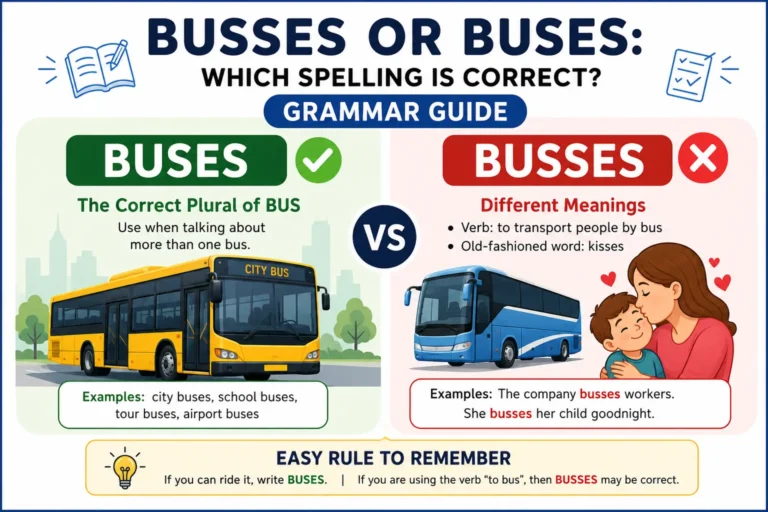
Busses or buses is a common question for English learners and native speakers alike. Many people feel unsure about which spelling is correct. The answer depends on the meaning of the word. Most of the time, buses is the correct plural form of bus. However, busses also exists in English, but it has a different use.
This guide explains the difference in simple words. You will learn when to use each spelling and how to avoid common mistakes. We will also look at examples, grammar rules, and expert tips. By the end, you will know exactly when to write buses and when busses is the better choice.
Quick Summary Box
- Buses is the correct plural of bus.
- Busses is a less common spelling.
- Busses usually means “kisses” or the verb “to bus.”
- Use buses when talking about vehicles.
- Most dictionaries and style guides prefer buses.
- Remember: One bus, two buses.
What Does “Busses or Buses” Mean?
The phrase busses or buses compares two spellings that look similar but have different meanings.
- Buses = More than one bus.
- Busses = A form of the verb bus or an old-fashioned word related to kissing.
In modern English, people almost always use buses when talking about transportation.
Example
✅ The school owns ten buses.
❌ The school owns ten busses.

Is It Buses or Busses?
The correct plural spelling is:
✅ Buses
English grammar says that nouns ending in -s usually add -es.
Examples:
- Bus → Buses
- Class → Classes
- Glass → Glasses
- Kiss → Kisses
Since bus ends in s, its plural becomes buses.
Why Do Some People Write “Busses”?
The spelling busses is not completely wrong.
It has two traditional uses:
- The verb to bus, meaning to transport people.
- An old word meaning kisses.
Examples:
- The company busses workers to the factory.
- She busses her child goodnight.
These meanings are much less common today.
Buses vs Busses Comparison Table
| Feature | Buses | Busses |
|---|---|---|
| Most common spelling | ✅ Yes | ❌ No |
| Plural of bus | ✅ Yes | Rare |
| Refers to vehicles | ✅ Yes | Usually no |
| Modern English | ✅ Standard | Limited use |
| Accepted by dictionaries | ✅ Yes | Yes, but different meaning |
Why “Buses” Is the Preferred Spelling
Most English dictionaries recommend buses.
Reasons include:
- It follows normal plural rules.
- It avoids confusion.
- It appears in schools, newspapers, and books.
- It is easier for readers to understand.
Professional writers almost always choose buses.
Real-Life Examples of Correct Usage
Here are common examples.
Public Transportation
The city added five new buses.
School
Yellow buses arrived before class.
Travel
Tourist buses stopped near the museum.
Sports
Team buses waited outside the stadium.
Airport
Airport buses carry passengers between terminals.

Common Mistakes People Make
Many writers confuse these spellings.
Mistake 1
❌ Three busses arrived.
✅ Three buses arrived
Mistake 2
Using busses because it looks similar to classes.
Remember:
Modern English still prefers buses.
Mistake 3
Mixing the noun and verb forms.
Correct:
- The company busses workers.
- The parking lot has many buses.
Easy Trick to Remember
Use this simple rule.
If you can ride it, write buses.
If you are using the verb to bus, then busses may be correct.
Think:
- Ride → buses
- Action → busses
How to Use “Buses” in Daily Life
You will often see buses in everyday writing.
Examples include:
- School buses
- City buses
- Electric buses
- Tour buses
- Shuttle buses
- Airport buses
- Double-decker buses
- Public buses
All these use buses, not busses.
Synonyms and Related Keywords
Using related words improves understanding and supports SEO.
Synonyms
- Coaches
- Transit vehicles
- Public transport
- School transport
- Passenger vehicles
Related Search Terms
- buses meaning
- buses grammar
- bus plural form
- bus plural spelling
- buses vs busses grammar
- correct spelling of buses
- English plural rules
- transportation vocabulary
- bus grammar rules
- plural nouns ending in s
Grammar Rule Behind the Word
English follows simple plural rules.
If a noun ends with:
- s
- x
- z
- ch
- sh
Add -es.
Examples:
| Singular | Plural |
|---|---|
| Bus | Buses |
| Box | Boxes |
| Dish | Dishes |
| Church | Churches |
| Glass | Glasses |
This rule makes buses the correct plural.
Why This Confuses So Many People
English has many words with double letters.
For example:
- Stopped
- Running
- Bigger
Because of these words, some people assume bus should become busses.
However, plural nouns follow different grammar rules than many verbs.
That is why buses remains correct.
Expert Insight:
Correct spelling builds trust.
Readers notice grammar mistakes quickly.
Search engines also value high-quality writing.
Using buses correctly helps:
- Improve readability
- Increase credibility
- Reduce confusion
- Support better SEO
- Build user trust
Professional writers always check grammar before publishing.
Frequently Asked Questions
Is “busses” ever correct?
Yes. It can be correct as a verb or in older writing related to kissing. It is rarely used as the plural of bus today.
What is the plural of bus?
The correct plural is buses.
Why isn’t it spelled “busses”?
Modern English grammar uses buses for the plural. This spelling avoids confusion with other meanings.
Which spelling do dictionaries recommend?
Most major dictionaries list buses as the preferred plural form.
Is “busses” wrong?
Not always. It has different meanings. However, it is not the preferred plural for vehicles.
Which spelling should students use?
Students should almost always write buses.
Does British English use “busses”?
Both American and British English mainly use buses for the plural of bus.
Conclusion
The answer to busses or buses is simple once you know the grammar rule. Buses is the standard and widely accepted plural form of bus. It appears in schools, books, newspapers, and everyday conversations. While busses is still a valid word, it usually serves as a verb or appears in older language. For almost every situation involving transportation, choose buses. This choice makes your writing clearer, more professional, and easier to understand. When in doubt, remember this simple rule: if you are talking about more than one bus, write buses. Using the correct spelling improves your grammar and helps readers trust your writing.