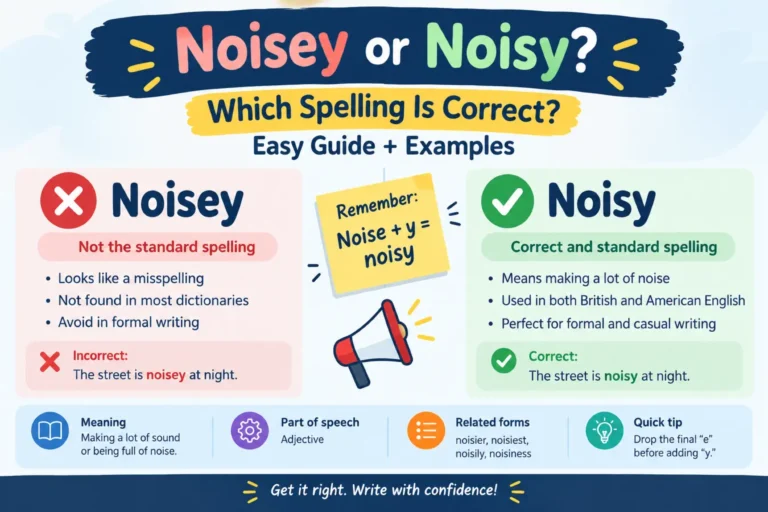
Have you ever wondered whether to write noisey or noisy? The correct spelling in standard modern English is noisy. People often write “noisey” because it seems to match the way the word sounds. However, the extra “e” is not part of the standard spelling.
The word noisy describes something that makes a lot of sound or creates an unpleasant noise. You can use it to describe busy streets, loud classrooms, barking dogs, or crowded restaurants. Learning the correct spelling helps you write better emails, school assignments, and blog posts.
In this guide, you will learn the meaning of noisy, the difference between noisy and noisey, and how to use the word correctly. You will also find simple examples, spelling tips, and answers to common questions. By the end, you will know which spelling to choose every time.
Quick Summary: Noisey or Noisy?
- Correct spelling: Noisy.
- Nonstandard spelling: Noisey.
- Meaning: Making a lot of noise or being full of sound.
- Part of speech: Adjective.
- Word origin: Noise + y = noisy.
- Comparative form: Noisier.
- Superlative form: Noisiest.
- Example: The classroom was noisy during lunch.
- Memory tip: Drop the final “e” in noise before adding “y.”
1. What Is the Correct Spelling: Noisey or Noisy?
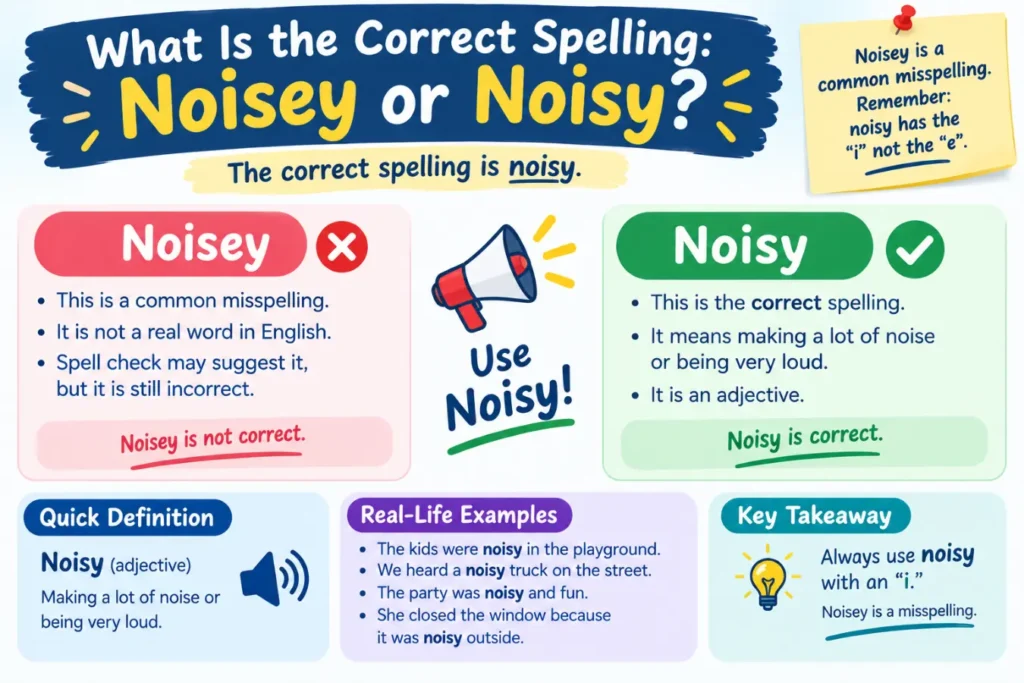
Noisy is the correct spelling in standard English. Noisey is generally a spelling mistake when used as the ordinary adjective.
Both spellings may appear online, but they do not have the same status in formal writing. Standard dictionaries list noisy as the adjective for something that makes a lot of sound.
Here is the correct usage:
- Correct: The street is noisy at night.
- Incorrect in standard writing: The street is noisey at night.
- Correct: Our neighbors have a noisy dog.
- Incorrect in standard writing: Our neighbors have a noisey dog.
The rule applies to both American and British English. You do not need to change the spelling based on your audience.
Remember: When you mean something loud or full of noise, write noisy.
2. What Does Noisy Mean?
The word noisy is an adjective that describes a person, place, object, or situation that makes a lot of sound.
The sound may be loud, unpleasant, distracting, or simply noticeable. The exact meaning depends on the situation.
For example, a noisy classroom may have students talking loudly. A noisy machine may produce a strong buzzing sound. A noisy street may have traffic, horns, and people talking.
According to the Cambridge Dictionary and Oxford Advanced Learner’s Dictionary, noisy describes something that makes a lot of noise or is full of noise.
Here are a few simple examples:
- The baby became noisy after lunch.
- The market is noisy in the morning.
- My old fan makes a noisy sound.
- We moved away from the noisy road.
- The children were noisy during the game.
In each sentence, noisy describes the sound or the environment.
3. Why Is Noisy Spelled Without an Extra E?
The word noisy comes from the noun noise. English often forms adjectives by adding the suffix “-y” to a noun.
When this happens, the final “e” in some base words disappears.
The spelling pattern is simple:
Noise → Noisy
You remove the final “e” and add “y.” You do not keep both letters.
Consider these similar examples:
| Base word | Correct adjective |
|---|---|
| Noise | Noisy |
| Ice | Icy |
| Spice | Spicy |
| Juice | Juicy |
| Haze | Hazy |
This pattern helps explain why “noisey” is not the standard spelling.
However, English spelling rules have exceptions. It is best to learn common word forms rather than assume every word follows the same pattern.
4. Noisey vs. Noisy: Key Differences
The main difference is spelling. In ordinary modern English, noisy is the standard form, while noisey is generally treated as a misspelling.
| Feature | Noisy | Noisey |
|---|---|---|
| Standard spelling | Yes | No |
| Part of speech | Adjective | Usually a misspelling of the adjective |
| Meaning | Making or containing much noise | Usually intended to mean noisy |
| Formal writing | Recommended | Avoid |
| School assignments | Correct choice | Incorrect choice |
| Professional emails | Correct choice | Avoid |
| British and American English | Used in both | Not a standard regional alternative |
There is one small qualification: “noisey” has appeared as an uncommon historical spelling and may also occur in names or deliberate creative spellings. That does not make it the correct choice for ordinary writing.
If you are writing an essay, article, report, or email, choose noisy.
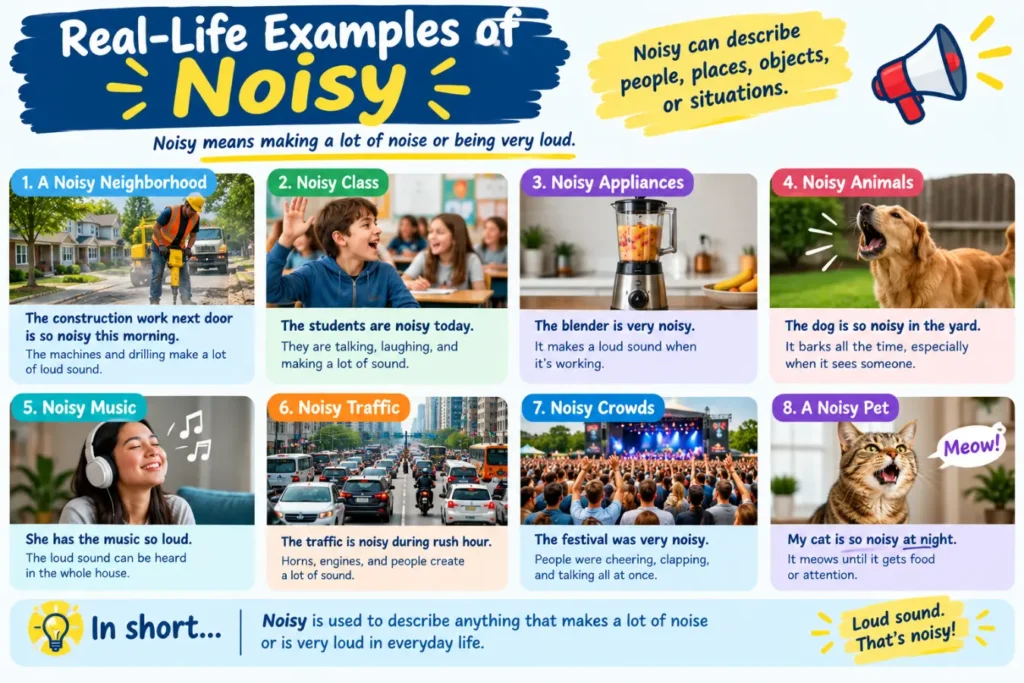
5. Real-Life Examples of Noisy
The easiest way to understand a word is to see how people use it in daily life.
home
- The washing machine is noisy during the spin cycle.
- Our dog becomes noisy when someone rings the bell.
- The children were noisy while playing indoors.
school
- The classroom became noisy after the teacher left.
- Please keep your voice low in the library.
- The students were noisy during the lunch break.
At work
- The office is too noisy for important phone calls.
- My old computer has a noisy cooling fan.
- Workers wore ear protection near the noisy machines.
Outside
- The street becomes noisy during rush hour.
- We visited a noisy market on Sunday.
- The crowd grew noisy after the match.
These examples show that noisy can describe people, places, animals, and machines.
6. How to Use Noisy Correctly in a Sentence
Noisy usually comes before a noun or after a linking verb such as “is,” “was,” or “became.”
Noisy before a noun
Use noisy to describe a noun directly.
Examples:
- We live near a noisy highway.
- She works in a noisy office.
- The noisy children ran across the playground.
- He bought a noisy vacuum cleaner.
Noisy after a linking verb
You can also place noisy after a verb.
Examples:
- The restaurant is noisy.
- The engine became noisy.
- The neighbors were noisy last night.
- This room feels noisy during busy hours.
Noisy with intensifiers
Words such as very, quite, extremely, and too can make the meaning stronger.
Examples:
- The bus is very noisy.
- The party was extremely noisy.
- This machine is too noisy for our small office.
- The café is quite noisy at lunchtime.
Choose the phrase that best matches your meaning. “Too noisy” often suggests that the sound causes a problem.
7. What Are the Correct Forms of Noisy?
The adjective noisy has several related forms. Learning them helps you avoid spelling mistakes in different sentences.
| Word form | Meaning | Example |
|---|---|---|
| Noise | A sound, especially an unwanted one | I heard a strange noise. |
| Noisy | Making or containing much noise | The room is noisy. |
| Noisier | Making more noise than something else | This fan is noisier than mine. |
| Noisiest | Making the most noise in a group | That was the noisiest classroom. |
| Noisily | In a noisy manner | The children played noisily. |
| Noisiness | The quality or state of being noisy | The noisiness disturbed our meeting. |
Notice that the comparative form is noisier, not “noiseyer.” The superlative is noisiest, not “noiseyest.”
Examples:
- Today is noisier than yesterday.
- This is the noisiest street in our area.
- The children talked noisily during the film.
These related words are useful for everyday conversation and professional writing.
8. Common Mistakes When Writing Noisy
Even simple English words can cause confusion. Here are some mistakes to avoid.
Mistake 1: Adding an extra E
Incorrect: The restaurant was noisey.
Correct: The restaurant was noisy.
The standard adjective does not keep the final “e” from noise.
Mistake 2: Writing noisey in formal work
Incorrect: The noisey machine disturbed the workers.
Correct: The noisy machine disturbed the workers.
Use the standard spelling in essays, reports, business emails, and published articles.
Mistake 3: Using noisier incorrectly
Incorrect: My new fan is more noisey than the old one.
Correct: My new fan is noisier than the old one.
The usual comparative form is noisier.
Mistake 4: Confusing noisy with nosey
These words look similar, but their meanings differ.
- Noisy: Making a lot of sound.
- Nosey: An informal variant of nosy, meaning too interested in other people’s private affairs.
Example: The noisy neighbors played music late at night.
Example: My nosey neighbor keeps asking personal questions.
Mistake 5: Assuming pronunciation decides spelling
Words can sound similar without sharing the same spelling. Remember the written form instead of guessing from the sound.
9. Easy Tips to Remember the Correct Spelling
Use these simple techniques to remember noisy.
Tip 1: Remember the word formula
Noise + y = noisy.
The final “e” disappears before you add “y.”
Tip 2: Compare similar words
Think of icy, spicy, and juicy. These adjectives follow a similar pattern.
Tip 3: Learn the word in a phrase
Memorize a common phrase such as “a noisy street.” You will find it easier to remember the correct spelling in context.
Tip 4: Check the comparative form
If you know the word becomes noisier and noisiest, you can recognize its standard spelling family.
Tip 5: Use spell-check tools
A dictionary or reliable spell-check tool can catch the extra “e.” Still, review the sentence to ensure the word fits your intended meaning.
10. Synonyms and Related Words for Noisy
Synonyms can make your writing more varied. However, not every synonym fits every situation.
| Synonym | Meaning or best use | Example |
|---|---|---|
| Loud | Producing a strong sound | The music is loud. |
| Boisterous | Energetic and loud | The children were boisterous. |
| Rowdy | Noisy and difficult to control | A rowdy crowd filled the street. |
| Clamorous | Making a loud, insistent noise | A clamorous crowd demanded answers. |
| Deafening | Extremely loud | The explosion was deafening. |
| Raucous | Harsh, loud, and often lively | We heard raucous laughter. |
| Bustling | Busy and active, often with many sounds | The market was bustling. |
Other related terms include sound, noise, loudness, disturbance, noisy environment, background noise, and noise pollution.
Choose a synonym based on the type and intensity of sound. For example, deafening is much stronger than noisy.
11. Is Noisy the Same in British and American English?
Yes. Both British and American English use noisy as the standard spelling.
Some English words have regional spelling differences. For example, American English uses “color,” while British English often uses “colour.”
Noisy does not follow that pattern.
| English variety | Standard spelling |
|---|---|
| American English | Noisy |
| British English | Noisy |
| Australian English | Noisy |
| Canadian English | Noisy |
| Pakistani English | Noisy |
You can use noisy in schoolwork, business writing, websites, and everyday messages across these varieties of English.
There is no need to add an “e” for a particular country.
12. Expert Insights: How to Improve Spelling and Writing
Good spelling helps readers understand your message. It also makes professional writing look more polished and reliable.
Here are practical tips for writers, students, editors, and website owners.
Check the base word. When you are unsure about an adjective, identify the original noun. In this case, the noun is noise.
Use a trusted dictionary. The Cambridge Dictionary and Oxford Advanced Learner’s Dictionary list noisy as the standard adjective. Their examples also show how the word works in sentences.
Check word forms together. Learn noisy, noisier, noisiest, and noisily as a group. This can help prevent related mistakes.
Edit for context. Spell-check tools may catch errors, but they cannot always determine what you mean. Read the whole sentence before accepting a correction.
Avoid forced keyword repetition. If you publish content about “noisey or noisy,” use the keyword naturally in the title, introduction, relevant headings, and FAQs. Add useful examples instead of repeating the phrase unnecessarily.
For content creators, the goal is to answer the reader’s question quickly and then provide enough detail to resolve related questions. Clear definitions, accurate examples, and trustworthy dictionary references improve usefulness. No particular keyword density or article length guarantees a first-page ranking.
13. Frequently Asked Questions About Noisey or Noisy
1. Is it noisey or noisy?
Noisy is the correct spelling in standard modern English. Noisey is generally a misspelling when used as the ordinary adjective.
2. What does noisy mean?
Noisy means making a lot of noise or being full of sound. It can describe a busy street, a loud machine, or a crowded room.
3. Why is noisy spelled without an E?
The word comes from noise. When the adjective is formed, the final “e” is dropped before adding “y.”
The result is noise → noisy.
4. Is noisey ever correct?
Noisey is an uncommon historical spelling and may appear in names or deliberate creative uses. However, noisy is the standard spelling for everyday and formal writing.
5. Is noisy correct in British English?
Yes. Noisy is the standard spelling in British English and American English. Neither variety requires the extra “e.”
6. What is the comparative form of noisy?
The comparative form is noisier. Use it when comparing two people, places, or things.
Example: This street is noisier than the next street.
7. What is the superlative form of noisy?
The superlative form is noisiest. Use it when something makes more noise than all the other items in a group.
Example: This is the noisiest room in the building.
8. What is another word for noisy?
Common synonyms include loud, rowdy, boisterous, raucous, and clamorous. Choose the word that best describes the sound and situation.
Conclusion: Noisey or Noisy?
When choosing between noisey or noisy, the correct answer is noisy. It is the standard English adjective for something that makes a lot of sound or is full of noise.
The spelling becomes easier to remember when you learn its origin. Start with the noun noise, remove the final “e,” and add “y.” The result is noisy.
You can use this word to describe busy streets, loud classrooms, barking dogs, machines, and crowded restaurants. Its related forms include noisier, noisiest, noisily, and noisiness.
Remember that British and American English use the same standard spelling. If you are writing an essay, email, article, or social media post, choose noisy rather than noisey.