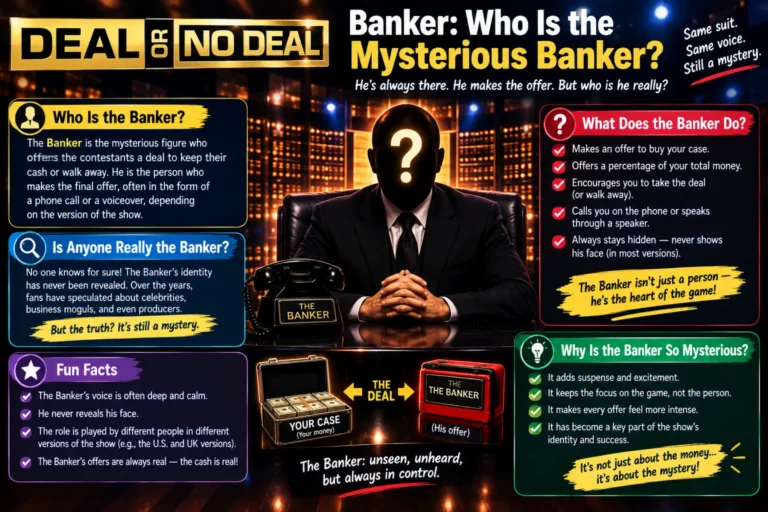
The Deal or No Deal banker is the mysterious figure who makes cash offers to contestants. The banker plays a key role in the show’s drama. Contestants must decide whether to accept an offer or keep playing. Each choice can change the final amount they win.
The banker usually stays out of sight. Instead, the host receives the offer and shares it with the player. The offer depends on the prizes still in play and the stage of the game. The exact format can differ between countries and versions.
In the original UK show, the banker’s identity became a major mystery. Richard Osman later identified producer Glenn Hugill as the original UK banker. The ITV revival uses a different, undisclosed banker.
This guide explains the banker’s role, offers, identity, and game strategy.
Quick Summary
- The Deal or No Deal banker makes cash offers to contestants.
- The banker tries to buy the contestant’s case before the game ends.
- Offers usually depend on the values left on the board.
- Saying Deal ends the contestant’s game.
- Saying No Deal keeps the game going.
- The original UK banker was producer Glenn Hugill.
- The banker in the ITV revival has not been publicly identified.
- Different countries may use different bankers and game rules.
- The banker creates tension between a sure offer and a risky gamble.
What Is the Deal or No Deal Banker?
The Deal or No Deal banker is the unseen character who makes money offers during the game.
The basic idea is simple. A contestant has a box or case with an unknown cash value. Other boxes contain different prize amounts.
The contestant opens other boxes during the game. Each opened box removes one possible prize.
At certain points, the banker makes an offer.
The contestant then chooses between two options:
- Deal: Take the banker’s offer and end the game.
- No Deal: Reject the offer and continue playing.
The banker therefore acts as the opposing side in the negotiation.
The format originated in the Netherlands and later spread to many countries. Banijay says the format has been commissioned in more than 80 territories.
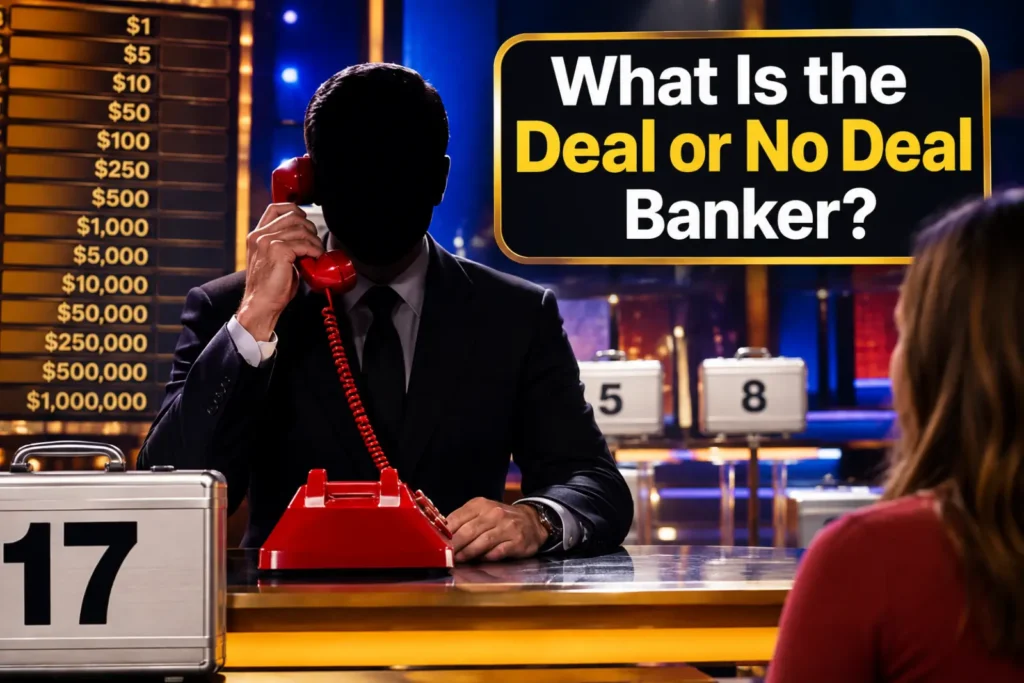
How Does the Banker Work?
The banker enters the game after a set number of boxes are opened.
The host receives the banker’s offer. The contestant then hears the amount.
For example, imagine five prizes remain:
| Prize | Amount |
|---|---|
| Box A | $1 |
| Box B | $10,000 |
| Box C | $50,000 |
| Box D | $100,000 |
| Box E | $500,000 |
The contestant still has several possible outcomes.
The banker might offer $80,000.
The player must then decide whether $80,000 is worth accepting.
If the contestant chooses Deal, the game ends.
If the contestant chooses No Deal, the player keeps playing.
The actual prize inside the player’s selected box remains unknown.
How Are Banker Offers Decided?
The exact method can vary by production.
However, the remaining prize values form an important part of the decision.
Suppose many large prizes remain. The contestant still has a strong chance of holding a valuable box.
That situation can support a larger offer.
Now suppose most large prizes have disappeared. The remaining board looks weaker.
The offer may then fall.
The game also uses timing and uncertainty to create drama. Official descriptions of the format emphasize the banker’s role in trying to unnerve and outwit contestants.
A simple way to understand the process is:
Remaining prizes → risk level → banker offer → contestant decision
The exact formula should not be assumed unless a particular show’s production team confirms it.
Who Was the Original Deal or No Deal Banker?
The answer depends on which version you mean.
For the original UK Deal or No Deal, the banker’s identity was kept secret for years.
Richard Osman later revealed that producer Glenn Hugill was the banker. Hugill had also worked as an actor, including a role on Coronation Street.
This revelation applied to the original Channel 4 era.
It does not mean that every version of the show uses Hugill.
That distinction matters because the format has been adapted in many countries.
Who Is the Banker on the ITV Revival?
The ITV revival launched with Stephen Mulhern as host.
The new version returned in 2023. Banijay describes the banker as the figure standing between contestants and the potential jackpot.
The banker’s identity has remained undisclosed in the revival.
Stephen Mulhern has also said he did not know the banker’s identity. This helped preserve the mystery around the character.
So, if you search for “who is the banker on Deal or No Deal?”, check the country and series first.
The answer can change between productions.
What Does the Banker Actually Do?
The banker’s main job is to make offers.
Those offers create a difficult choice for the contestant.
Consider this example:
A player could potentially win $250,000.
The banker offers $75,000.
The player now has a guaranteed option.
But rejecting the offer could lead to a much larger prize.
It could also lead to a much smaller prize.
That uncertainty is the heart of the show.
The banker does not simply announce a price. The offer creates a decision under risk.
This makes the banker one of the central parts of the show’s format.
Deal or No Deal Banker vs. Contestant
The contestant and banker have different goals within the game.
| Contestant | Banker |
|---|---|
| Wants a valuable final payout | Wants to make a suitable offer |
| Chooses boxes | Responds with offers |
| Can accept or reject | Controls the offer |
| Takes risk by continuing | Creates the cash-out option |
| Wants to protect potential winnings | Tries to buy the case before the end |
This creates the show’s main conflict.
The contestant wants to know whether the offer is worth taking.
The banker wants the contestant to make a decision.
A Real-Life Example of the Banker Concept
Imagine you are offered two choices.
You can take $40,000 today.
Or you can continue playing.
Your remaining possible prizes are:
- $500
- $5,000
- $20,000
- $50,000
- $100,000
The $40,000 offer gives certainty.
Continuing gives you a chance at $100,000.
However, you could also end with $500.
That is the basic tension created by the banker.
The show turns this simple financial choice into a dramatic television moment.
Is the Banker Trying to Trick Contestants?
The banker is presented as an opponent.
However, viewers should separate the show’s character from the actual production process.
The banker is part of the show’s format. The offer is designed to create a decision point.
It is better to think of the banker as a game mechanism rather than a personal enemy.
The contestant still controls the final choice.
The show builds tension around that choice.
Common Mistakes About the Deal or No Deal Banker
1. Assuming every banker is the same person
Different countries have different productions.
The original UK banker and later versions should not be treated as one person.
2. Assuming every offer follows one fixed formula
The exact offer system can differ between versions.
Do not apply one show’s rules to another.
3. Believing the banker knows the contestant’s box value
The game’s mystery depends on the unknown location of the prizes.
The contestant’s box value is not normally revealed until the game reaches its appropriate conclusion.
4. Confusing the banker with the host
The host communicates the offer.
The banker represents the opposing side of the game.
They are separate roles.
5. Assuming the banker must be a professional banker
The title is part of the show’s fictional game structure.
In the original UK production, the role was linked to producer Glenn Hugill.
Tips for Understanding Banker Offers
You do not need advanced math to understand the game.
Start by looking at the remaining prizes.
Then ask three simple questions:
- What large prizes are still available?
- What small prizes are still available?
- How much certainty does the current offer provide?
For example, a $50,000 offer looks different when $100,000 remains.
It also looks different when $1 million remains.
The same offer can feel very different on different boards.
That is why the remaining prizes matter so much.
Deal or No Deal Banker and Expected Value
Expected value can help explain the game’s financial side.
Suppose five equally likely prizes remain:
- $0
- $10,000
- $20,000
- $30,000
- $40,000
Their average value is:
($0 + $10,000 + $20,000 + $30,000 + $40,000) ÷ 5 = $20,000
The banker might offer an amount around that general range.
However, viewers should not assume the offer must equal the mathematical average.
The show’s production can use its own approach.
Also, contestants may value certainty differently from risk.
That makes the decision personal.
Deal or No Deal Banker: Why the Role Matters
The banker gives the show its central question.
Without the banker, contestants would simply open boxes and discover their final prize.
The offer creates a choice.
That choice adds suspense.
It also lets viewers think about risk, probability, and money.
The banker therefore serves both a storytelling role and a game-design role.
Banijay describes the format as a contest involving nerves and intuition.
Deal or No Deal Banker in Different Versions
The format appears in many markets.
The core idea remains similar.
However, the details can change.
Prize values can differ.
The number of cases can differ.
The host can change.
The banker’s identity can change.
Even the way contestants interact with the banker can change.
For this reason, always identify the specific country or season when researching the banker.
The original UK version used red boxes and a telephone-based banker character. The ITV revival keeps the banker concept while using its own production setup.
Deal or No Deal Banker Synonyms and Related Search Terms
People use several phrases when searching for this topic.
Useful related terms include:
- who is the Deal or No Deal banker
- Deal or No Deal banker identity
- Deal or No Deal banker name
- who plays the banker on Deal or No Deal
- Deal or No Deal banker revealed
- how does the Deal or No Deal banker work
- Deal or No Deal banker offers
- Deal or No Deal mystery banker
- Deal or No Deal original banker
- Glenn Hugill banker
- Deal or No Deal cash offer
- Deal or No Deal rules
- Deal or No Deal game strategy
These phrases cover different search intentions.
Some users want the banker’s identity.
Others want to understand how offers work.
A useful article should answer both.
Expert Insights: What Should Viewers Remember?
The most important point is simple.
The Deal or No Deal banker is part of the game’s decision system.
Do not focus only on the mysterious identity.
Focus on what the banker does.
The offer gives the contestant a choice between certainty and continued risk.
Also, check the version of the show before trusting an answer.
The original UK banker was identified as Glenn Hugill. The later ITV version has a different undisclosed banker.
For content creators, this distinction is also important.
A page should clearly state which country and season it discusses.
That improves factual accuracy and helps readers find the answer they need.
Frequently Asked Questions
Who is the Deal or No Deal banker?
The answer depends on the version. Glenn Hugill was identified as the banker for the original UK Channel 4 version. The ITV revival uses a different undisclosed banker.
Is the Deal or No Deal banker real?
Yes, a real person or production team handles the banker role. The banker is presented as a mysterious character within the show’s format.
What does the Deal or No Deal banker do?
The banker makes cash offers to contestants. The contestant can accept the offer or reject it and continue playing.
How does the banker decide the offer?
Offers generally reflect the prizes still available and the stage of the game. Exact methods can vary between productions.
Was Glenn Hugill really the Deal or No Deal banker?
Richard Osman identified Glenn Hugill as the banker connected with the original UK series. Later reporting also confirmed the identification.
Does the banker know what is inside the contestant’s box?
The game’s format keeps the selected box’s value unknown until the appropriate reveal. The banker role should not be confused with knowing every hidden prize location.
Can contestants reject the banker’s offer?
Yes. Saying No Deal rejects the offer and allows the contestant to continue.
Does the banker always offer more money each round?
No. Offers can rise or fall depending on the remaining prizes and the game’s progress.
Conclusion
The Deal or No Deal banker is one of the most important parts of the show’s format. The banker makes offers that force contestants to choose between certainty and risk.
The role also creates one of television‘s most famous mysteries. In the original UK series, Richard Osman identified producer Glenn Hugill as the banker. The ITV revival uses a different banker whose identity remains undisclosed.
The key idea is easy to remember. The contestant owns the decision, while the banker controls the offer.
A good way to understand each offer is to study the prizes left on the board. Then compare the guaranteed amount with the risks of continuing.
That simple choice gives Deal or No Deal its lasting suspense.