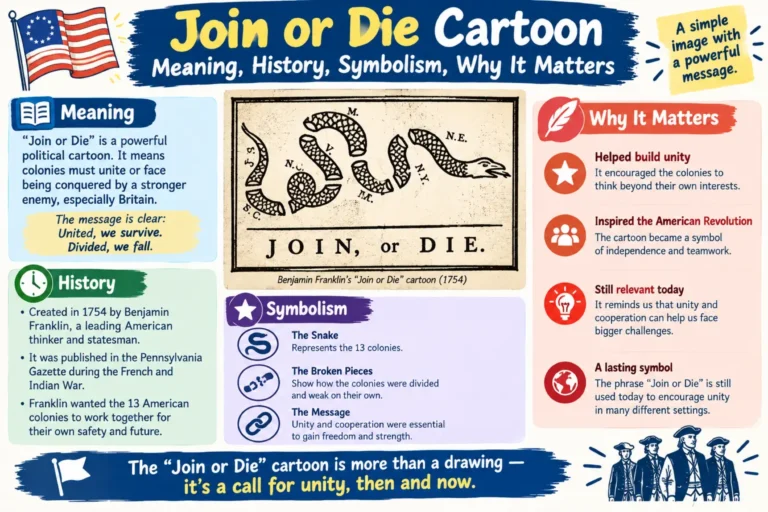
The Join or Die cartoon is one of the most famous political cartoons in American history. It shows a snake cut into several pieces. Each piece represents a British colony or colonial region. Benjamin Franklin published the image in The Pennsylvania Gazette on May 9, 1754.
The cartoon carried a simple warning: the colonies needed to unite or face danger alone. Franklin created the image during rising conflict between Britain and France in North America. The message first focused on colonial defense. Later, colonists reused the image during disputes with Britain.
Today, the cartoon remains an important example of visual political messaging. It shows how one simple image can make a complex political argument easy to understand.
Quick Summary
- The Join or Die cartoon appeared on May 9, 1754.
- Benjamin Franklin published the famous woodcut in The Pennsylvania Gazette.
- The image shows a snake divided into eight sections.
- The sections represented British colonies or colonial regions.
- Franklin wanted the colonies to work together for defense.
- The original message focused on conflict with France and Native American allies.
- Colonists later reused the image during the American Revolution.
- The cartoon became an early symbol of colonial unity.
- It is often considered the first political cartoon published in an American newspaper.
What Is the Join or Die Cartoon?
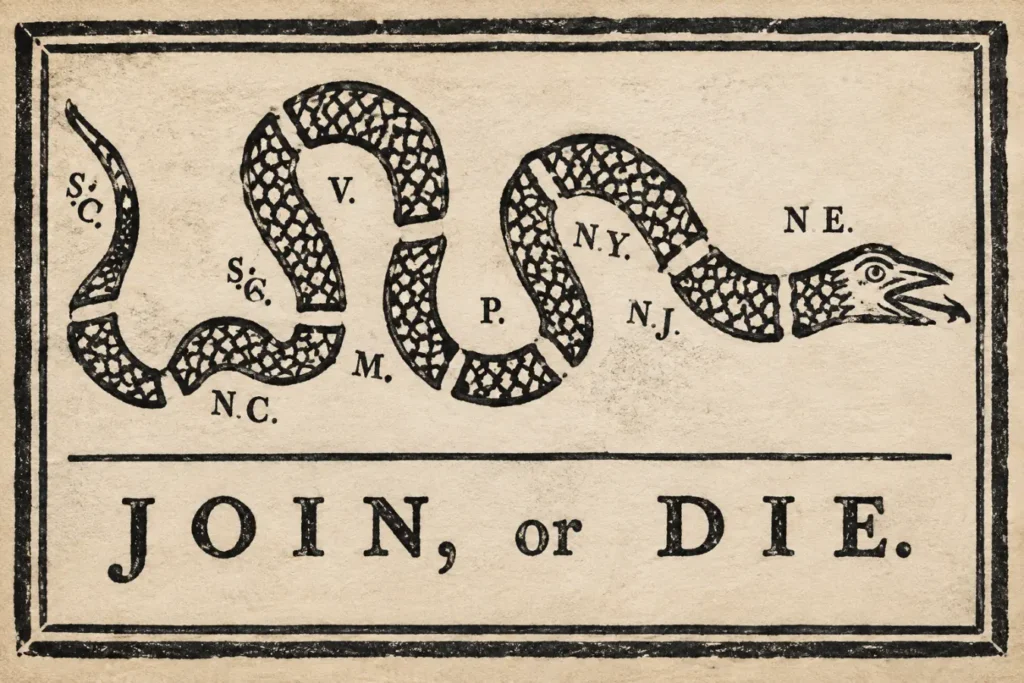
The Join or Die cartoon is an eighteenth-century political cartoon showing a divided snake.
The snake represents the British colonies in North America. Its broken body represents political division.
The words “Join, or Die” appear below the snake.
The message is direct. The colonies needed to cooperate if they wanted to protect their shared interests.
Franklin published the cartoon in the Pennsylvania Gazette in 1754. The image appeared with an editorial about the divided condition of the colonies.
The cartoon is important because it turned a political argument into a simple visual symbol.
Who Created the Join or Die Cartoon?
Benjamin Franklin is closely associated with the Join or Die cartoon.
Franklin published the woodcut in his newspaper, the Pennsylvania Gazette. The Library of Congress identifies Franklin as the creator of the work.
However, historians note an important detail about its production. Franklin may not have physically engraved the woodcut himself. The identity of the person who actually produced the engraving is uncertain.
Therefore, the safest historical description is this:
Benjamin Franklin developed, published, and promoted the Join or Die image, while the exact engraver remains uncertain.
This distinction adds useful historical accuracy when discussing the cartoon.
When Was Join or Die Published?
The original Join or Die cartoon appeared on May 9, 1754.
It was published in the Pennsylvania Gazette in Philadelphia. The publication came shortly before the Albany Congress met in June 1754.
Franklin wanted greater cooperation between the colonies.
The timing was important. Britain and France were competing for control and influence in North America. Conflict was growing around the Ohio Valley.
The cartoon therefore served as a warning.
Franklin argued that divided colonies could struggle to defend themselves. A united group would have greater strength.
What Does the Snake Mean?
The snake is the central symbol in the cartoon.
Its body is divided into eight pieces. Each piece represents a colony or colonial group.
The broken snake shows political separation. The missing connections show the danger of acting alone.
The image also used a popular belief about snakes. People once believed that a cut snake could return to life if its pieces were joined quickly.
That idea made the visual message stronger.
The pieces needed to come together.
In political terms, the colonies needed to come together too.
The snake also had another advantage. It was a creature associated with North America. Later, the rattlesnake became a powerful symbol of American resistance and independence.
What Do the Snake’s Eight Sections Represent?
The original image contains eight labeled sections.
The labels represented these colonial areas:
| Snake Label | Colony or Region |
|---|---|
| N.E. | New England |
| N.Y. | New York |
| N.J. | New Jersey |
| P. | Pennsylvania |
| M. | Maryland |
| V. | Virginia |
| N.C. | North Carolina |
| S.C. | South Carolina |
New England appears as one section. It represented several colonies in the region.
Delaware and Georgia do not appear as separate sections. Delaware was connected politically with Pennsylvania at the time. Georgia was also left out of the original image.
This is why the cartoon does not show thirteen separate pieces.
Why Did Benjamin Franklin Publish Join or Die?
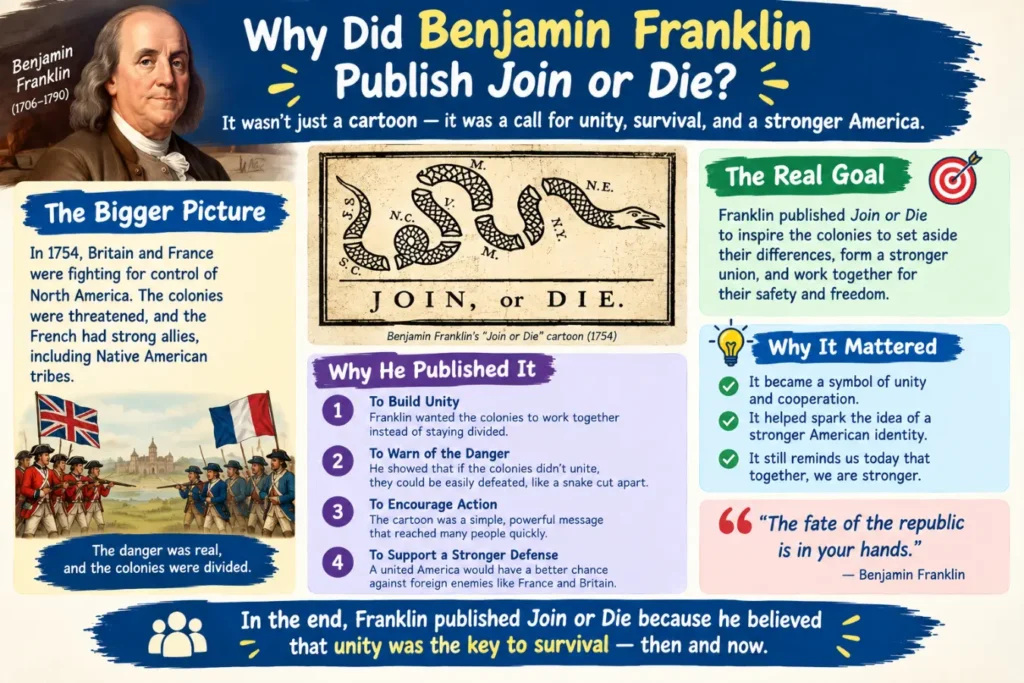
Franklin published the cartoon to encourage colonial cooperation.
The immediate issue involved growing conflict between Britain and France in North America.
Franklin believed the colonies needed stronger cooperation for defense. He also supported ideas for colonial union connected with the Albany Congress.
The cartoon made that argument quickly.
A reader did not need a long political essay to understand the image.
A broken snake looked weak.
A complete snake looked stronger.
The message was therefore easy to remember:
Separate colonies were vulnerable. United colonies had greater strength.
The original message was not a direct call for independence from Britain. The National Park Service notes that Franklin’s first purpose was colonial unity against French expansion.
Join or Die and the French and Indian War
The cartoon appeared as tensions rose into the French and Indian War.
The conflict began in 1754 and became part of the wider struggle between Britain and France.
Franklin was concerned about the colonies’ ability to respond to the threat.
The Join or Die image encouraged cooperation between colonial governments.
The Albany Congress soon considered plans for greater colonial unity. Franklin supported a proposed union that could coordinate defense and other shared matters.
The plan did not become the lasting colonial government Franklin hoped for.
Still, the cartoon helped introduce the idea of colonial unity to a wider audience.
How Did Join or Die Become a Revolutionary Symbol?
The meaning of Join or Die changed over time.
Franklin first used it to encourage unity during the conflict with France.
Later, colonists reused the image during conflicts with Britain.
During the Stamp Act crisis, versions of the cartoon appeared in colonial newspapers. The image also returned during the American Revolutionary period.
This later use gave the cartoon a new political meaning.
Instead of simply saying, “Unite for defense,” the image could suggest, “Unite against British control.”
That change shows why political symbols matter.
The same image can carry different meanings as events change.
Join or Die vs. American Revolution Messaging
| Feature | Join or Die | Later Revolutionary Use |
|---|---|---|
| Original date | 1754 | Mainly 1760s–1770s |
| Main issue | Colonial defense | Resistance to British policies |
| Central symbol | Divided snake | Divided snake |
| Main message | Unite for strength | Unite against political pressure |
| Key audience | British American colonies | American colonists |
| Historical role | Encouraged colonial cooperation | Became a resistance symbol |
The important point is that the original cartoon did not begin as an independence poster.
Its meaning evolved as political tensions grew.
Why Is Join or Die Important Today?
The cartoon remains important because it demonstrates the power of visual communication.
The image contains very little text.
Yet it communicates a complete political argument.
The snake creates an immediate problem. Its body is broken.
The slogan provides the solution. The pieces must join.
This makes the cartoon useful in history classes, political communication studies, and media lessons.
It also shows how symbols can survive for centuries.
The National Park Service still uses the cartoon as an educational resource for teaching children about political persuasion and colonial history.
Real-Life Examples of the Join or Die Message
The idea behind the cartoon can still apply to modern situations.
Example 1: A Sports Team
A sports team may have talented players.
However, individual talent cannot replace teamwork.
Players must cooperate to reach a shared goal.
Example 2: A Community Project
A neighborhood project needs many people.
One person may provide money.
Another may provide skills.
Someone else may organize the work.
Together, their efforts can produce better results.
Example 3: A Business Team
A business may have separate departments.
Marketing, sales, finance, and operations all have different roles.
They still need to work toward the same goal.
These examples do not have the same political meaning as Franklin’s cartoon.
They simply show why the idea of unity remains easy to understand.

Common Mistakes About the Join or Die Cartoon
Several misunderstandings appear when people discuss this historical image.
Mistake 1: Saying It Was Created During the American Revolution
The original cartoon appeared in 1754.
The American Revolution began much later.
The cartoon later became associated with revolutionary resistance, but that was not its first purpose.
Mistake 2: Saying It Shows All 13 Colonies
The snake has eight sections.
Some sections represent groups of colonies.
Georgia and Delaware are not shown as separate sections.
Mistake 3: Saying Franklin Wanted Independence in 1754
Franklin’s original goal involved colonial unity and defense.
He was not yet calling for American independence.
Mistake 4: Ignoring the Historical Context
The image makes much more sense when viewed alongside the French and Indian War.
Without that context, the cartoon can seem like a simple call for rebellion.
Mistake 5: Assuming Franklin Engraved It Himself
Franklin is credited with the work, but the actual engraver is not firmly identified.
Tips for Analyzing the Join or Die Cartoon
Use these simple questions when studying the image.
- What do you see?
Look at the snake and its separate sections. - What do the labels represent?
Identify the colonies or regions. - What does the broken body suggest?
Think about division and weakness. - What does the slogan demand?
It calls for unity. - What was happening in 1754?
Consider the growing conflict between Britain and France. - Who was the intended audience?
The message targeted colonial readers. - Did the meaning change later?
Yes. Colonists later reused the image during conflicts with Britain.
These questions can help students write stronger political cartoon analyses.
How to Use Join or Die in Daily Life
The phrase is mainly historical today.
However, its basic idea can describe teamwork.
You might use it when discussing:
- Team cooperation
- Group projects
- Community action
- Political unity
- Shared goals
- Organizational teamwork
- Collective responsibility
Use the phrase carefully.
The original wording has a serious historical meaning.
It is not simply a casual slogan about teamwork.

Join or Die Synonyms and LSI Keywords
Search engines understand topics through related words and concepts.
Useful semantic keywords include:
- Join or Die snake cartoon
- Benjamin Franklin political cartoon
- Join or Die meaning
- Join or Die symbolism
- Join or Die 1754
- Join or Die snake
- Pennsylvania Gazette
- American political cartoons
- colonial unity
- Benjamin Franklin cartoon
- French and Indian War
- Albany Congress
- American Revolution political cartoons
- thirteen colonies
- colonial America
- revolutionary symbols
- political cartoon analysis
- Franklin snake cartoon
- colonial resistance
- American independence symbols
These terms can support topical relevance without repeating the primary keyword too often.
Expert Insights: Why the Cartoon Still Works
The biggest lesson from the Join or Die cartoon is visual simplicity.
Franklin used one image and a few words to explain a difficult political problem.
That strategy still works today.
Modern campaigns use logos, symbols, charts, memes, and short slogans for similar reasons.
People often understand images faster than long explanations.
The cartoon also teaches another important lesson.
Historical context changes meaning.
The same snake appeared during different political conflicts.
Its message shifted from colonial cooperation to resistance against British authority.
For historians, this makes the cartoon especially valuable.
It is not only an image.
It is evidence of changing political ideas in colonial America.
FAQs About the Join or Die Cartoon
What is the Join or Die cartoon?
It is a 1754 political cartoon showing a snake divided into sections. The image encouraged the British colonies in North America to unite.
Who created the Join or Die cartoon?
Benjamin Franklin published and is widely credited with the cartoon. The exact person who engraved the woodcut is uncertain.
When was Join or Die published?
It appeared on May 9, 1754, in the Pennsylvania Gazette.
What does the snake represent?
The divided snake represents the British colonies as separate political units. Its broken form suggests weakness through division.
Why does Join or Die have only eight sections?
Some sections represent groups of colonies. New England appears as one section, while Delaware and Georgia are not separately represented.
Was Join or Die about the American Revolution?
Not originally.
Franklin first used it to encourage colonial unity during the growing conflict with France.
Colonists later reused the image during resistance to British policies.
Why is Join or Die important?
It is an early and influential example of American political cartooning.
It also shows how images can influence public opinion and encourage political action.
What is the main message of Join or Die?
The main message is simple: people or groups can become stronger when they unite around a shared goal.
Conclusion
The Join or Die cartoon remains one of the most recognizable political images from colonial America.
Benjamin Franklin published it in the Pennsylvania Gazette on May 9, 1754. The divided snake represented separate British colonies. Its message called for unity during a period of growing conflict in North America.
The cartoon later gained new meaning during disputes with Britain and the American Revolutionary period.
Its lasting value comes from its simple design.
A broken snake represents division.
A united snake represents strength.
That idea helped the cartoon survive long after its original publication.