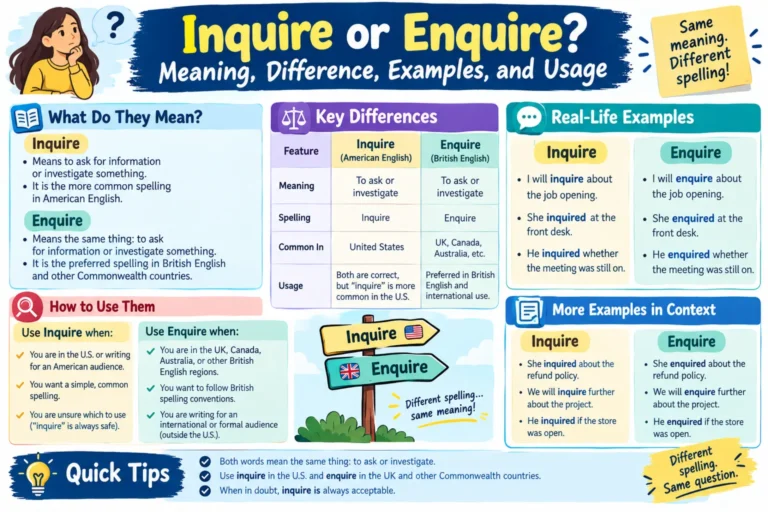
Inquire or enquire can both mean to ask for information. The main difference comes from regional English usage.
American English usually prefers inquire. British English often uses enquire in everyday situations.
Both forms are correct in the right context. However, their use can vary by country and writing style.
You may see both words in emails, websites, schools, and business documents. This can make the choice confusing.
The good news is that the difference is easy to understand.
In this guide, you will learn their meanings, differences, examples, and common mistakes. You will also learn which spelling works best in different types of writing.
By the end, you will know whether to write inquire or enquire with confidence.
Quick Summary: Inquire or Enquire?
- Inquire and enquire can both mean “to ask for information.”
- Inquire is more common in American English.
- Enquire is common in British English for general questions.
- Inquire can have a formal meaning related to an investigation.
- Enquire often sounds natural in everyday British English.
- Both spellings can be correct.
- Your audience should guide your spelling choice.
- Inquiry is the common American spelling.
- Enquiry is common in British English.
What Does “Inquire” Mean?
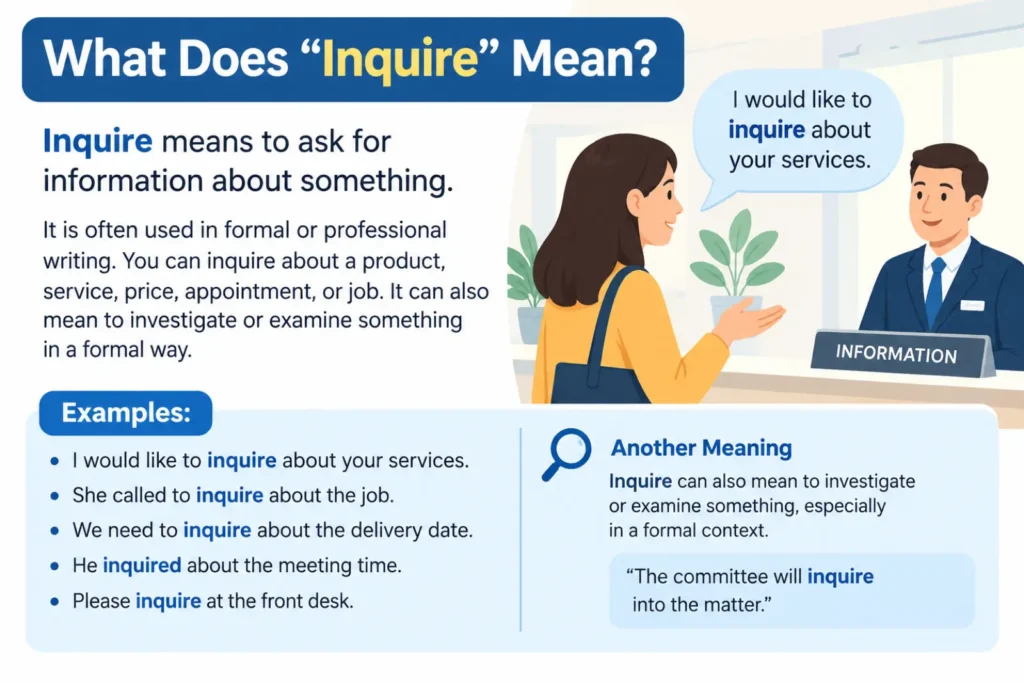
Inquire means to ask for information about something.
It often appears in formal or professional writing. For example, someone may inquire about a product, service, price, or appointment.
Examples of “inquire”
- I would like to inquire about your services.
- She called to inquire about the job.
- We need to inquire about the delivery date.
- He inquired about the meeting time.
- Please inquire at the front desk.
The word can also describe a formal investigation.
For example:
The committee will inquire into the matter.
Here, inquire means to investigate or examine something carefully.
This second meaning is especially common in formal contexts.
What Does “Enquire” Mean?
Enquire also means to ask for information.
It is especially common in British English and other varieties influenced by British English.
Examples of “enquire”
- I would like to enquire about the course.
- She called to enquire about the price.
- Please enquire at reception.
- He enquired about the available rooms.
- We received several enquiries from customers.
In everyday British English, enquire often works naturally when someone simply wants information.
So, if you write for a British audience, enquire may be the better choice.
Inquire vs Enquire: What Is the Difference?
The biggest difference is regional preference.
American English strongly favors inquire. British English commonly uses enquire for ordinary requests.
However, British English also uses inquire in formal contexts.
| Feature | Inquire | Enquire |
|---|---|---|
| Basic meaning | Ask for information | Ask for information |
| American English | Very common | Uncommon |
| British English | Used | Very common |
| Formal investigation | Common | Less common |
| Everyday British questions | Used | Common |
| Noun form | Inquiry | Enquiry |
| Correct spelling | Yes | Yes |
The words therefore overlap in meaning.
The main choice depends on regional English and context.
Inquire or Enquire in American English
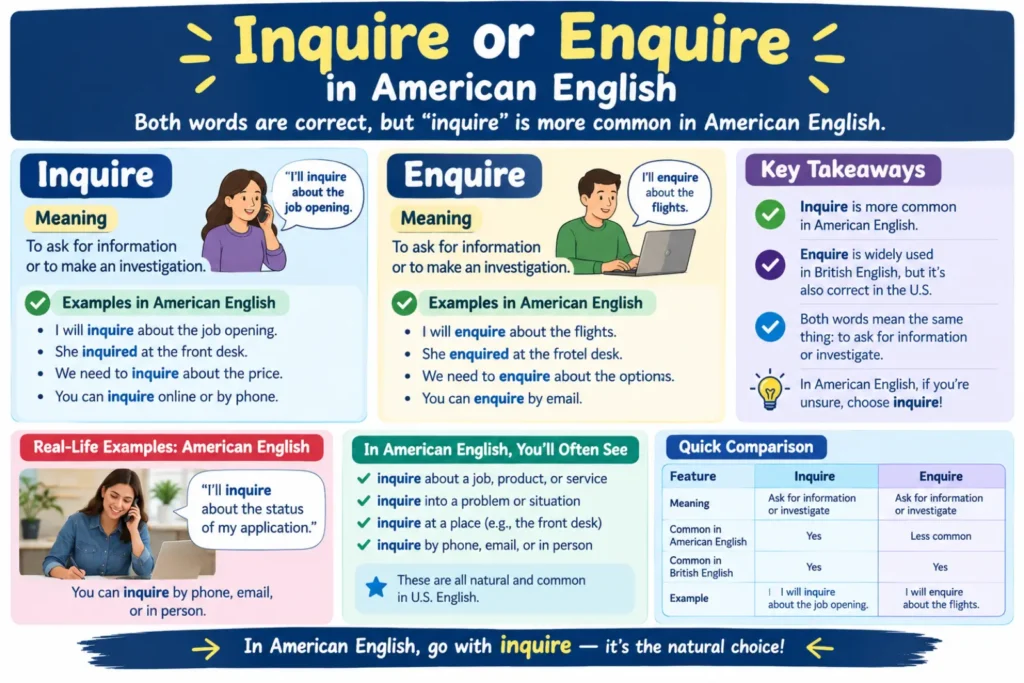
If you write for readers in the United States, choose inquire.
American English generally uses inquire for both general questions and formal investigations.
Examples
- I am writing to inquire about your services.
- She inquired about the application process.
- We received an inquiry from a customer.
- The agency will inquire into the complaint.
The spelling enquire may look unusual to many American readers.
Therefore, businesses targeting the US should normally use inquire.
Inquire or Enquire in British English
British English accepts both forms.
However, enquire is common when someone simply asks for information.
Examples
- I would like to enquire about your prices.
- Please enquire at the reception desk.
- She enquired about the train schedule.
- We received an enquiry from a customer.
British English also uses inquire for formal investigations.
For example:
The court will inquire into the circumstances.
This distinction can help you choose the most natural word.
Is “Inquire” or “Enquire” More Formal?
Neither spelling is automatically more formal.
Inquire often appears in formal American English. It also appears in formal British contexts.
Enquire can sound perfectly professional in British English.
For example:
I am writing to enquire about the position.
This sentence works well in a British business email.
An American writer would usually write:
I am writing to inquire about the position.
The difference comes from regional convention rather than correctness.
When Should You Use “Inquire”?
Use inquire when you want a safe choice for American English.
It also works well in international English when your audience prefers American spelling.
Use it when:
- Asking about a product
- Asking about a service
- Requesting additional information
- Asking about an application
- Making a formal inquiry
- Describing an investigation
Real-life examples
Customer service:
I would like to inquire about your return policy.
Job application:
I am writing to inquire about the marketing position.
Education:
I would like to inquire about the admission requirements.
Formal investigation:
The committee will inquire into the complaint.
When Should You Use “Enquire”?
Use enquire when writing primarily for British English readers.
It works especially well for ordinary requests for information.
Real-life examples
Hotel booking:
I would like to enquire about room availability.
University admission:
I am writing to enquire about the application deadline.
Business communication:
A customer called to enquire about our services.
Travel:
We contacted the station to enquire about train times.
If your audience lives in the UK, enquire often feels natural and familiar.
Inquire or Enquire in Business Emails
Both forms work in professional emails.
The best choice depends on your audience.
For US clients
Use inquire:
I am writing to inquire about the status of my application.
For UK clients
Use enquire:
I am writing to enquire about the status of my application.
The sentence structure stays the same.
Only the spelling changes.
For global companies, consistency matters more than choosing one form universally.
Choose a style guide and follow it throughout your website and communications.
Inquiry or Enquiry: What About the Noun?
The same regional difference appears in the noun forms.
Inquiry is the standard American spelling.
Enquiry is common in British English.
Examples
American English:
We received your inquiry.
British English:
We received your enquiry.
Both sentences communicate the same basic idea.
However, British English can also use inquiry for a formal investigation.
For example:
The public inquiry examined the causes of the accident.
This distinction appears often in formal British writing.
Common Mistakes With Inquire and Enquire
Many writers make small mistakes when choosing these words.
Mistake 1: Mixing regional styles
A writer may use American and British spellings randomly.
For example, a website might use inquire on one page and enquiry on another.
This can make the content look inconsistent.
Better approach: Choose one regional style.
Mistake 2: Assuming “enquire” is wrong
Enquire is not a spelling mistake.
It is a standard English word.
British English commonly uses it for general requests.
Mistake 3: Assuming “inquire” is only American
British English also uses inquire.
It can appear in formal contexts, especially when referring to investigations.
Mistake 4: Using the wrong noun
Remember the common regional pairs:
- American English: inquire → inquiry
- British English: enquire → enquiry
Keep your spelling consistent.
Mistake 5: Choosing based on SEO alone
Some writers worry about which spelling Google prefers.
Search engines understand spelling variations and related meanings.
You should write for your audience first.
Use the spelling your target readers expect.
Tips for Choosing the Right Word
Here are some simple rules.
1. Know your audience
Write inquire for American readers.
Use enquire for general questions in British English.
2. Follow your company’s style guide
A consistent writing style creates a more professional brand.
3. Check the surrounding spelling
Look at words such as:
- color vs colour
- organize vs organise
- center vs centre
These clues can show which English variety your content follows.
4. Keep your website consistent
Do not switch between regional spellings without a reason.
5. Consider formal context
For investigations, inquire and inquiry often work well, including in British English.
Inquire or Enquire: Real-Life Scenarios
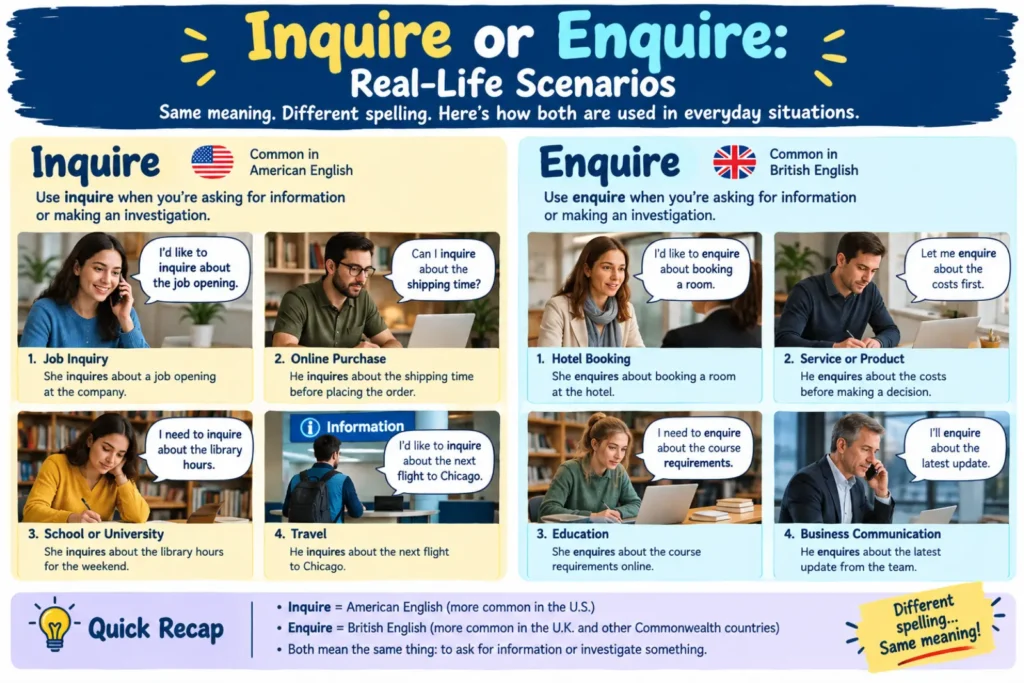
Imagine you run an online store in the United States.
A customer wants information about shipping.
You could write:
Please contact us to inquire about shipping options.
Now imagine your company serves customers in the UK.
You might write:
Please contact us to enquire about shipping options.
Both sentences are correct.
The target audience determines the preferred spelling.
Another example
A UK university may write:
Please enquire about international student admissions.
A US university may write:
Please inquire about international student admissions.
Again, both versions work.
Synonyms and Related Terms
Several words can replace inquire or enquire, depending on the context.
Common synonyms
- Ask
- Question
- Request
- Seek information
- Find out
- Investigate
- Examine
- Research
- Check
However, these words do not always have exactly the same meaning.
For example, ask is much more general.
Investigate suggests a deeper examination.
Request information sounds more formal.
Related SEO terms
Natural semantic keywords include:
- inquire meaning
- enquire meaning
- inquire vs enquire
- inquiry vs enquiry
- British English spelling
- American English spelling
- English word differences
- correct spelling
- formal English
- business English
- professional email language
Use these terms naturally. Avoid repeating them just to increase keyword density.
Expert Insight: Why This Difference Matters
From an editing and SEO perspective, audience alignment matters more than choosing one spelling as universally correct.
A professional website should match the English variety used by its main audience.
For example, a US-focused website should normally use American spelling.
A UK-focused website should normally follow British spelling.
This approach improves consistency and reader trust.
It also helps maintain a clear brand voice.
For SEO, do not create separate pages simply because inquire and enquire use different spellings.
Instead, explain the difference on one useful page when both terms serve the same search intent.
That approach avoids unnecessary duplicate content.
Expert tip: Use the primary spelling naturally, then mention its regional alternative where helpful.
How to Use Inquire and Enquire in Daily Life
You can encounter these words in many everyday situations.
Shopping
- I want to inquire about the price.
- I would like to enquire about delivery.
Education
- I am writing to inquire about admission.
- I would like to enquire about the course.
Employment
- She called to inquire about the vacancy.
- He emailed to enquire about the position.
Travel
- We called to inquire about flight times.
- They contacted the hotel to enquire about rooms.
Customer service
- The customer made an inquiry.
- The customer sent an enquiry.
These examples show why both spellings remain useful.
Frequently Asked Questions
Is “inquire or enquire” the same thing?
Yes, they can have the same basic meaning. Both can mean to ask for information.
Which is correct, inquire or enquire?
Both are correct. Inquire is preferred in American English. Enquire is common in British English.
Is enquire British or American?
Enquire is mainly associated with British English and related varieties.
Is inquire American or British?
Inquire is especially common in American English. British English also uses it, particularly in formal contexts.
Should I use inquiry or enquiry?
Use inquiry for American English. Use enquiry for many general questions in British English.
Is “enquire” more polite than “inquire”?
No. Neither word is automatically more polite. The difference mainly relates to regional usage and context.
Can I use “inquire” in British English?
Yes. British English accepts inquire. It often appears in formal contexts, especially for investigations.
Which spelling should I use for an international website?
Choose the English variety that matches your main audience. Then use it consistently across your website.
Conclusion
Inquire or enquire can both be correct English words.
The main difference comes from regional usage and context.
American English generally prefers inquire and inquiry.
British English often uses enquire and enquiry for general requests.
British English also uses inquire for formal investigations.
Therefore, neither spelling is simply right or wrong.
The best choice depends on your audience, context, and chosen style guide.
If you write for American readers, inquire is usually the safest choice.
If you write for British readers, enquire often sounds more natural for everyday questions.
Most importantly, stay consistent throughout your content.