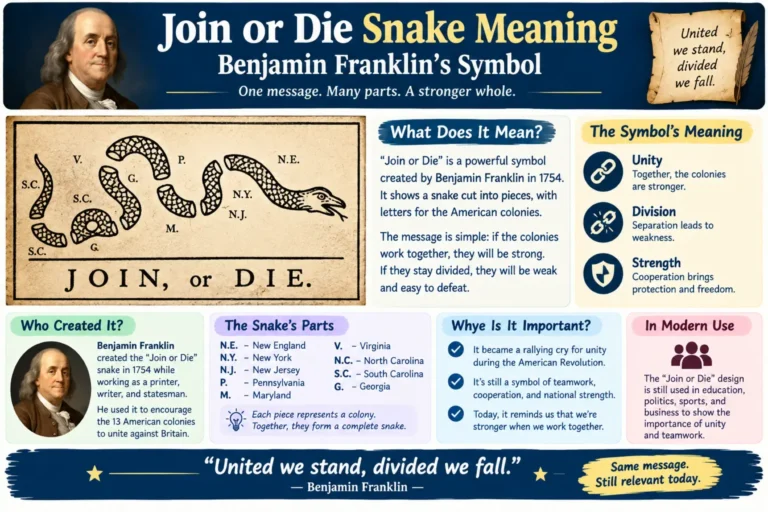
Join or Die snake meaning refers to Benjamin Franklin’s famous 1754 political cartoon. The image shows a snake cut into several pieces. Each piece represents a British American colony or colonial region. Franklin used the image to urge the colonies to unite. He wanted them to work together against a growing French threat in North America. The message was simple and powerful. Divided colonies would struggle to defend themselves. United colonies would have a better chance of survival. The cartoon first appeared in the Pennsylvania Gazette on May 9, 1754. Later, colonists reused the image during the American Revolution. Its meaning then shifted toward resistance against British rule. Today, the snake remains one of America’s best-known early political symbols.
Quick Summary: Join or Die Snake Meaning
- “Join or Die” means that unity was necessary for survival.
- Benjamin Franklin published the cartoon in 1754.
- The snake represented the British American colonies.
- The broken body showed the danger of colonial division.
- Franklin wanted the colonies to cooperate against the French threat.
- The image supported the idea behind the Albany Plan of Union.
- The cartoon later became a symbol of American resistance and unity.
- It appeared again during the growing conflict with Britain.
- The image is considered an important early example of American political cartoons.
What Does “Join or Die” Mean?
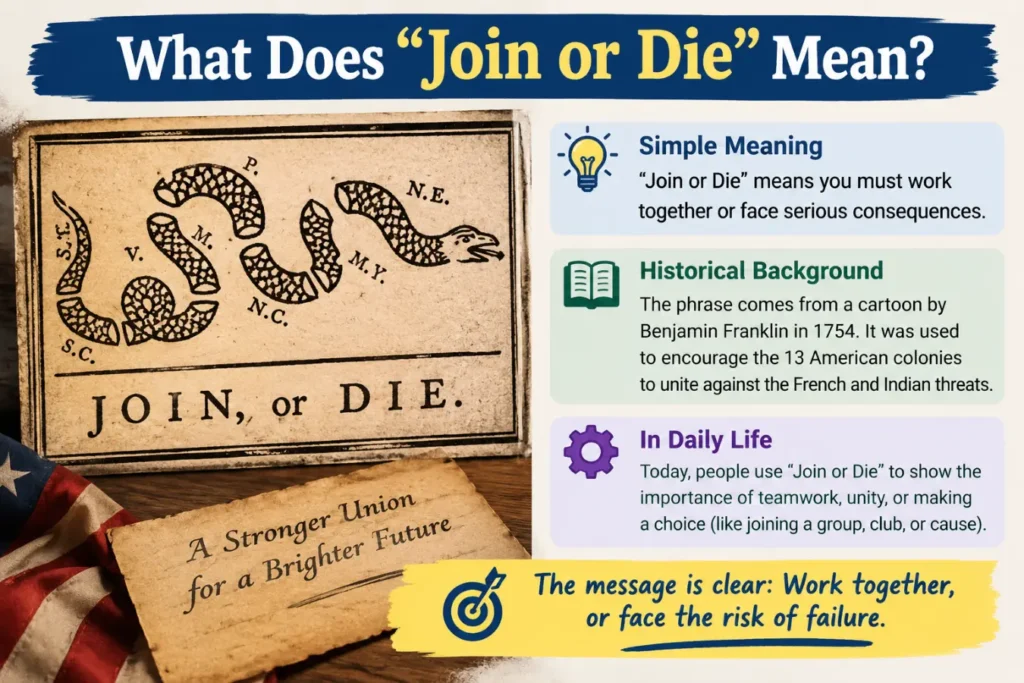
The phrase “Join or Die” means that people must unite when facing a serious shared danger.
Franklin used the phrase as a political warning.
He believed the colonies were too divided to defend themselves effectively. Each colony had its own government and interests.
The snake made this idea easy to understand.
A snake cut into pieces cannot function as one complete animal. Franklin used that image to represent the divided colonies.
The message was direct:
Join together, or risk destruction.
This message focused on cooperation rather than independence in 1754. The American Revolution had not yet begun.
The original goal was colonial unity against external threats. Franklin wanted stronger cooperation among the colonies.
Who Created the Join or Die Snake Cartoon?
Benjamin Franklin published the “Join, or Die” woodcut in the Pennsylvania Gazette.
The newspaper published the image on May 9, 1754. The Library of Congress identifies Franklin as the creator and records the image as a woodcut.
Franklin was more than a printer and publisher. He also became an important political thinker.
At the time, tensions were growing between Britain and France in North America.
Franklin believed colonial cooperation could improve defense.
His newspaper gave him an effective way to spread that message.
The cartoon also appeared with an article discussing the weakness caused by colonial disunity.
This combination made the message stronger.
Readers could understand the political argument quickly by looking at the snake.
Why Did Benjamin Franklin Use a Snake?
Franklin used the snake as a visual symbol of colonial unity.
The snake was divided into several pieces. Each piece carried an abbreviation for a colony or colonial region.
The original image included labels such as:
| Snake Segment | Colony or Region |
|---|---|
| N.E. | New England |
| N.Y. | New York |
| N.J. | New Jersey |
| P. | Pennsylvania |
| M. | Maryland |
| V. | Virginia |
| N.C. | North Carolina |
| S.C. | South Carolina |
The Library of Congress records these labels in the original image.
The snake therefore worked like a simple map.
Franklin connected geography, politics, and survival in one image.
The broken snake showed that the colonies existed separately.
The slogan added urgency.
Together, the image and words created a strong political argument.
What Did the Broken Snake Represent?
The broken snake represented the political separation of the British colonies.
Each section represented a colony or colonial group.
The separate pieces showed that the colonies did not always act together.
That division created problems during times of danger.
Franklin wanted the colonies to understand one important point.
Their shared interests could be stronger than their differences.
The image did not originally represent the thirteen independent American states.
That distinction matters.
In 1754, the colonies still belonged to the British Empire. The image appeared before the Declaration of Independence.
The original message focused on colonial cooperation and defense.
Join or Die and the Albany Plan of Union
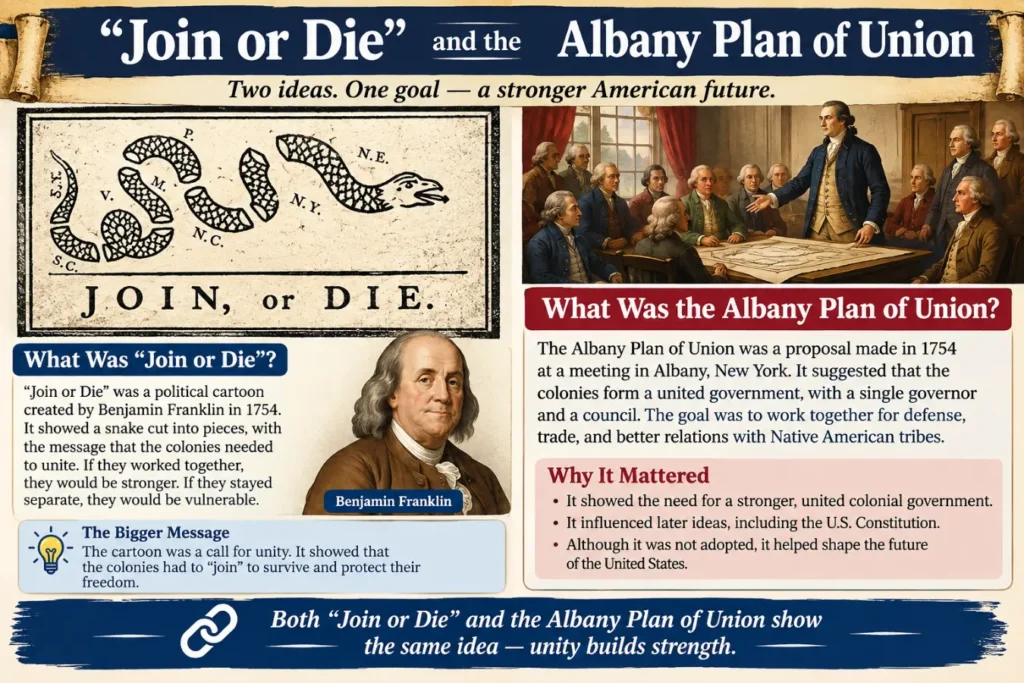
The Join or Die cartoon connected closely with the Albany Plan of Union.
Representatives from several colonies met at the Albany Congress in 1754.
They discussed defense, diplomacy, and cooperation.
Franklin supported a plan for a more unified colonial government.
The Albany Plan proposed a general government for the colonies. It included a President General and a Grand Council.
The plan aimed to improve cooperation while allowing colonies to keep much of their existing structure.
The delegates adopted the plan on July 10, 1754.
However, the plan never became reality.
Both colonial governments and British authorities rejected or failed to implement it.
Still, the idea showed that colonial leaders were already discussing political union before the American Revolution.
Was Join or Die About the American Revolution?
Not originally.
This is one of the most common misunderstandings about the cartoon.
The first Join or Die image appeared in 1754. The American Revolution began much later.
Franklin originally wanted the colonies to unite against French and allied Native American forces.
The French and Indian War was beginning at that time.
Later, however, colonists reused the symbol for a different political purpose.
During the years leading toward the American Revolution, the image became associated with resistance to British policies.
The same basic message remained:
Unity creates strength.
The target of that unity changed.
This shift explains why the cartoon remains important in American history.
How Did the Meaning Change Over Time?
The meaning of Join or Die changed as American political events changed.
In 1754, the message encouraged cooperation among British colonies.
During the American Revolution, the symbol gained a stronger patriotic meaning.
Colonists reused versions of the snake image in newspapers and other publications.
The message now encouraged resistance against British authority.
The Library of Congress notes that the snake later became a symbol of the American Revolution.
This change shows how political symbols can gain new meanings.
The original image focused on defense.
Later versions focused on resistance and independence.
The core idea of unity remained constant.
Join or Die vs. “Don’t Tread on Me”
People sometimes connect Join or Die with “Don’t Tread on Me.”
Both phrases became connected with American uses of the snake symbol.
However, they are not the same message.
| Symbol or Phrase | Main Message | Historical Context |
|---|---|---|
| Join or Die | Unite or face danger | 1754 colonial defense |
| Don’t Tread on Me | Do not threaten or oppress us | Revolutionary-era resistance |
| Broken Snake | Division weakens the whole | Colonial unity |
| Later Snake Symbols | Strength, resistance, independence | American Revolution |
The Library of Congress explains that the snake later became associated with the patriotic motto “Don’t Tread on Me.”
Therefore, these symbols share historical roots but have different meanings.
Why Is the Join or Die Cartoon Important?
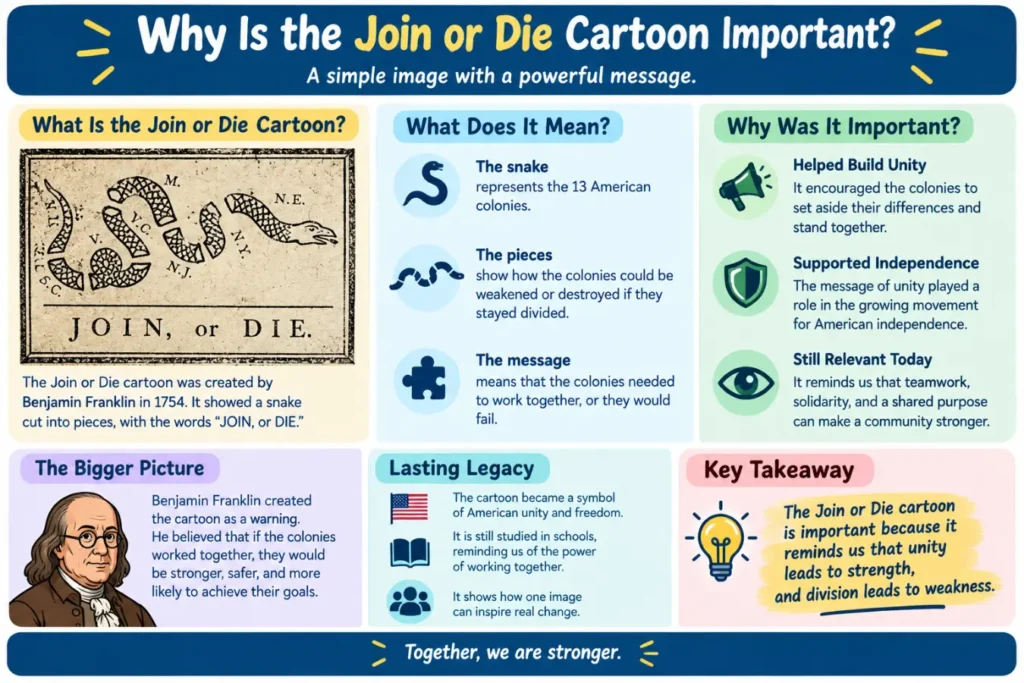
The cartoon matters because it communicated a complicated political idea very quickly.
Franklin did not need several pages of explanation.
The broken snake showed division.
The words “Join or Die” created urgency.
The result was an early example of powerful political communication.
The Library of Congress describes the image as the first political cartoon published in an American newspaper.
Its influence also extended beyond its first publication.
Other newspapers reused the image.
Later generations changed and adapted the symbol for new political causes.
That long history shows the power of simple visual messaging.
Real-Life Example of the Join or Die Meaning
Imagine eight communities facing the same outside threat.
Each community has limited money and limited soldiers.
They all act separately.
One community may defend itself well. Another may struggle.
Now imagine those communities share supplies, information, and soldiers.
Their combined strength becomes much greater.
That situation captures the basic idea behind Join or Die.
Franklin believed the colonies could gain strength through cooperation.
The cartoon turned that political argument into an image people could understand quickly.
Common Mistakes About Join or Die
Mistake 1: Thinking It Was Created During the Revolution
The cartoon appeared in 1754, years before the American Revolution.
Mistake 2: Thinking It Originally Meant Independence
Franklin originally promoted colonial unity.
He did not use the first version to demand independence from Britain.
Mistake 3: Calling the Snake a Map of the United States
The original snake represented British colonies and colonial regions.
The United States did not yet exist.
Mistake 4: Saying Every Piece Represented One Modern State
The original labels did not match the modern United States exactly.
New England appeared as a combined regional label.
Mistake 5: Treating “Join or Die” as Only a Military Slogan
The message involved political cooperation too.
Franklin wanted stronger coordination between colonial governments.
What Can We Learn From the Join or Die Symbol?
The cartoon offers several useful lessons about communication.
First, simple images can explain complex ideas.
Second, symbols become stronger when they connect with current events.
Third, context matters.
A symbol can change meaning as society changes.
Finally, unity can become a powerful political message.
Franklin understood the value of visual communication.
His cartoon connected an emotional warning with a practical political goal.
That approach remains useful today.
Modern organizations still use short slogans and simple graphics to communicate complicated ideas.
Join or Die Meaning in Daily Life
The phrase can also work as a general metaphor today.
For example, a sports team may use unity as its central message.
A workplace may ask employees to cooperate during a difficult project.
A community may work together after a natural disaster.
In each case, people become stronger when they coordinate their efforts.
However, modern uses should not erase the historical context.
The original phrase belonged to a specific moment in colonial American history.
Using it today works best when people understand its background.
Synonyms and LSI Keywords for Join or Die
Readers searching for this topic may use several related terms.
Useful semantic keywords include:
- Join or Die meaning
- Join or Die snake meaning
- Benjamin Franklin Join or Die
- Join or Die cartoon
- Join or Die snake
- Join or Die symbolism
- Join or Die political cartoon
- Benjamin Franklin snake cartoon
- 1754 Join or Die
- Join or Die Albany Plan
- Albany Plan of Union
- French and Indian War
- colonial unity
- American Revolution symbols
- broken snake political cartoon
- Join or Die colonies
- meaning of Join or Die
- Franklin political cartoon
- historical meaning of Join or Die
- Join or Die symbolism explained
These terms naturally support the main topic without repeating the exact keyword excessively.
Expert Insights: Why the Symbol Still Matters
From a historical communication perspective, Join or Die works because it combines text and imagery.
The viewer understands the broken snake immediately.
The slogan then gives the image a clear interpretation.
This creates a strong visual argument.
Another important point involves historical context.
The image predates American independence by more than two decades.
Therefore, readers should avoid placing later revolutionary ideas into the original 1754 message.
The Library of Congress confirms that Franklin wanted colonial governments to unite for protection.
The National Constitution Center also notes that the cartoon later appeared during other major political conflicts.
That changing use makes the symbol especially valuable for studying political communication.
Frequently Asked Questions About Join or Die
What does the Join or Die snake mean?
The snake represents the British American colonies. Its broken body shows colonial division. The phrase urges the colonies to unite for survival.
Who created the Join or Die cartoon?
Benjamin Franklin published the famous woodcut in the Pennsylvania Gazette on May 9, 1754.
Why did Benjamin Franklin create Join or Die?
Franklin wanted the colonies to cooperate against the French threat and improve their common defense.
What do the snake pieces represent?
The pieces represent British American colonies or colonial regions. The original image includes labels for places such as New York, New Jersey, Pennsylvania, Virginia, Maryland, North Carolina, South Carolina, and New England.
Was Join or Die created during the American Revolution?
No. Franklin published it in 1754, before the American Revolution began.
How does Join or Die relate to the Albany Plan?
The cartoon promoted colonial unity at the same time Franklin supported the Albany Plan of Union. The plan sought greater cooperation among the colonies.
What does the snake symbolize?
The snake symbolizes the colonies as parts of a larger whole. The broken body represents the weakness created by division.
Is Join or Die still used today?
Yes. The phrase and snake image continue to appear in historical education, political art, books, and popular culture.
conclusion: Join or Die Snake Meaning
The Join or Die snake meaning centers on unity, cooperation, and survival.
Benjamin Franklin published the famous cartoon in 1754.
The broken snake represented divided British American colonies.
Franklin wanted those colonies to cooperate against the French threat.
The image also supported the broader idea behind the Albany Plan of Union.
Importantly, the cartoon did not originally call for American independence.
Its first message focused on colonial cooperation and common defense.
Later, colonists reused the symbol during the American Revolution.
Its meaning then became connected with resistance to British rule.
That history makes the image more than a simple political cartoon.
It shows how one powerful symbol can change with political events.
The easiest way to remember its meaning is simple:
The broken snake represents division. “Join or Die” calls for unity.
That message helped make Franklin’s 1754 cartoon one of the most recognizable political images in early American history.