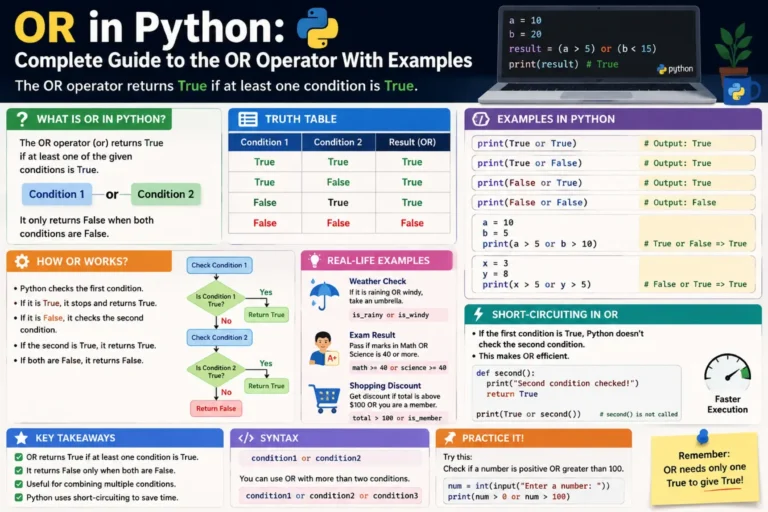
OR in Python is a logical operator that helps you combine two or more conditions. It returns a true result when at least one condition is true.
Python uses the or keyword for logical OR operations. It makes programs easier to read and write. You can use it inside if, while, and other conditional statements.
For example, you may want to check if a user is an admin or a manager. You can combine both checks with or.
The or operator also works with values beyond simple Boolean expressions. Python uses short-circuit evaluation when it processes or.
This guide explains or in Python with simple examples. You will learn how it works and when to use it.
We will also cover common mistakes and useful tips. By the end, you can use Python’s or operator with confidence.
Quick Summary: OR in Python
oris a logical operator in Python.- It checks whether at least one condition is true.
- Python returns
Truewhen either condition is true. - Python returns
Falsewhen both conditions are false. - The
oroperator uses short-circuit evaluation. - You can use
orwith conditions, Boolean values, and other objects. - Python’s
orcan also return an actual value instead ofTrueorFalse.
What Does OR Mean in Python?
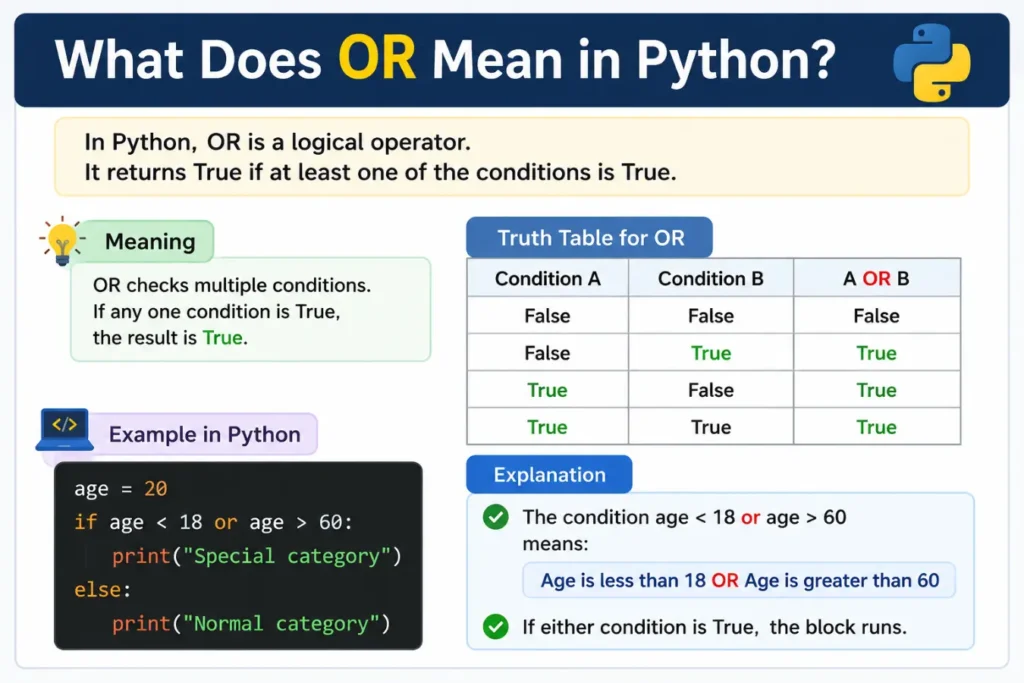
The Python or operator checks multiple expressions.
It returns a truthy result when at least one expression is truthy.
Consider this simple example:
age = 20

if age < 18 or age > 60:
    print("Special category")
The condition has two parts.
The first checks whether age is below 18. The second checks whether it is above 60.
The or operator connects these conditions.
If either condition becomes true, Python enters the if block.
In Boolean logic, the basic rule looks like this:
| Condition A | Condition B | A or B |
|---|---|---|
| False | False | False |
| False | True | True |
| True | False | True |
| True | True | True |
Therefore, or means at least one condition must be true.
How Does the OR Operator Work in Python?
Python evaluates expressions from left to right.
It first checks the expression on the left side of or.
If that expression is truthy, Python does not need to check the right side.
This behavior is called short-circuit evaluation.
For example:
x = 10

if x > 5 or x < 2:
    print("Condition met")
Here, x > 5 is true.
Python already knows that the complete or expression will be true.
Therefore, it can skip the second condition.
This behavior can improve performance. It can also prevent unnecessary function calls.
OR in Python With Boolean Values
You can use or directly with Boolean values.
a = True
b = False

result = a or b

print(result)
Output:
TrueAt least one value is True.
Now consider this example:
a = False
b = False

result = a or b

print(result)
Output:
FalseBoth values are false.
Therefore, the result is false.
OR in Python With If Statements
The or operator often appears inside if statements.
For example:
temperature = 35

if temperature > 30 or temperature < 5:
    print("Extreme temperature")
The program checks two conditions.
It checks whether the temperature exceeds 30. It also checks whether it falls below 5.
If either condition is true, Python prints the message.
This pattern works well when several situations should trigger the same action.
Real-Life Examples of OR in Python
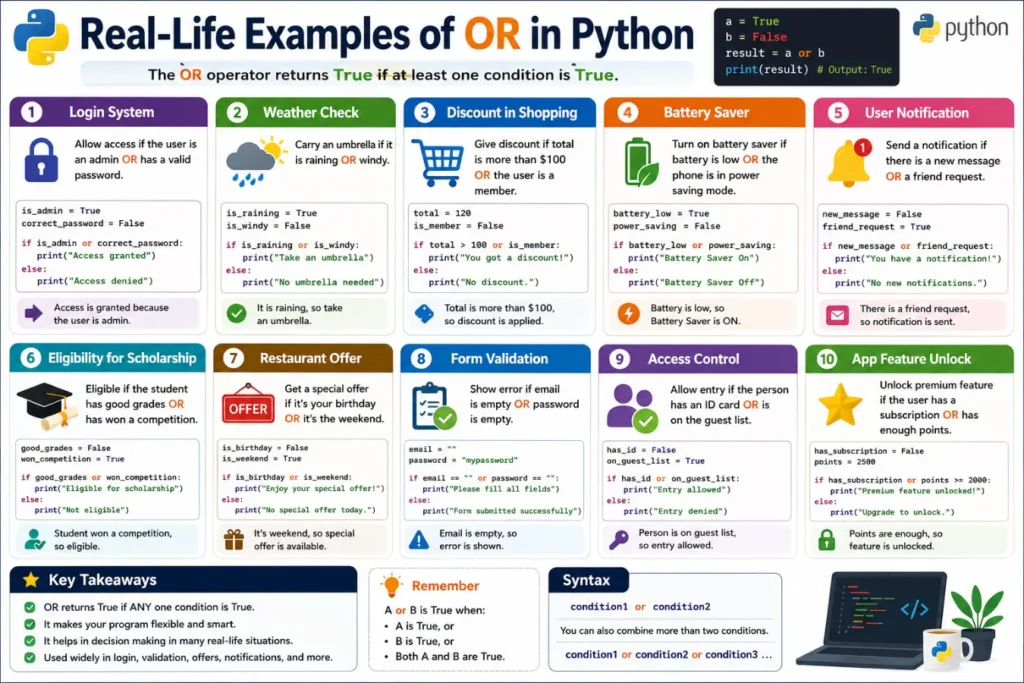
Imagine a website that allows access to admins or moderators.
You could write:
role = "moderator"

if role == "admin" or role == "moderator":
    print("Access granted")
The user receives access because one condition is true.
Another example involves age:
age = 16

if age < 13 or age > 65:
    print("Special pricing")
The program checks two different age groups.
You can also check user input:
answer = "yes"

if answer == "yes" or answer == "y":
    print("Accepted")
This approach allows multiple valid inputs.
OR in Python vs AND in Python
The or and and operators both combine conditions. However, they follow different rules.
| Feature | or | and |
| Basic meaning | At least one condition | Every condition |
| True when | One or more values are truthy | All values are truthy |
| False when | All values are false | One or more values are false |
| Common use | Multiple possible choices | Multiple required conditions |
| Example | age < 18 or age > 60 | age >= 18 and age <= 60 |
For example:
age = 25

if age >= 18 and age <= 60:
    print("Adult working range")
Both conditions must be true.
With or, only one condition needs to be true.
if age < 18 or age > 60:
    print("Special category")
Understanding this difference prevents many conditional logic errors.
How Python OR Handles Truthy and Falsy Values
Python does not limit or to True and False.
It also works with other Python objects.
Python considers some values falsy.
Common falsy values include:
FalseNone00.0""[]{}()
Most other values are truthy.
For example:
name = ""

result = name or "Guest"

print(result)
Output:
GuestThe empty string is falsy.
Therefore, Python evaluates the second value and returns "Guest".
This pattern is common when you need a fallback value.
What Value Does OR Return in Python?
This point often surprises beginners.
Python’s or operator does not always return True or False.
It returns one of its operands.
For example:
result = "Python" or "Java"

print(result)
Output:
PythonThe first value is truthy.
Python returns it without evaluating the second value.
Now consider:
result = "" or "Python"

print(result)
Output:
PythonThe empty string is falsy.
Therefore, Python moves to the second operand.
This behavior makes or useful for fallback values.
Using OR in Python for Default Values
You can use or to provide a simple default.
username = ""

display_name = username or "Guest"

print(display_name)
The result becomes "Guest".
This works because an empty string is falsy.
You can use the same idea with other values:
items = []

items = items or ["Default item"]

print(items)
The empty list is falsy.
Therefore, Python uses the default list.
However, be careful with this pattern. A legitimate value such as 0 may also be treated as falsy.
Common OR in Python Mistakes
Beginners often make small mistakes with logical operators.
Mistake 1: Using ||
Some programming languages use || for logical OR.
Python does not.
Incorrect:
if age > 18 || age < 10:
    print("Valid")
Python raises a syntax error.
Correct:
if age > 18 or age < 10:
    print("Valid")
Mistake 2: Repeating the Variable Incorrectly
Consider this code:
if age == 18 or 21:
    print("Allowed")
This does not check whether age equals 18 or 21.
The correct version is:
if age == 18 or age == 21:
    print("Allowed")
You must write the comparison on both sides.
Mistake 3: Confusing or With and
This code:
if age < 18 or age > 60:means either condition can be true.
Changing or to and creates a very different condition.
Always check whether your rule requires one condition or all conditions.
Mistake 4: Ignoring Truthy Values
Remember that Python evaluates objects by truth value.
For example:
value = []

if value:
    print("Has data")
The empty list is falsy.
Understanding truthiness helps you predict or behavior.
Tips for Using OR in Python
Follow these tips when working with the or operator.
1. Keep Conditions Clear
Use readable expressions.
if is_admin or is_manager:
    print("Access granted")
This is easier to understand than complex nested logic.
2. Use Parentheses When Needed
Parentheses can make complex expressions clearer.
if (age < 18 or age > 60) and has_ticket:
    print("Allowed")
They show how Python should group the conditions.
3. Remember Operator Precedence
Python evaluates and before or.
For example:
if a or b and c:
    ...
Python reads this like:
if a or (b and c):
    ...
Use parentheses when your intended logic differs.
4. Use in for Multiple Choices
Sometimes in makes code cleaner.
Instead of:
if color == "red" or color == "blue" or color == "green":
    print("Valid color")
You can write:
if color in ("red", "blue", "green"):
    print("Valid color")
This often improves readability.
OR in Python in Daily Programming
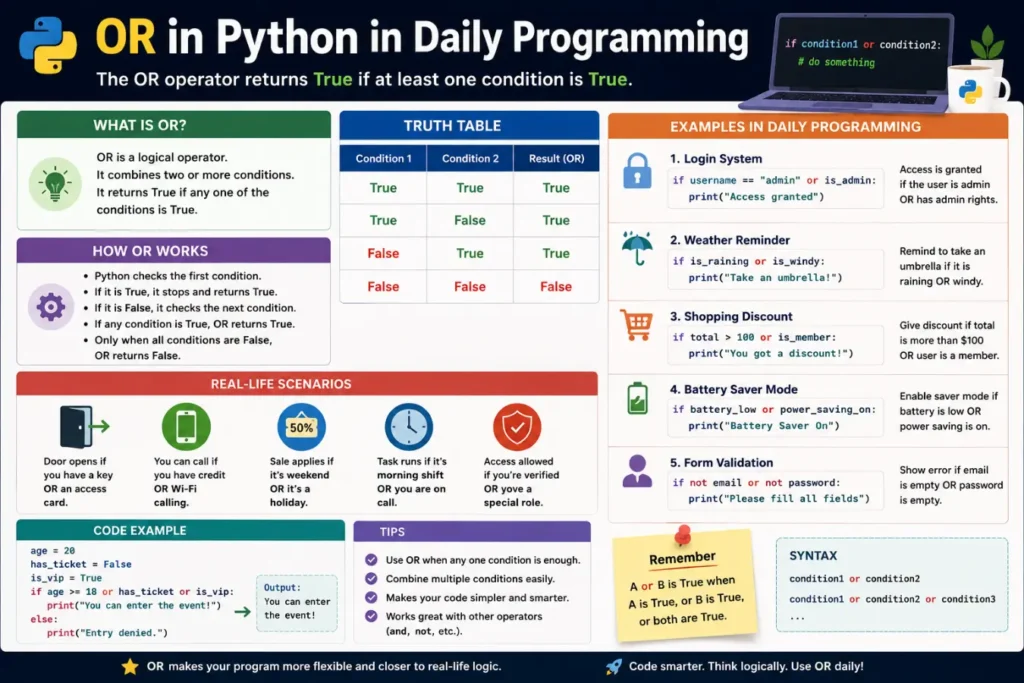
Developers use or in many everyday situations.
You might use it for:
- User permissions
- Form validation
- Search filters
- Default values
- Input handling
- Configuration settings
- Login rules
- Menu choices
- Data validation
- Error handling
For example, a program may accept several commands:
command = "start"

if command == "start" or command == "run":
    print("Program started")
You can also combine or with functions:
if is_logged_in() or is_guest():
    show_homepage()
This makes conditional rules easy to express.
OR in Python: Synonyms and Related Keywords
People may search for the same concept using different terms.
Useful semantic keywords include:
- Python OR operator
- Python logical OR
- Python
oroperator - logical operators in Python
- Boolean OR in Python
- Python Boolean expressions
- Python conditional operators
- Python truthy and falsy values
- Python short-circuit evaluation
orstatement in Python- how to use OR in Python
- Python OR condition
- Python multiple conditions
- Python
orvsand
These terms describe closely related concepts.
Use them naturally when creating Python tutorials or documentation.
Expert Insights About OR in Python
The or operator looks simple, but its behavior has useful details.
First, remember that Python uses short-circuit evaluation. This means Python can stop evaluating an or expression after finding a truthy operand.
Second, remember that or returns an operand. It does not always return a Boolean.
Third, think about readability before shortening your code.
A clever expression is not useful if another developer cannot understand it.
Finally, test edge cases when using or for default values.
Values such as 0, False, and an empty string can trigger the fallback.
These details matter in real Python applications.
Frequently Asked Questions About OR in Python
What is or in Python?
or is a logical operator in Python. It checks multiple expressions and succeeds when at least one expression is truthy.
What is the OR symbol in Python?
Python uses the keyword or for logical OR. It does not use ||.
How do I write OR in a Python if statement?
Use the or keyword between conditions.
if age < 18 or age > 60:
    print("Special category")
Is or the same as || in Python?
No. Python uses or. The || operator causes a syntax error in Python.
What is the difference between and and or in Python?
and requires all relevant conditions to be truthy. or requires at least one condition to be truthy.
Does Python or return True or False?
Not always. Python’s or returns one of its operands. The result can be a string, number, list, or another object.
What is short-circuit evaluation in Python?
Short-circuit evaluation means Python stops checking an or expression after finding a truthy value.
Can I use or with strings in Python?
Yes. Python can use or with strings and other objects.
name = ""
result = name or "Guest"
The result is "Guest"..
Conclusion: Understanding OR in Python
OR in Python helps you combine conditions and make flexible decisions. The or keyword succeeds when at least one expression is truthy.
You can use it with Boolean values, comparisons, strings, lists, functions, and other objects. Python also uses short-circuit evaluation with or.
Remember one important detail. The or operator can return an actual operand instead of a Boolean value.
This behavior makes it useful for fallback values. However, it can also cause mistakes when you overlook Python’s truthy and falsy rules.
Use clear conditions and parentheses when logic becomes complex. Also, choose in when you need to compare one value against several choices.