Alumni or alumnus can be confusing, even for strong English speakers. Both words describe people who studied at a school or university. However, they do not mean exactly the same thing.
The main difference comes from number and traditional Latin grammar. Alumnus refers to one male graduate or former student. Alumni refers to two or more male students or a mixed group.
Modern English often uses alumni more broadly. Schools, colleges, and universities commonly use it for former students as a group.
Knowing the difference helps you write clearer English. It also prevents common grammar mistakes in resumes, emails, websites, and academic writing.
In this guide, you will learn the simple rules. You will also see real-life examples and quick usage tips.
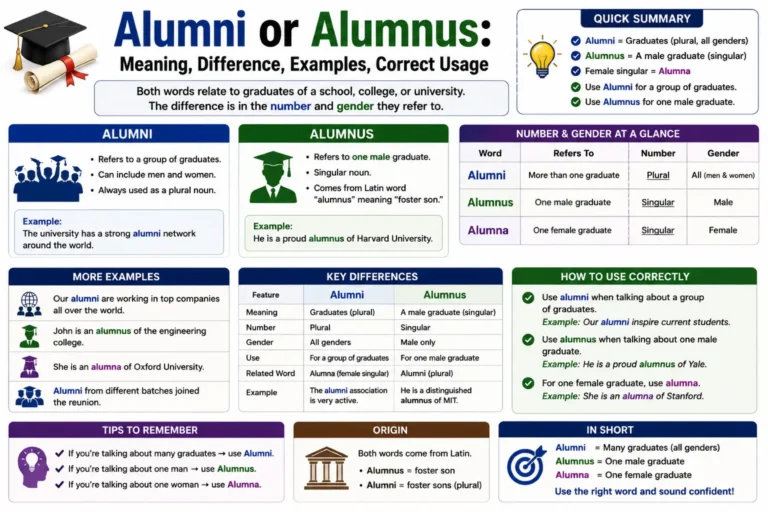
Quick Summary: Alumni or Alumnus?
- Alumnus means one male former student or graduate.
- Alumni traditionally means two or more male former students.
- Alumna means one female former student or graduate.
- Alumnae traditionally means two or more female former students.
- Alumni often describes a group of former students today.
- Use alumnus when talking about one male person.
- Use alumni when talking about several former students.
- Alum works as a gender-neutral informal term for one former student.
What Does Alumnus Mean?
Alumnus means a male former student or graduate of a school, college, or university.
It comes from Latin. The word originally referred to someone who received education or support from an institution.
In modern English, alumnus usually describes a man who attended or graduated from an educational institution.
Examples
- James is an alumnus of Harvard University.
- My brother is an alumnus of this college.
- The university honored a famous alumnus.
Notice that each example talks about one male person.
Therefore, “alumnus” is singular.

What Does Alumni Mean?
Alumni is traditionally the plural form of alumnus.
It means two or more male former students. It can also refer to a mixed group of former students.
For example:
- The school invited its alumni to the annual event.
- Many alumni attended the reunion.
- The university has thousands of alumni around the world.
In everyday English, many institutions use alumni as a general term for former students.
So, you may see “alumni” used for groups containing men and women.
Alumni vs Alumnus: What Is the Difference?
The easiest way to remember the difference is one person versus a group.
| Word | Number | Traditional gender | Meaning |
|---|---|---|---|
| Alumnus | Singular | Male | One male former student |
| Alumni | Plural | Male or mixed group | Two or more former students |
| Alumna | Singular | Female | One female former student |
| Alumnae | Plural | Female | Two or more female former students |
| Alum | Singular | Gender-neutral | One former student |
Simple rule
If you mean one male former student, use alumnus.
If you mean multiple former students, use alumni.
Example
Correct: Ahmed is an alumnus of the university.
Correct: Ahmed and Ali are alumni of the university.
The first sentence describes one person. The second describes two people.
Is Alumni Singular or Plural?
Alumni is traditionally plural.
It refers to more than one former student.
For example:
The university’s alumni are successful leaders.
The verb are fits the plural subject “alumni.”
However, modern organizations sometimes use “alumni” as a collective label. You may see phrases such as “alumni network” or “alumni office.”
These phrases do not mean that “alumni” itself has become a standard singular noun.
For one former student, alumnus, alumna, or alum works better.
Alumnus vs Alumna vs Alumni vs Alumnae
These four words follow traditional Latin-based gender and number patterns.
Alumnus refers to one man.
Alumna refers to one woman.
Alumni traditionally refers to multiple men or a mixed group.
Alumnae traditionally refers to multiple women.
Examples
- One man: He is an alumnus.
- One woman: She is an alumna.
- Several men: They are alumni.
- Several women: They are alumnae.
- Mixed group: They are alumni.
Modern English often avoids these gender distinctions.
Many people simply use alum or alumni.
Real-Life Examples of Alumni or Alumnus
Understanding real situations makes the difference easier.
Example 1: University website
Sarah is an alumna of the University of Michigan.
This sentence identifies one female former student.
Example 2: Company biography
David is an alumnus of Stanford University.
This sentence identifies one male former student.
Example 3: Reunion announcement
The college invited all alumni to its annual reunion.
Here, “alumni” refers to a group.
Example 4: Professional networking
Our alumni work in technology, finance, medicine, and education.
The sentence discusses many former students.
Example 5: Informal conversation
I am an alum of this university.
“Alum” is short, simple, and gender-neutral.

How to Use Alumni in Daily Life
You may encounter alumni in many common situations.
Schools often have alumni associations. These groups connect former students with each other and with their institutions.
You may also see:
- Alumni events
- Alumni newsletters
- Alumni donations
- Alumni networks
- Alumni meetings
- Alumni awards
- Alumni directories
- Alumni interviews
- Alumni chapters
- Alumni scholarships
For example:
The alumni association organized a networking event.
Here, “alumni” works as part of a common institutional phrase.
You do not need to change it to “alumnuses.”

Common Mistakes With Alumni and Alumnus
These words create several common grammar errors.
Mistake 1: Using alumni for one person
Incorrect: He is an alumni of the university.
Better: He is an alumnus of the university.
You can also say:
He is an alum of the university.
Mistake 2: Using alumnus for a group
Incorrect: The alumnus attended the reunion.
This sounds like only one former student attended.
Better: The alumni attended the reunion.
Mistake 3: Writing “alumnuses”
The traditional plural of alumnus is alumni.
Therefore, avoid “alumnuses” in standard English.
Mistake 4: Ignoring context
The best word depends on the number of people and the writing style.
Formal academic writing may use “alumnus” and “alumna.” Modern writing may prefer “alum.”
Tips to Remember the Difference
Here are some easy memory tricks.
Think “one” for alumnus
Alumnus = one male former student.
If you can point to one man, “alumnus” may be the right choice.
Think “many” for alumni
Alumni = a group of former students.
If you are discussing a school community, “alumni” is usually appropriate.
Use “alum” for simple modern English
“Alum” avoids gender distinctions.
For example:
She is an alum of Yale.
He is an alum of Yale.
This form works for both men and women.
Synonyms and Related Terms
Several words can express a similar idea.
Alum
“Alum” is a common informal, gender-neutral term for a former student.
Graduate
“Graduate” usually means someone who completed a course or degree.
However, “graduate” and “alumnus” are not always identical.
A person can attend an institution without graduating. That person may still be an alumnus or alum.
Former student
This phrase is very clear and gender-neutral.
For example:
She is a former student of the college.
Graduate of
This phrase works well in professional writing.
For example:
He is a graduate of Oxford University.
Choose the term that best fits your meaning and audience.
Expert Insights: Why the Difference Matters
Correct word choice improves clarity and credibility.
This matters especially in professional and academic writing. Universities often use these terms in official communications.
An incorrect form can make otherwise strong writing look careless.
However, context matters. Modern English continues to simplify traditional gendered terms.
For that reason, alum has become useful in many situations.
For formal documents, check the style used by the institution you are discussing. Consistency matters more than using complicated vocabulary.
SEO authority tip: When explaining language terms, define the word first. Then provide examples and answer common questions.
This structure helps readers understand the topic quickly.
When Should You Use Alumnus?
Use alumnus when you mean one male former student.
Use it when:
- You discuss one man.
- You write formal or academic content.
- Gender-specific wording fits the context.
- You want to describe one male graduate or former student.
Example
The award was presented to an alumnus of the university.
If the person is female, use alumna in traditional usage.
If you want gender-neutral language, use alum or former student.
When Should You Use Alumni?
Use alumni when you discuss multiple former students.
It works especially well for groups and institutions.
Examples
The alumni returned for homecoming.
The school has a large alumni network.
Alumni supported the new scholarship program.
For a mixed group, “alumni” is also widely accepted in traditional usage.
Frequently Asked Questions About Alumni or Alumnus
Is alumnus singular or plural?
Alumnus is singular. It traditionally refers to one male former student or graduate.
Is alumni singular or plural?
Alumni is traditionally plural. It refers to multiple former students, especially men or a mixed group.
Can a woman be called an alumnus?
Traditional grammar uses alumna for one woman. Modern English often uses alum as a gender-neutral alternative.
What is the plural of alumnus?
The traditional plural is alumni.
What is the female version of alumnus?
The traditional female form is alumna.
What is the plural of alumna?
The traditional plural is alumnae.
Can I use alumni for men and women?
Yes. Alumni commonly refers to a mixed group of former students. Many institutions use it as a general group term.
Is “alum” grammatically correct?
Yes. Alum is a common informal, gender-neutral term for a former student or graduate.
Quick Grammar Cheat Sheet
Remember these four traditional forms:
One man → alumnus
One woman → alumna
Several men or a mixed group → alumni
Several women → alumnae
For modern, gender-neutral writing:
One former student → alum
Several former students → alumni
This simple system covers most everyday situations.
Conclusion: Alumni or Alumnus?
Understanding alumni or alumnus becomes easy once you remember one basic rule.
Alumnus traditionally means one male former student. Alumni traditionally means multiple former students.
For one woman, use alumna. For several women, traditional usage uses alumnae. In modern English, alum offers a simple gender-neutral option.
The right choice depends on number, gender, context, and writing style.
When you write for schools or universities, follow their preferred terminology. For everyday writing, simple terms often work best.