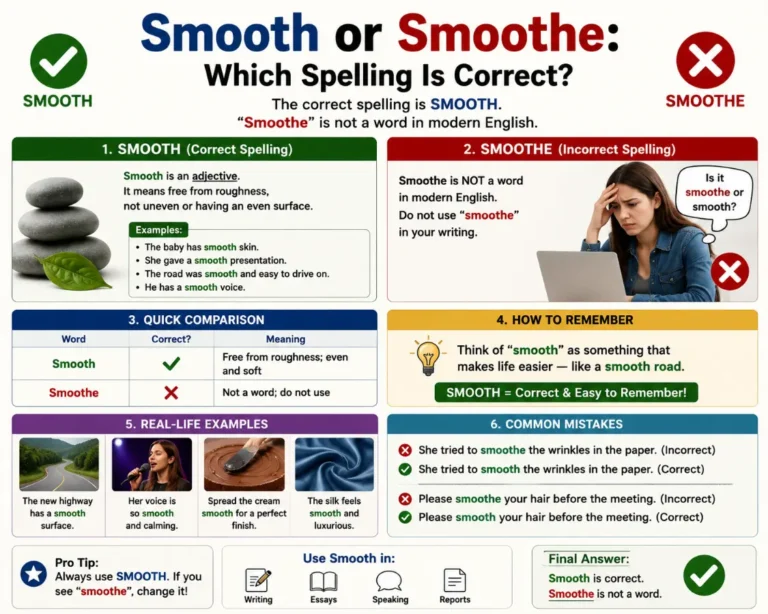
Smooth or smoothe is a common spelling question in English. The correct modern spelling is smooth. You do not need the extra “e” at the end. The word “smooth” can work as an adjective and a verb. It can describe a soft surface or an easy experience. It can also describe the act of making something even. You may see “smoothe” in older texts or unusual contexts. However, modern standard writing usually uses “smooth.” This simple spelling rule can prevent many mistakes. It also helps you write better emails, essays, websites, and social posts. In this guide, you will learn the difference between smooth and smoothe. You will also see clear examples, common mistakes, synonyms, and useful grammar tips.
Quick Summary: Smooth or Smoothe?
- Smooth is the standard modern spelling.
- Smoothe is an old or uncommon variant.
- Use smooth in normal modern writing.
- “Smooth” can work as an adjective.
- “Smooth” can also work as a verb.
- The past tense is smoothed.
- The adverb form is smoothly.
- “Smoothen” exists, but smooth is usually the simpler choice.
- Use “smoothe” only when historical or special usage requires it.
What Does “Smooth” Mean?
“Smooth” has several common meanings.
First, it can describe a surface without bumps or rough areas.
For example:
The table has a smooth surface.
It can also describe something that happens easily.
For example:
The meeting went smoothly.
“Smooth” may also describe a calm or pleasant style.
For example:
She gave a smooth presentation.
The meaning depends on the sentence.
Still, the spelling stays the same.
Smooth or Smoothe: Which Is Correct?
Smooth is the correct choice for modern standard English.
You should normally write:
The fabric feels smooth.
You should not normally write:
The fabric feels smoothe.
The same rule applies when “smooth” works as a verb.
Write:
Please smooth the paper.
Not:
Please smoothe the paper.
Historical sources show that “smoothe” has existed as an alternative or archaic form. Modern usage strongly favors “smooth,” especially in professional writing.
Is “Smoothe” a Real Word?
This question has a slightly more complex answer.
Smoothe has appeared in English, especially in older writing. Some dictionaries and historical sources record it as an alternative form.
However, that does not make it the best choice today.
Modern readers expect smooth.
Therefore, use “smooth” for:
- School assignments
- Business writing
- Blog posts
- Website content
- Emails
- Reports
- Professional documents
- Everyday messages
You may encounter “smoothe” in historical texts. You may also see it in creative names or branding.
In normal writing, however, choose smooth.
Why Do People Write “Smoothe”?
The spelling “smoothe” looks logical to many English learners.
One reason is pronunciation.
The word “smooth” sounds as if it might need an ending like “soothe.” The words “soothe,” “breathe,” and “bathe” also contain a final “e.”
This can create confusion.
However, English spelling does not always follow one simple pattern.
The word is already spelled smooth.
It does not need another letter to become a verb.
Compare these examples:
- The wall is smooth.
- Smooth the wall.
- She smoothed the wall.
- He is smoothing the wall.
- The machine works smoothly.
Notice that the base form stays smooth.
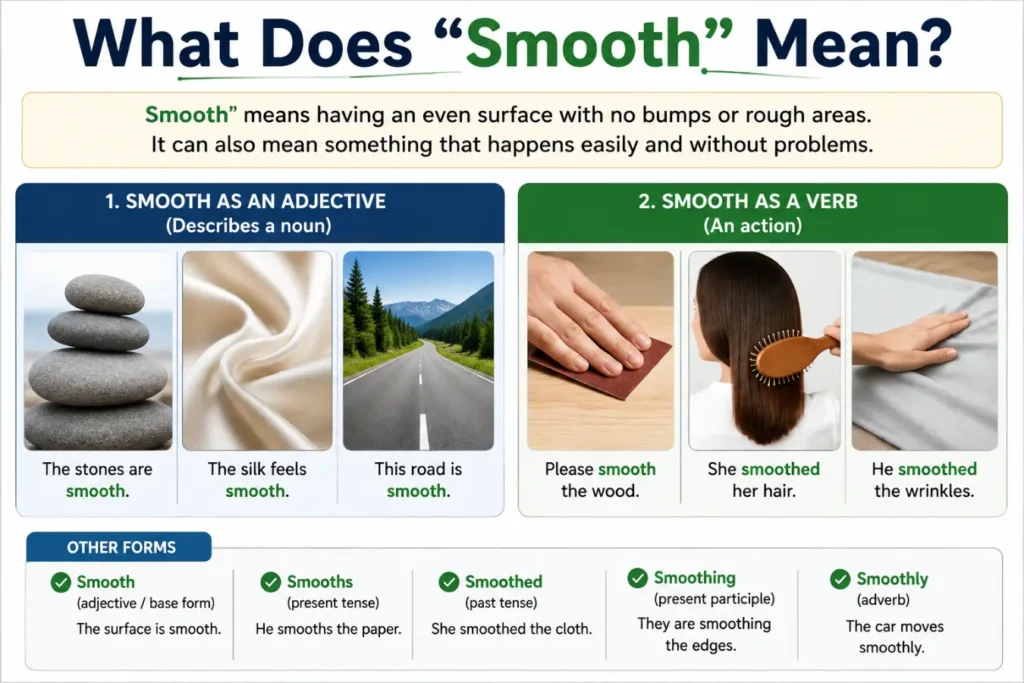
Smooth as an Adjective
“Smooth” often works as an adjective.
An adjective describes a person, place, thing, or idea.
Here are some examples:
- She has smooth skin.
- The road is smooth.
- This paper feels smooth.
- He has a smooth voice.
- The process was smooth.
- We had a smooth journey.
In each example, “smooth” describes something.
It can describe physical texture.
It can also describe an experience, process, or style.
Smooth as a Verb
“Smooth” can also work as a verb.
As a verb, it means to make something even, flat, calm, or less rough.
For example:
Smooth the paper before you fold it.
Another example is:
She smoothed her dress before the meeting.
The verb forms are simple:
| Form | Example |
|---|---|
| Smooth | Smooth the surface. |
| Smooths | He smooths the fabric. |
| Smoothed | She smoothed her hair. |
| Smoothing | They are smoothing the edges. |
Notice something important.
You do not need “smoothe” as the base verb.
Smooth vs Smoothe: Comparison Table
| Feature | Smooth | Smoothe |
| Modern standard spelling | Yes | No |
| Common in everyday English | Yes | No |
| Works as an adjective | Yes | Historical/uncommon |
| Works as a verb | Yes | Historical use exists |
| Used in professional writing | Yes | Usually avoid |
| Past tense | Smoothed | Smoothed |
| Adverb | Smoothly | — |
| Best choice today | Yes | No |
The safest rule is simple:
Use “smooth” in modern English unless you have a specific historical reason to use “smoothe.”
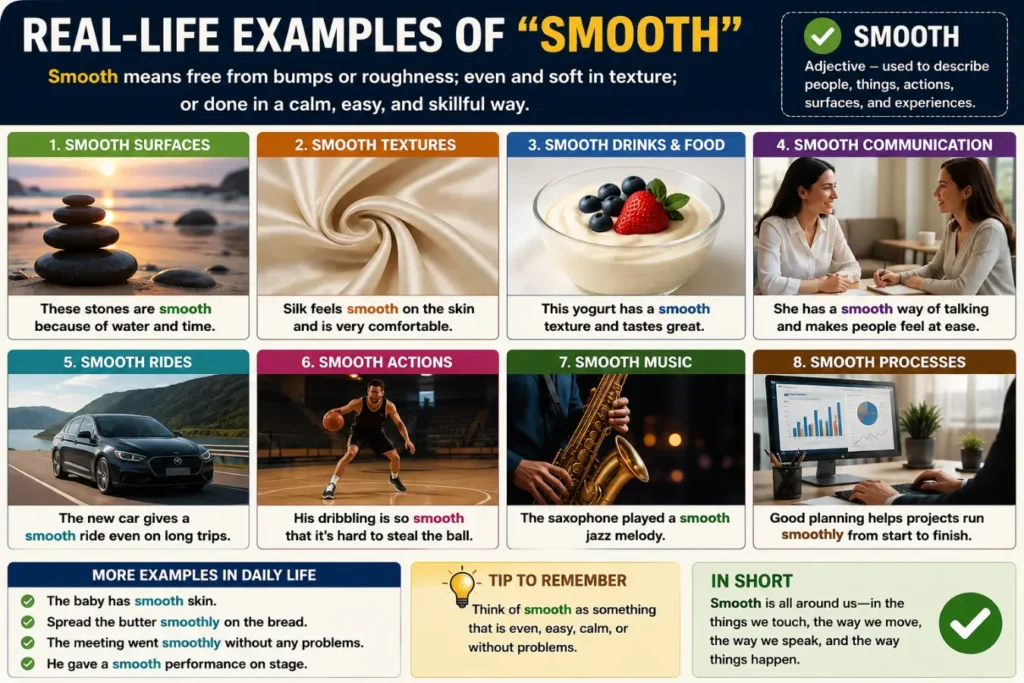
Real-Life Examples of “Smooth”
Here are practical examples from daily life.
Example 1: Clothes
She smoothed her shirt before taking the photo.
Here, “smoothed” is a verb.
Example 2: Skin
This lotion leaves my skin smooth.
Here, “smooth” is an adjective.
Example 3: Roads
The new road provides a smooth ride.
Here, “smooth” describes the ride.
Example 4: Work
The project had a smooth start.
Here, “smooth” describes the process.
Example 5: Conversation
They had a smooth conversation.
Here, “smooth” describes how easily the conversation went.
Example 6: Surface
Use sandpaper to smooth the rough edge.
Here, “smooth” is a verb.
Common Mistakes With Smooth
Many writers make small mistakes with this word.
Mistake 1: Writing “Smoothe”
Incorrect:
The surface feels smoothe.
Correct:
The surface feels smooth.
Mistake 2: Adding “e” Before a Verb
Incorrect:
Please smoothe the paper.
Correct:
Please smooth the paper.
Mistake 3: Using “Smoothes” When “Smooths” Is Intended
For the third-person singular present tense, standard usage uses smooths.
Correct:
She smooths her hair.
Not:
She smoothes her hair.
Some historical and variant usage exists, but “smooths” is the normal modern form.
Mistake 4: Confusing “Smooth” and “Smoothly”
Use smooth as an adjective.
The process was smooth.
Use smoothly as an adverb.
The process went smoothly.
This distinction helps your sentences sound natural.
How to Remember the Correct Spelling
Use this easy memory trick:
Smooth has no extra E.
Think of these examples:
smooth road
smooth skin
smooth surface
smooth process
If you are using the word in normal modern English, leave out the extra “e.”
You can also remember the main verb forms:
smooth → smooths → smoothed → smoothing
This pattern makes the spelling easier to remember.
Smooth vs Smoothly vs Smoothness
These related words have different jobs.
Smooth
Use it as an adjective or verb.
The surface is smooth.
Smooth the surface.
Smoothly
Use it as an adverb.
Everything went smoothly.
Smoothness
Use it as a noun.
The smoothness of the fabric felt pleasant.
Knowing these forms can help improve your grammar.
Smooth Synonyms and Related Words
The best synonym depends on the context.
A physical surface, you can use:
- Even
- Flat
- Soft
- Polished
- Sleek
- Level
For an easy experience, you can use:
- Easy
- Effortless
- Seamless
- Trouble-free
- Simple
- Uninterrupted
For a person’s style, you might use:
- Polished
- Confident
- Charming
- Refined
- Graceful
Do not treat every synonym as an exact replacement.
The meaning can change with the context.
Smooth vs Polished: Are They the Same?
“Smooth” and “polished” can overlap.
However, they do not always mean the same thing.
Smooth focuses on an even or pleasant surface.
The stone feels smooth.
Polished often suggests a refined, finished, or shiny quality.
The table has a polished finish.
The same difference can appear in writing.
A smooth paragraph flows easily.
A polished paragraph looks carefully edited.
Smooth vs Smoothen
“Smoothen” is another word that sometimes causes confusion.
It can mean to make something smoother.
However, smooth is usually the simpler and more natural verb.
Compare:
Smooth the surface.
Smoothen the surface.
The first sentence is more direct.
For most everyday writing, choose smooth.
Garner’s Modern English Usage also notes that “smoothen” is less preferred than “smooth.”
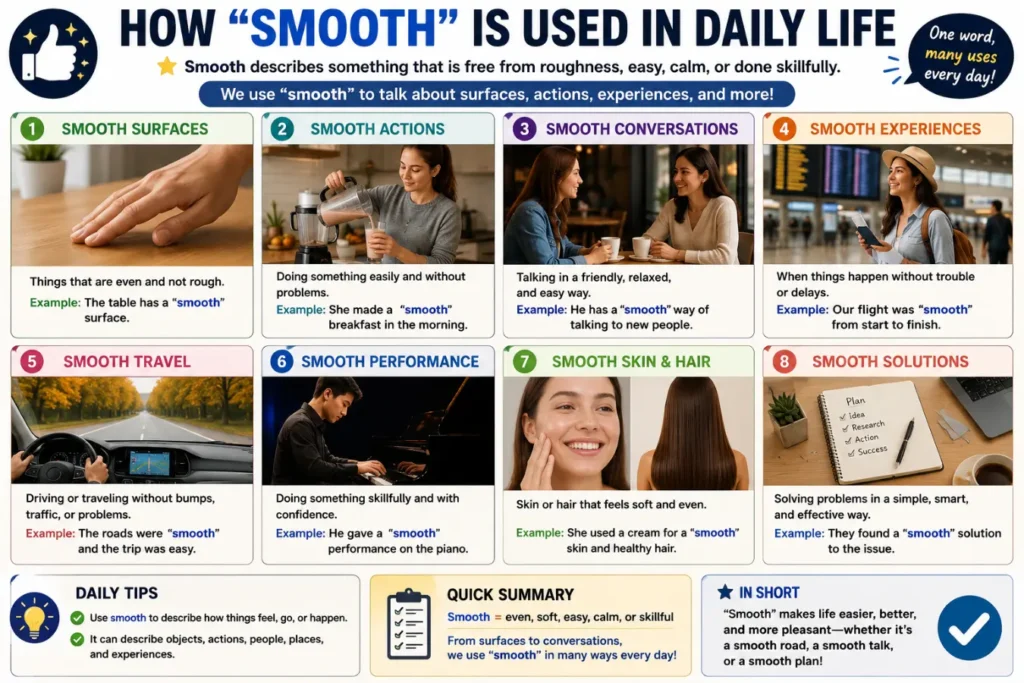
How “Smooth” Is Used in Daily Life
You probably use the idea of “smooth” every day.
You may describe:
- Smooth skin
- Smooth hair
- Smooth roads
- Smooth paper
- Smooth fabric
- Smooth coffee
- Smooth movement
- Smooth communication
- Smooth teamwork
- Smooth travel
- Smooth business processes
The word works in both physical and abstract situations.
For example:
The silk feels smooth.
This describes texture.
But:
The event went smoothly.
This describes an experience.
That flexibility makes “smooth” a very useful English word.
Expert Insights: Why This Spelling Matters
Clear spelling builds trust.
A small spelling mistake can distract readers. It can also make professional content look less polished.
For websites, this matters even more.
Good content should answer the reader’s question quickly. It should also use natural language and accurate grammar.
For the keyword “smooth or smoothe,” the strongest answer is simple:
Use “smooth” in modern standard English.
You should also avoid forcing the keyword into every paragraph.
Natural language improves readability.
It also helps your content answer related searches.
SEO Authority Tips
- Answer the main question near the beginning.
- Use clear H2 and H3 headings.
- Add examples that match search intent.
- Include related terms naturally.
- Use short paragraphs.
- Explain grammar with simple examples.
- Add an FAQ section for common questions.
- Link to related grammar guides on your website.
- Update the article when language references change.
Internal Linking Suggestions
To strengthen this article, add links to related pages on your website.
Good internal link ideas include:
- Smooth vs Smoothly
- Smooth vs Smoothen
- Common English Spelling Mistakes
- Adjective vs Adverb
- Commonly Confused English Words
- How to Improve English Grammar
- English Words That Are Often Misspelled
Use descriptive anchor text.
Avoid generic anchors such as “click here.”
FAQs About Smooth or Smoothe
Is it smooth or smoothe?
Smooth is the standard modern spelling. “Smoothe” is an old or uncommon variant.
Is smoothe a correct English word?
“Smoothe” has historical use, but it is not the normal modern spelling. Use smooth in everyday and professional writing.
How do you spell smooth?
The correct spelling is smooth.
It has no final “e.”
Can smooth be a verb?
Yes. “Smooth” can work as a verb.
For example:
Smooth the paper.
What is the past tense of smooth?
The past tense is smoothed.
Example:
She smoothed the fabric.
Is “smoothes” or “smooths” correct?
Smooths is the standard modern form.
Example:
He smooths his hair.
Is smoothen correct English?
“Smoothen” exists, but it is less common. In most cases, smooth is the clearer choice.
What is the adverb of smooth?
The adverb is smoothly.
Example:
The meeting went smoothly.
Conclusion: Smooth or Smoothe?
When choosing smooth or smoothe, the answer is simple. Use smooth in modern standard English. It works as both an adjective and a verb. You can describe a smooth surface, a smooth process, or a smooth voice. You can also smooth a surface or smooth your clothes. The word “smoothe” has appeared in historical English, so you may find it in older texts. However, it is not the normal choice for modern writing.
Remember the easiest rule:
Smooth = modern standard spelling.
Smoothe = historical or uncommon variant.
If you are writing an email, essay, blog post, or business document, choose smooth. It is clear, familiar, and correct for modern usage.