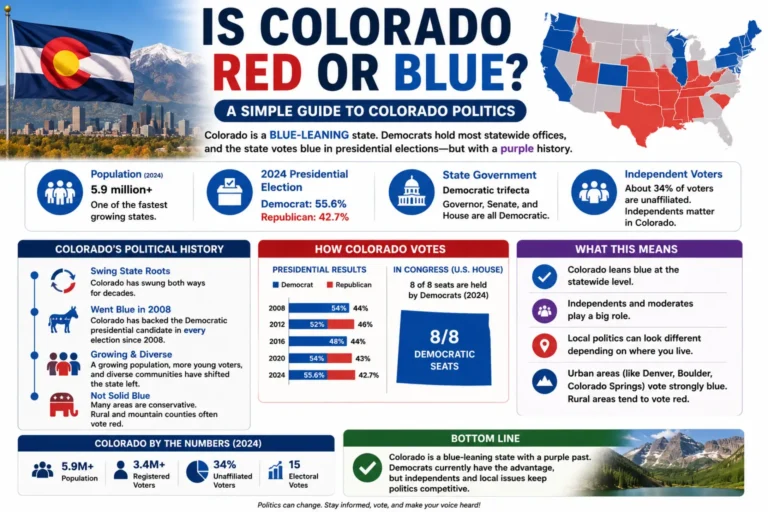
Is Colorado red or blue? Colorado is generally considered a blue state in modern national politics. Democrats have won the state in recent presidential elections. Colorado also has strong Democratic support in many statewide races. However, the state is not politically uniform. Rural areas often lean Republican, while Denver and many mountain communities often lean Democratic. Suburban voters can also shift election results. In the 2024 presidential election, Kamala Harris won Colorado with about 54.0% of the vote. Donald Trump received about 43.1%.
This mix makes Colorado more interesting than a simple red or blue label. Its political map changes from region to region. Local elections can also produce different results. So, what color is Colorado today? Blue overall, with important red areas and competitive voters.
Quick Summary
- Colorado is generally a blue state.
- Democrats have recently won Colorado’s presidential elections.
- Kamala Harris won Colorado in 2024.
- Rural Colorado often leans Republican.
- Denver and many urban areas strongly favor Democrats.
- Some suburban and mountain communities are politically mixed.
- Colorado still has many independent or unaffiliated voters.
- A statewide label does not describe every Colorado county.
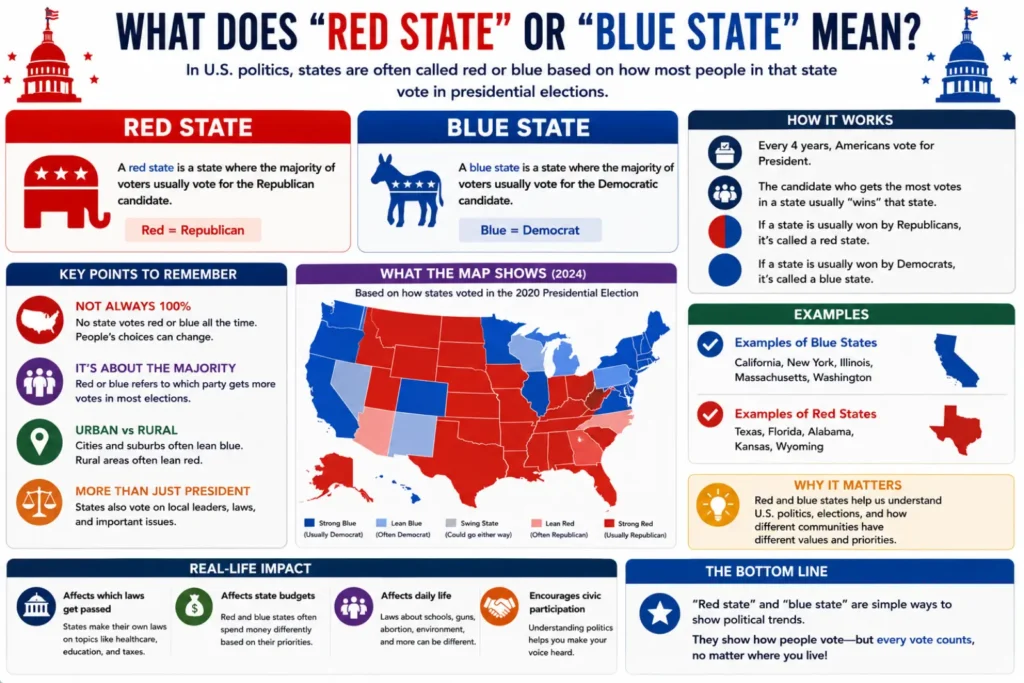
What Does “Red State” or “Blue State” Mean?
The terms red state and blue state describe voting patterns in the United States.
A red state usually supports Republican candidates.
A blue state usually supports Democratic candidates.
These labels come from election maps and political reporting.
They do not mean every person in a state supports one party.
Colorado voters have different views on taxes, energy, housing, guns, healthcare, and other issues.
Therefore, calling Colorado blue describes a broad voting trend.
It does not describe every voter.
Why Is Colorado Considered a Blue State?
Colorado is considered blue because Democrats have performed strongly in recent statewide elections.
The clearest example is the presidential vote.
In 2024, Colorado gave Kamala Harris 1,728,159 votes.
Donald Trump received 1,377,441 votes.
Harris therefore won the state by more than 350,000 votes.
Colorado also has a strong Democratic presence in major population centers.
Denver is the most obvious example.
Other urban and suburban communities also contribute large numbers of Democratic votes.
This pattern has helped Colorado become a reliable Democratic state in recent presidential elections.
However, Republican support remains strong in many parts of Colorado.
That creates a more complex political map.
Is Colorado a Democrat or Republican State?
Colorado currently leans Democratic at the statewide level.
That does not make Colorado a completely Democratic state.
Republicans remain competitive in many rural counties.
They also have strong support in parts of eastern Colorado and some western communities.
The political divide often follows geography.
Large cities tend to favor Democrats.
Rural communities often favor Republicans.
Suburbs can move between the parties.
This creates a state with different political regions.
The best short answer is:
Colorado is blue statewide, but parts of Colorado are strongly red.
Colorado Red vs. Blue: Political Comparison
| Political pattern | Blue-leaning Colorado | Red-leaning Colorado |
|---|---|---|
| Typical party | Democratic | Republican |
| Common location | Denver and urban areas | Rural and eastern areas |
| Major voting issues | Climate, healthcare, social policy | Taxes, guns, energy, limited government |
| Population pattern | Dense cities and suburbs | Smaller towns and rural communities |
| Recent presidential trend | Democratic | Republican |
| Political identity | Progressive or moderate Democratic | Conservative or Republican |
This table gives a general picture.
It does not predict how every county or voter will vote.
Which Parts of Colorado Are More Democratic?
Denver is one of Colorado’s strongest Democratic areas.
The city has consistently supported Democratic candidates.
Boulder also has a strong Democratic reputation.
Many communities along the Front Range also lean Democratic.
The Front Range includes major population centers such as Denver, Boulder, Fort Collins, and Colorado Springs.
However, these communities do not all vote the same way.
For example, Colorado Springs has historically had stronger Republican support than Denver.
Some mountain communities also vote Democratic.
Places with large tourism economies can have different political patterns.
Therefore, Colorado’s blue areas are not limited to one part of the state.
Which Parts of Colorado Are More Republican?
Many rural areas of Colorado lean Republican.
Eastern Colorado provides several examples.
Agricultural communities often have stronger Republican support.
Parts of western Colorado also lean Republican.
Some counties have voted heavily for Republican presidential candidates.
The 2024 official election results show this geographic divide.
For example, Trump won several rural counties by large margins.
Harris won heavily populated urban counties by large margins.
This matters because population size affects statewide elections.
A large city can contain more voters than many rural counties combined.
As a result, rural Republican support does not necessarily produce a Republican statewide victory.
How Did Colorado Become More Blue?
Colorado was not always viewed as a solid blue state.
Its political history includes many competitive elections.
Over time, population growth changed the state’s political balance.
Denver and nearby suburbs grew rapidly.
The state also attracted younger professionals and highly educated workers.
Many new residents moved into urban and mountain communities.
These demographic changes helped Democrats gain strength.
Political preferences also changed among some suburban voters.
At the same time, Republicans maintained strong support in rural areas.
This created today’s political divide.
Colorado became increasingly reliable for Democrats at the presidential level.
Yet its Republican regions remain important.
What Happened in the 2024 Presidential Election?
The 2024 presidential election provides a clear answer to the question.
Kamala Harris won Colorado.
She received 1,728,159 votes.
Donald Trump received 1,377,441 votes.
Harris won about 54.0% of the vote.
Trump received about 43.1%.
Colorado then sent all 10 of its Electoral College votes to Harris.
The state’s electors formally cast those votes in December 2024.
This result supports the view that Colorado remains blue in presidential politics.
However, the result does not mean every Colorado county voted Democratic.
The official county results show major differences across the state.
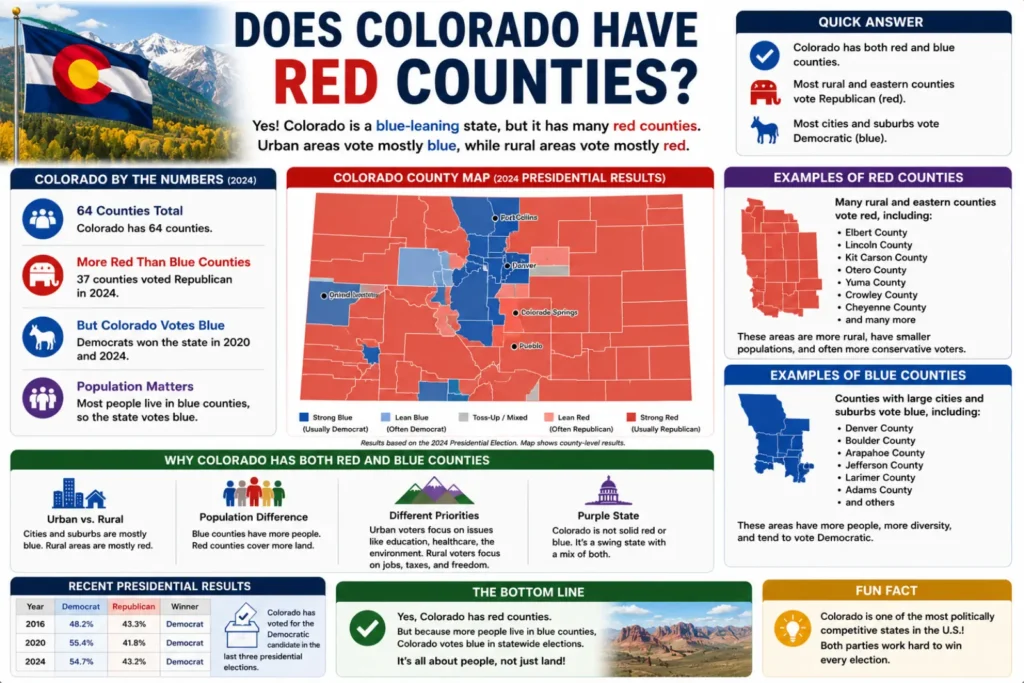
Does Colorado Have Red Counties?
Yes.
Colorado has many counties where Republicans perform strongly.
Some rural counties give Republican candidates large margins.
This creates a red-and-blue political map.
The state’s biggest Democratic advantage comes from population centers.
Denver County is a major example.
Boulder County is another strong Democratic area.
Meanwhile, several rural counties have strong Republican voting patterns.
So, asking whether Colorado has red areas has a simple answer.
Yes, many parts of Colorado are red.
The state itself remains blue because of its overall statewide voting pattern.
Is Colorado a Swing State?
Colorado is less of a swing state today than it was in earlier periods.
A swing state usually has close elections.
Both major parties have a realistic chance of winning.
Colorado has moved toward Democrats in recent presidential elections.
That makes it less competitive at the presidential level.
Still, political conditions can change.
Voters can change their preferences.
Candidates can also perform differently in local elections.
Economic issues may influence future elections.
Therefore, it is better to call Colorado a blue-leaning state rather than an impossible state for Republicans.
Common Mistakes About Colorado Politics
Mistake 1: Saying Every Colorado Voter Is Democratic
That is not true.
Colorado has millions of voters with different political views.
Republicans have strong regional support.
Mistake 2: Calling Every Rural County Blue
Many rural counties lean Republican.
Election results show major differences between counties.
Mistake 3: Assuming Denver Represents the Entire State
Denver is politically important.
However, Colorado includes large rural and suburban regions.
Those regions have different voting patterns.
Mistake 4: Using One Election as Permanent Proof
Political trends can change.
One election cannot guarantee future results.
Look at several elections before making a long-term judgment.
Mistake 5: Ignoring Unaffiliated Voters
Not every Colorado voter belongs to a major political party.
Colorado election rules recognize unaffiliated voters.
The state also uses “Unaffiliated” when voters select no qualified political party affiliation in certain registration situations.
How to Understand Colorado’s Political Map
Use three factors when studying Colorado politics.
First, look at population.
Large cities can have a major effect on statewide results.
Second, look at geography.
Urban, suburban, mountain, and rural areas often vote differently.
Third, look at the election.
Presidential elections may produce different patterns than local races.
These three factors give a clearer picture.
They also prevent oversimplified political conclusions.
Real-Life Examples of Colorado’s Political Divide
Imagine a voter in Denver.
That voter lives in a heavily Democratic area.
Now imagine a voter in a small eastern Colorado farming community.
That voter may live in a strongly Republican county.
Both voters live in Colorado.
Yet their local political environments can look completely different.
Now consider a suburban voter.
That voter may support one party for president and another party locally.
This is why statewide labels have limits.
They describe broad patterns rather than individual political beliefs.
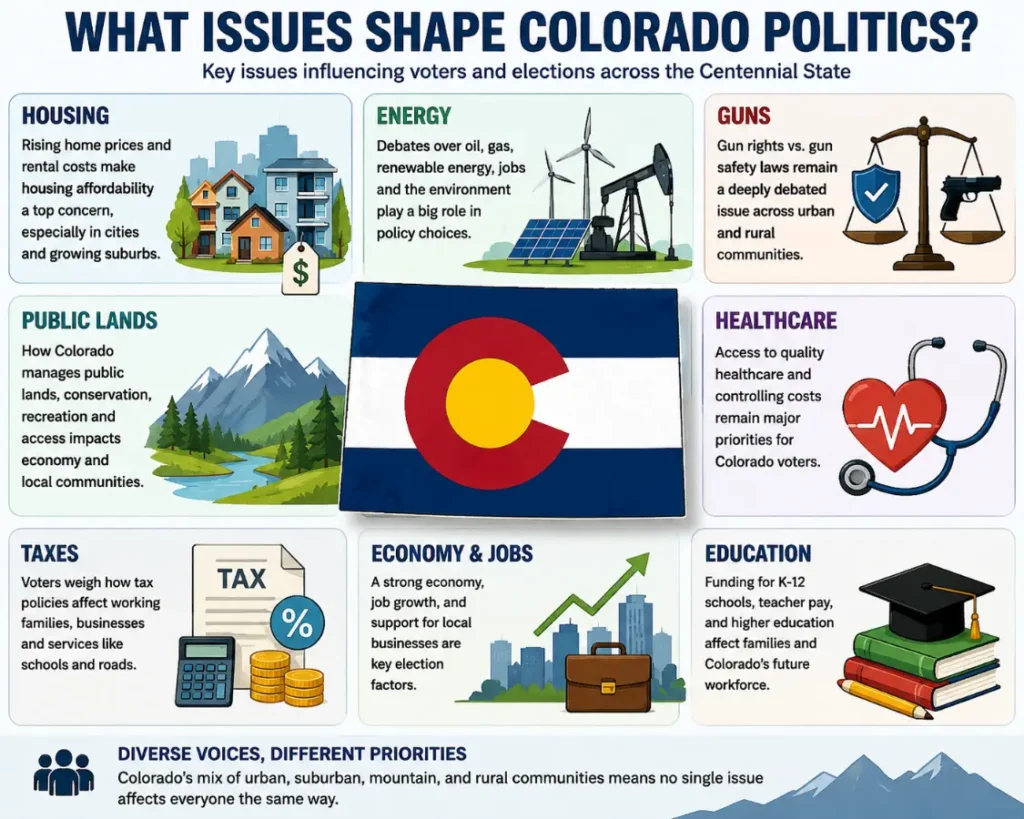
What Issues Shape Colorado Politics?
Several issues can influence Colorado voters.
Housing
Housing costs matter in growing cities.
Affordability can influence both urban and suburban voters.
Energy
Colorado has important oil, gas, renewable energy, and environmental debates.
Energy policy can divide voters across regions.
Guns
Gun policy remains an important political issue.
Republican and Democratic voters often have different views on regulations.
Public Lands
Colorado has extensive public lands and outdoor recreation.
Land use and conservation can shape local politics.
Healthcare
Healthcare access and cost remain important election issues.
Taxes
Tax policy can affect voters and businesses.
Different regions can have different economic priorities.
Colorado Political Synonyms and LSI Keywords
Use these related terms when researching Colorado politics:
- Colorado political affiliation
- Colorado voting trends
- Colorado blue state
- Colorado red state
- Colorado election results
- Colorado Democrats
- Colorado Republicans
- Colorado political map
- Colorado voting history
- Colorado presidential elections
- blue states
- red states
- Colorado swing state
- Colorado conservative areas
- Colorado liberal areas
- Colorado independent voters
- Colorado county election results
- Colorado political demographics
- Colorado voter trends
These terms help explain the topic naturally.
They also cover different search intents around the primary keyword.
Expert Insight: Why the Red or Blue Label Matters
The phrase “red or blue” provides a useful starting point.
However, serious political analysis needs more context.
Election experts should examine several election cycles.
They should also compare presidential, congressional, and local races.
County-level results can reveal major regional differences.
Population growth also matters.
Colorado’s political future depends on voters, migration, turnout, candidates, and national issues.
Therefore, the strongest answer is not simply “blue.”
A better answer is “Colorado is blue statewide, with strong red regions.”
That description reflects the state’s political diversity.
For accurate election information, readers should use official Colorado election resources. The Colorado Secretary of State provides election laws, results, and voter resources.
Is Colorado Red or Blue? FAQs
Is Colorado a red or blue state?
Colorado is generally a blue state.
Democrats have performed strongly in recent statewide presidential elections.
Did Colorado vote for Trump in 2024?
No.
Colorado voted for Kamala Harris in the 2024 presidential election.
Harris received about 54% of the statewide vote.
Is Denver red or blue?
Denver is strongly Democratic.
It is one of Colorado’s strongest blue areas.
Are there Republican areas in Colorado?
Yes.
Many rural and eastern Colorado counties strongly support Republicans.
Is Colorado a swing state?
Colorado is currently more reliably Democratic than a typical swing state.
However, local and future elections can remain competitive.
Why is Colorado considered blue?
Large population centers and changing voter patterns have helped Democrats.
Recent presidential results also support the blue label.
Can Colorado become red again?
Yes, political trends can change.
Party support depends on voters, candidates, issues, turnout, and future elections.
Does every county in Colorado vote blue?
No.
Colorado contains both strongly Democratic and strongly Republican counties.
Conclusion: Is Colorado Red or Blue?
So, is Colorado red or blue? Colorado is best described as a blue state in modern national politics. Democrats have won recent presidential elections in Colorado. In 2024, Kamala Harris defeated Donald Trump statewide.
However, Colorado is not politically uniform.
Denver and other major population centers strongly support Democrats.
Many rural counties lean Republican.
Some suburban and mountain communities have more mixed voting patterns.
This creates a clear statewide blue trend with important red regions.
The simplest answer is blue.
The more accurate answer is blue statewide, but politically diverse across its counties.
When studying Colorado politics, always check recent election results. Avoid judging the entire state from one city or county. That approach gives a clearer and more accurate picture of Colorado’s political identity.