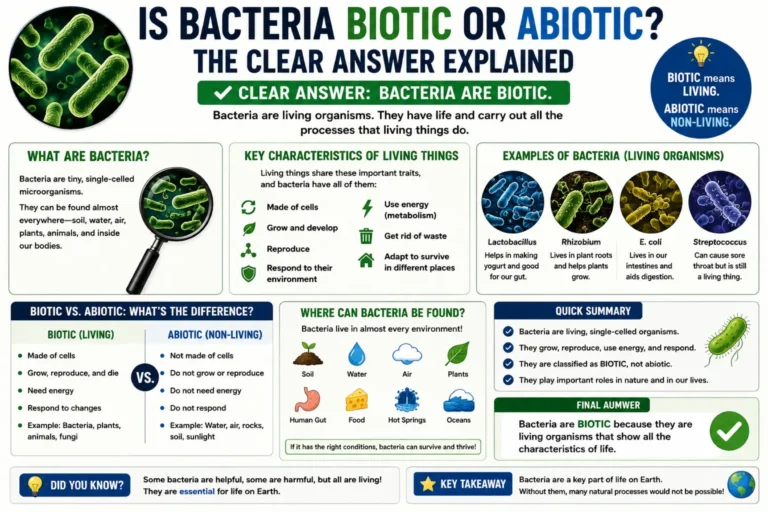
Is bacteria biotic or abiotic? Bacteria are biotic because they are living organisms. They can grow, reproduce, use energy, and respond to their surroundings. These traits separate them from non-living things. Understanding this difference helps you learn basic biology and ecology. It also makes science questions much easier to answer. Bacteria may look tiny and simple, but they show clear signs of life. They exist in soil, water, food, and inside living organisms. Some bacteria help plants grow and support healthy ecosystems. Other bacteria can cause disease. The key point stays the same. Bacteria belong to the living, or biotic, part of an ecosystem. In this guide, you will learn why bacteria are biotic. You will also see how biotic and abiotic factors differ.
Quick Summary: Are Bacteria Biotic or Abiotic?
- Bacteria are biotic factors.
- Bacteria are living, single-celled organisms.
- They can grow, reproduce, and use energy.
- They can respond to changes around them.
- Soil, water, sunlight, air, and temperature are abiotic factors.
- Bacteria can interact with both biotic and abiotic factors.
- Some bacteria help ecosystems, plants, animals, and humans.
- Other bacteria can cause infections or spoil food.
- Dormant bacterial spores remain biological material, even when highly inactive.
What Does Biotic Mean?
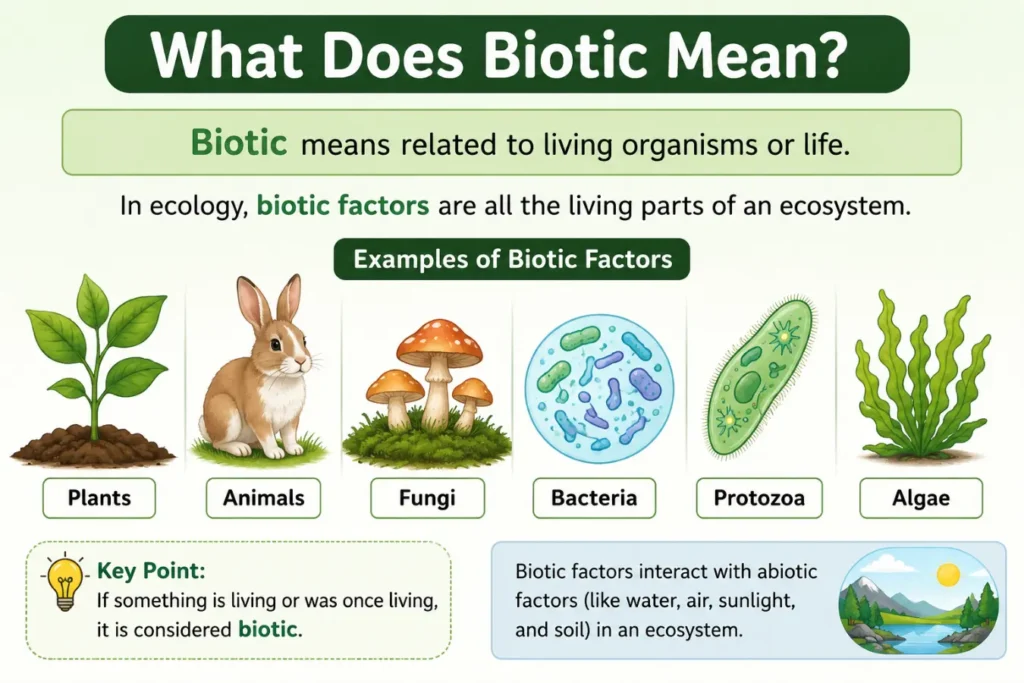
Biotic means related to living organisms or life.
In ecology, biotic factors include all living parts of an ecosystem. These factors include plants, animals, fungi, bacteria, and other microorganisms.
For example, a tree is biotic because it grows and reproduces. A bird is also biotic because it carries out life processes.
Bacteria fit this definition.
They are microscopic organisms made of cells. Most bacteria have one cell. Despite their small size, they perform important life functions.
Therefore, bacteria are classified as biotic factors.
What Does Abiotic Mean?
Abiotic means non-living.
Abiotic factors do not carry out biological life processes. They include physical and chemical parts of an environment.
Common abiotic factors include:
- Water
- Sunlight
- Air
- Temperature
- Soil minerals
- Rocks
- Humidity
- Salinity
- pH
For example, sunlight is abiotic because it is not alive. Water is also abiotic because it does not grow or reproduce.
These factors still affect living organisms.
Temperature can change bacterial growth. Water availability can affect plant health. Soil pH can influence which organisms survive.
Thus, ecosystems contain both biotic and abiotic factors.
Why Are Bacteria Biotic?
Bacteria are biotic because they show several characteristics of life.
First, bacteria can grow. They take in nutrients and use them to build new cellular material.
Second, bacteria can reproduce. Many bacteria reproduce through a process called binary fission.
Third, bacteria use energy. Their cells carry out chemical reactions that support survival and growth.
Fourth, bacteria can respond to their environment. Changes in nutrients, temperature, chemicals, and other conditions can affect their behavior.
Bacteria also contain genetic material. Their DNA provides instructions for many cellular processes.
These characteristics clearly place bacteria in the living world.
How Do Bacteria Fit Into an Ecosystem?
Bacteria play many roles in ecosystems.
Some bacteria act as decomposers. They break down dead organic material and return nutrients to the environment.
Other bacteria help plants obtain nutrients. Certain soil bacteria take part in the nitrogen cycle.
Bacteria can also form relationships with animals and plants. Some relationships benefit both organisms.
For example, bacteria in the digestive systems of animals can help process certain nutrients.
Bacteria also interact with abiotic factors. Water, temperature, oxygen, nutrients, and pH can affect bacterial growth.
This connection shows why ecology studies both living and non-living factors together.
Biotic vs Abiotic: What Is the Difference?
The simplest difference is this:
Biotic factors are living or biological. Abiotic factors are non-living physical or chemical factors.
| Feature | Biotic | Abiotic |
|---|---|---|
| Meaning | Related to living things | Related to non-living things |
| Living? | Yes | No |
| Examples | Bacteria, plants, animals, fungi | Water, sunlight, rocks, temperature |
| Can reproduce? | Living organisms can | No |
| Contains biological systems? | Yes | No |
| Role in ecosystems | Living component | Physical or chemical component |
Bacteria belong in the biotic column.
Water, sunlight, temperature, and minerals belong in the abiotic column.
Are All Microorganisms Biotic?
Most microorganisms that are living organisms are biotic.
Bacteria, fungi, protozoa, and microscopic algae are examples of living microorganisms.
However, the word microorganism describes size, not one specific type of life.
Viruses create an important exception in basic biology discussions. Scientists debate how to classify viruses as living or non-living because they cannot reproduce independently.
That debate does not change the answer about bacteria.
Bacteria are living cellular organisms, so they are biotic.
Are Bacterial Spores Biotic or Abiotic?
Some bacteria can form highly resistant structures called endospores.
An endospore helps certain bacteria survive harsh conditions. It can remain inactive for long periods.
Because an endospore has very low metabolic activity, it may seem non-living.
However, it remains a biological structure produced by a living bacterial cell. It does not become an ordinary abiotic object such as a rock or mineral.
For school-level biology, bacterial spores should therefore be understood as biotic biological material.
The important distinction is between being inactive and being non-living.
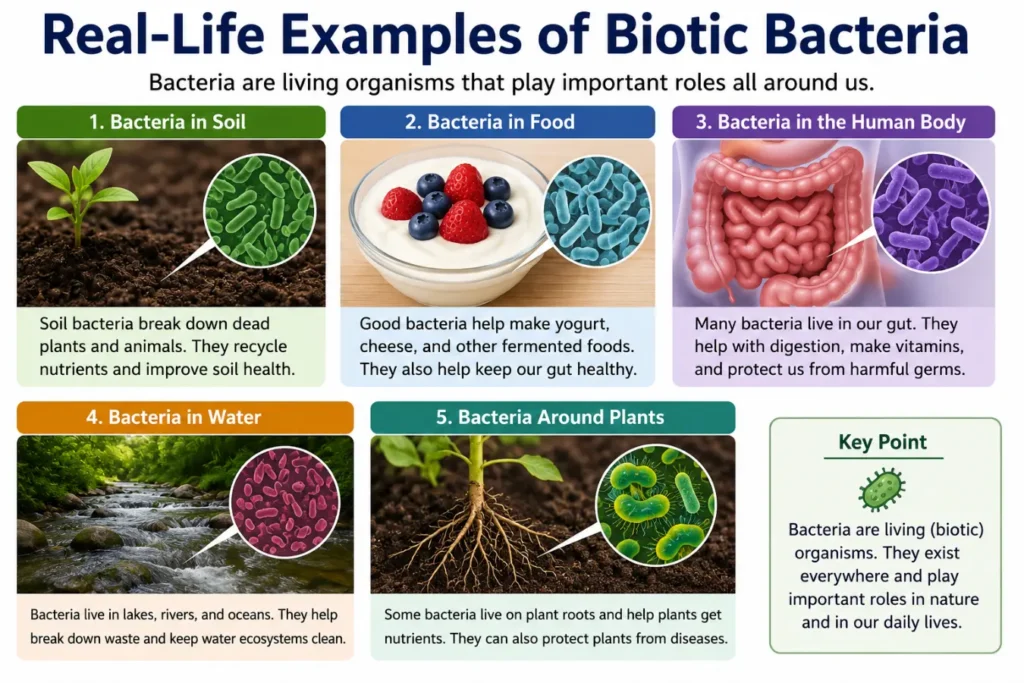
Real-Life Examples of Biotic Bacteria
Bacteria exist almost everywhere.
1. Bacteria in Soil
Soil contains many bacterial species. Some help break down organic matter.
Others take part in nutrient cycles. These processes help keep ecosystems functioning.
2. Bacteria in Food
Certain bacteria help make foods such as yogurt and some fermented products.
Other bacteria can spoil food. Some can also cause foodborne illness.
3. Bacteria in the Human Body
The human body hosts many bacteria.
They live on the skin and in areas such as the digestive tract. Many have harmless or helpful relationships with humans.
4. Bacteria in Water
Bacteria can live in freshwater, oceans, lakes, rivers, and other aquatic environments.
Water conditions can influence which bacterial communities survive.
5. Bacteria Around Plants
Some soil bacteria interact with plant roots.
Certain bacteria can help plants obtain nutrients or improve nutrient availability.
These examples all show bacteria functioning as living parts of ecosystems.
Common Mistakes About Bacteria and Biotic Factors
Students often make a few simple mistakes with this topic.
Mistake 1: Thinking “Tiny” Means Abiotic
Size does not decide whether something is living.
Bacteria are tiny, but they are living organisms.
Mistake 2: Confusing Bacteria With Viruses
Bacteria and viruses are different biological entities.
Bacteria are cellular organisms. Viruses do not have the same cellular structure.
Mistake 3: Calling Soil Fully Abiotic
Soil contains abiotic materials such as minerals and water.
However, soil also contains living organisms, including bacteria, fungi, plants, and small animals.
Therefore, soil itself can contain both biotic and abiotic components.
Mistake 4: Thinking Inactive Means Abiotic
An inactive biological structure does not automatically become non-living.
Bacterial endospores provide a useful example.
Mistake 5: Thinking All Bacteria Are Harmful
Some bacteria cause disease.
However, many bacteria have useful roles in nature, food production, and biological processes.
How to Remember the Answer Easily
Use this simple memory trick:
Biotic = biology = living.
Abiotic = not living.
Then ask one question:
“Is the thing a living organism?”
If the answer is yes, think biotic.
Bacteria are living organisms.
Therefore:
Bacteria → living → biotic.
For multiple-choice questions, this shortcut can help you answer quickly.
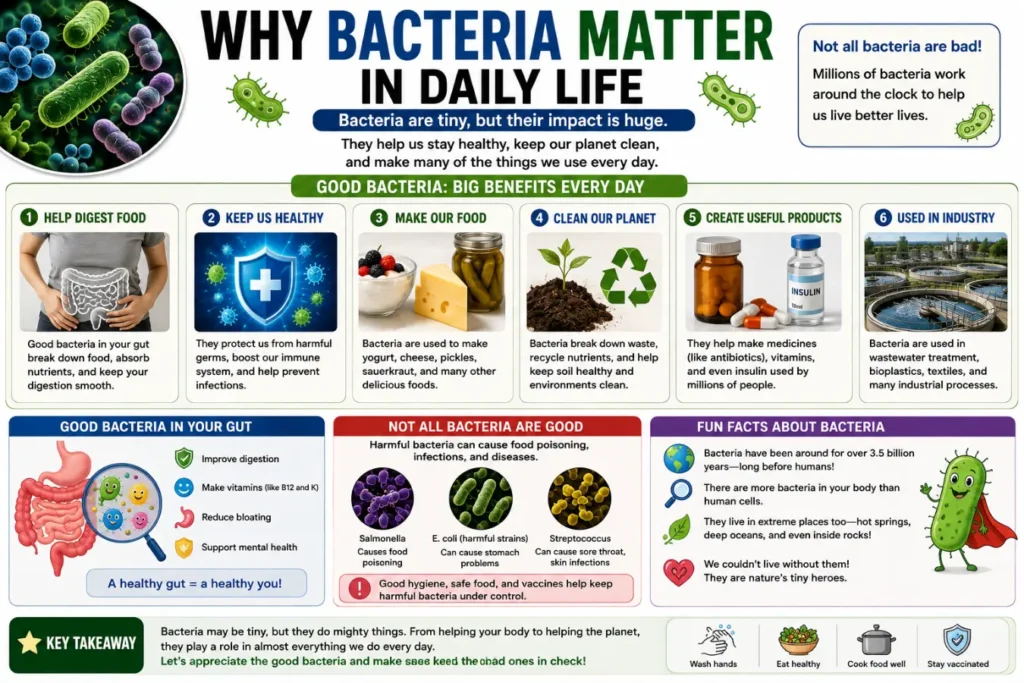
Why Bacteria Matter in Daily Life
Bacteria affect everyday life in many ways.
They help recycle nutrients in nature. They can influence soil health and plant growth.
Some bacteria help produce fermented foods. Others can affect food safety.
Bacteria also live naturally on and inside the human body.
At the same time, some bacterial species can cause disease. This makes hygiene, food safety, and proper medical care important.
The word “bacteria” does not mean “bad.”
It simply describes a large group of microscopic organisms with many different roles.
Biotic and Abiotic Factors Work Together
Biotic and abiotic factors do not work separately.
They constantly interact.
For example, bacteria need suitable environmental conditions to grow. Temperature, moisture, oxygen, nutrients, and pH can all affect bacterial activity.
At the same time, bacteria can change their environment.
Decomposer bacteria can break down organic material. This process releases nutrients into soil and water.
This creates a two-way relationship.
Abiotic conditions affect bacteria, while bacterial activity can influence the environment.
This relationship forms an important part of ecology.
Synonyms and Related SEO Keywords
Readers may search for this topic using different terms.
Useful related phrases include:
- Is bacteria biotic or abiotic?
- Are bacteria biotic factors?
- Is bacteria a biotic factor?
- Bacteria biotic factor meaning
- Biotic and abiotic factors
- Living and non-living factors
- Are microorganisms biotic?
- Is bacteria a living organism?
- Bacteria in an ecosystem
- Examples of biotic factors
- Examples of abiotic factors
- Bacteria and ecology
- Biotic components of an ecosystem
- Abiotic components of an ecosystem
- Difference between biotic and abiotic factors
These phrases describe closely related search intent without repeating the main keyword unnaturally.
Expert Insight: Why the Classification Matters
The biotic-versus-abiotic distinction helps explain how ecosystems work.
Bacteria are not simply “tiny things” in the environment. They are active biological components.
They grow, reproduce, use resources, and interact with other organisms.
Their activities can also influence nutrient cycles.
This makes bacteria important when studying ecology, environmental science, microbiology, and biology.
A useful expert approach is to focus on life processes, rather than appearance.
If an organism carries out biological processes, its microscopic size does not make it abiotic.
That principle gives you a reliable way to solve similar biology questions.
Frequently Asked Questions
Is bacteria biotic or abiotic?
Bacteria are biotic because they are living organisms. They grow, reproduce, use energy, and respond to environmental conditions.
Is bacteria a biotic factor?
Yes. Bacteria are biotic factors because they form part of the living community within an ecosystem.
What is an example of a biotic factor?
Examples include bacteria, plants, animals, fungi, algae, and other living organisms.
What is an example of an abiotic factor?
Examples include sunlight, water, temperature, rocks, minerals, air, and soil pH.
Are microorganisms biotic?
Living microorganisms are biotic. Examples include bacteria, fungi, protozoa, and microscopic algae.
Are bacteria living organisms?
Yes. Bacteria are living, single-celled organisms. They carry out essential life processes.
Can bacteria be both biotic and abiotic?
No. Bacteria themselves are biotic. However, bacteria live among abiotic factors such as water, temperature, minerals, and sunlight.
Why are bacteria important in ecosystems?
Bacteria help decompose organic material and participate in nutrient cycles. Some also interact with plants and animals.
Conclusion
Is bacteria biotic or abiotic? Bacteria are biotic because they are living organisms. They can grow, reproduce, use energy, and respond to their surroundings. These life processes separate them from abiotic factors.
Abiotic factors include non-living parts of an ecosystem. Examples include water, sunlight, temperature, rocks, and minerals. Bacteria interact with these factors every day.
Bacteria also perform important ecological roles. They help break down organic material and support nutrient cycles. Some bacteria benefit humans, plants, and other organisms. Others can cause disease.
The easiest rule to remember is simple: biotic means living, while abiotic means non-living. Since bacteria are living organisms, they belong to the biotic side.