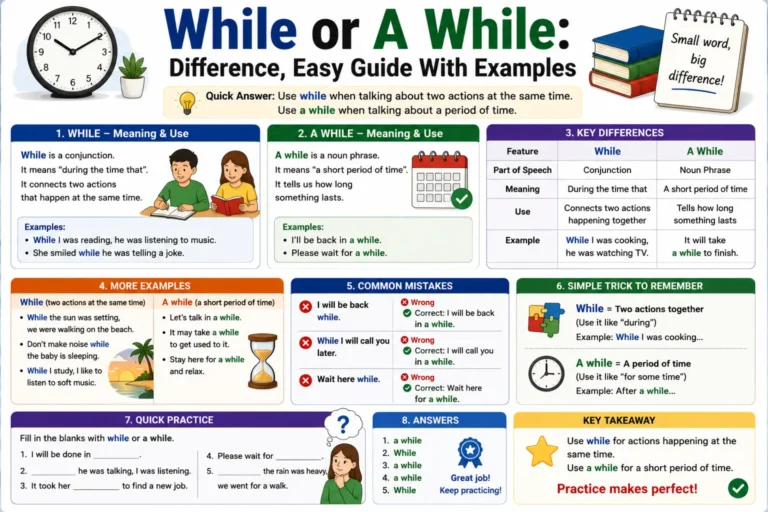
Awhile or a while is a common grammar question that confuses many English learners and native speakers. The two forms look almost the same. However, they have different meanings and uses.
Knowing the difference helps you write and speak more clearly. It also helps you avoid common grammar mistakes.
In this guide, you will learn when to use awhile and when to use a while. You will also see simple examples, useful tips, and common errors. By the end, you will feel confident using both forms in everyday English.
Quick Summary
- Awhile is an adverb.
- A while is a noun phrase.
- Use awhile after verbs like wait, stay, and rest.
- Use a while after prepositions like for, after, and in.
- Both mean a short period of time, but their grammar differs.
- Remember: If “for” fits naturally, use “a while.”
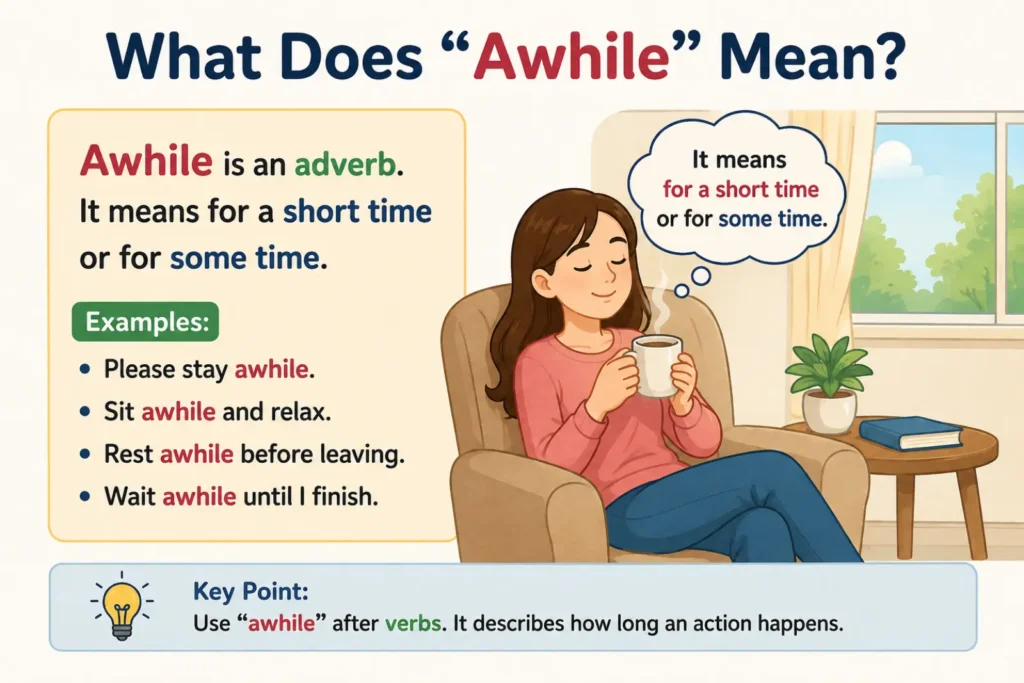
What Does “Awhile” Mean?
Awhile is an adverb.
It means for a short time.
It describes how long an action happens.
Examples
- Please stay awhile.
- Sit awhile and relax.
- Rest awhile before leaving.
- Wait awhile until I finish.
Notice that no word comes between the verb and awhile.
What Does “A While” Mean?
A while is a noun phrase.
It means a period of time.
It usually follows a preposition such as:
- for
- after
- in
- within
Examples
- We waited for a while.
- I haven’t seen her in a while.
- After a while, the rain stopped.
- It took a while to finish.
Awhile or A While: The Main Difference
The biggest difference is grammar.
| Feature | Awhile | A While |
|---|---|---|
| Part of speech | Adverb | Noun phrase |
| Meaning | For a short time | A short period of time |
| Used after | Verbs | Prepositions |
| Example | Stay awhile. | Stay for a while. |
Easy Rule
If you can add for, use a while.
Correct
- Wait a while.
- Wait for a while.
Correct
- Wait awhile.
Both work because awhile already means for a while.
When Should You Use “Awhile”?
Use awhile after action verbs.
Common verbs include:
- stay
- wait
- sit
- relax
- rest
- talk
- linger
Examples
- Please sit awhile.
- Let’s talk awhile.
- Relax awhile before dinner.
- Stay awhile with us.
These sentences sound natural and correct.
When Should You Use “A While”?
Use a while whenever you need a noun phrase.
It often follows:
- for
- after
- in
- quite
- a long
Examples
- It took a while.
- We waited for a while.
- I haven’t called him in a while.
- After a while, everyone smiled.
Real-Life Examples
Here are everyday examples.
At Home
- Sit awhile.
- Dinner will be ready in a while.
At Work
- Let’s discuss this awhile.
- The meeting lasted a while.
While Traveling
- Rest awhile before driving.
- We stopped for a while.
At School
- Read awhile before class.
- It took a while to solve the problem.
Common Mistakes People Make
Many writers confuse these two expressions.
Mistake 1
❌ Stay for awhile.
✅ Stay for a while
Mistake 2
❌ Sit a while.
✅ Sit awhile.
(Some style guides accept “sit a while,” but “sit awhile” is more traditional.)
Mistake 3
❌ In awhile
✅ In a whil
Mistake 4
❌ After awhile
✅ After a while
Easy Tricks to Remember
These simple tricks make the rule easy.
Trick 1
If you see for, use a while.
Example:
- Wait for a while.
Trick 2
If the word follows a verb directly, use awhile.
Example:
- Rest awhile.
Trick 3
Think of awhile as already meaning for a while.
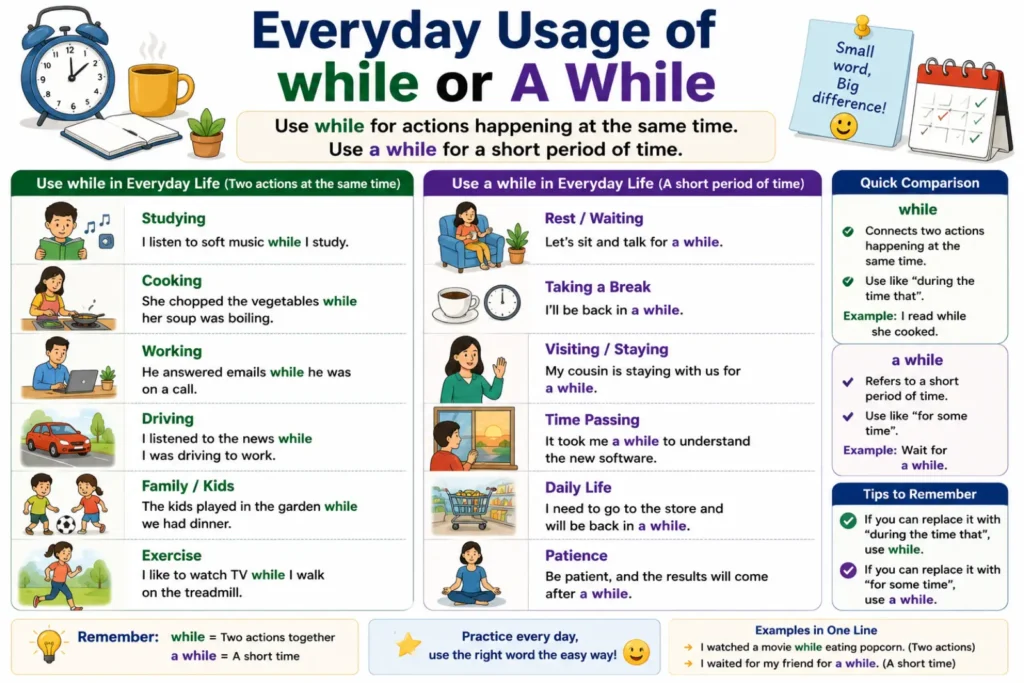
Everyday Usage
Native English speakers use both forms often.
Speaking
- Stay awhile.
- Wait for a while.
- Relax awhile.
Writing
- I’ll be back in a while.
- We talked awhile.
- The movie lasted a while.
Both appear in books, blogs, emails, and conversations.
Synonyms and Related Words
Here are useful alternatives.
Synonyms
- briefly
- temporarily
- momentarily
- shortly
- for a moment
- for some time
- for a bit
- for a little while
Related Search Terms
- awhile meaning
- a while meaning
- awhile vs a while
- difference between awhile and a while
- grammar rules for awhile
- when to use awhile
- when to use a while
- is awhile one word
- is a while two words
- English grammar guide
Expert Insights
Professional editors focus on grammar and sentence flow.
Many grammar experts agree on one simple rule.
Awhile works as an adverb.
A while works as a noun phrase.
Modern style guides, teachers, and editors recommend checking whether for belongs naturally in the sentence.
This small grammar choice improves writing quality and helps readers understand your meaning faster.
Strong grammar also builds trust. That matters for school papers, business emails, blog posts, and professional writing.
(FAQs)
Is it “awhile” or “a while”?
Both are correct. The right choice depends on grammar.
Can I say “stay awhile”?
Yes. That sentence is correct.
Is “for awhile” correct?
Most grammar experts prefer for a while.
What does “awhile” mean?
It means for a short time.
What does “a while” mean?
It means a period of time.
Is “in awhile” correct?
No.
Use in a while.
Why do people confuse these words?
They sound the same but have different grammar functions.
Is “awhile” one word?
Yes.
Awhile is one word.
A while is always two words.
Featured Snippet: Awhile vs. A While
| Question | Answer |
| What is the difference between awhile and a while? | Awhile is an adverb meaning for a short time. A while is a noun phrase meaning a short period of time. Use awhile after verbs and a while after prepositions like for, in, and after. |
Conclusion
Understanding awhile or a while becomes easy once you know the grammar rule. Awhile is an adverb that means for a short time. A while is a noun phrase that refers to a period of time. The easiest trick is to check whether the word for fits naturally. If it does, choose a while. If the word follows a verb directly, awhile is usually the better choice. With regular practice, these two forms become simple to recognize. Use the examples in this guide whenever you need a quick reminder, and your writing will sound more natural, accurate, and professional.