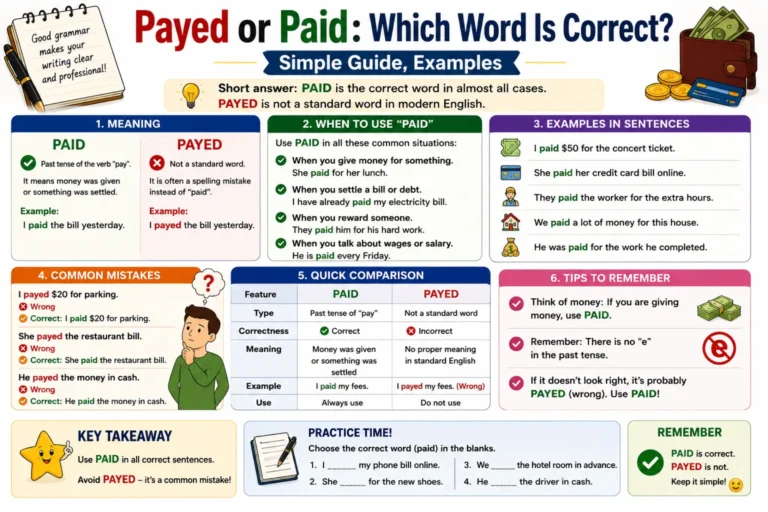
Have you ever wondered whether payed or paid is the correct word? Many English learners and even native speakers make this mistake. The two words look similar, but they have different meanings. In most cases, paid is the correct choice. However, payed is also a real English word. It is just much less common.
This guide explains the difference in simple words. You will learn when to use each word. You will also see easy examples, common mistakes, and helpful tips. By the end, you will know exactly which spelling fits your sentence. Whether you write emails, school papers, or blog posts, this guide will help you avoid a common grammar error.
Quick Summary Box
Featured Snippet Answer
- Paid is the correct past tense and past participle of pay in almost every situation.
- Payed is a real word but only in nautical contexts.
- Use paid when talking about money, salaries, bills, or rewards.
- Use payed only when referring to letting out rope or sealing a ship with tar.
- If you are unsure, choose paid.
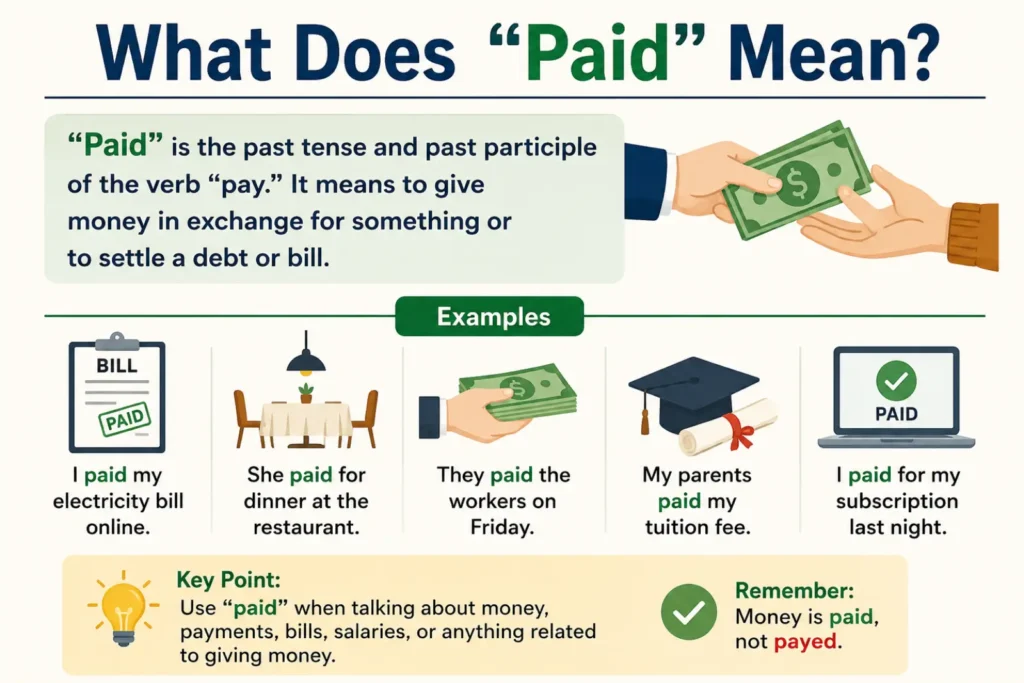
What Does “Paid” Mean?
Paid is the standard past tense and past participle of the verb pay.
It means someone gave money or settled a debt.
Examples
- I paid my electricity bill yesterday.
- She paid for dinner.
- They paid the workers on Friday.
- We paid the membership fee online.
In everyday English, paid is almost always correct.
What Does “Payed” Mean?
Payed is a real English word. However, it has a very special meaning.
People mainly use it in sailing and shipping.
It means:
- Letting out rope or cable.
- Covering wooden ships with tar to make them waterproof.
Examples
- The sailors payed out the anchor rope.
- The crew payed the ship’s deck with tar.
Outside these situations, avoid using payed.
Payed or Paid: Key Differences
| Feature | Paid | Payed |
|---|---|---|
| Common usage | Yes | Very rare |
| Related to money | Yes | No |
| Past tense of pay | Yes | Only in nautical meaning |
| Used in business | Yes | No |
| Used in everyday English | Yes | Almost always |
| Used in sailing | No | Yes |
Winner: Use paid in almost every sentence.
Why Do People Confuse Payed and Paid?
Many English verbs end with -ed.
For example:
- Walk → Walked
- Jump → Jumped
- Clean → Cleaned
People expect pay to become payed.
However, pay is an irregular verb.
The correct form is:
- Pay
- Paid
- Paid
This irregular spelling causes confusion.
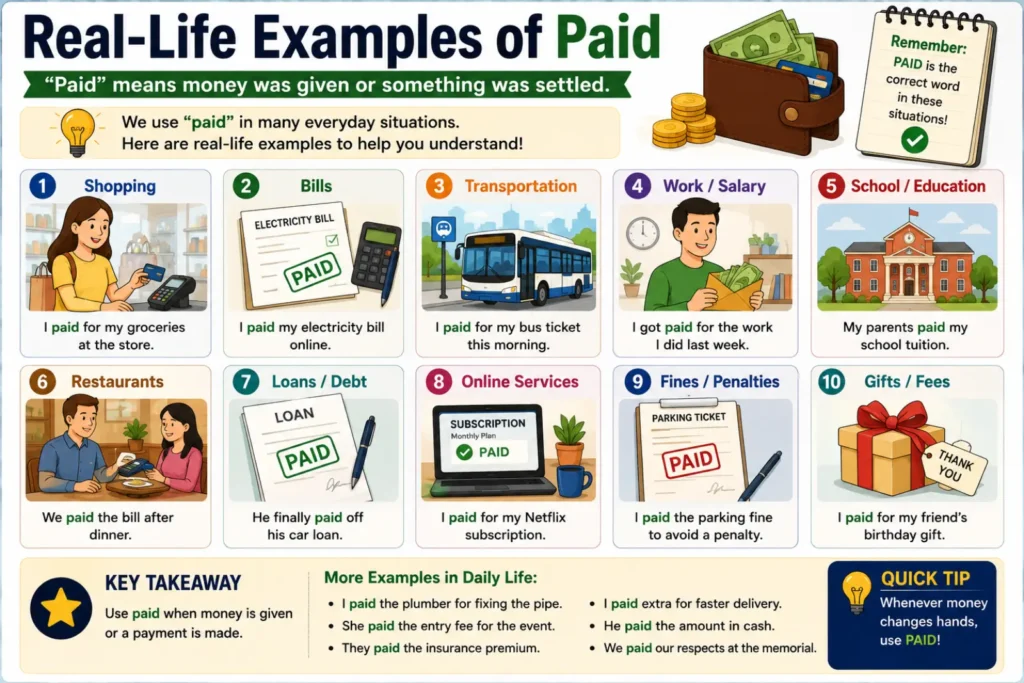
Real-Life Examples of Paid
Here are common situations where paid is correct.
Money
- I paid cash.
- She paid by credit card.
Work
- The company paid employees early.
- He paid overtime wages.
Shopping
- We paid for groceries.
- They paid the full price.
Education
- My parents paid my tuition.
Travel
- I paid for the hotel online.
These examples cover everyday English.
Real-Life Examples of Payed
Most people never use payed.
Still, here are correct examples.
Sailing
- The crew payed out more rope.
- They carefully payed the cable.
Ship Maintenance
- Workers payed the hull with tar.
Unless you work in maritime industries, you probably will not need this word.
Common Mistakes People Make
Many writers accidentally use payed when they mean paid.
Incorrect
- I payed my rent.
- She payed the bill.
- They payed for lunch.
Correct
- I paid my rent.
- She paid the bill.
- They paid for lunch.
Always double-check before publishing your writing.
Easy Trick to Remember the Difference
Here is a simple memory tip.
Money = Paid
Think about your wallet.
Whenever money changes hands, use paid.
Remember this sentence:
Money gets paid, not payed.
The only exception is sailing.
Paid in Daily Life
You see paid almost everywhere.
Examples include:
- Paid advertisements
- Paid subscriptions
- Paid leave
- Paid internship
- Paid parking
- Paid vacation
- Paid membership
- Paid invoice
These phrases appear in business, education, and daily conversations.
Synonyms and Related Keywords
Using related words helps improve writing and SEO.
Synonyms
- Settled
- Compensated
- Rewarded
- Reimbursed
- Remunerated
- Cleared
LSI Keywords
- pay or paid
- paid meaning
- payed meaning
- correct spelling of paid
- grammar mistake paid
- English grammar tips
- paid vs payed
- irregular verbs
- spelling differences
- common English mistakes
Grammar Rule Behind Paid
The verb pay is irregular.
Its forms are:
| Verb Form | Word |
|---|---|
| Base Form | Pay |
| Past Tense | Paid |
| Past Participle | Paid |
| Present Participle | Paying |
Notice that payed does not appear in normal grammar tables.
That is because it belongs only to maritime English.
Expert Insights
Grammar experts agree on one simple rule.
Use paid whenever money is involved.
Reserve payed for specialized nautical writing.
Professional writers, editors, teachers, and publishers follow this rule.
Using the correct spelling improves:
- Writing quality
- Reader trust
- Grammar accuracy
- Professional communication
- SEO content quality
Correct grammar also reduces confusion for readers.
Common Situations and Correct Usage
| Sentence | Correct Word |
|---|---|
| I ___ the bill. | Paid |
| She ___ the workers. | Paid |
| We ___ the invoice. | Paid |
| The sailor ___ out rope. | Payed |
| They ___ the ship with tar. | Payed |
Tips to Avoid This Mistake
- Remember that pay is an irregular verb.
- Use paid for money.
- Think of payed only when reading about ships.
- Run a grammar checker before publishing.
- Read your sentence aloud.
- Practice with simple examples.
These habits improve your grammar over time.
(FAQs)
Is paid or payed correct?
Paid is correct in almost every situation. Payed only applies to nautical terms.
Why is it paid instead of payed?
Because pay is an irregular verb.
Is payed a real word?
Yes. It refers to sailing and ship maintenance.
Can I say “I payed the bill”?
No.
The correct sentence is:
I paid the bill.
Which spelling should students use?
Students should almost always use paid.
Is payed wrong in English?
Not always.
It is correct in maritime writing.
What is the easiest way to remember?
Think:
Money = Paid
Conclusion
When choosing between payed or paid, the answer is simple for almost every situation. Paid is the correct past tense and past participle of pay when talking about money, bills, salaries, purchases, or any financial transaction. Payed is not a spelling mistake, but it belongs to a very specific nautical context involving ropes, cables, or waterproofing ships with tar. Most people will never need to use it in everyday writing. Remember the easy rule: if money is involved, use “paid.” This simple tip will help you write with confidence, avoid common grammar mistakes, and improve the clarity and professionalism of your English.