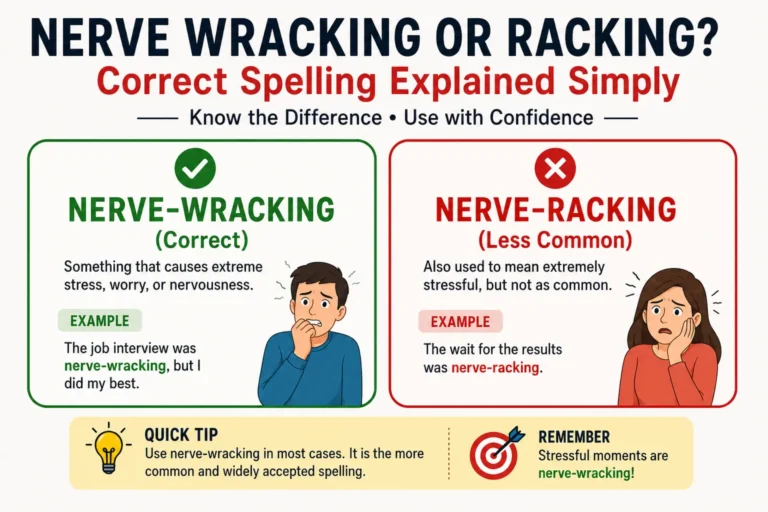
Nerve wracking or racking? Many people ask this question when they describe something stressful, scary, or worrying. The correct spelling is usually nerve-wracking. It describes an experience that makes you feel nervous or tense. For example, a job interview can be nerve-wracking. A difficult exam can also feel nerve-wracking.
Many writers confuse nerve-wracking with nerve-racking. Both forms appear in English writing. However, nerve-wracking is the standard spelling in modern English. The phrase comes from the idea of putting great stress on a person’s nerves. This guide explains the difference in simple words. You will learn the correct spelling, meaning, examples, common mistakes, synonyms, and usage tips.
Quick Summary
- Nerve-wracking is the most common and widely accepted spelling.
- It means something causes stress, worry, fear, or nervousness.
- Nerve-racking also appears in English, but it is less common.
- Use nerve-wracking in most everyday and professional writing.
- Example: “The job interview was nerve-wracking.”
- The word often describes stressful events, situations, tasks, or experiences.
- The opposite can include calming, relaxing, or reassuring.
What Does Nerve-Wracking Mean?
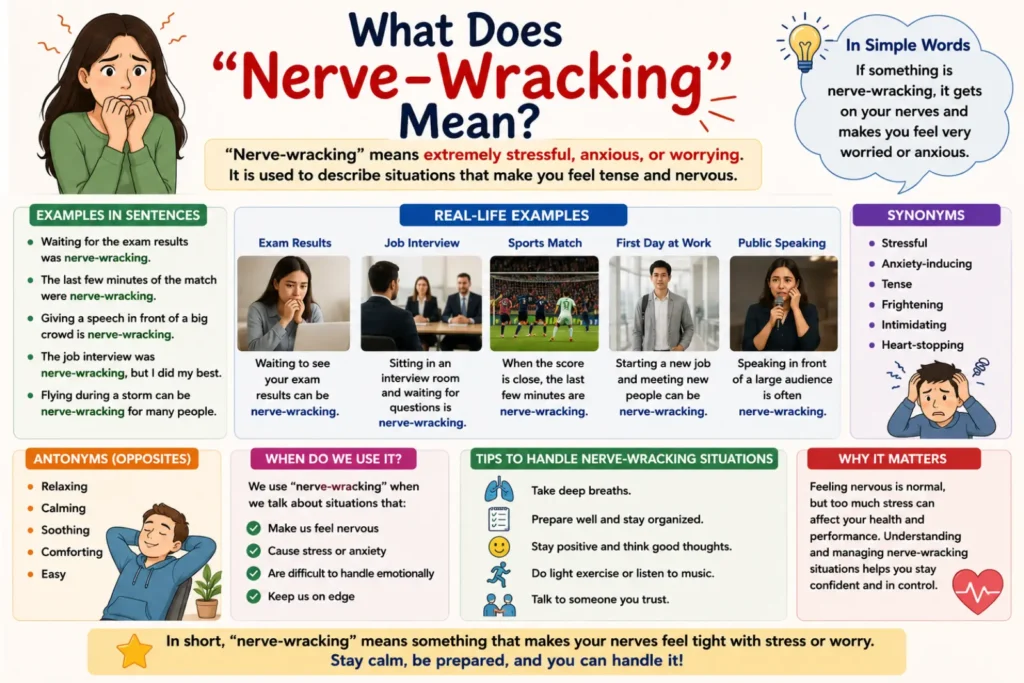
Nerve-wracking means causing strong worry, stress, tension, or nervousness.
The word acts as an adjective. It describes a person, event, task, situation, or experience.
For example:
- The exam was nerve-wracking.
- Waiting for the results felt nerve-wracking.
- Giving a speech can be nerve-wracking.
- The final minutes of the game were nerve-wracking.
In simple words, something feels nerve-wracking when it makes you feel very nervous.
Nerve Wracking or Racking: Which Spelling Is Correct?
The most common standard spelling is nerve-wracking.
The word wracking means causing great pain, stress, or damage. In this phrase, it connects with the idea of putting stress on your nerves.
The spelling nerve-racking also exists. Some dictionaries and writers accept it. However, it appears less often than nerve-wracking.
Therefore, use this form in most cases:
nerve-wracking
This spelling works well in blogs, articles, emails, school writing, and professional content.
Nerve-Wracking vs Nerve-Racking: Comparison Table
| Spelling | Meaning | Common Usage | Best Choice |
|---|---|---|---|
| Nerve-wracking | Very stressful or worrying | Very common | Yes |
| Nerve-racking | Very stressful or worrying | Less common | Acceptable |
| Nerve wracking | Usually written without a hyphen | Less standard | Avoid when possible |
The main difference involves spelling and usage. Both nerve-wracking and nerve-racking can express stress.
However, nerve-wracking remains the safest choice for modern writing.
Why Does Nerve-Wracking Have a Hyphen?
The hyphen joins two words that work together as one adjective.
In nerve-wracking, the words combine to describe something.
For example:
- a nerve-wracking interview
- a nerve-wracking experience
- a nerve-wracking decision
The hyphen makes the meaning clear.
Without the hyphen, the phrase can look less polished. Professional writers often use the hyphen before a noun.
Example
Correct: It was a nerve-wracking experience.
Less polished: It was a nerve wracking experience.
The hyphenated form is usually the better choice.
What Is the Difference Between Wracking and Racking?
The words wracking and racking have different meanings.
Wracking
Wracking often means causing extreme pain, stress, or suffering.
Example:
- The decision caused nerve-wracking stress.
Racking
Racking can mean placing something on a rack.
Example:
- The workers were racking the bottles.
It can also appear in phrases connected with stress.
However, the spelling nerve-wracking remains more common for describing intense nervousness.
Real-Life Examples of Nerve-Wracking
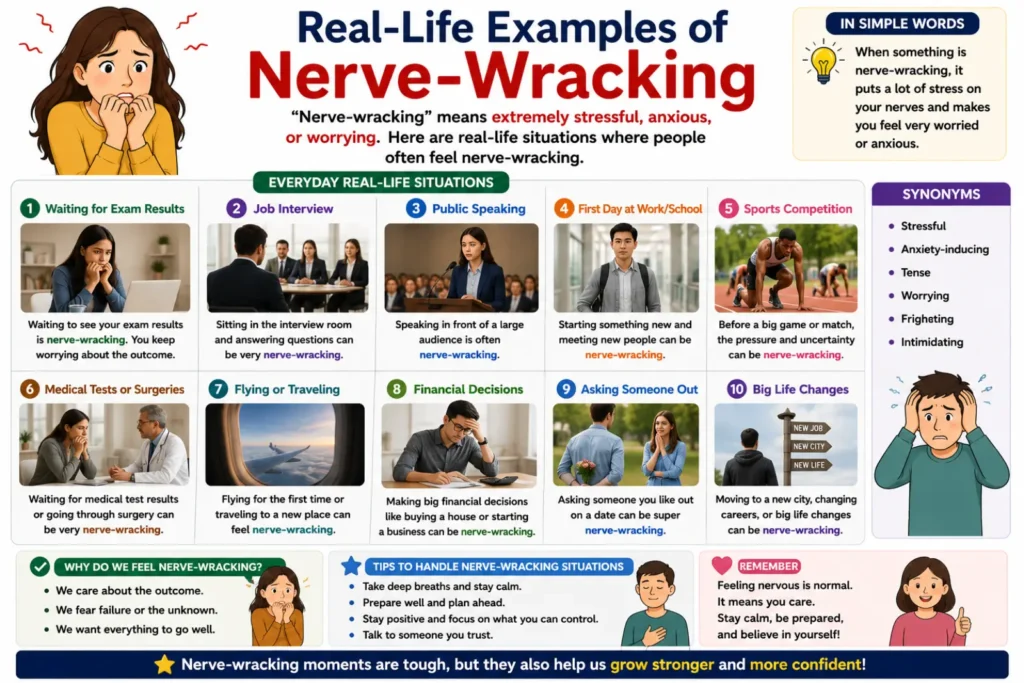
People use nerve-wracking in many everyday situations.
1. Job Interviews
A job interview can feel nerve-wracking.
You may worry about your answers and performance.
Example:
“The final interview was nerve-wracking, but I stayed calm.”
2. Exams
Important exams often create stress.
Students may feel nervous before receiving their results.
Example:
“Waiting for my exam results was nerve-wracking.”
3. Public Speaking
Many people feel nervous when speaking before a crowd.
This situation often feels nerve-wracking.
Example:
“Giving my first presentation was nerve-wracking.”
4. Medical Tests
Waiting for important test results can cause worry.
Many people describe this experience as nerve-wracking.
Example:
“The wait for the results was nerve-wracking.”
5. Important Decisions
Big decisions can create pressure.
Moving, changing jobs, or making a major purchase may feel nerve-wracking.
Example:
“Moving to a new city was a nerve-wracking experience.”
6. Sports Events
Close games can create strong tension.
Fans often describe the final moments as nerve-wracking.
Example:
“The last five minutes of the match were nerve-wracking.”
Common Mistakes With Nerve-Wracking
Many writers make small mistakes with this phrase.
Here are the most common ones.
Mistake 1: Writing “Nerve Wrecking”
Nerve-wrecking is usually incorrect for this meaning.
The word wrecking means destroying or damaging something.
For example:
- The storm wrecked the building.
It does not usually describe nervousness.
Correct: The interview was nerve-wracking.
Mistake 2: Using “Nerve Wracking” Without a Hyphen
Some people write nerve wracking as two separate words.
Readers can understand the meaning. However, nerve-wracking is usually the cleaner choice.
Mistake 3: Confusing the Phrase With “Nervous”
The word nervous describes a person’s feelings.
The word nerve-wracking describes something that causes those feelings.
Compare these examples:
- I felt nervous before the interview.
- The interview was nerve-wracking.
Both sentences work. They describe different parts of the experience.
Mistake 4: Overusing the Word
Do not use nerve-wracking in every sentence.
Too much repetition can make writing feel unnatural.
Use related words when appropriate.
Nerve-Wracking Synonyms and Related Words
You can replace nerve-wracking with several similar words.
Useful synonyms include:
- stressful
- tense
- worrying
- frightening
- anxiety-inducing
- unsettling
- stressful
- alarming
- difficult
- challenging
- intense
- terrifying
The best synonym depends on the situation.
For example, stressful sounds general.
Terrifying sounds much stronger.
Tense often describes a situation with pressure or uncertainty.
Nerve-Wracking in Everyday English
People use this phrase in casual and formal situations.
You can use it when talking about:
- work
- school
- travel
- sports
- relationships
- health
- money
- public speaking
- important decisions
Casual Example
“Waiting for that phone call was so nerve-wracking.”
Professional Example
“The final stage of the recruitment process was nerve-wracking.”
Academic Example
“Students often find oral examinations nerve-wracking.”
The phrase works well in many contexts.
How to Use Nerve-Wracking in a Sentence
The most common sentence pattern is:
Subject + was/were + nerve-wracking.
Examples:
- The exam was nerve-wracking.
- The journey was nerve-wracking.
- The interview was nerve-wracking.
You can also place the adjective before a noun.
Examples:
- It was a nerve-wracking experience.
- She faced a nerve-wracking decision.
- He prepared for a nerve-wracking presentation.
This makes the phrase easy to use in everyday writing.
Is Nerve-Wracking One Word or Two?
The standard form is usually two words joined by a hyphen:
nerve-wracking
It is not normally written as one word.
Avoid writing:
- nervewracking
The hyphenated form looks clearer and more standard.
Is Nerve-Racking Wrong?
No, nerve-racking is not always wrong.
Some English speakers and dictionaries recognize it as a variant spelling.
However, nerve-wracking is more widely used.
If you want the safest option, choose:
nerve-wracking
This choice works well for most readers.
It also matches the spelling that many people expect in modern English.
Expert Insight
Clear word choice improves communication.
Small spelling differences can change how professional writing looks.
The phrase nerve-wracking offers a simple and familiar way to describe stress.
Writers should also consider their audience.
For general readers, familiar words work best.
For professional content, consistent spelling improves trust.
The key lesson is simple: choose the most widely accepted form unless your style guide says otherwise.
SEO Keywords and Semantic Variations
This topic can naturally target several related search terms.
Useful semantic keywords include:
- nerve wracking or racking
- nerve-wracking meaning
- nerve-racking meaning
- is nerve-wracking correct
- nerve-wracking spelling
- nerve wracking definition
- nerve-wracking synonym
- nerve-wracking examples
- nerve-wracking experience
- nerve-wracking situation
- nerve-wracking vs nerve-racking
- correct spelling of nerve-wracking
- what does nerve-wracking mean
These variations help search engines understand the topic.
Use them naturally.
Avoid repeating the same keyword too often.
Frequently Asked Questions
Is it nerve-wracking or nerve-racking?
Nerve-wracking is the most common spelling. Nerve-racking also appears as a variant.
What does nerve-wracking mean?
It means causing strong stress, worry, tension, or nervousness.
Is “nerve-wrecking” correct?
Usually, no. Nerve-wracking is the correct choice for describing something stressful.
Should nerve-wracking have a hyphen?
Yes. The standard form usually includes a hyphen: nerve-wracking.
Is nerve-wracking one word?
No. It is normally written as two words joined by a hyphen.
Can I say “a nerve-wracking experience”?
Yes. This is a common and natural phrase.
What is a synonym for nerve-wracking?
Common synonyms include stressful, tense, worrying, and anxiety-inducing.
Is nerve-wracking formal English?
Yes. You can use it in both casual and formal writing.
conclusion
The answer to “nerve wracking or racking?” is simple. Nerve-wracking is the most common and safest spelling for modern English writing. It describes something that causes stress, worry, tension, or nervousness. You can use it for exams, interviews, speeches, decisions, sports events, and many other situations.
The spelling nerve-racking also appears as a variant. However, most writers should choose nerve-wracking for clear and familiar writing. Also, avoid confusing it with nerve-wrecking. That spelling does not normally express nervousness.
When in doubt, remember this simple rule: a stressful experience is usually nerve-wracking.