If you are unsure whether to write aswell or as well, the correct spelling is usually as well. These two words work together in several common English sentences. However, aswell is not standard English in modern writing. It usually appears as a spelling mistake.
This guide explains the difference between aswell and as well in simple terms. You will learn the correct spelling, meaning, grammar rules, examples, and common mistakes. You will also see when to use as well in everyday writing.
Whether you are writing an email, school assignment, blog post, or business message, the correct choice matters. One simple space can change the quality of your writing.
Quick Summary:
- As well is the correct standard spelling.
- Aswell is usually incorrect.
- As well often means “also” or “too.”
- Use as well as two separate words.
- Example: “I want to come as well.”
- Example: “She speaks French as well.”
- Use as well as to connect two ideas or items.
- Correct spelling improves clarity and professional writing.
What Does “As Well” Mean?
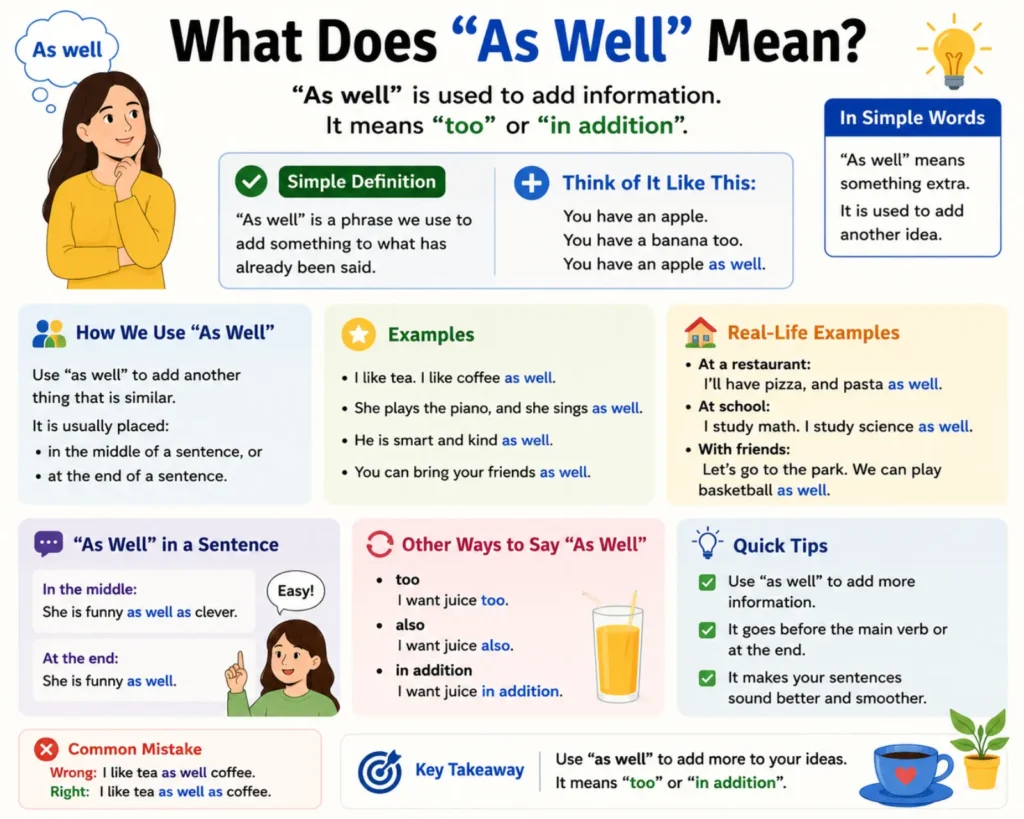
As well usually means also, too, or in addition.
It adds another person, thing, or idea to a sentence.
Examples
- I want to go as well.
- She likes coffee as well.
- He plays football as well.
- We need a laptop as well.
In these examples, as well adds extra information.
Is “Aswell” Correct?
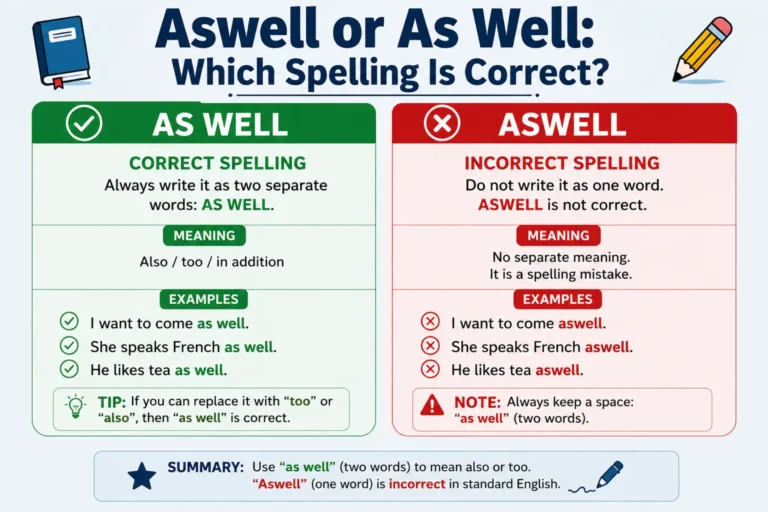
No, aswell is generally not correct in standard English.
The correct form is:
as well
Always write the expression as two separate words.
Incorrect
- I want to come aswell.
- She is coming aswell.
- He likes it aswell.
Correct
- I want to come as well.
- She is coming as well.
- He likes it as well.
The spelling mistake happens because people often pronounce the words quickly together.
As Well vs Aswell: The Main Difference
The main difference is simple.
| Form | Correct? | Meaning | Example |
|---|---|---|---|
| as well | Yes | Also or too | I want to join as well. |
| aswell | No | Not standard English | Incorrect spelling |
Therefore, use as well in formal and informal writing.
How to Use “As Well” in a Sentence
You can use as well in several common ways.
1. At the End of a Sentence
This is the most common use.
- I would like some tea as well.
- She wants to attend as well.
- They watched the movie as well.
Here, as well means too.
2. With “As Well As”
The phrase as well as means in addition to.
- She speaks English as well as Spanish.
- He bought a phone as well as a tablet.
- The job requires skill as well as experience.
This phrase connects two related ideas.
3. In Formal Writing
As well works well in professional writing.
- Please send the report as well.
- The team reviewed the budget as well.
- The manager attended the meeting as well.
However, also may sound more formal in some sentences.
“As Well” vs “Also” vs “Too”
These words often have similar meanings.
As Well
Usually appears at the end of a sentence.
I want to come as well.
Also
Often appears before the main verb.
I also want to come.
Too
Often appears at the end of a sentence.
I want to come too.
All three can mean also.
However, their position in a sentence can differ.
| Word | Common Position | Example |
|---|---|---|
| as well | End | I like it as well. |
| also | Before the main verb | I also like it. |
| too | End | I like it too. |
Real-Life Examples of “As Well”
You can see as well in everyday conversations.
At School
- I finished my homework as well.
- Sarah joined the science club as well.
At Work
- Please send the invoice as well.
- The manager reviewed the proposal as well.
In Text Messages
- I am coming as well.
- That sounds good to me as well.
In Emails
- Please confirm the meeting time as well.
- We would appreciate the updated document as well.
Common Mistakes With “As Well”
Many writers make similar mistakes.
Mistake 1: Writing “Aswell”
Incorrect: I want to go aswell.
Correct: I want to go as well.
Always keep the words separate.
Mistake 2: Confusing “As Well” With “As Well As”
These phrases have different uses.
As well can mean also.
I like the book as well.
As well as can mean in addition to.
I like the book as well as the movie.
Mistake 3: Using “As Well” Too Often
Repeating the phrase can make writing sound weak.
Instead, vary your language when appropriate.
You can sometimes use:
- also
- too
- additionally
- in addition
- moreover
Choose the word that best fits the sentence.
Mistake 4: Adding a Comma Without Reason
Writers sometimes add unnecessary commas.
Usually correct:
I want to come as well.
A comma is not normally needed before as well at the end of a simple sentence.
Tips for Remembering the Correct Spelling
Use these simple memory tricks.
Think of “As Well” as Two Words
The phrase contains two separate ideas:
- as
- well
Keep them separate when you write them.
Replace It With “Too”
If too works in the sentence, as well may also work.
I like pizza too.
Becomes:
I like pizza as well.
Remember the Common Phrase
You may already know:
as well as
Because as well as uses three separate words, as well also uses two separate words.
When Should You Use “As Well” in Daily Life?
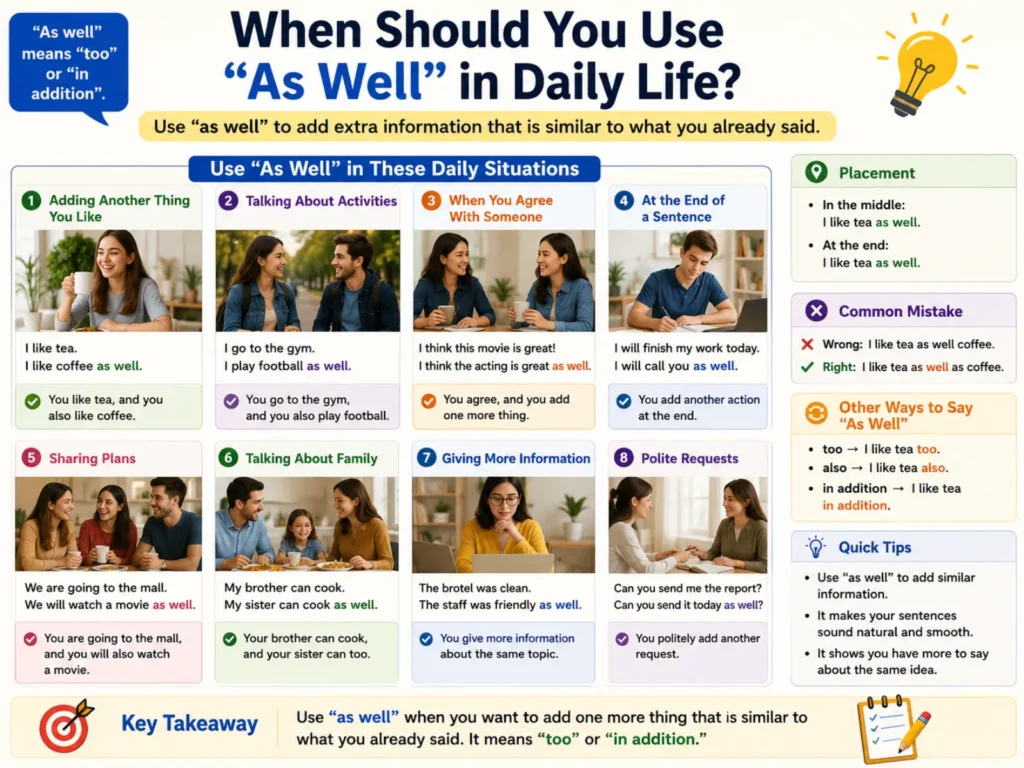
Use as well when you want to add information.
It works naturally in conversations, messages, emails, and formal writing.
Example: Making Plans
I am going to the park as well.
This means you are also going to the park.
Example: Adding an Item
Please bring your notebook as well.
This means the notebook is an additional item.
Example: Adding a Person
Ahmed is coming as well.
This means Ahmed is also coming.
Synonyms and Related Search Terms
These words and phrases relate closely to as well:
- also
- too
- additionally
- in addition
- moreover
- as well as
- also meaning
- as well meaning
- as well grammar
- aswell or as well
- is aswell one word
- correct spelling of as well
- as well vs also
- as well vs too
These related terms help explain the wider meaning of the phrase.
Is “As Well” Formal or Informal?
As well works in both formal and informal English.
Informal Example
I want one as well.
Professional Example
Please provide the updated figures as well.
The phrase sounds natural in most writing situations.
However, the best choice depends on sentence structure and tone.
Expert Insight: Why This Spelling Matters
Correct spelling improves trust.
Readers notice simple errors, especially in professional content. The mistake aswell can make writing look careless.
Strong writers focus on small details. They also choose words based on context.
For SEO content, correct grammar supports readability. Clear writing helps users understand information quickly. It also creates a stronger impression of expertise and reliability.
The best practice is simple:
Write as well, never aswell in standard English.
Frequently Asked Questions
Is “aswell” one word?
No. Aswell is not the standard spelling. Write as well as two words.
Is “as well” grammatically correct?
Yes. As well is grammatically correct and often means also or too.
What is the difference between “aswell” and “as well”?
As well is correct. Aswell is usually a spelling mistake.
Can I use “as well” at the end of a sentence?
Yes. This is one of its most common uses.
I want to join as well.
Is “as well” the same as “also”?
Often, yes. Both words can mean also.
I also like it.
I like it as well.
Is “as well as” different from “as well”?
Yes. As well often means also. As well as often means in addition to.
Should I write “aswell” in a text message?
No. Use as well in texts, emails, and formal writing.
Which is better for professional writing: “as well” or “also”?
Both are correct. As well often sounds natural at the end of a sentence. Also often fits naturally inside a sentence.
Conclusion
When choosing between aswell or as well, always choose as well. The correct expression contains two separate words. It usually means also, too, or in addition.
You can use as well in conversations, emails, schoolwork, business writing, and online content. The phrase is simple and flexible. However, do not confuse it with as well as, which has a different grammatical role.
The spelling rule is easy to remember. Aswell is usually incorrect. As well is the standard form.
So, when you write your next sentence, remember this simple rule:
Use “as well,” not “aswell.”