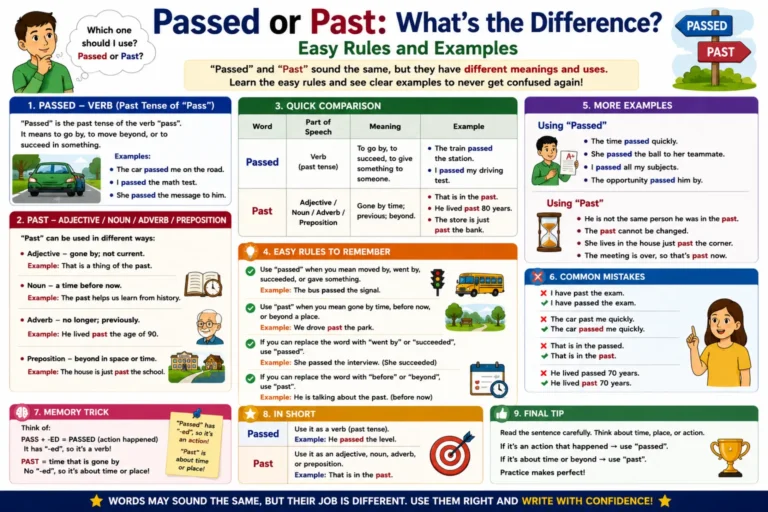
Passed or past can confuse even strong English speakers. Both words sound similar, but they have different meanings. Passed usually shows an action or movement. Past usually shows time, place, or something that happened before. This small difference matters in school, work, emails, and daily conversations. Many people use the wrong word because both words can sound alike. The good news is that the rule is simple. In this guide, you will learn the difference between passed and past. You will also see clear examples, common mistakes, and easy memory tricks. By the end, you will know which word fits each sentence. You will also understand common phrases such as “passed by,” “in the past,” and “past tense.”
Quick Summary: Passed or Past?
- Passed is usually a verb.
- Past usually relates to time, place, or earlier events.
- Use passed for an action that happened.
- Use past for time before now.
- “She passed the test” is correct.
- “She lived there in the past” is correct.
- “He walked past the store” is correct.
- A simple trick: passed = action; past = time or place.
What Does “Passed” Mean?
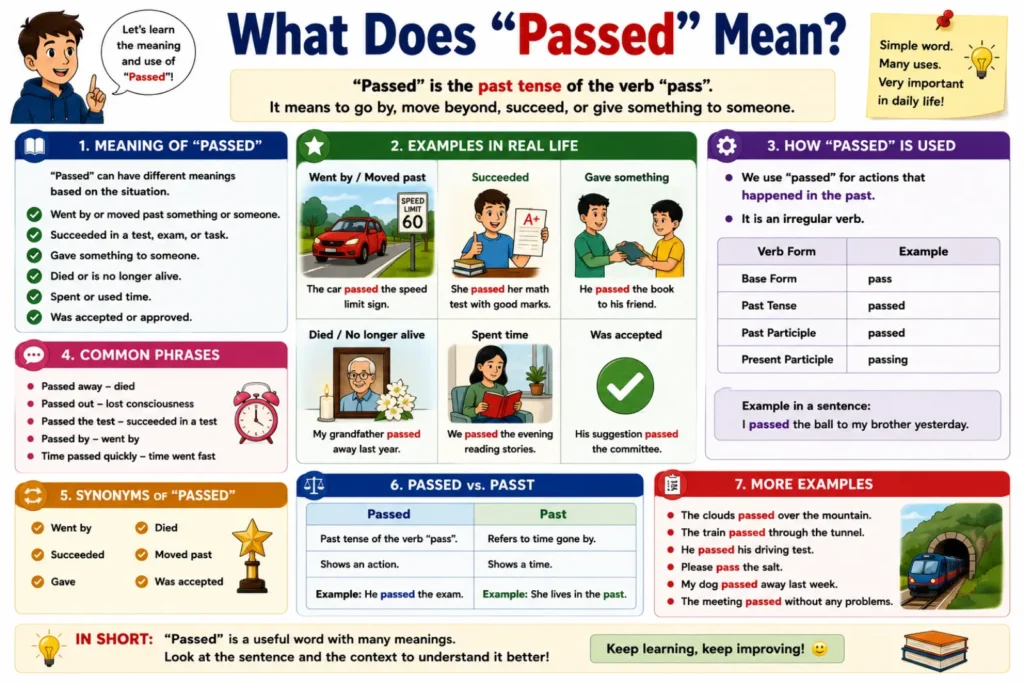
Passed is the past tense of the verb pass.
It describes an action that someone or something completed.
For example:
- I passed the exam.
- She passed the ball.
- The car passed our house.
- He passed me in the hallway.
- Time passed quickly.
In each example, passed describes an action.
The word can show movement, success, transfer, or the passing of time.
What Does “Past” Mean?
Past usually refers to time, place, or earlier events.
It can work as a noun, adjective, adverb, or preposition.
Examples include:
- I learned from my past.
- We walked past the school.
- The train went past us.
- She lived there in the past.
- The past year brought many changes.
The word past often connects to something earlier or beyond a point
Passed or Past: The Main Difference
The easiest rule is simple:
Passed describes an action. Past describes time, place, or something earlier.
Compare these examples:
- He passed the shop.
Here, passed shows movement. - He walked past the shop.
Here, past shows the place he moved beyond.
Both sentences can describe similar events. However, the grammar differs.
Simple memory rule
Passed = something happened.
Past = something earlier or beyond.
This rule works in most everyday situations.
Passed vs Past: Comparison Table
| Word | Main Use | Part of Speech | Example |
|---|---|---|---|
| Passed | An action | Verb | She passed the test. |
| Past | Earlier time | Noun/Adjective | He learned from the past. |
| Past | Beyond a place | Preposition/Adverb | We walked past the bank. |
| Passed | Moving beyond something | Verb | The car passed the truck. |
| Past | Time before now | Noun/Adjective | In the past, life was different. |
The key difference comes down to action versus time or position.
When Should You Use “Passed”?
Use passed when you need a verb.
It often shows an action that happened before now.
1. Passing a test
- I passed my driving test.
- She passed the final exam.
- They passed the course.
Here, passed means successfully completed.
2. Moving beyond something
- The bus passed our house.
- He passed the other runner.
- The plane passed over the city.
Here, passed shows movement.
3. Giving something to someone
- She passed me the salt.
- He passed the note to his friend.
- Please pass the bread.
The past form becomes passed.
4. Time moving forward
- Several hours passed.
- The summer passed quickly.
- Ten years passed before they met again.
Here, passed still describes an action.
When Should You Use “Past”?
Use past when you discuss earlier time, location, or events.
1. Talking about earlier time
- I visited London in the past.
- She has changed since her past.
- We should learn from the past.
2. Talking about a place beyond something
- Walk past the library.
- The dog ran past me.
- The store is just past the bridge.
Here, past shows position or direction.
3. Talking about earlier events
- His past mistakes taught him valuable lessons.
- The company has a successful past.
- We cannot change the past.
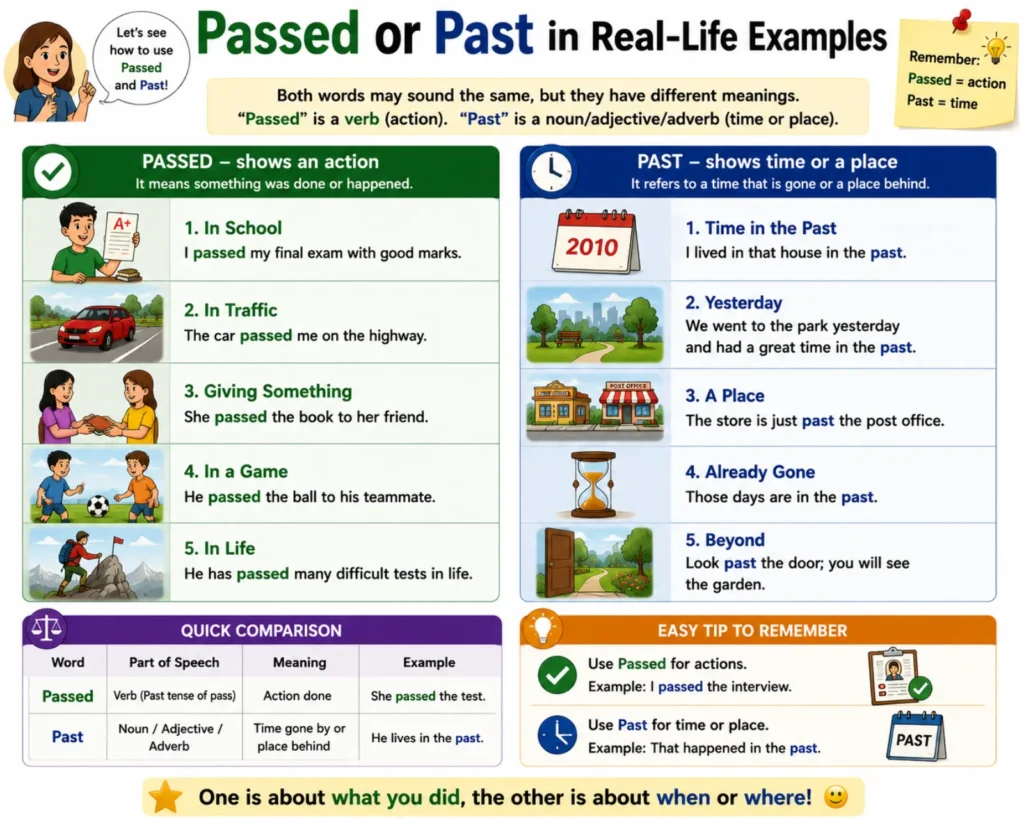
Passed or Past in Real-Life Examples
Understanding real situations makes the difference easier.
Example 1: School
Correct: I passed my English exam.
Why?
The sentence describes an action and result.
Incorrect: I past my English exam.
Example 2: Walking
Correct: We walked past the restaurant.
Why?
The sentence shows a location beyond the restaurant.
Incorrect: We walked passed the restaurant.
However, this sentence can be correct:
We passed the restaurant while walking.
Here, passed acts as the verb.
Example 3: Time
Correct: Many years passed.
Why?
The sentence describes time moving.
Correct: Many years have gone by since the past event.
Here, past describes an earlier event.
Example 4: Driving
Correct: The truck passed my car.
This describes the action of overtaking.
Correct: The truck drove past my car.
This describes movement beyond the car.
“Passed By” vs “Past”
These phrases often confuse learners.
Passed by
Passed by usually describes an action.
Examples:
- I passed by your house yesterday.
- She passed by without saying hello.
- The bus passed by quickly.
Past
Past can show movement beyond something.
Examples:
- I walked past your house.
- The bus went past the station.
- She ran past me.
Both forms can sound similar.
The grammar tells you which word works.
“Passed Away” or “Past Away”?
The correct phrase is passed away.
Passed away is a polite phrase for someone who died.
Example:
- Her grandfather passed away peacefully.
Past away is incorrect.
This is an important spelling difference.
“Passed Time” or “Past Time”?
Both phrases can be correct.
However, they have different meanings.
Passed time
This describes time moving or being spent.
- We passed time by playing cards.
- The hours passed quickly.
Past time
This means an earlier time.
- In past times, people traveled differently.
- The past time is gone.
The phrase pastime also means a hobby or activity.
Example:
“Passed the Point” or “Past the Point”?
Both can work, but they serve different grammar roles.
Passed the point
This shows an action.
- The runner passed the point where the road turned.
Past the point
This shows a position beyond something.
- The road continues past the point where it turns.
A helpful question is:
Does the word describe an action?
If yes, choose passed.
Does it describe a location or earlier time?
If yes, choose past.
Common Mistakes With Passed and Past
Many mistakes happen because the words sound similar.
Mistake 1: “I past the test.”
Correct:
I passed the test.
Passing a test describes an action.
Mistake 2: “I walked passed the store.”
Correct:
I walked past the store.
Here, past shows a location.
Mistake 3: “In the passed, people used letters.”
Correct:
In the past, people used letters.
The sentence refers to earlier time.
Mistake 4: “He past me on the road.”
Correct:
He passed me on the road.
The sentence describes movement.
Mistake 5: “She past away last year.”
Correct:
She passed away last year.
The phrase always uses passed.
Easy Tricks to Remember Passed or Past
Try these simple memory tricks.
Trick 1: Passed has an action
Think of passed as a verb.
Ask:
“What did someone do?”
If the answer is “passed,” use passed.
Example:
- What did she do? She passed the exam.
Trick 2: Past points backward
Think of past as pointing backward in time.
Examples:
- the past
- past events
- past mistakes
- past years
Trick 3: “Past” often follows movement verbs
These phrases commonly use past:
- walk past
- run past
- drive past
- go past
- move past
Examples:
- We drove past the airport.
- She ran past the finish line.
Passed or Past in Daily Life
You will see these words everywhere.
At school
- I passed the exam.
- My past grades improved.
At work
- The deadline passed.
- We reviewed the past year’s results.
While traveling
- The train passed the station.
- We walked past the hotel.
In conversations
- Time passed quickly.
- Let’s not discuss the past.
In personal growth
- She passed through a difficult period.
- He learned from his past.
Passed or Past: Synonyms and Related Keywords
These related words can help you understand the difference.
Synonyms for “passed”
Depending on the meaning, synonyms include:
- succeeded
- moved beyond
- went by
- transferred
- overtook
- completed
- approved
Example:
She passed the exam.
Similar meaning:
She succeeded in the exam.
Synonyms for “past”
Depending on the meaning, synonyms include:
- earlier
- previous
- former
- before
- bygone
- beyond
- history
Example:
We walked past the store.
Similar meaning:
We walked beyond the store.
Related SEO keywords
- passed vs past
- past or passed
- difference between passed and past
- when to use passed or past
- passed or past grammar
- passed and past examples
- passed away or past away
- walked past or walked passed
- passed the test or past the test
- past tense of pass
Expert Insight: Why This Difference Matters
Clear grammar improves communication.
A small spelling mistake can change the meaning of a sentence.
The words passed and past sound similar. However, they perform different jobs.
Strong writers check the word’s role in each sentence.
Professional editors often use this quick test:
- Find the main verb.
- Ask what action happened.
- Check whether the word shows time or place.
- Choose passed for the action.
- Choose past for earlier time or position.
This method works better than memorizing every phrase.
Frequently Asked Questions About Passed or Past
Is it “passed” or “past” the store?
Both can be correct.
- I passed the store.
“Passed” is the action. - I walked past the store.
“Past” shows the location beyond the store.
Is it “passed” or “past” the test?
The correct phrase is:
I passed the test.
Use passed because passing a test describes an action.
Is “past” the past tense of “pass”?
No.
The past tense of pass is passed.
Example:
- Present: I pass the test.
- Past: I passed the test.
Past is a different word.
Is it “passed away” or “past away”?
The correct phrase is:
passed away
“Past away” is incorrect.
Is “walked past” correct?
Yes.
Example:
She walked past the library.
Here, past describes movement beyond a place.
What is an easy way to remember passed and past?
Remember:
Passed = action. Past = time or place.
This simple rule works in most sentences.
Is “time passed” correct?
Yes.
Example:
Time passed quickly.
Here, passed describes time moving forward.
Conclusion
Understanding passed or past becomes easy when you focus on the word’s job. Use passed for an action. Use past for earlier time, previous events, or a place beyond something. For example, you passed an exam. You walked past a store. You learned from the past. Time passed quickly. These examples show the main difference clearly. When you feel unsure, ask one simple question. Does the word describe an action? If yes, choose passed. Does it describe time or position? If yes, choose past. This quick rule will help you write clearer English. With regular practice, choosing passed or past will soon feel natural.