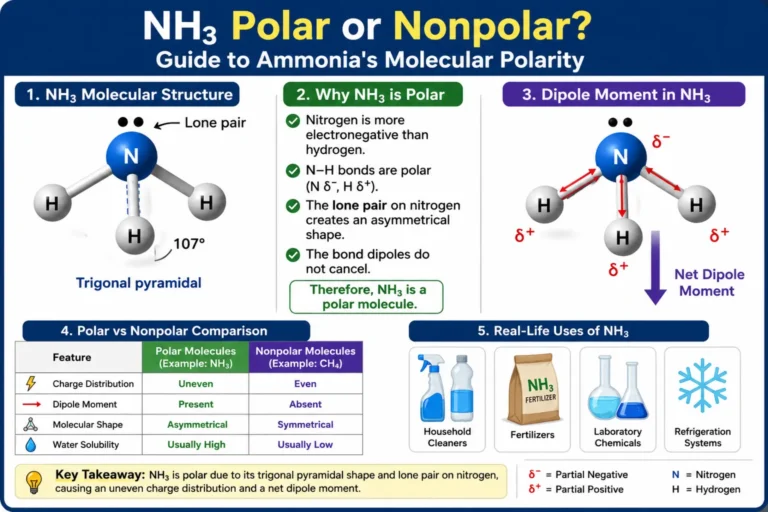
NH3 polar or nonpolar is one of the most common chemistry questions. The short answer is simple. NH3 (ammonia) is a polar molecule.
Many students find molecular polarity confusing. However, it becomes easy once you understand the shape of the molecule. You also need to know how electrons behave.
Ammonia has one nitrogen atom and three hydrogen atoms. It also has one lone pair of electrons. This lone pair changes the molecule’s shape. As a result, the positive and negative charges do not balance. Therefore, NH3 becomes a polar molecule.
In this guide, you will learn why NH3 is polar, how its shape affects polarity, and where polarity matters in everyday life. The explanations use simple language and real-world examples.
Quick Summary Box
- NH3 (ammonia) is a polar molecule.
- Nitrogen is more electronegative than hydrogen.
- NH3 has a trigonal pyramidal shape.
- The lone pair on nitrogen creates an uneven charge.
- The dipole moments do not cancel.
- Polar molecules dissolve well in water.
- NH3 forms hydrogen bonds with water.
- Polarity affects ammonia’s chemical and physical properties.
What Is NH3?
NH3 is the chemical formula for ammonia.
It contains:
- One nitrogen (N) atom
- Three hydrogen (H) atoms
Ammonia is a colorless gas with a strong smell. It plays an important role in farming, cleaning products, and chemical manufacturing.
Basic Facts
| Property | Value |
|---|---|
| Chemical formula | NH3 |
| Molecule name | Ammonia |
| Central atom | Nitrogen |
| Molecular shape | Trigonal pyramidal |
| Bond angle | About 107° |
| Polarity | Polar |
Is NH3 Polar or Nonpolar?
NH3 is a polar molecule.
The molecule has an uneven distribution of electrical charge.
Three main reasons explain this.
- Nitrogen attracts electrons more strongly than hydrogen.
- NH3 has a trigonal pyramidal shape.
- The bond dipoles do not cancel each other.
Therefore, ammonia has a permanent dipole moment.
Featured Snippet Answer
NH3 (ammonia) is polar because nitrogen is more electronegative than hydrogen, and the molecule has a trigonal pyramidal shape. The lone pair on nitrogen causes an uneven charge distribution, giving NH3 a permanent dipole moment.
What Does Polar Mean?
A polar molecule has two ends.
- One end has a slight positive charge.
- The other end has a slight negative charge.
This happens because electrons spend more time near one atom than another.
Think of a magnet.
One side acts differently from the other side.
Polar molecules behave in a similar way.
Why Is NH3 Polar?
Several factors work together.
1. Nitrogen Is More Electronegative
Electronegativity measures how strongly an atom attracts electrons.
Nitrogen pulls shared electrons closer than hydrogen.
As a result:
- Nitrogen becomes slightly negative (δ−)
- Hydrogen becomes slightly positive (δ+)
This creates polar N-H bonds.
2. NH3 Has a Lone Pair
Nitrogen has one lone pair of electrons.
These electrons occupy extra space.
They push the hydrogen atoms downward.
This changes the molecular shape.
Without the lone pair, NH3 would be symmetrical.
Because of the lone pair, it becomes asymmetrical.
3. The Dipoles Do Not Cancel
Each N-H bond has its own dipole.
The trigonal pyramidal shape prevents them from canceling.
Instead, they combine into one overall dipole.
That makes NH3 a polar molecule.
Molecular Shape of NH3
The molecular shape explains polarity very well.
NH3 follows the VSEPR theory.
Nitrogen has:
- Three bonding pairs
- One lone pair
These four electron groups arrange themselves to reduce repulsion.
The result is a trigonal pyramidal structure.
Shape Summary
| Feature | NH3 |
|---|---|
| Electron geometry | Tetrahedral |
| Molecular geometry | Trigonal pyramidal |
| Lone pairs | 1 |
| Bond angle | 107° |
| Symmetrical | No |
NH3 Polar vs Nonpolar Molecules
Understanding the difference becomes easier through comparison.
| Feature | Polar Molecules | Nonpolar Molecules |
|---|---|---|
| Charge distribution | Uneven | Even |
| Dipole moment | Present | Absent |
| Water solubility | Usually high | Usually low |
| Example | NH3, H2O | CO2, CH4 |
| Molecular symmetry | Usually asymmetrical | Usually symmetrical |
NH3 belongs to the polar category because its charges remain uneven.
Real-Life Examples of NH3 Polarity
Polarity affects many everyday uses.
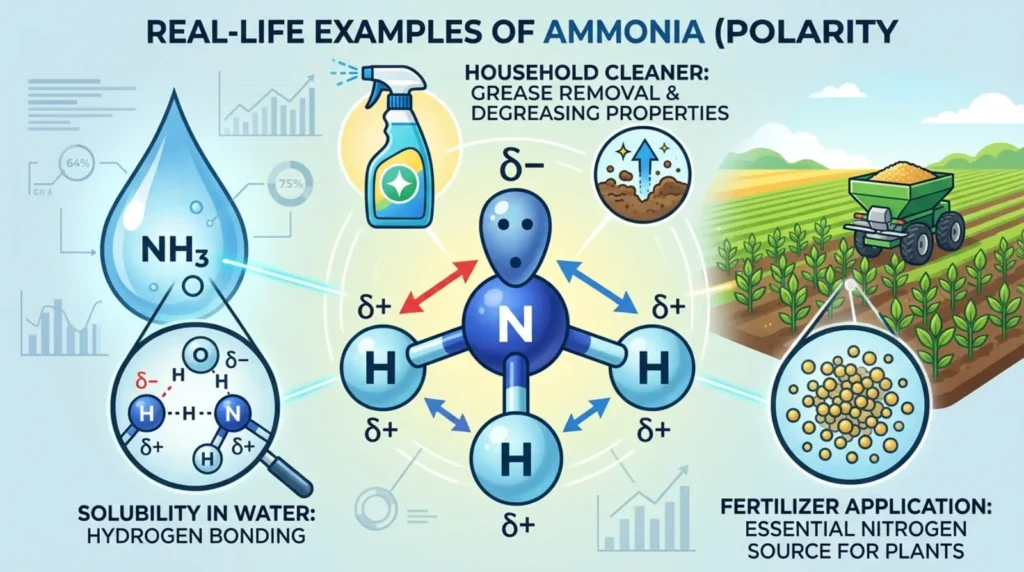
Household Cleaners
Many cleaning products contain ammonia.
Its polarity helps dissolve dirt and grease.
Fertilizers
Farmers use ammonia to provide nitrogen.
Its polarity helps it dissolve in water.
Plants then absorb it more easily.
Laboratory Chemicals
Scientists use ammonia in many chemical reactions.
Its polarity makes it an effective solvent for certain substances.
Refrigeration
Industrial cooling systems often use ammonia.
Its chemical properties make it an efficient refrigerant.
Why Does NH3 Dissolve Well in Water?
Water is also a polar molecule.
Polar molecules mix well with other polar molecules.
NH3 forms hydrogen bonds with water.
These strong attractions help ammonia dissolve quickly.
This explains the phrase:
“Like dissolves like.”
Common Mistakes About NH3 Polarity
Students often make these errors.
Mistake 1: Counting Atoms Only
Some believe three identical hydrogen atoms make NH3 nonpolar.
The lone pair changes everything.
Mistake 2: Ignoring Molecular Shape
Bond polarity alone is not enough.
The molecular shape also determines polarity.
Mistake 3: Confusing Electron Geometry With Molecular Geometry
NH3 has tetrahedral electron geometry.
However, its molecular geometry is trigonal pyramidal.
Polarity depends on molecular geometry.
Mistake 4: Comparing NH3 With CH4
Methane (CH4) is symmetrical.
Its dipoles cancel.
NH3 is not symmetrical.
Therefore, NH3 remains polar.
Tips to Remember NH3 Is Polar
Use these simple tricks.
- Remember the lone pair.
- Think “pyramids are not symmetrical.”
- Nitrogen pulls electrons strongly.
- Uneven shape means uneven charge.
- Polar bonds plus asymmetrical shape equal a polar molecule.
How NH3 Polarity Affects Daily Life
Polarity influences many properties.
Faster Dissolving
Ammonia mixes well with water.
Better Cleaning
Its polarity helps remove stains and oils.
Chemical Reactions
Many reactions depend on ammonia’s polarity.
Biological Importance
Nitrogen compounds in living systems share similar chemical behavior.
Synonyms and Related Keywords
Use these related search terms to understand the topic better.
LSI Keywords
- ammonia polarity
- NH3 molecular polarity
- is ammonia polar
- NH3 molecular shape
- ammonia dipole moment
- trigonal pyramidal molecule
- VSEPR theory NH3
- nitrogen electronegativity
- polar molecules
- nonpolar molecules
- ammonia chemical properties
- NH3 Lewis structure
Expert Insights:
Chemists never determine polarity by looking at the formula alone.
They first examine electronegativity.
Next, they study molecular geometry.
Finally, they check whether bond dipoles cancel.
This method works for nearly every molecule.
Learning NH3 helps you understand many other compounds. It also builds a strong foundation for chemistry, biology, and environmental science. Students who master polarity often find topics like intermolecular forces and chemical bonding much easier.
(FAQs)
Is NH3 polar or nonpolar?
NH3 is polar because it has a trigonal pyramidal shape and one lone pair on nitrogen.
Why is NH3 considered polar?
Nitrogen attracts electrons more strongly than hydrogen. The lone pair creates an uneven charge distribution.
Does NH3 have a dipole moment?
Yes. NH3 has a permanent dipole moment because its bond dipoles do not cancel.
Is NH3 more polar than CH4?
Yes. CH4 is nonpolar because it is symmetrical. NH3 is asymmetrical.
Does NH3 dissolve in water?
Yes. NH3 dissolves easily because both ammonia and water are polar.
What is the molecular shape of NH3?
NH3 has a trigonal pyramidal molecular shape.
What causes NH3 to be polar?
The combination of polar N-H bonds and one lone pair on nitrogen makes NH3 polar.
Can NH3 form hydrogen bonds?
Yes. NH3 forms hydrogen bonds because nitrogen has a lone pair and bonded hydrogen atoms.
Conclusion
Understanding NH3 polar or nonpolar becomes simple when you focus on electronegativity and molecular shape. Although ammonia contains three identical hydrogen atoms, the lone pair on nitrogen changes the molecule into a trigonal pyramidal structure. Because of this asymmetrical shape, the bond dipoles do not cancel. As a result, NH3 is a polar molecule.
This polarity explains why ammonia dissolves well in water, forms hydrogen bonds, and works effectively in cleaning products, fertilizers, and many industrial processes. When studying molecular polarity, always examine both bond polarity and molecular geometry. Following these steps will help you correctly identify whether a molecule is polar or nonpolar.