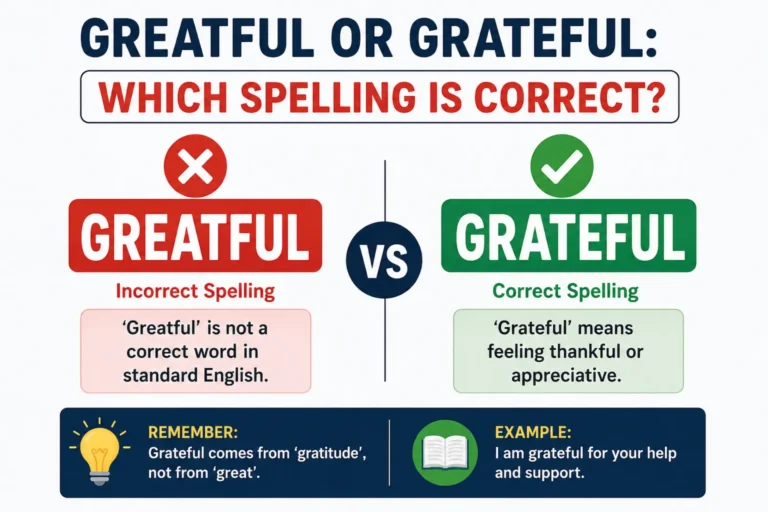
Greatful or grateful is a common spelling question. Many people write greatful, but they are not sure if it is correct. The good news is that the answer is simple. Only one spelling is correct in standard English.
This guide explains the difference in clear and easy words. You will learn the correct spelling, meaning, pronunciation, and real-life examples. You will also see why many people make this mistake and how to avoid it forever.
By the end of this article, you will know when to use grateful with confidence. Whether you are writing emails, school papers, blog posts, or social media captions, this guide will help you avoid a common English error.
Quick Summary
- Grateful is the correct spelling.
- Greatful is incorrect in modern English.
- Grateful means thankful or appreciative.
- Remember: “Grateful” comes from the word gratitude, not great.
- Use grateful in all formal and informal writing.
What Does Grateful Mean?
Grateful means feeling thankful for something someone has done or for something good that happened.
It shows appreciation and kindness.
Simple definition
Grateful = Feeling thankful and appreciative.
Examples
- I am grateful for your help.
- She felt grateful after receiving the gift.
- We are grateful for your support.
- They were grateful for another chance.
Is It Greatful or Grateful?
The correct spelling is grateful.
The spelling greatful is wrong.
Many people think “greatful” makes sense because it contains the word great. However, English does not follow that pattern.
Correct
✅ Grateful
Incorrect
❌ Greatful
Always use grateful in professional, academic, and everyday writing.
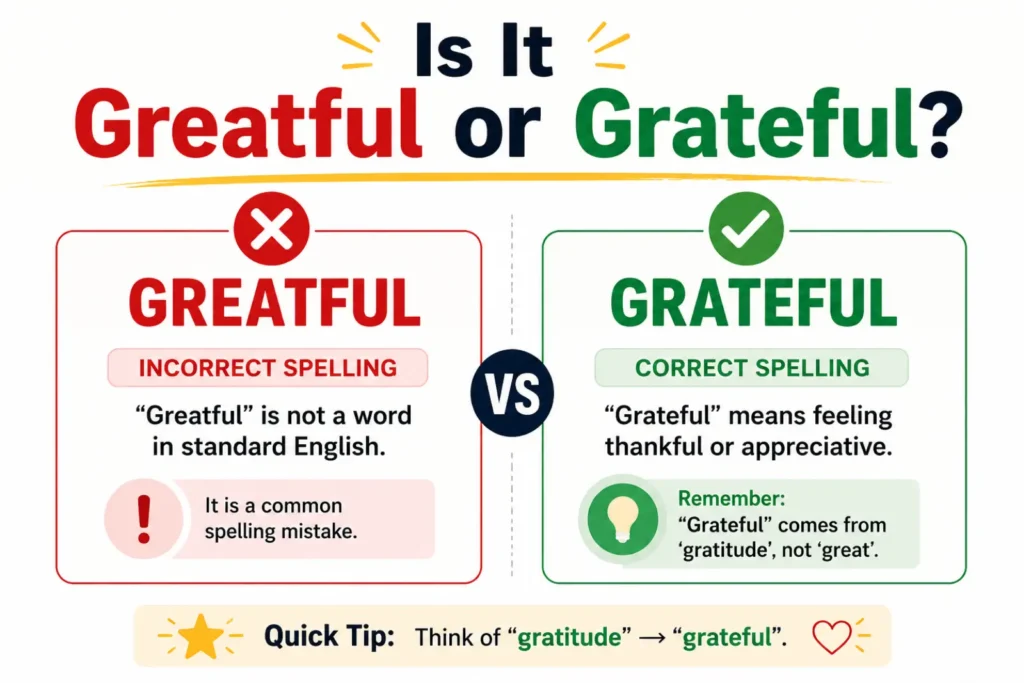
Greatful vs Grateful Comparison Table
| Feature | Grateful | Greatful |
|---|---|---|
| Correct spelling | ✅ Yes | ❌ No |
| Dictionary word | ✅ Yes | ❌ No |
| Used in formal writing | ✅ Yes | ❌ No |
| Means thankful | ✅ Yes | ❌ No |
| Accepted in English | ✅ Yes | ❌ No |
Quick answer
If you are choosing between greatful or grateful, always choose grateful.
Why Do People Write “Greatful”?
This mistake happens because of the word great.
People naturally think:
Great + ful = Greatful
However, English forms the word from gratitude, not from great.
Notice these words:
- Gratitude
- Grateful
- Ungrateful
All of them begin with grat-, not great-.
This pattern makes the spelling easier to remember.
How to Remember the Correct Spelling
Simple memory tricks can help.
Trick 1
Think:
Grateful comes from gratitude.
Both start with grat.
Trick 2
Remember this sentence:
I feel gratitude, so I am grateful.
Trick 3
Do not connect the word with great.
Even if something is great, the spelling stays grateful.
Real-Life Examples of Grateful
Here are examples you can use every day.
At work
- I am grateful for this opportunity.
- We are grateful for your feedback.
At school
- The students were grateful for the teacher’s support.
- I am grateful for your guidance.
With friends
- Thank you. I am grateful for your kindness.
- She felt grateful after her friend helped her.
Family
- We are grateful to our parents.
- I feel grateful every day.
Business emails
- We are grateful for your continued trust.
- Thank you for your valuable time.
Common Mistakes People Make
Many writers make the same spelling mistakes.
Mistake 1
❌ I am greatful for your help.
✅ I am grateful for your help.
Mistake 2
❌ We feel greatful today.
✅ We feel grateful today.
Mistake 3
❌ She was very greatful.
✅ She was very grateful.
Always check your spelling before sending emails or publishing content.
How to Use Grateful in Daily Life
You can use grateful in many situations.
Expressing thanks
“I am grateful for your support.”
Writing thank-you notes
“We are grateful for your kindness.”
Social media
“Feeling grateful today.”
Professional emails
“I am grateful for the opportunity to work with your team.”
Personal conversations
“I’m grateful that you came.”

Grateful vs Thankful
Both words are similar, but they are not always the same.
| Grateful | Thankful |
|---|---|
| Shows deep appreciation | Shows thanks |
| Often used for lasting feelings | Often used for specific events |
| Slightly more formal | More common in conversation |
Example
“I’m grateful for your friendship.”
“I’m thankful for your gift.”
Both sentences are correct.
Synonyms of Grateful
Using different words improves your writing.
Common synonyms
- Thankful
- Appreciative
- Obliged
- Indebted
- Blessed
- Appreciative
- Recognizing kindness
Related LSI keywords
- grateful meaning
- thankful meaning
- appreciation
- gratitude
- feeling thankful
- grateful definition
- grateful examples
- grateful in a sentence
- gratitude vs grateful
- grateful spelling
These related terms help readers understand the topic better.
Expert Tips to Avoid Spelling Errors
Professional writers use simple habits.
Read slowly
Many spelling mistakes happen because people type too fast.
Use spell check
Most writing tools detect “greatful.”
Learn word families
Remember these words:
- Gratitude
- Grateful
- Ungrateful
Proofread important documents
Check emails, resumes, and assignments before sending them.
These habits improve writing quality over time.
Common Situations Where You Should Use Grateful
Here are common examples.
After receiving help
“I’m grateful for your advice.”
After getting a promotion
“I am grateful for this opportunity.”
During Thanksgiving
“We are grateful for our family.”
After recovering from illness
“She feels grateful for her health.”
After graduation
“I am grateful to my teachers.”
Why Correct Spelling Matters
Correct spelling builds trust.
It also improves communication.
When readers see spelling mistakes, they may question your credibility.
Correct spelling also helps:
- Improve professional writing
- Build confidence
- Create better first impressions
- Avoid confusion
- Support clear communication
Using grateful instead of greatful shows strong writing skills.
Frequently Asked Questions
Is greatful a real word?
No. Greatful is not a correct English spelling.
Which spelling is correct: greatful or grateful?
Grateful is the only correct spelling.
Why is grateful spelled without “great”?
The word comes from gratitude, not from great.
What does grateful mean?
It means feeling thankful or appreciative.
Can I use grateful in formal writing?
Yes. It is correct for business, school, and professional writing.
What is the opposite of grateful?
The opposite is ungrateful.
Is grateful the same as thankful?
They have similar meanings. However, grateful often expresses deeper appreciation.
Expert Insight
Strong writing depends on accuracy. Small spelling errors can reduce credibility, especially in professional or academic settings. Understanding that grateful comes from gratitude makes the correct spelling easier to remember. This simple connection helps you write with greater confidence and avoid one of the most common English spelling mistakes. Consistent, correct spelling also improves readability, supports clear communication, and helps create a more polished impression
Conclusion
If you have ever wondered whether to write greatful or grateful, the answer is simple. Grateful is the only correct spelling in English. It means feeling thankful and appreciative, while greatful is a common spelling mistake that should be avoided.
The easiest way to remember the correct form is to think of the word gratitude. Both gratitude and grateful begin with grat-, making the connection easy to recall. Whether you are writing an email, a school assignment, a social media post, or professional content, using grateful will make your writing more accurate and credible. Keep practicing this spelling, and it will soon become second nature.