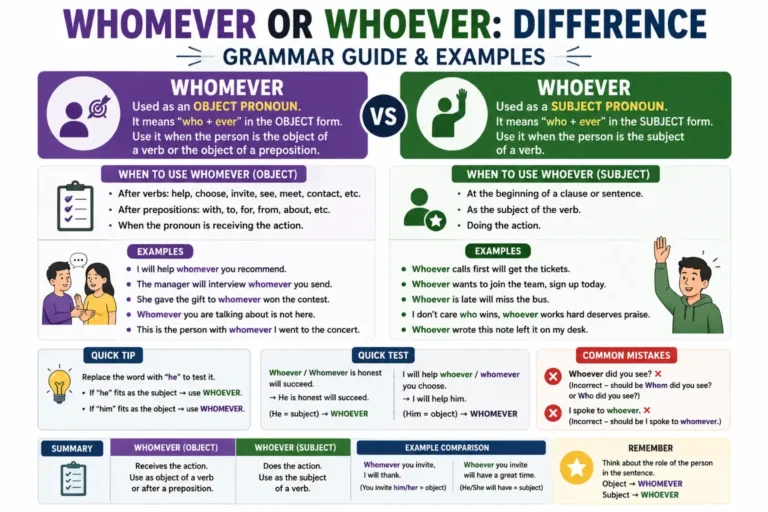
Whomever or whoever is a grammar question that confuses many English learners and native speakers. These two words look similar, but they have different jobs in a sentence. Choosing the correct one can make your writing clearer and more professional.
The good news is that you do not need to memorize difficult grammar rules. A few simple tricks can help you decide whether to use whoever or whomever. Once you understand the difference, you will write emails, essays, reports, and social media posts with more confidence.
This guide explains both words in simple English. You will learn their meanings, compare them side by side, see real-life examples, and discover easy memory tips. By the end, you will know exactly when to use whoever and whomever without guessing.
Quick Summary Box
- Whoever is a subject pronoun.
- Whomever is an object pronoun.
- Use whoever when the person performs the action.
- Use whomever when the person receives the action.
- If you can replace the word with he or she, use whoever.
- If you can replace it with him or her, use whomever.
- In everyday English, whoever is more common than whomever.
What Does Whoever Mean?
The word whoever refers to any person who performs an action. It works as the subject of a sentence or clause.
Think of whoever as replacing he, she, or they.
Simple Definition
Whoever = Any person who does the action.
Examples
- Whoever finishes first wins the prize.
- Give the ticket to whoever arrives early.
- Whoever calls me first will get the answer.
- Whoever studies hard usually succeeds.
- Whoever wants pizza can join us.
In each sentence, whoever performs the action.
What Does Whomever Mean?
The word whomever refers to any person who receives an action. It acts as the object of a verb or preposition.
Think of whomever as replacing him, her, or them.
Simple Definition
Whomever = Any person who receives the action.
Examples
- Choose whomever you trust.
- Invite whomever you like.
- Hire whomever the manager recommends.
- Support whomever your team selects.
- You may interview whomever you prefer.
In these examples, whomever receives the action instead of performing it.
Whoever vs Whomever: Key Differences
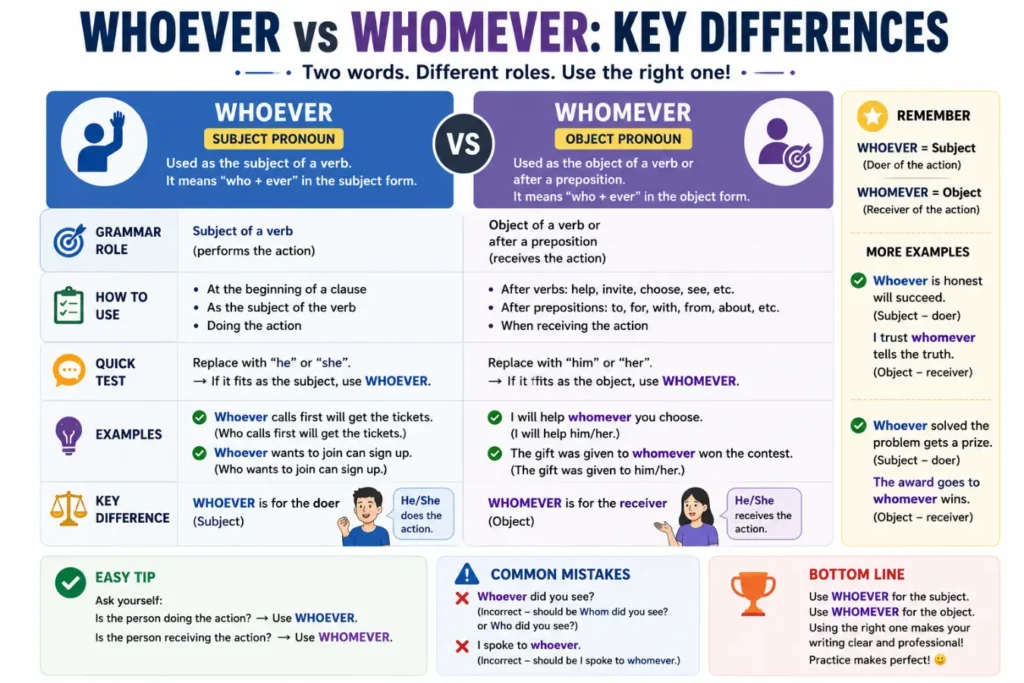
Although these words look alike, they serve different grammar roles. Understanding this difference makes choosing the correct word much easier.
| Feature | Whoever | Whomever |
|---|---|---|
| Grammar Role | Subject | Object |
| Replaces | He, She, They | Him, Her, Them |
| Performs the Action | Yes | No |
| Receives the Action | No | Yes |
| Common in Everyday English | Very Common | Less Common |
| Example | Whoever arrives first wins. | Invite whomever you choose. |
Quick Rule
- Use whoever when the person does the action.
- Use whomever when the person receives the action.
The Easy “He or Him” Test
The simplest way to choose between whoever and whomever is to replace the word with he or him.
If “He” Sounds Correct
Use whoever.
Example:
Whoever wants dessert may have some.
Test:
He wants dessert.
“He” works, so whoever is correct.
If “Him” Sounds Correct
Use whomever.
Example:
Choose whomever you trust.
Test:
You trust him.
“Him” works, so whomever is correct.
This trick works in most grammar situations.
Why Do People Confuse Whoever and Whomever?
Many people avoid whomever because it sounds formal. Others use it too often because they think it sounds more professional.
Modern English favors whoever in casual conversations. However, formal writing still uses whomever when grammar requires it.
Another reason for confusion is that these words often appear in long or complex sentences. When several clauses appear together, identifying the subject and object becomes harder.
The “he or him” test makes these sentences much easier to understand.
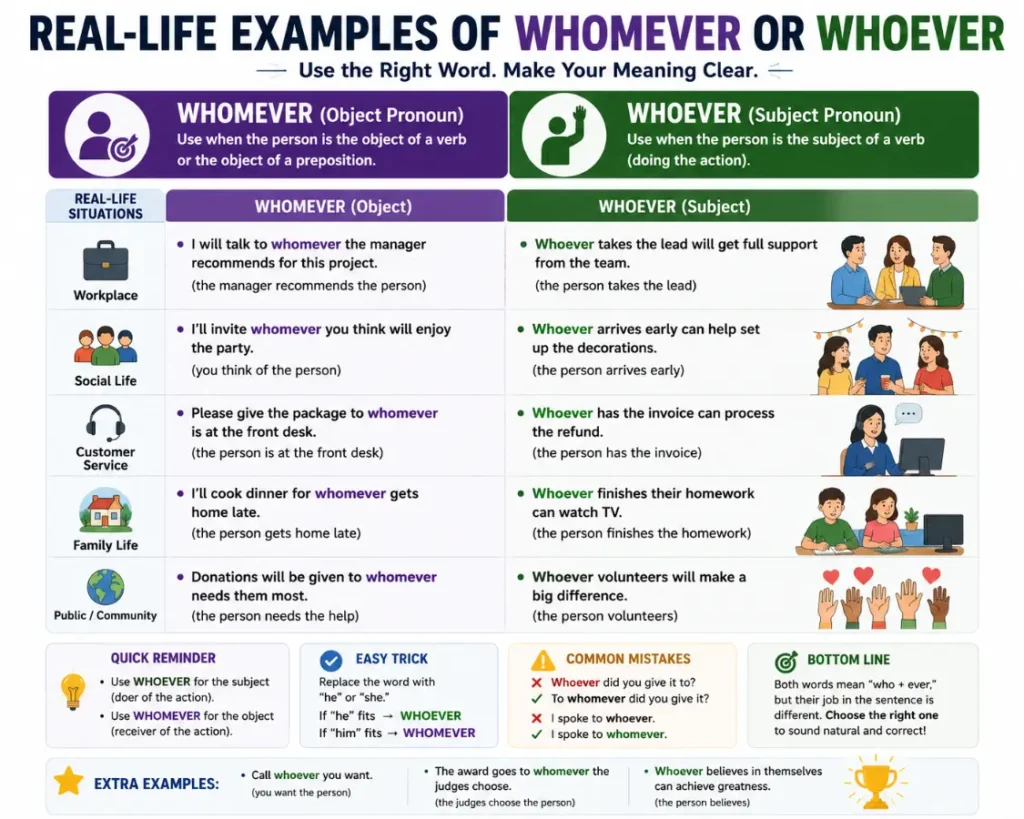
Real-Life Examples
Learning through everyday situations helps you remember the difference.
At School
Whoever
- Whoever finishes the assignment first may leave early.
- Whoever answers correctly earns extra credit.
Whomever
- Ask whomever you need for help.
- The teacher will reward whomever the class selects.
At Work
Whoever
- Whoever completes the project first will present it.
- Whoever has the experience should lead the meeting.
Whomever
- Hire whomever you believe is qualified.
- Contact whomever the client recommends.
At Home
Whoever
- Whoever cooks dinner chooses the movie.
- Whoever wakes up first makes breakfast.
Whomever
- Invite whomever you want to the party.
- Thank whomever helped you clean the house.
Common Mistakes People Make
Many writers confuse whoever and whomever because the grammar rule seems difficult. In reality, most mistakes happen because people focus on sounding formal instead of choosing the correct word.
Here are some common mistakes and their corrections.
Mistake 1
❌ Whomever finishes first wins the race.
✅ Whoever finishes first wins the race.
Why?
The word performs the action. It is the subject of the sentence.
Mistake 2
❌ Give the award to whoever you choose.
✅ Give the award to whomever you choose.
Why?
The person receives the action. They are the object of the verb “choose.
Mistake 3
❌ I’ll hire whoever you recommend.
✅ I’ll hire whomever you recommend.
Why?
You recommend him or her, not he or she.
Mistake 4
❌ Send the email to whoever you trust most.
✅ Send the email to whomever you trust most.
Why?
The person is the object of the verb “trust.”
Mistake 5
❌ Whomever studies hard will succeed.
✅ Whoever studies hard will succeed.
Why?
The person performs the action of studying.
When Should You Use Whoever?
Use whoever whenever the word acts as the subject of a sentence or clause.
Think about the person doing the action.
Common Situations
- School assignments
- Business writing
- Everyday conversations
- Public speaking
- Emails
- Blog posts
- News articles
Examples
- Whoever arrives first can open the meeting.
- Whoever volunteers will receive training.
- Whoever practices daily improves faster.
- Whoever calls first gets the appointment.
- Whoever finds the answer should share it.
In every sentence, whoever performs the action.
When Should You Use Whomever?
Use whomever whenever the word functions as the object of a verb or preposition.
The person receives the action instead of performing it.
Common Situations
- Formal writing
- Legal documents
- Academic papers
- Professional emails
- Official announcements
Examples
- Hire whomever you think is best.
- Reward whomever deserves recognition.
- Support whomever the committee selects.
- Call whomever you need.
- Invite whomever you prefer.
Although whomever is correct in these examples, many people still use whoever in casual conversation.
Daily Life Examples
The easiest way to remember grammar is to connect it to everyday situations.
At School
Whoever
- Whoever studies regularly earns better grades.
- Whoever volunteers will lead the project.
Whomever
- Ask whomever the teacher recommends.
- Help whomever needs assistance.
At Work
Whoever
- Whoever finishes the report first may leave early.
- Whoever solves the problem deserves recognition.
Whomever
- Hire whomever has the strongest qualifications.
- Thank whomever assisted the customer.
With Friends
Whoever
- Whoever brings snacks chooses the game.
- Whoever plans the trip decides the schedule.
Whomever
- Invite whomever you enjoy spending time with.
- Trust whomever earns your respect.
Family Conversations
Whoever
- Whoever cleans the kitchen chooses dessert.
- Whoever gets home first starts dinner.
Whomever
- Give the gift to whomever you love.
- Ask whomever knows the answer.
Easy Memory Tricks
Simple memory tricks help you choose the correct word without thinking too hard.
Trick 1: He or Him Test
Replace the word with he or him.
If he fits, use whoever.
If him fits, use whomever.
Example:
Whoever wins receives a prize.
He wins.
Correct.
Example:
Invite whomever you trust.
You trust him.
Correct.
Trick 2: Subject or Object
Ask yourself one question.
Who performs the action?
If the person performs it, use whoever.
If the person receives it, use whomever.
Trick 3: Keep It Simple
If the sentence sounds confusing, break it into two smaller sentences.
Original:
Give the prize to whoever wins.
Break it apart.
He wins.
Give the prize to him.
Because the word is the subject of the clause “whoever wins,” whoever is correct.
Breaking sentences apart often makes the answer obvious.
Why Modern English Uses Whoever More Often
Grammar books still teach both words. However, everyday English has changed over time.
Most native speakers use whoever in both formal and informal conversations.
Even professional writers sometimes choose whoever because it sounds more natural.
You will still see whomever in:
- Legal writing
- Government documents
- Academic papers
- Formal business communication
In casual speech, using whoever rarely sounds incorrect.
Knowing the grammar rule simply helps you write more accurately when it matters most.
Synonyms and Related Words
Learning similar words can improve your vocabulary and help you understand whomever and whoever more clearly.
Synonyms for Whoever
These words or phrases have similar meanings in certain contexts.
- Anyone who
- Any person who
- The person who
- Whoever it may be
- Whichever person
Example Sentences
- Anyone who studies hard can succeed.
- The person who arrives first will open the meeting.
- Whoever volunteers will receive training.
Synonyms for Whomever
These alternatives can replace whomever in some sentences.
- Anyone whom
- Any person whom
- The person whom
- Whoever (in informal English)
- The individual you choose
Example Sentences
- Invite anyone whom you trust.
- Hire the person whom you believe is qualified.
- Thank the individual you choose.
Related Search Terms (LSI Keywords)
Using related search terms helps readers understand the topic and improves SEO.
- whoever meaning
- whomever meaning
- whoever vs whomever
- difference between whoever and whomever
- grammar rules for whoever and whomever
- who vs whom
- English grammar guide
- subject and object pronouns
- grammar mistakes
- English writing tips
- pronoun examples
- formal English grammar
History and Origin of Whoever and Whomever
The words whoever and whomever have existed in English for hundreds of years.
Whoever developed from the pronoun who, which has always referred to the subject of a sentence.
Whomever comes from whom, the object form of who. English once used whom much more often than it does today.
Over time, everyday English became simpler. Many native speakers now replace whomever with whoever, especially in casual conversations.
Even though whomever appears less often, it remains correct in formal writing when the grammar requires an object pronoun.
Understanding this history explains why many people feel uncertain about these words today.
Expert Insights
Professional editors agree that clarity is more important than sounding overly formal.
If a sentence feels awkward with whomever, rewrite it instead of forcing complicated grammar. Good writing should sound natural and be easy to understand.
Grammar experts also recommend checking the clause instead of the whole sentence. The role of the word inside its own clause determines whether whoever or whomever is correct.
Reading books, newspapers, and professional articles can also improve your understanding. The more examples you see, the easier these grammar choices become.
Using the correct pronoun builds credibility. It also makes your writing stronger in school, business, and professional communication.
Practice Quiz
Test your understanding with these simple questions.
1. ______ arrives first will receive the award.
Answer: Whoever
2. Invite ______ you trust most.
Answer: Whomever
3. ______ studies consistently usually earns better grades.
Answer: Whoever
4. Thank ______ helped organize the event.
Answer: Whoever
5. Hire ______ the manager recommends.
Answer: Whomever
If you answered most questions correctly, you now understand when to use whoever and whomever.
(FAQs)
1. What is the difference between whoever and whomever?
Whoever is a subject pronoun. Whomever is an object pronoun.
2. Is “whoever” more common than “whomever”?
Yes. Most people use whoever in everyday speech and informal writing.
3. When should I use whomever?
Use whomever when the word receives the action of a verb or follows a preposition.
4. What is the easiest way to remember the rule?
Use the he or him test.
- If he fits, choose whoever.
- If him fits, choose whomever.
5. Can I always use whoever?
In casual English, many people do. However, formal writing still follows the grammar rule.
6. Why is whomever becoming less common?
Modern English prefers simpler sentence structures, so whoever appears more often in conversation.
7. Do grammar checkers always catch these mistakes?
Not always. Some grammar tools miss complex sentence structures, so understanding the rule is still valuable.
Conclusion
Understanding whomever or whoever does not have to be difficult. The key is knowing the role each word plays in a sentence. Whoever acts as the subject and performs the action. Whomever acts as the object and receives the action.
The easiest way to remember the difference is the he or him test. If you can replace the word with he, use whoever. If him fits better, use whomever. This simple trick works in most situations and helps you avoid common grammar mistakes.
With regular practice, using the correct word becomes natural. Whether you are writing emails, essays, blog posts, or professional documents, choosing whoever or whomever correctly makes your writing clearer, more accurate, and more confident.