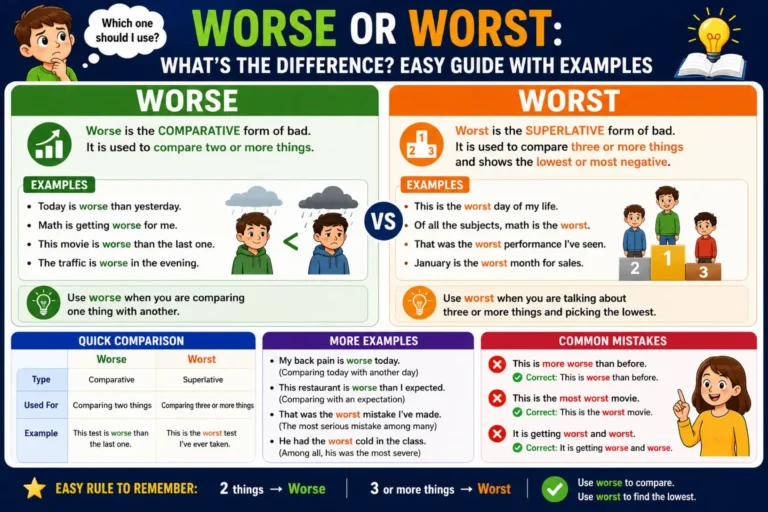
Worse or worst is a common grammar question that confuses many English learners. These two words look similar and come from the same root word, bad. However, they have different meanings and uses.
Knowing when to use worse and worst can improve your writing and speaking. It also helps you avoid common grammar mistakes in school, work, and everyday conversations.
The good news is that the rule is simple. Once you understand how these words compare things, choosing the correct one becomes easy. This guide explains the difference in simple English. You will find clear definitions, comparison tables, real-life examples, and helpful memory tricks. By the end, you will know exactly when to use worse and worst with confidence.
Quick Summary Box
- Worse compares two things.
- Worst describes the lowest or most negative among three or more things.
- Worse is the comparative form of bad.
- Worst is the superlative form of bad.
- Use worse when comparing one thing to another.
- Use worst when something is at the bottom of a group.
- A simple rule: Bad → Worse → Worst.
What Does Worse Mean?
The word worse is the comparative form of bad. You use it when comparing two people, places, things, or situations.
It means one thing is more bad than another.
Simple Definition
Worse = More bad when comparing two things.
Examples
- Today is worse than yesterday.
- My cold feels worse this morning.
- This road is worse than the old one.
- His performance was worse than mine.
- Driving in heavy rain is worse than driving in light rain.
- This phone has worse battery life than my old one.
Each example compares two things.
Worse as an Adjective
An adjective describes a noun.
Examples:
- We had worse weather today.
- She made a worse decision.
- They faced worse conditions during the trip.
Worse as an Adverb
Worse can also describe how an action happens.
Examples:
- He sings worse than his brother.
- She performed worse after the injury.
- The machine works worse in cold weather.
What Does Worst Mean?
The word worst is the superlative form of bad. It describes the most bad person, thing, or situation in a group of three or more.
It shows the lowest quality or poorest result.
Simple Definition
Worst = The most bad in a group.
Examples
- This is the worst movie I have ever seen.
- Monday was the worst day of the week.
- He received the worst score in the class.
- That was the worst traffic we experienced all year.
- Winter is the worst season for my allergies.
- This restaurant serves the worst pizza in town.
Each sentence refers to one item that ranks lowest in a larger group.
Worst as an Adjective
Examples:
- It was the worst mistake of my career.
- She had the worst headache yesterday.
- This is the worst weather this month.
Worst as a Noun
Sometimes worst works as a noun.
Examples:
- Prepare for the worst.
- We expected the worst.
- The worst is over now.
In these examples, worst refers to the most difficult or unpleasant situation.
Worse vs Worst: Key Differences
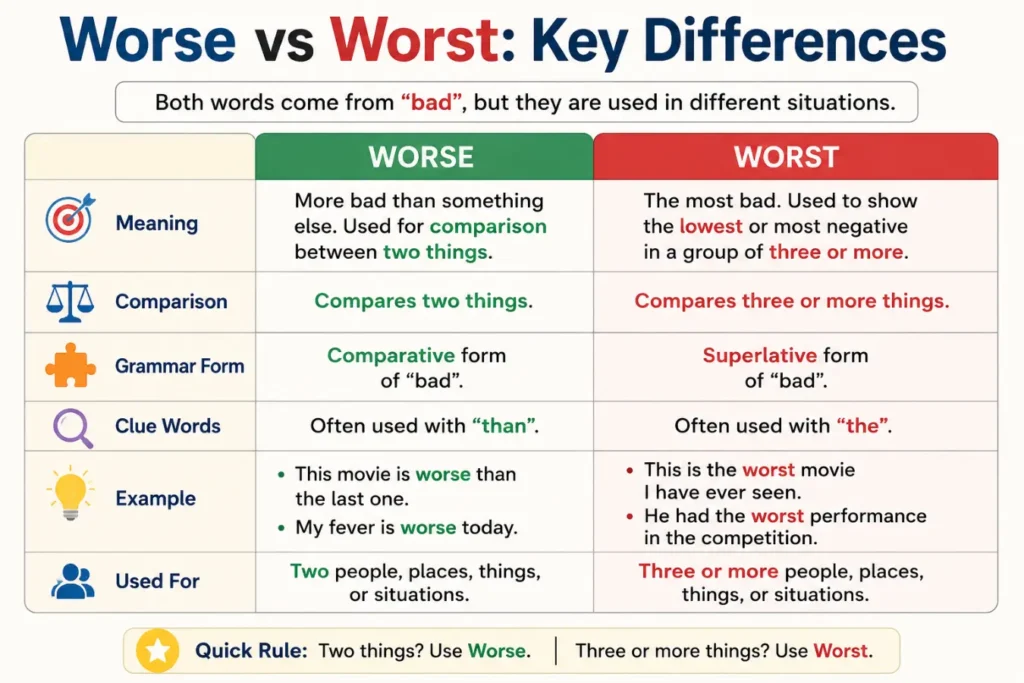
Although these words are related, they are not interchangeable. The main difference is the number of things being compared.
| Feature | Worse | Worst |
|---|---|---|
| Meaning | More bad | Most bad |
| Grammar Form | Comparative | Superlative |
| Used For | Comparing two things | Comparing three or more things |
| Common Words | Than | The |
| Example | This test is worse than the last one. | This is the worst test of the year. |
Quick Rule
- Use worse when comparing two things.
- Use worst when choosing one thing from a group of three or more.
Example Comparison
Worse
- Summer is worse than spring for allergies.
- My new laptop is worse than my old one.
- His second attempt was worse than the first.
Worst
- This is the worst summer I can remember.
- That was the worst meal on the menu.
- She had the worst result in the competition.
Bad, Worse, Worst: Understanding the Degrees of Comparison
The words bad, worse, and worst show different levels of comparison.
| Degree | Word | Example |
| Positive | Bad | This movie is bad. |
| Comparative | Worse | This movie is worse than the last one. |
| Superlative | Worst | This is the worst movie I have ever watched. |
Remember this simple pattern:
Bad → Worse → Worst
This pattern works just like:
- Good → Better → Best
- Little → Less → Least
- Far → Farther/Further → Farthest/Furthest
Learning these irregular comparisons will improve your grammar and help you write naturally.
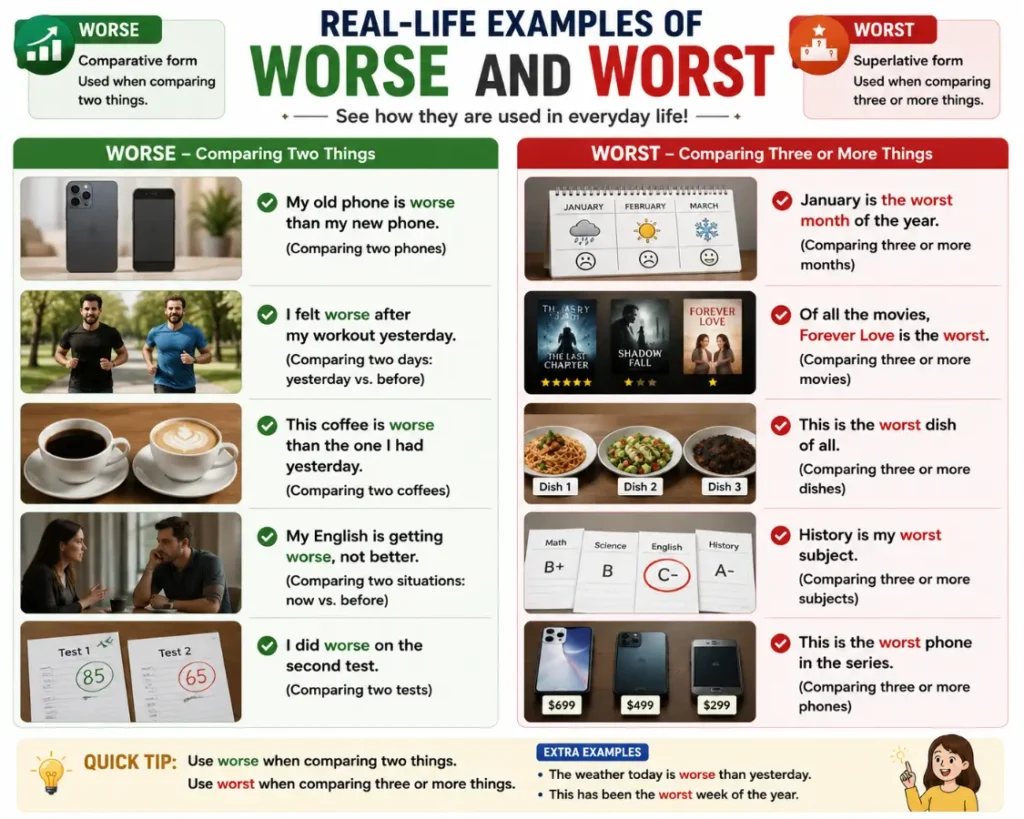
Real-Life Examples of Worse and Worst
The best way to learn worse and worst is through everyday examples. These situations show how native English speakers use these words.
At School
Worse
- My math grade is worse than last month.
- Today’s quiz was worse than yesterday’s.
- His handwriting is worse than mine.
Worst
- That was the worst exam of the semester.
- She received the worst grade in the class.
- Science was my worst subject in school.
At Work
Worse
- Sales were worse this month than last month.
- The traffic was worse today.
- My internet connection is worse after the update.
Worst
- Last Friday was the worst workday of the year.
- That was the worst meeting I have attended.
- This project became our worst challenge.
At Home
Worse
- The weather became worse in the evening.
- My headache feels worse today.
- The noise is worse at night.
Worst
- Yesterday was the worst day this week.
- That storm was the worst one this season.
- This is the worst cold I have ever had.
While Traveling
Worse
- The second hotel was worse than the first.
- The traffic became worse after noon.
- This road is worse than the highway.
Worst
- That was the worst flight of my life.
- It was the worst vacation experience ever.
- This airport has the worst delays.
Sports and Fitness
Worse
- Our team played worse in the second half.
- I feel worse after missing practice.
- His performance was worse than last week.
Worst
- That was our worst game this season.
- She had the worst time in the race.
- This was the worst injury of his career.
Common Mistakes People Make
Many learners confuse worse and worst because both describe something negative. However, each word has a different purpose.
Mistake 1
❌ This is worse movie I have seen.
✅ This is the worst movie I have seen.
Why?
You are talking about one movie in a large group.
Mistake 2
❌ My headache is the worst than yesterday.
✅ My headache is worse than yesterday.
Why?
You are comparing only two situations.
Mistake 3
❌ This is worse day of my life.
✅ This is the worst day of my life.
Why?
You are choosing one day from your entire life.
Mistake 4
❌ Today is the worst than yesterday.
✅ Today is worse than yesterday.
Why?
The word than usually signals a comparison between two things.
Mistake 5
❌ He is worse student in the class.
✅ He is the worst student in the class.
Why?
You are comparing one student with the whole class.
When Should You Use Worse?
Use worse when comparing two things.
Common situations include:
- Comparing two days
- Comparing two people
- Comparing two products
- Comparing two experiences
- Comparing two places
- Comparing two performances
Examples
- My new phone is worse than my old one.
- Winter feels worse than autumn this year.
- The second attempt was worse than the first.
- This restaurant is worse than the one nearby.
- Her second speech was worse than her first.
A helpful clue is the word than. If your sentence includes than, worse is often the correct choice.
When Should You Use Worst?
Use worst when talking about one thing in a group of three or more.
Examples include:
- The worst movie
- The worst student
- The worst restaurant
- The worst year
- The worst experience
- The worst decision
Examples
- This is the worst book I have read this year.
- He had the worst performance in the competition.
- Last summer was the worst season for tourism.
- That was the worst customer service experience.
- She made the worst decision of her career.
The word the often appears before worst because it identifies one thing as the lowest in a group.
Easy Tips and Tricks to Remember the Difference
Learning one simple rule can help you avoid mistakes.
Tip 1: Count the Things
Ask yourself how many things you are comparing.
- Two things → Worse
- Three or more things → Worst
Tip 2: Look for “Than”
The word than usually means you need worse.
Example:
- This test is worse than the last one.
Tip 3: Look for “The”
The word the often comes before worst.
Example:
- This is the worst meal I have eaten.
Tip 4: Remember the Pattern
Bad → Worse → Worst
Just like:
- Good → Better → Best
- Little → Less → Least
Tip 5: Practice Every Day
Create your own sentences using both words.
The more you practice, the easier grammar becomes.
Usage in Daily Life
You hear worse and worst every day.
People use them when talking about:
- Weather
- Health
- School
- Business
- Food
- Sports
- Travel
- Movies
- Technology
- Family life
Everyday Examples
- My cough is getting worse.
- This is the worst traffic today.
- The weather looks worse tomorrow.
- That was the worst mistake I ever made.
- His cooking is worse than mine.
- This phone has the worst battery life.
Reading and listening to English every day will help you recognize these patterns naturally.
Synonyms and Related Words
Using related words improves your vocabulary and makes your writing more natural.
Synonyms for Worse
- Poorer
- Inferior
- More difficult
- More serious
- More unpleasant
- More harmful
- More severe
- Less effective
Synonyms for Worst
- Poorest
- Lowest
- Most difficult
- Most harmful
- Most unpleasant
- Least successful
- Lowest quality
- Most disappointing
Related Search Terms (LSI Keywords)
Include these naturally in your content for better SEO.
- worse meaning
- worst meaning
- worse vs worst
- difference between worse and worst
- when to use worse
- when to use worst
- grammar rules
- English comparison words
- common English mistakes
- comparative and superlative adjectives
- English vocabulary tips
Why Do People Confuse Worse and Worst?
Many English learners mix up worse and worst because the words look and sound similar. They also come from the same base word, bad.
The biggest reason for confusion is that both words describe something negative. However, they compare different numbers of things.
- Worse compares two things.
- Worst compares three or more things.
Another reason is that many learners translate directly from their native language. In English, comparative and superlative forms follow specific grammar rules. Learning these patterns helps you avoid common mistakes.
The more you read and practice, the easier it becomes to choose the correct word naturally.
Expert Insights
Grammar experts recommend learning comparison words in complete sentences instead of memorizing definitions.
When you read books, blogs, or news articles, notice how writers use worse and worst. Real examples help you remember grammar rules faster.
Professional writers also proofread their work before publishing. A quick review can catch small mistakes that grammar checkers sometimes miss.
Using the correct word improves clarity and builds trust with readers. It also makes your writing look more polished in school, business, and everyday communication.
If you remember the simple pattern Bad → Worse → Worst, you will avoid most grammar errors.
Practice Quiz
Test your understanding with these simple questions.
1. My headache feels ______ than yesterday.
Answer: worse
2. This is the ______ movie I have ever watched.
Answer: wors
3. Today’s traffic is ______ than it was this morning.
Answer: worse
4. That was the ______ performance in the competition.
Answer: worst
5. My internet connection is getting ______ every day.
Answer: worse
6. Last winter was the ______ season for travel.
Answer: worst
If you answered all six correctly, you now understand the difference between worse and worst.
(FAQs)
1. What is the difference between worse and worst?
Worse compares two things. Worst describes one thing as the lowest or most negative in a group of three or more.
2. Is it “worse than” or “worst than”?
The correct phrase is worse than.
Example:
This book is worse than the first one.
3. Can I say “the worse”?
Usually, no.
In most situations, you should say the worst when talking about the lowest in a group.
4. Is worse a comparative adjective?
Yes.
Worse is the comparative form of bad.
5. Is worst a superlative adjective?
Yes.
Worst is the superlative form of bad.
6. How can I remember the difference?
Remember this simple order:
Bad → Worse → Worst
Two things = Worse
Three or more = Worst
7. Can worse and worst be used as adverbs?
Yes.
Examples:
- She sings worse than her sister.
- He performed the worst in the competition.
Conclusion
Understanding worse or worst is easier once you know the basic grammar rule. Worse compares two things, while worst identifies the lowest or most negative option in a group of three or more. Although these words are closely related, they cannot replace each other.
A simple way to remember the difference is the pattern Bad → Worse → Worst. Also, look for helpful clues in your sentence. The word than usually points to worse, while the often appears before worst.
Practice using both words in everyday conversations and writing. Over time, choosing the correct word will become natural. Whether you are writing an email, completing homework, or creating professional content, using worse and worst correctly will make your English clearer, stronger, and more accurate.