Is red positive or negative? This is a common question when working with batteries, electrical wires, electronics, or vehicles. Many people believe the answer is always the same. However, the truth depends on the electrical system you are using.
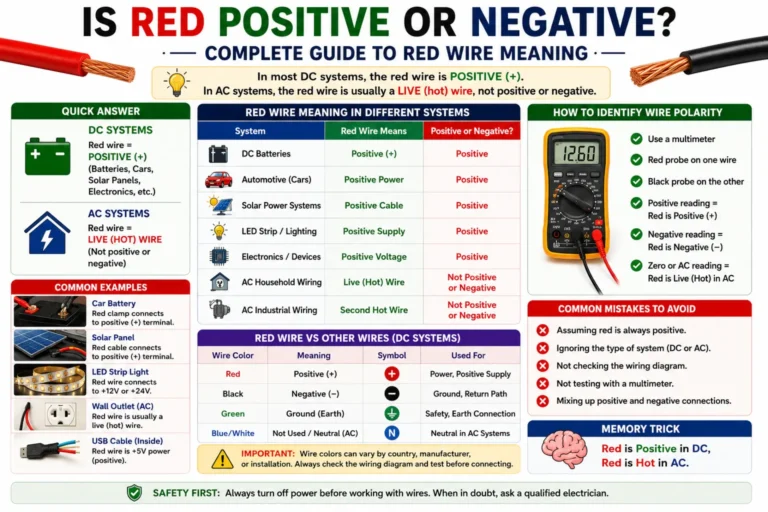
In most DC (direct current) systems, the red wire is positive (+). You will see this in batteries, cars, solar systems, and many electronic devices. However, in AC (alternating current) wiring, a red wire usually does not mean positive. Instead, it often serves as a second live (hot) wire.
Understanding wire colors helps you avoid mistakes and work more safely. This guide explains everything in simple English. You will learn what the red wire means, where it is used, how it compares with other wire colors, common mistakes to avoid, and real-life examples. By the end, you’ll know when a red wire is positive and when it is not.
Quick Summary Box
- In most DC systems, the red wire is positive (+).
- In AC wiring, the red wire is usually a live (hot) wire, not positive.
- Always check your wiring diagram before connecting wires.
- Red wire meanings vary by country and electrical standard.
- Never rely on wire color alone for electrical safety.
- Use a multimeter to confirm wire polarity before making connections.
What Does the Red Wire Mean?
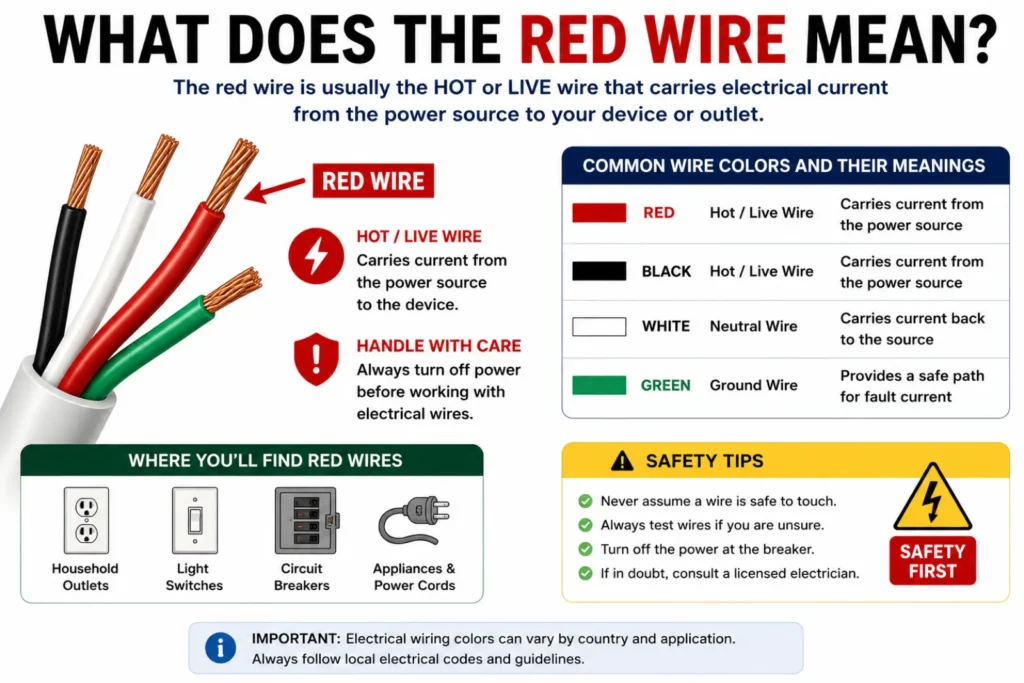
A red wire is an electrical conductor used to carry electrical current. Its exact meaning depends on the type of electrical system.
There are two main electrical systems:
- DC (Direct Current)
- AC (Alternating Current)
Because these systems work differently, the red wire can have different purposes.
In DC Systems
The red wire usually means:
- Positive terminal (+)
- Positive power supply
- Positive battery connection
Examples include:
- Car batteries
- Flashlights
- Solar panels
- Portable electronics
- LED lighting systems
In AC Systems
The red wire usually means:
- Live wire
- Hot conductor
- Second hot wire
- Switched live wire (in some installations)
It does not mean positive or negative.
Why Wire Colors Matter
Wire colors make electrical systems easier to understand.
Instead of testing every wire individually, electricians can often identify wires by their colors.
Different colors help identify:
- Positive wires
- Negative wires
- Ground wires
- Neutral wires
- Live wires
Using the correct wire color reduces confusion and improves safety.
However, wire colors are guides, not guarantees. Older installations or modified wiring may use different colors.
Is Red Positive or Negative in Different Electrical Systems?
The answer depends on where the wire is used.
| Electrical System | Red Wire Meaning | Positive or Negative? |
|---|---|---|
| DC Battery | Positive (+) | ✅ Positive |
| Car Electrical System | Positive Power | ✅ Positive |
| Solar Panel System | Positive Cable | ✅ Positive |
| LED Strip Lights | Positive Supply | ✅ Positive |
| Electronics | Positive Voltage | ✅ Positive |
| AC Household Wiring | Live (Hot) Wire | ❌ Neither |
| Industrial AC Wiring | Second Hot Wire | ❌ Neither |
This table shows why context is important. The same red wire can mean different things depending on the system.
Understanding DC and AC in Simple Words
Before learning more about wire colors, it helps to understand the difference between DC and AC electricity.
What Is DC (Direct Current)?
DC electricity flows in one direction.
Because the current always moves the same way, DC systems have:
- Positive (+)
- Negative (−)
That is why red usually represents the positive side.
Common DC Devices
- Car batteries
- Motorcycles
- Power banks
- Smartphones
- Laptops
- Flashlights
- Solar panels
- Security cameras
In almost all of these devices:
- Red = Positive (+)
- Black = Negative (−)
What Is AC (Alternating Current)?
AC electricity changes direction many times every second.
Instead of positive and negative terminals, AC wiring normally uses:
- Live (Hot)
- Neutral
- Ground
Because AC constantly changes direction, electricians usually do not describe wires as positive or negative.
That is why a red wire in household wiring is generally a live wire instead of a positive wire.
Red Wire vs Black Wire
People often confuse red and black wires because they frequently appear together.
The meaning depends on the electrical system.
| Feature | Red Wire | Black Wire |
|---|---|---|
| DC Systems | Positive (+) | Negative (−) |
| Car Battery | Positive Terminal | Negative Terminal |
| Solar Panels | Positive Cable | Negative Cable |
| Electronics | Positive Supply | Ground or Negative |
| AC Wiring | Second Hot Wire | Primary Hot Wire |
Always verify the wiring before making any connection.
Why People Get Confused About Red Wires
Many online articles say:
Red always means positive.
This is only partly true.
People become confused because they mix DC wiring with AC wiring.
For example:
- A car battery uses DC electricity.
- A house outlet uses AC electricity.
Although both may contain red wires, they serve different purposes.
This is why understanding the type of electrical system is more important than memorizing wire colors.
Is the Red Wire Always Positive?
No.
The red wire is not always positive.
It is positive in most DC electrical systems, but it usually acts as a live (hot) wire in AC systems.
Before connecting any wire, always:
- Read the wiring diagram.
- Check the manufacturer’s instructions.
- Test the wire with a multimeter.
- Never rely only on wire color.
These simple steps help prevent wiring mistakes and improve electrical safety
Is the Red Wire Positive or Negative in Different Situations?
The answer depends on the type of electrical system. A red wire does not always have the same meaning. Below are the most common places where you will see a red wire and what it represents.
Is the Red Wire Positive in a Car Battery?
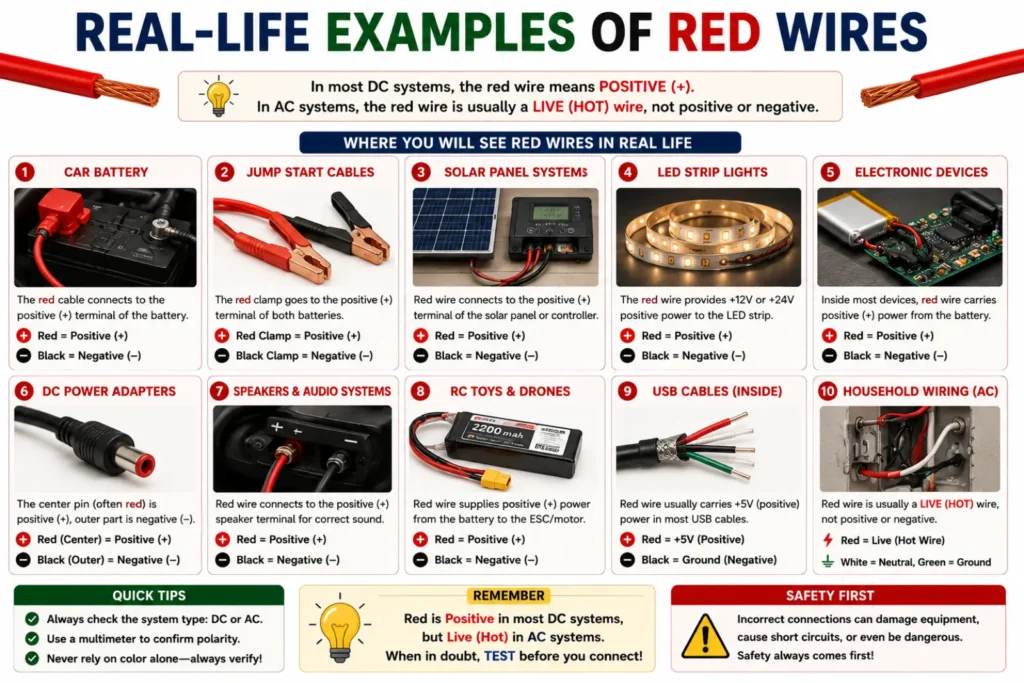
Yes. In almost every modern vehicle, the red battery cable is positive (+).
The positive cable connects the battery to the vehicle’s electrical system. It supplies power to components such as the starter motor, lights, radio, and engine control unit.
The black cable connects to the negative terminal and is usually attached to the vehicle’s chassis.
Car Battery Color Guide
| Wire Color | Meaning |
|---|---|
| Red | Positive (+) |
| Black | Negative (−) |
Real-Life Example
When jump-starting a car:
- Connect the red clamp to the positive terminal of the dead battery.
- Connect the other red clamp to the positive terminal of the working battery.
- Connect the black clamp to the negative terminal of the working battery.
- Attach the remaining black clamp to an unpainted metal surface on the disabled vehicle.
Following the correct order helps reduce the risk of sparks.
Is the Red Wire Positive in Household Wiring?
No. Household electrical systems use AC (Alternating Current) instead of DC.
In many AC wiring systems, the red wire is a live (hot) wire, not a positive wire.
Depending on the installation, it may be used for:
- A second hot wire
- A switched hot wire
- A wire connecting two switches
- Certain 240-volt circuits
Since AC power constantly changes direction, electricians do not normally describe wires as positive or negative.
Common Household Wire Colors
| Wire Color | Typical Meaning |
|---|---|
| Black | Hot (Live) |
| Red | Hot (Live) |
| White | Neutral |
| Green or Bare Copper | Ground |
Always remember that wiring colors can vary by country and electrical code.
Is the Red Wire Positive in Solar Systems?
Yes. Most solar power systems use the following color convention:
- Red = Positive (+)
- Black = Negative (−)
This makes installation easier and helps reduce wiring mistakes.
Example
When connecting a solar panel to a charge controller:
- Connect the red cable to the positive terminal.
- Connect the black cable to the negative terminal.
Reversing the connections may damage equipment or prevent the system from working properly.
Is the Red Wire Positive in Electronics?
In most electronic devices, red represents the positive power supply.
You will commonly see this in:
- LED strip lights
- Arduino projects
- Raspberry Pi accessories
- DC motors
- CCTV cameras
- Computer cooling fans
- Battery-powered devices
Example
When wiring an LED strip:
- Red wire = Positive (+)
- Black wire = Negative (−)
Connecting the wires backward may stop the light from working or damage the circuit.
Is the Red Wire Positive in USB Cables?
Not always.
Inside many USB cables, the red wire carries +5 volts (positive power).
However, USB cables also contain data wires and a ground wire.
A typical USB color arrangement is:
| Wire Color | Function |
|---|---|
| Red | +5V Power |
| Black | Ground |
| White | Data − |
| Green | Data + |
Manufacturers may use different colors in some cables, so always verify the wiring if you are repairing or modifying a USB cable.
Real-Life Examples of Red Wires
Understanding real-world examples makes the concept much easier.
Example 1: Charging a Car Battery
A mechanic connects the red charging cable to the positive battery terminal.
This allows the battery charger to deliver power correctly.
Example 2: Installing LED Lights
An electrician connects the red wire to the positive output of the power supply.
The lights turn on because the polarity is correct.
Example 3: Setting Up a Solar Panel
A homeowner installs a small solar system.
The red cable from the panel connects to the positive terminal on the charge controller.
The black cable connects to the negative terminal.
Example 4: Replacing a Doorbell Transformer
A homeowner notices both black and red wires inside the electrical box.
Since this is an AC circuit, the red wire is another live conductor rather than a positive wire.
Example 5: Repairing a USB Cable
A technician identifies the red wire as the +5V power wire before reconnecting the cable.
Testing the wiring first helps prevent damage to the device.
Common Mistakes People Make
Many wiring problems happen because people assume every red wire has the same meaning.
Here are some of the most common mistakes.
Mistake 1: Assuming Red Always Means Positive
❌ Wrong
“Every red wire is positive.”
✅ Correct
Red usually means positive in DC systems, but it often means a live wire in AC systems.
Mistake 2: Ignoring the Wiring Diagram
Some people connect wires based only on color.
This can damage equipment or create a safety hazard.
Always follow the manufacturer’s wiring diagram.
Mistake 3: Mixing AC and DC Wiring Rules
A person familiar with car wiring may assume household wiring follows the same color code.
This assumption is incorrect.
Cars use DC electricity.
Homes use AC electricity.
Mistake 4: Not Using a Multimeter
Never rely only on wire colors.
Always test the wire before making electrical connections.
A multimeter can confirm voltage and polarity safely.
Mistake 5: Forgetting That Colors May Vary
Different countries and manufacturers sometimes use different wiring standards.
Older buildings may also have non-standard colors.
Always inspect the installation carefully before working on it.
Electrical Safety Tips
Working with electricity always requires caution.
Follow these simple safety tips:
- Turn off the power before touching any wires.
- Read the wiring diagram carefully.
- Use insulated tools.
- Test wires with a multimeter.
- Never assume a wire is safe because of its color.
- Replace damaged wires immediately.
- If you are unsure, contact a qualified electrician.
Following these precautions can help prevent electrical shocks, equipment damage, and wiring mistakes.
Using Red Wires in Daily Life
You may not notice it, but red wires appear in many everyday devices. Knowing what they usually mean helps you understand basic electrical systems and avoid simple mistakes.
At Home
Many battery-powered devices use a red wire for the positive connection.
Examples
- Flashlights
- Smoke detectors
- LED lamps
- Toys
- Battery chargers
In these devices, the red wire usually connects to the positive terminal.
In Cars
Automotive electrical systems rely heavily on red wires.
You may see them connected to:
- Car batteries
- Starter motors
- Car stereos
- Amplifiers
- GPS units
- Dash cameras
The red wire normally carries positive battery voltage.
In Solar Energy Systems
Solar installations commonly use red wires to carry positive DC power.
Examples include:
- Solar panels
- Charge controllers
- Inverters
- Battery banks
Using the correct polarity helps protect expensive equipment from damage.
In Electronics
Many hobby electronics follow the same color standard.
Examples include:
- Arduino projects
- Raspberry Pi kits
- Robotics
- LED displays
- DC motors
Red usually supplies positive voltage, while black provides the negative or ground connection.
In Household Wiring
Home electrical wiring is different.
A red wire often carries live electricity rather than positive voltage.
Never assume household wiring follows battery color rules.
Tips to Remember Red Wire Meanings
These simple tricks make the topic easier to remember.
1. Think About the Power Source
Ask yourself:
Is this DC or AC electricity?
If it is DC, red usually means positive.
If it is AC, red usually means a live wire.
2. Remember This Easy Phrase
“Red is Positive in DC, Hot in AC.”
This memory trick helps most beginners remember the difference.
3. Always Read the Wiring Diagram
Manufacturers sometimes use different colors.
Following the wiring diagram is always safer than guessing.
4. Use a Multimete
A multimeter quickly confirms:
- Voltage
- Polarity
- Continuity
It is one of the safest tools for checking electrical wiring.
5. Never Trust Color Alone
Wire colors provide guidance, but they are not a guarantee.
Repairs, older installations, or imported equipment may use different color codes.
Always test before connecting.
Red Wire Color Comparison
Understanding other wire colors also helps.
| Wire Color | DC Systems | AC Systems |
|---|---|---|
| Red | Positive (+) | Hot (Live) |
| Black | Negative (−) | Hot (Live) |
| White | Rare | Neutral |
| Green | Ground | Ground |
| Bare Copper | Ground | Ground |
This comparison shows why identifying the electrical system is so important.
Synonyms and Related (LSI) Keywords
Using related keywords improves SEO and helps search engines understand your content.
Related Search Terms
- red wire positive or negative
- red wire meaning
- positive wire color
- electrical wire colors
- DC wire polarity
- AC wire colors
- battery wire colors
- automotive wiring colors
- household wire color guide
- solar wire polarity
- red and black wire meaning
- electrical polarity explained
- positive and negative wire colors
- how to identify wire polarity
- live wire vs positive wire
Expert Insight
Electricians and electrical engineers always recommend verifying a wire before making any connection. Although color codes follow common standards, they are not universal.
For example, a red wire is almost always positive in a DC battery system. However, the same color in household AC wiring usually indicates a live conductor instead of positive voltage.
Professional installers rely on three things:
- Wiring diagrams
- Manufacturer instructions
- Electrical testing tools
Following these practices improves safety, prevents equipment damage, and reduces installation errors.
If you are uncertain, never guess. Test the wire first or ask a qualified electrician for help.
(FAQs)
1. Is a red wire always positive?
No. In most DC systems, the red wire is positive. In AC household wiring, it is usually a live (hot) wire.
2. Is the red wire positive on a battery?
Yes. Most batteries use the red terminal for the positive connection and the black terminal for the negative connection.
3. Is the red wire positive in a car?
Yes. Automotive electrical systems almost always use red for positive battery power.
4. Is the red wire positive in house wiring?
No. Household AC wiring normally uses the red wire as a live conductor, not as a positive wire.
5. Can wire colors vary?
Yes. Wire colors may differ depending on the country, manufacturer, equipment, or installation date.
6. Should I trust wire colors alone?
No. Always confirm wiring with a multimeter or the manufacturer’s wiring diagram.
7. What happens if I connect wires backward?
Incorrect polarity may prevent a device from working or permanently damage electronic equipment.
8. Which wire is usually negative?
In most DC electrical systems, the black wire is the negative (−) connection.
Conclusion
Understanding is red positive or negative becomes simple once you know the type of electrical system you are working with. In most DC systems, such as batteries, cars, solar panels, and electronic devices, the red wire represents the positive (+) connection. However, in AC household wiring, the red wire usually serves as a live (hot) conductor, not a positive wire. This important difference helps prevent wiring mistakes and improves electrical safety. Never rely only on wire colors because standards can vary between countries, manufacturers, and older installations. Always check the wiring diagram and confirm connections with a multimeter before working on electrical equipment. Following these simple steps will help you work more confidently, protect your devices, and stay safe whenever you handle electrical wiring.