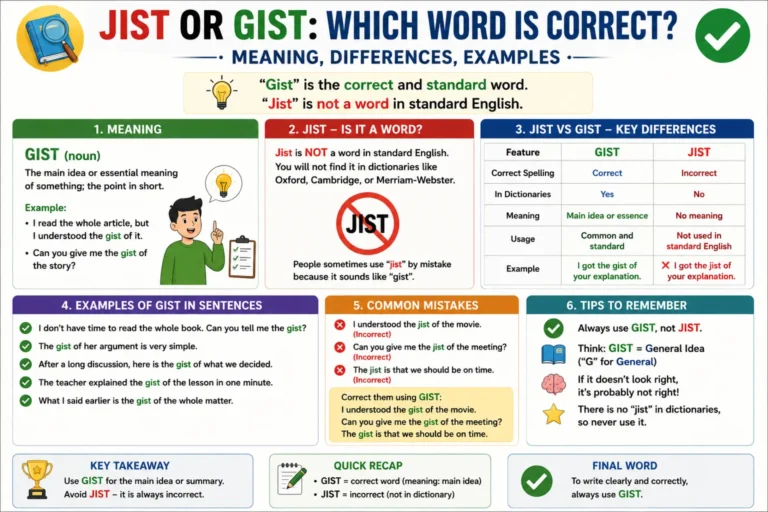
Jist or gist is a common search because many people hear the word before they ever see it written. Both words sound the same, so it is easy to understand why people get confused. However, only one spelling is correct in standard English.
The correct word is gist. It means the main idea or the most important point of something you hear, read, or watch. The spelling jist is almost always a mistake, even though it matches the way the word sounds.
This guide explains everything you need to know about jist or gist in simple English. You will learn the correct spelling, meaning, pronunciation, examples, common mistakes, and helpful tips. By the end of this article, you will feel confident using gist correctly in everyday conversations, school assignments, business writing, and online communication.
Quick Summary Box
- Correct spelling: Gist
- Incorrect spelling: Jist
- Meaning: The main idea or central point
- Pronunciation: Sounds like “jist”
- Part of speech: Noun
- Common phrase: “Get the gist”
- Used in: Conversations, writing, meetings, books, and presentations
- Remember: It sounds like “jist” but is always spelled gist
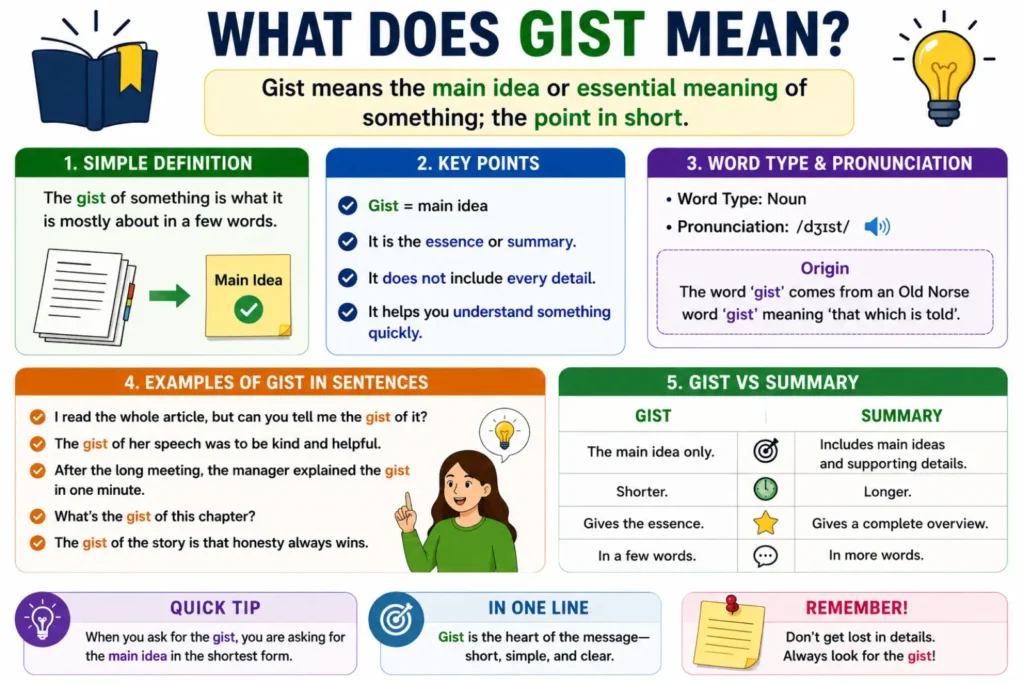
What Does Gist Mean?
The word gist means the most important idea or central message of something. It helps people understand the overall meaning without learning every small detail.
When someone asks for the gist, they want a short explanation instead of a long one.
Simple Definition
Gist means the main idea, key point, or essential meaning of something spoken or written.
This definition is easy to remember because it focuses on understanding the most important information.
Everyday Examples
- I missed the beginning, but I understood the gist.
- Can you tell me the gist of the meeting?
- She explained the gist of the article in two minutes.
- I didn’t read the whole book, but I know the gist.
- The teacher asked students to write the gist of the story.
In every example, gist refers to the main message instead of every detail.
Why Do People Search for “Jist or Gist”?
Many English learners type jist into search engines because that is exactly how the word sounds.
English pronunciation often surprises learners. Many words do not look the way they sound.
For example:
- Giant
- Giraffe
- Gym
- Genius
In each word, the letter G makes a soft sound like the letter J.
The same rule applies to gist. Although it sounds like jist, the correct spelling begins with the letter G.
This spelling has been accepted for hundreds of years and appears in dictionaries, textbooks, newspapers, and professional writing.
Is “Jist” Ever Correct?
In standard English, jist is not considered the correct spelling.
Most dictionaries list it only as a common misspelling of gist.
If you are writing:
- School assignments
- College essays
- Business emails
- Reports
- Blog posts
- Books
- Professional documents
Always use gist.
Writing jist may cause readers to think it is a spelling error.
Jist vs Gist: What’s the Difference?
The answer is very simple.
There is only one correct English word.
| Feature | Gist | Jist |
|---|---|---|
| Correct English spelling | ✅ Yes | ❌ No |
| Found in dictionaries | ✅ Yes | ❌ Usually no |
| Means the main idea | ✅ Yes | ❌ No |
| Accepted in professional writing | ✅ Yes | ❌ No |
| Recommended for students | ✅ Yes | ❌ No |
Quick Answer
If you mean the main idea, always write gist.
Never use jist unless you are discussing the common spelling mistake itself.
How Is “Gist” Pronounced?
This is one reason people become confused.
The word gist is pronounced exactly like jist.
Pronunciation
Gist = /dʒɪst/
It rhymes with words like:
- Mist
- List
- Wrist
- Twist
Even though the pronunciation begins with a J sound, the spelling always starts with G.
Many English words follow the same pattern, which makes spelling difficult for beginners.
Where Did the Word “Gist” Come From?
The word gist has an interesting history.
It comes from an old legal expression used in French. Over time, English speakers adopted the word to describe the essential point or central meaning of an argument or statement.
Today, people use gist in everyday conversations instead of only in legal writing.
Although its history is old, its meaning has stayed almost the same. It still refers to the most important part of something.
That is why phrases like “get the gist” remain popular in modern English.
Why Learning the Correct Spelling Matters
Good spelling improves communication.
People understand your writing more easily when you use the correct words.
Using gist instead of jist also makes your writing look more professional.
This is especially important if you write:
- Emails
- Reports
- Academic papers
- Blog posts
- Website content
- Social media captions
- Business documents
Correct spelling builds trust with readers. It also helps search engines recognize high-quality content.
When readers trust your writing, they are more likely to continue reading and share your content with others.
How to Use “Gist” in Everyday Life
The word gist is useful in many situations. You can use it when you want to talk about the main idea instead of every detail.
People often use gist in conversations, school, work, and online discussions. It is a simple way to explain that you understand the essential message.
Here are some common situations where you can use the word.
At School
Teachers often ask students to explain the gist of a lesson or story.
Examples:
- I understood the gist of today’s science lesson.
- Please write the gist of the chapter.
- The teacher explained the gist before the class discussion.
At Work
Professionals use gist to summarize meetings, reports, and emails.
Examples:
- Can you give me the gist of the meeting?
- I read the report and got the gist.
- The manager shared the gist of the project.
During Conversations
Friends and family also use this word.
Examples:
- I missed the first part, but I got the gist.
- What’s the gist of the story?
- I understand the gist, so you don’t need to explain everything.
While Reading or Watching
You can also use gist after reading books or watching videos.
Examples:
- I watched half the movie and understood the gist.
- The article was long, but I got the gist.
- She explained the video’s gist in one sentence.
Real-Life Examples of Gist
Learning through examples makes new vocabulary easier to remember.
Here are practical situations where people naturally use gist.
Example 1: Reading a Book
Your friend asks if you finished a novel.
You reply:
“Not yet, but I understand the gist.”
Example 2: Watching a Presentation
The presentation lasts one hour.
You only watch the last twenty minutes.
Even then, you understand the main message.
You can say:
“I got the gist of the presentation.”
Example 3: Office Meeting
A coworker arrives late.
Another coworker says:
“I’ll give you the gist.”
This means they will explain only the important points.
Example 4: Classroom Discussion
A student misses school.
The teacher gives a short explanation.
The student replies:
“Now I understand the gist.”
Example 5: News Report
A news article contains many details.
After reading it quickly, you know the main point.
You can say:
“I got the gist of the news.”
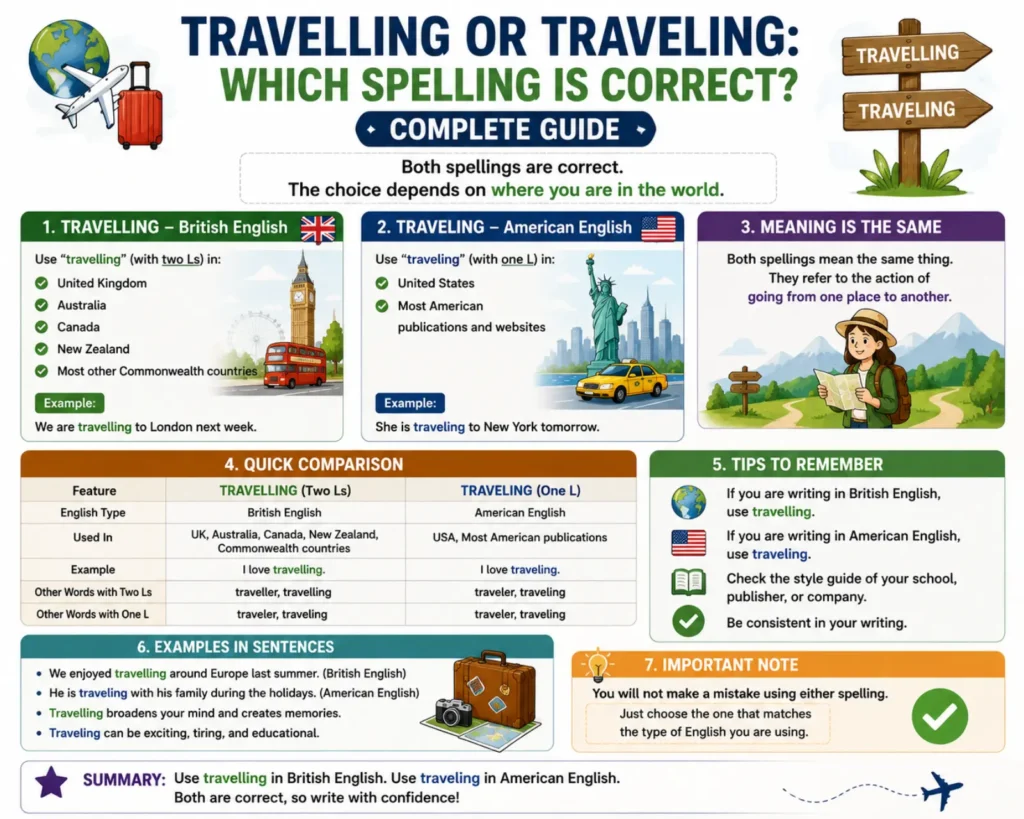
Gist vs Summary
Many people believe gist and summary mean exactly the same thing.
They are similar, but they are not identical.
A gist gives only the main idea.
A summary explains the main ideas with more detail.
| Feature | Gist | Summary |
|---|---|---|
| Length | Very short | Longer |
| Purpose | Main idea only | Main ideas and key details |
| Detail Level | Low | Medium |
| Reading Time | Few seconds | Several minutes |
| Best For | Quick understanding | Complete review |
Example
Original Text
A teacher spends thirty minutes explaining how plants grow.
The Gist
Plants need sunlight, water, and nutrients to grow.
The Summary
Plants grow through photosynthesis. They need sunlight, water, carbon dioxide, and nutrients from the soil. The teacher also explained each stage of plant growth and how different environments affect development.
Notice how the summary includes much more information.
Common Phrases That Use “Gist”
English speakers often use gist in common expressions.
Learning these phrases helps you sound more natural.
Get the gist
Meaning: Understand the main idea.
Example:
“I didn’t read everything, but I got the gist.”
Give me the gist
Meaning: Explain only the important points.
Example:
“Give me the gist before the meeting starts.”
That’s the gist of it
Meaning: That is the basic idea.
Example:
“We worked hard, solved the problem, and that’s the gist of it.”
Miss the gist
Meaning: Fail to understand the main point.
Example:
“You focused on small details and missed the gist.”
Common Mistakes People Make
Many English learners make the same mistakes.
Knowing them helps you avoid errors.
Mistake 1: Writing “Jist”
This is the most common mistake.
❌ I got the jist.
✅ I got the gist.
Always remember that gist starts with the letter G.
Mistake 2: Thinking Gist Means Every Detail
The word only means the main point.
It does not include every fact.
Incorrect idea:
“Gist means the complete explanation.”
Correct idea:
“Gist means the essential message.”
Mistake 3: Using Gist as a Verb
Gist is a noun.
Do not use it as a verb.
❌ I gisted the article.
✅ I understood the gist of the article.
✅ She explained the gist clearly.
Mistake 4: Confusing Gist with Summary
These words overlap, but they are different.
Remember this rule.
- Gist = Main idea
- Summary = Main ideas plus important details
Easy Tips to Remember the Correct Spelling
Simple memory tricks make spelling easier.
Remember the Common Phrase
Think about this sentence:
“Get the gist.”
This phrase appears in books, articles, movies, and conversations.
The more you see it, the easier it becomes to remember.
Read More English
Reading quality English content helps you recognize correct spelling naturally.
Practice Writing
Write three or four sentences using gist every day.
Practice builds confidence.
Think of the Letter G
Although it sounds like J, the correct spelling always begins with G.
A simple reminder is:
Good writers get the gist.
This short sentence makes the spelling easier to rem
Synonyms of Gist
Sometimes, you may want to use a different word instead of gist. While no synonym has the exact same meaning in every context, many words express a similar idea.
Here are some common synonyms:
- Main idea
- Main point
- Key point
- Central idea
- Core message
- Essence
- Heart of the matter
- Bottom line
- Overall meaning
- Big picture
- Central theme
- Key message
- Main concept
- Essential point
- Primary idea
Examples Using Synonyms
Instead of saying:
I understood the gist of the article.
You can also say:
- I understood the main idea of the article.
- I understood the key point of the article.
- I understood the central message of the article.
These alternatives work well in many situations. However, gist remains one of the most natural and commonly used words in everyday English.
Related Keywords and LSI Terms
Search engines understand topics better when articles include related words naturally. These keywords also help readers find answers to similar questions.
Primary Keyword
- jist or gist
Secondary Keywords
- gist meaning
- gist definition
- what does gist mean
- gist examples
- get the gist meaning
- correct spelling of gist
- gist vs summary
- how to use gist
- gist in a sentence
- is jist a word
Long-Tail Keywords
- is it jist or gist
- how do you spell gist
- what is the meaning of gist
- how to use gist in a sentence
- gist pronunciation and meaning
- why do people spell gist as jist
- difference between gist and summary
- examples of gist in everyday life
Semantic Keywords
- main idea
- central meaning
- key message
- overall point
- brief explanation
- essential information
- core concept
- quick summary
- concise explanation
Use these terms naturally throughout your writing. Avoid repeating the same keyword too often, as keyword stuffing can hurt readability and SEO.
Expert Insights: Why Using the Correct Word Matters
Using the correct spelling is more important than many people realize. Small spelling mistakes can affect how readers view your writing.
When you use gist correctly, your content appears more professional. Readers trust accurate writing because it shows attention to detail.
Correct spelling also improves communication. Your audience understands your message faster, and there is less chance of confusion.
If you create blog posts, emails, reports, or social media content, using the right words builds credibility. Teachers, employers, and clients often notice these small details.
For website owners and content creators, accurate language also supports search engine optimization (SEO). Search engines aim to show users reliable, high-quality content. Clear writing and proper spelling contribute to a better user experience, which can improve engagement over time.
The best writers focus on clarity first. They choose simple words, short sentences, and correct spelling to help readers understand information quickly.
When Should You Use “Gist”?
Use gist whenever you want to talk about the main idea instead of every detail.
Here are some everyday situations where the word fits naturally:
- Reading books or articles
- Listening to a speech
- Watching a presentation
- Attending a business meeting
- Studying for an exam
- Reading news reports
- Watching educational videos
- Listening to podcasts
- Following classroom lessons
- Explaining a long story briefly
In all these situations, gist refers to understanding the essential message without focusing on every small detail.
(FAQs)
1. Is “jist” a real word?
No. In standard English, jist is considered a misspelling of gist. If you mean the main idea of something, always write gist.
2. Which spelling is correct: gist or jist?
The correct spelling is gist. Although it is pronounced like “jist,” dictionaries and style guides accept only gist.
3. What does gist mean?
Gist means the main idea, central point, or essential meaning of something spoken or written.
4. How do you pronounce gist?
The word is pronounced /dʒɪst/, which sounds like jist.
5. Can I use gist in formal writing?
Yes. Gist is suitable for academic writing, business communication, reports, and professional documents.
6. What is the difference between gist and summary?
A gist gives only the main idea. A summary includes the main idea along with important supporting details.
7. What does the phrase “get the gist” mean?
It means to understand the basic meaning or most important point without learning every detail.
8. Why do so many people spell gist as jist?
The mistake happens because the pronunciation sounds like the letter J, even though the correct spelling begins with G.
Conclusion
Many people search for jist or gist because the pronunciation makes the spelling confusing. The answer is simple: gist is the correct word, while jist is almost always a spelling mistake. Gist refers to the main idea or essential meaning of something, making it useful in conversations, classrooms, workplaces, and everyday writing.
Remember the common phrase “get the gist” to help you recall the correct spelling. With regular reading and practice, using gist will become second nature. Whether you are writing an email, summarizing a book, or explaining a meeting, choosing the correct word makes your communication clearer and more professional