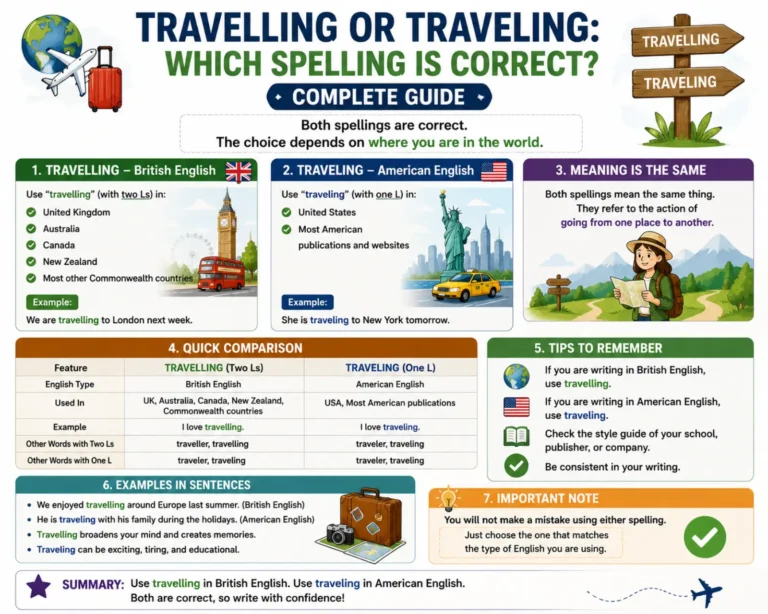
Travelling or traveling is a common spelling question in English. Many people wonder which version is correct. The good news is that both spellings are correct. The difference depends on the type of English you use. American English prefers traveling, while British English uses travelling. This small spelling change can affect your writing, especially if you create blog posts, business documents, academic papers, or website content. Using the correct spelling for your audience makes your writing look more professional. It also improves readability and builds trust. In this guide, you will learn the meaning of both spellings, understand why they differ, compare their usage, explore real-life examples, and discover simple tips for using each word correctly.
Quick Summary Box
- Travelling is the British English spelling.
- Traveling is the American English spelling.
- Both words have the same meaning.
- Neither spelling is wrong.
- Choose the spelling that matches your audience.
- Stay consistent throughout your writing.
- Search engines recognize both spellings.
What Does Travelling or Traveling Mean?
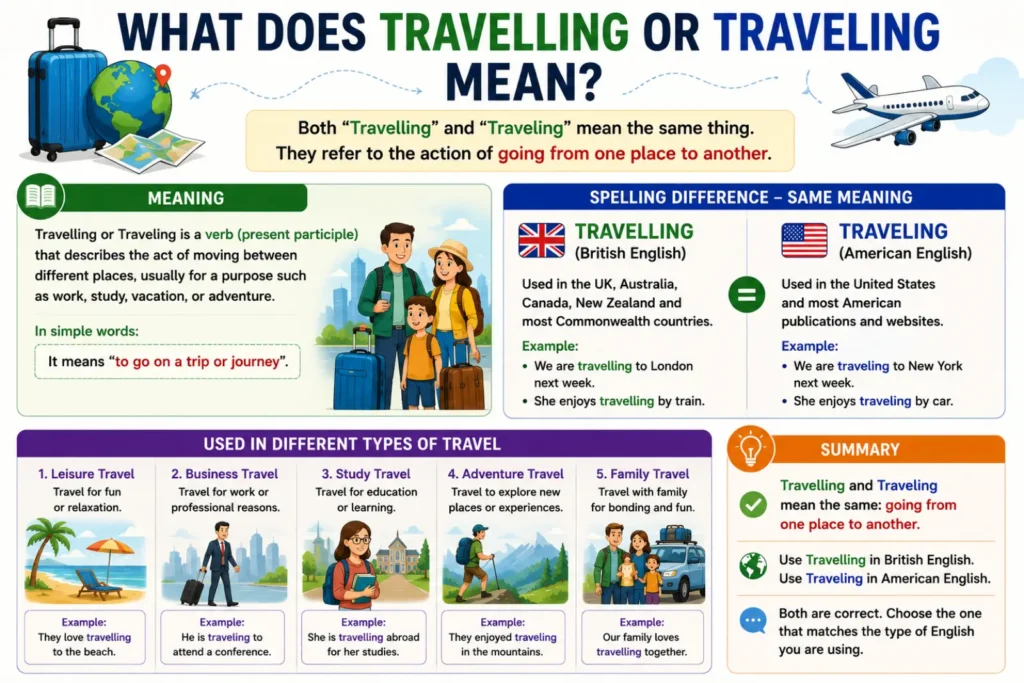
The words travelling and traveling describe the act of moving from one place to another. People travel for many different reasons.
Some travel for work.
Others travel for education.
Many people travel for holidays.
Some people travel to visit family and friends.
Travel can be short or long. It can happen within the same city or across different countries.
Common ways to travel include:
- Car
- Bus
- Train
- Airplane
- Bicycle
- Ship
- Walking
No matter how someone travels, the meaning of the word stays the same.
Why Are There Two Different Spellings?
English is spoken around the world. Different countries follow different spelling rules.
The two most common forms are:
- American English
- British English
These versions share the same language. However, they have different spelling rules for many words.
For example:
| American English | British English |
|---|---|
| Traveling | Travelling |
| Traveled | Travelled |
| Traveler | Traveller |
| Canceled | Cancelled |
| Labeled | Labelled |
| Modeling | Modelling |
British English usually doubles the final L before adding endings such as -ing or -ed.
American English often keeps only one L.
This spelling rule explains why both traveling and travelling exist.
Travelling vs Traveling: What’s the Difference?
The only difference is the spelling.
The meaning, pronunciation, and grammar remain the same.
| Feature | Traveling | Travelling |
| English Style | American English | British English |
| Meaning | Going from one place to another | Going from one place to another |
| Pronunciation | Same | Same |
| Grammar | Correct | Correct |
| Main Countries | United States | United Kingdom, Australia, New Zealand |
Simple Rule
Use traveling if your readers use American English.
Use travelling if your readers use British English.
Where Is “Traveling” Used?
The spelling traveling appears mainly in American English.
You will often see it in:
- American newspapers
- US government websites
- American universities
- US travel blogs
- Business websites targeting American readers
Examples
- I enjoy traveling every summer.
- She is traveling to California next week.
- Traveling teaches valuable life lessons.
- We started traveling after graduation.
- Traveling helps people understand different cultures.
If your audience lives in the United States, this spelling is usually the best choice.
Where Is “Travelling” Used?
The spelling travelling follows British English rules.
Many countries use this version.
These include:
- United Kingdom
- Australia
- New Zealand
- Ireland
- South Africa
Some Canadian publishers also use British spelling, although Canada often mixes both styles.
Examples
- We love travelling around Europe.
- She enjoys travelling by train.
- Travelling gives children new experiences.
- They spent years travelling across Asia.
- Travelling improves confidence.
If your website targets British readers, this spelling fits better.
Why Does American English Use One “L”?
Many people ask why American English removes one L.
The answer comes from spelling reforms.
American English adopted simpler spelling rules over time.
British English kept many traditional spellings.
This difference appears in several words.
Examples include:
| American | British |
| Traveling | Travelling |
| Traveled | Travelled |
| Canceled | Cancelled |
| Counselor | Counsellor |
| Modeling | Modelling |
The pronunciation never changes.
Only the spelling changes.
Real-Life Examples of Both Spellings
Understanding real examples makes the rule easy to remember.
Example 1: Student Essay
An American student writes:
Traveling helps students learn about different cultures.
A British student writes:
Travelling helps students learn about different cultures.
Both sentences are correct.
Example 2: Travel Blog
A US blogger writes:
My Traveling Guide to Florida
A UK blogger writes:
My Travelling Guide to Scotland
Again, both titles are correct.
Example 3: Business Website
An American company advertises:
Business Traveling Services
A British company advertises:
Business Travelling Solutions
The spelling matches the audience.
Example 4: Social Media Post
American English:
Traveling today. Wish me luck!
British English:
Travelling today. Wish me luck!
The message stays exactly the same.
How Search Engines Treat Both Spellings
Many bloggers worry about SEO.
They ask whether Google prefers one spelling.
The answer is simple.
Google understands both spellings.
Modern search engines recognize that traveling and travelling have the same meaning.
However, your audience still matters.
If most visitors come from the United States, using traveling may improve user experience.
If your readers live in the United Kingdom, travelling feels more natural.
Consistency is also important.
Avoid switching between spellings on the same page.
A consistent writing style improves readability and creates a professional impression.
Common Mistakes People Make
Many writers confuse these spellings.
Here are the most common mistakes.
1. Mixing Both Spellings
Wrong example:
Traveling is exciting because travelling teaches new skills.
Choose one version.
Do not mix them.
2. Thinking One Is Incorrect
Many learners believe travelling is wrong.
Others think traveling is incorrect.
Neither idea is true.
Both spellings are accepted worldwide.
3. Ignoring Your Target Audience
Imagine writing for American readers.
Using British spelling throughout the article may seem unusual.
The opposite is also true.
Always think about your readers before choosing a spelling.
4. Using Different Spellings Across a Website
Some websites accidentally switch between both spellings.
This creates inconsistency.
Readers notice these small details.
Professional websites follow one style guide.
Easy Tips to Remember
These simple tips help you choose the right spelling every time.
- Writing for Americans? Use traveling.
- Writing for British readers? Use travelling.
- Keep the same spelling throughout your article.
- Match your spelling with your brand style.
- Follow your company’s editorial guidelines.
- Proofread before publishing.
- Use your spell checker based on your preferred English version.
These habits improve writing quality and build trust with readers.
How to Use Travelling or Traveling in Daily Life
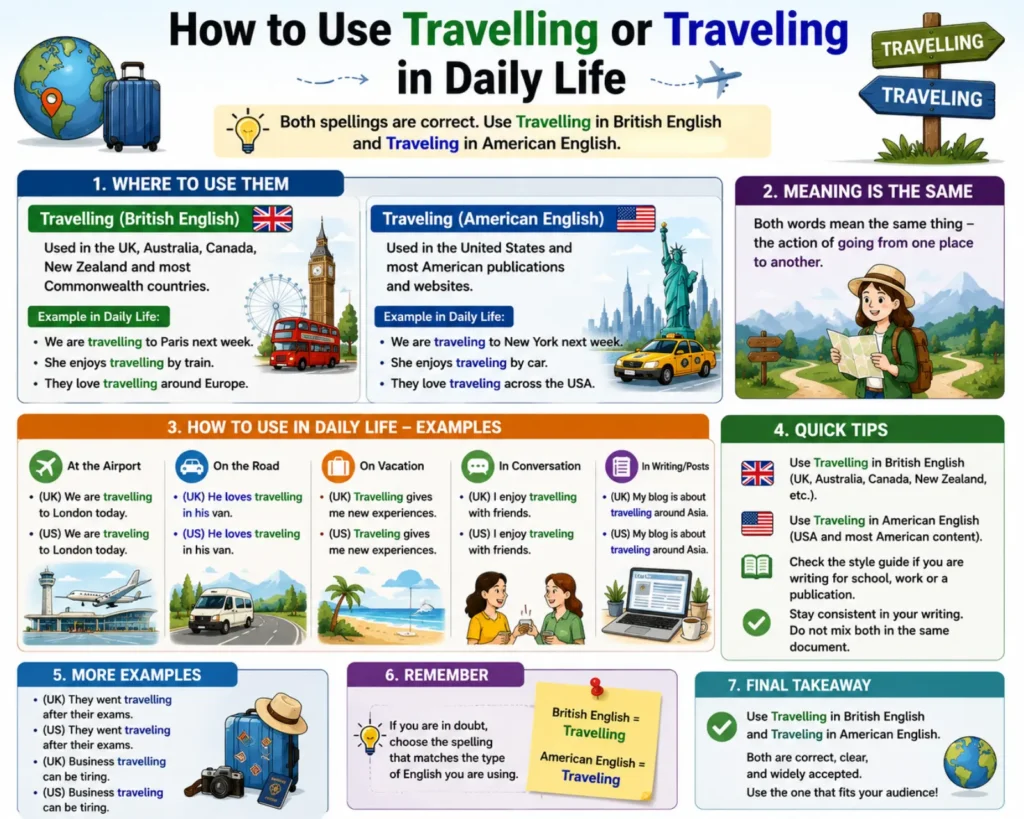
You will see these words almost every day. They appear in conversations, books, blogs, advertisements, and social media posts.
Here are a few examples.
In Conversations
- I enjoy traveling with my family every summer.
- She loves travelling by train across Europe.
- We are traveling next weekend.
- They spent a year travelling around the world.
At Work
Many businesses use these words in emails and reports.
Examples include:
- Our traveling team will arrive tomorrow.
- The travelling expenses have been approved.
- Traveling employees must submit receipts.
- Travelling staff should follow company policies.
In School
Students often use these words in essays and presentations.
For example:
- Traveling helps students learn about different cultures.
- Travelling teaches important life skills.
The meaning stays the same in every situation. Only the spelling changes.
Synonyms of Travelling and Traveling
Using the same word too often can make writing repetitive. Synonyms improve readability and help search engines understand your content.
Here are some common synonyms.
| Synonym | Meaning |
|---|---|
| Journeying | Going from one place to another |
| Touring | Visiting different places |
| Exploring | Discovering new locations |
| Roaming | Moving freely between places |
| Wandering | Traveling without a fixed plan |
| Voyaging | Traveling over long distances |
| Backpacking | Traveling with minimal luggage |
| Sightseeing | Visiting famous attractions |
| Commuting | Traveling regularly between home and work |
| Trekking | Traveling on foot over long distances |
Choose a synonym only when it matches the meaning of your sentence.
Related Keywords (LSI Keywords)
Search engines use related words to understand your topic.
Include these naturally in your content.
Short-Tail Keywords
- travel
- traveler
- traveller
- trip
- journey
- tourism
- vacation
Long-Tail Keywords
- travelling or traveling difference
- travelling vs traveling spelling
- traveling meaning in English
- British vs American English spelling
- traveler vs traveller
- traveled vs travelled
- which spelling is correct traveling or travelling
- traveling grammar guide
- English spelling differences
- travel writing tips
These keywords improve topical relevance without stuffing the main keyword.
SEO Tips for Using the Keyword
Ranking on Google requires more than repeating one keyword.
Follow these best practices.
Use the Keyword Naturally
Place travelling or traveling in important areas.
These include:
- Title
- Introduction
- Headings
- Meta description
- Conclusion
Avoid forcing the keyword into every paragraph.
Write for Readers First
Google rewards helpful content.
Focus on answering questions clearly.
Simple language improves user experience.
Use Short Paragraphs
Large blocks of text discourage readers.
Keep paragraphs short and easy to scan.
Add Helpful Tables
Tables improve readability.
They also increase the chance of earning featured snippets.
Answer Common Questions
FAQ sections help your page appear in Google’s “People Also Ask” results.
Common Myths About Travelling and Traveling
Many people believe incorrect information about these spellings.
Let’s clear up a few myths.
Myth 1: Traveling Is Always Correct
This is false.
Traveling is correct only in American English.
Myth 2: Travelling Is Old English
No.
Travelling remains the standard spelling in British English today.
Myth 3: Google Prefers One Spelling
Google understands both versions.
It ranks pages based on quality, relevance, and user intent.
Myth 4: You Must Use Both Spellings for SEO
This is unnecessary.
Choose the spelling that fits your audience.
Then use it consistently.
Expert Insights
Professional writers always think about their readers before choosing a spelling.
Audience expectations matter.
A visitor from the United States expects American spelling.
A reader from the United Kingdom expects British spelling.
Matching your audience improves trust.
It also creates a smoother reading experience.
Consistency is another important factor.
Changing between traveling and travelling on the same page may confuse readers.
Many professional editors use a style guide before publishing content.
This keeps spelling, grammar, and formatting consistent across every article.
For businesses, consistent language also strengthens brand identity.
Why This Topic Matters
The difference between travelling and traveling may seem small.
However, small details influence how readers view your writing.
Correct spelling shows professionalism.
It also demonstrates attention to detail.
Students can earn better grades by following the correct language style.
Businesses build credibility through consistent communication.
Bloggers improve user experience by matching their audience’s expectations.
Even search engines benefit from clear, well-structured content.
Understanding this simple spelling difference makes you a stronger writer.
(FAQs)
1. Which spelling is correct, travelling or traveling?
Both spellings are correct.
Use traveling in American English and travelling in British English.
2. Why do Americans spell traveling with one “L”?
American English often removes the extra L in words ending with -ing and -ed.
This follows American spelling conventions.
3. Why does British English use travelling?
British English usually doubles the final L before adding endings.
That is why travelling is standard in the UK.
4. Does pronunciation change?
No.
Both words have the same pronunciation.
Only the spelling changes.
5. Which spelling should bloggers use?
Use the version that matches your target audience.
American websites usually choose traveling.
British websites usually choose travelling.
6. Can I use both spellings in one article?
It is better not to.
Choose one style and use it throughout the article.
Consistency improves readability.
7. Does Google understand both spellings?
Yes.
Google recognizes both spellings and understands that they have the same meaning.
8. Which spelling is better for SEO?
Neither spelling has an SEO advantage.
High-quality content, user intent, and consistency matter much more than the spelling choice.
conclusion
The debate over travelling or traveling is simpler than many people think. Both spellings are correct, and both describe the act of going from one place to another. The only difference is the variety of English you choose. American English uses traveling, while British English prefers travelling. The best choice depends on your audience, not on grammar. Once you choose one spelling, stay consistent throughout your writing. This small habit improves readability, builds trust, and creates a more professional impression. Whether you are writing a blog post, school assignment, business report, or travel guide, using the correct spelling for your readers will strengthen your communication and help your content perform better in search results.