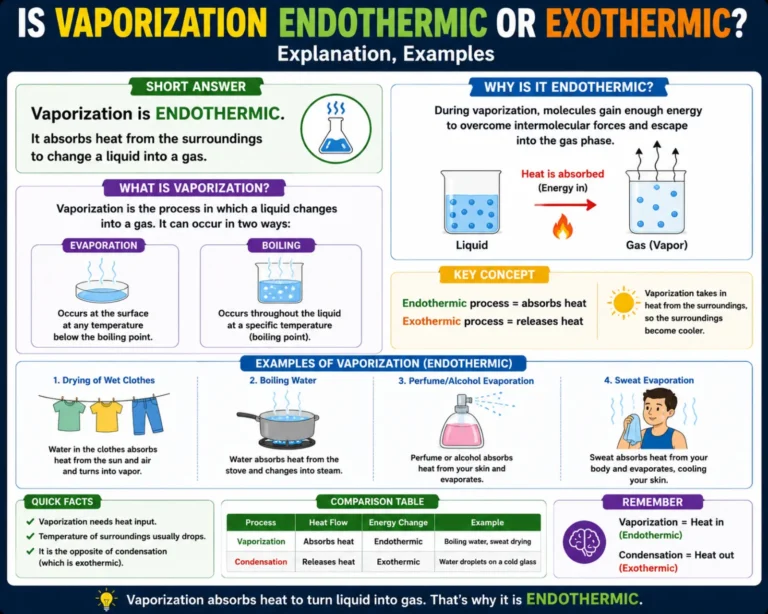
Is vaporization endothermic or exothermic? The simple answer is that vaporization is an endothermic process. It absorbs heat from its surroundings to change a liquid into a gas. This process happens every day. Water boils on the stove, puddles dry after rain, and sweat evaporates from your skin. All these examples involve vaporization. Understanding this concept helps you learn about heat energy, phase changes, and the behavior of matter. It also makes chemistry easier to understand. In this guide, you will discover why vaporization is endothermic, how it works, and where you see it in daily life. The explanations use simple language and practical examples, making this topic easy for students of all levels.
Quick Summary
Is Vaporization Endothermic or Exothermic?
- Vaporization is an endothermic process.
- It absorbs heat from the surroundings.
- A liquid changes into a gas.
- Heat helps particles move faster.
- Intermolecular forces break during vaporization.
- Boiling and evaporation are both types of vaporization.
- No new substance forms during the process.
What Is Vaporization?
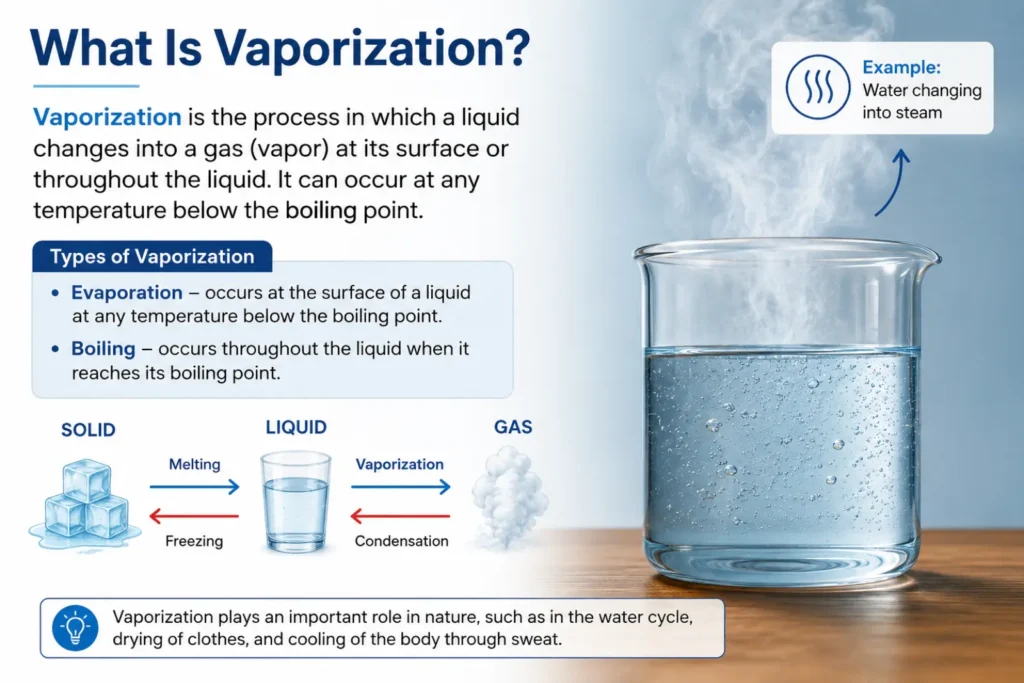
Vaporization is the process in which a liquid changes into a gas.
This change happens when liquid particles gain enough energy.
The added heat allows them to move freely.
The substance changes its physical state, but its chemical identity stays the same.
For example:
- Water becomes water vapor.
- Alcohol evaporates into the air.
- Liquid nitrogen turns into nitrogen gas.
These are all examples of vaporization.
Why Is Vaporization Endothermic?
Vaporization requires energy.
The liquid particles stay close together because intermolecular forces hold them in place.
Heat provides the energy needed to overcome these forces.
As the particles gain energy, they move faster.
Eventually, they escape into the air as gas.
Since the liquid absorbs heat, vaporization is an endothermic process.
Simple Rule
Absorbs heat → Endothermic process
How Does Vaporization Work?
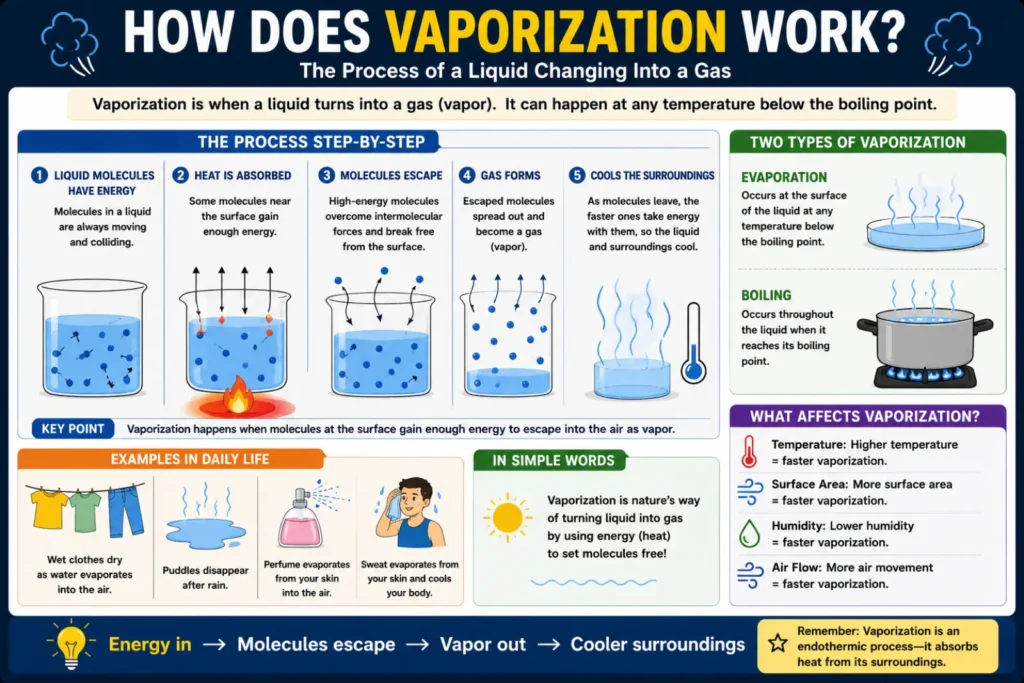
Every liquid contains moving particles.
Some particles move faster than others.
When heat enters the liquid, particle motion increases.
The fastest particles overcome the attractive forces between molecules.
They leave the liquid and enter the gas phase.
This process continues until the entire liquid changes into gas or the heat source is removed.
What Happens to Molecules During Vaporization?
The molecules do not change into new substances.
Only their movement changes.
Before vaporization:
- Molecules stay close together.
- They move slowly.
- Attractive forces keep them in place.
After vaporization:
- Molecules spread far apart.
- They move much faster.
- They have enough energy to remain in the gas phase.
This is a physical change, not a chemical reaction.
Types of Vaporization
There are two main types of vaporization.
1. Evaporation
Evaporation happens only at the surface of a liquid.
It can occur at any temperature.
Examples include:
- Wet clothes drying
- Sweat cooling your skin
- Rainwater disappearing from roads
2. Boiling
Boiling occurs throughout the liquid.
It happens only at the boiling point.
Examples include:
- Water boiling in a kettle
- Soup cooking on a stove
- Steam rising from hot water
Both evaporation and boiling absorb heat.
Therefore, both are endothermic processes.
Heat Energy and Vaporization
Heat plays a key role in vaporization.
Without heat, most liquids cannot become gases.
The absorbed heat is called the latent heat of vaporization.
This energy breaks the intermolecular forces without raising the temperature during the phase change.
Key Facts
| Property | Description |
|---|---|
| Process | Vaporization |
| Type | Physical change |
| Energy Change | Endothermic |
| Heat Flow | Heat enters the liquid |
| State Change | Liquid → Gas |
| Chemical Identity | Remains the same |
What Are the 3 Exothermic Reactions?
Exothermic reactions are chemical reactions that release heat energy into their surroundings. As a result, the surroundings become warmer. These reactions often produce light, flames, or a noticeable increase in temperature. Three common examples of exothermic reactions are combustion, neutralization, and respiration.
1. Combustion (Burning)
Combustion occurs when a fuel reacts with oxygen and releases a large amount of heat and light. This is one of the most familiar exothermic reactions. It powers car engines, heats homes, and is used for cooking.
Examples:
- Burning wood
- Burning natural gas
- Burning gasoline
Why it is exothermic: The reaction releases more energy than it absorbs, producing heat and often a flame.
2. Neutralization
A neutralization reaction happens when an acid reacts with a base to form salt and water. During this process, heat is released, making the reaction exothermic.
Example:
- Hydrochloric acid (HCl) + Sodium hydroxide (NaOH) → Sodium chloride (NaCl) + Water (H₂O)
Why it is exothermic: New chemical bonds form during the reaction, releasing energy as heat.
3. Respiration
Respiration is a natural process that takes place inside the cells of living organisms. It breaks down glucose with oxygen to release energy, which the body uses for movement, growth, and other vital functions.
Chemical equation:
Glucose + Oxygen → Carbon dioxide + Water + Energy
Why it is exothermic: The chemical energy stored in glucose is released as heat and usable energy (ATP), helping maintain body temperature and support life.
Real-Life Examples of Vaporization
You can observe vaporization almost every day.
Here are some common examples.
Boiling Water
Water absorbs heat from the stove.
It changes into steam.
Drying Clothes
Sunlight provides heat.
Water evaporates from the fabric.
Sweating
Sweat absorbs heat from your skin.
It evaporates and cools your body.
Puddles Drying
Rainwater absorbs heat from sunlight.
It slowly changes into water vapor.
Perfume Evaporating
Perfume absorbs heat from the air.
Its liquid particles escape into the atmosphere.
These examples show why vaporization is an important process in everyday life.
Endothermic vs Exothermic: Comparison Table
Students often confuse endothermic and exothermic processes. The table below makes the difference easy to understand.
| Feature | Endothermic | Exothermic |
|---|---|---|
| Heat Flow | Absorbs heat | Releases heat |
| Energy Change | Energy enters the system | Energy leaves the system |
| Surroundings | Become cooler | Become warmer |
| Example | Vaporization, melting | Freezing, condensation |
| Particle Energy | Increases | Decreases |
Easy Memory Trick
- Endo = Enter
- Exo = Exit
If heat enters the substance, the process is endothermic.
If heat exits the substance, the process is exothermic.
Vaporization vs Evaporation vs Boiling
Many people think these terms have the same meaning.
They are related, but they are not identical.
| Feature | Vaporization | Evaporation | Boiling |
| Definition | Liquid changes into gas | Surface particles become gas | Entire liquid becomes gas |
| Temperature | Any or boiling point | Any temperature | Boiling point only |
| Speed | General process | Slow | Fast |
| Location | Entire process | Surface only | Throughout the liquid |
Evaporation and boiling are both forms of vaporization.
Why Does Vaporization Cool Things?
Vaporization removes heat from the surroundings.
Only the fastest liquid particles escape into the air.
These particles carry energy with them.
The remaining particles have less energy.
As a result, the liquid becomes cooler.
This explains why:
- Sweat cools your skin.
- Wet clothes feel cold.
- Alcohol feels cool after it touches your hand.
Cooling happens because vaporization absorbs heat.
Everyday Uses of Vaporization
Vaporization plays an important role in daily life.
Cooling the Body
Sweat evaporates and removes heat from your skin.
Cooking
Boiling water cooks vegetables, pasta, and rice.
Water Cycle
Sunlight causes water to evaporate from oceans, rivers, and lakes.
Water vapor later forms clouds and rain.
Air Conditioning
Air conditioners rely on refrigerants that absorb heat through vaporization.
Industrial Processes
Many factories use vaporization in cooling systems and chemical production.
Common Mistakes Students Make
Understanding vaporization becomes easier when you avoid common errors.
Mistake 1: Thinking Vaporization Releases Heat
Vaporization always absorbs heat.
It is never an exothermic process.
Mistake 2: Confusing Evaporation with Boiling
Evaporation happens only at the surface.
Boiling occurs throughout the liquid.
Mistake 3: Believing Molecules Break Apart
The molecules remain the same.
Only their physical state changes.
Mistake 4: Forgetting Heat Flow
Always ask where the heat goes.
If heat enters the substance, the process is endothermic.
Tips to Remember Vaporization
These simple tricks make learning easier.
- Remember Endo = Enter.
- Vaporization always needs heat.
- Think about boiling water on a stove.
- Sweat cools your body because it absorbs heat.
- If a liquid becomes a gas, heat must enter.
These memory tips help during exams.
Related Terms and LSI Keywords
Search engines understand related words and phrases.
Use these naturally when writing about vaporization.
Related Search Terms
- vaporization process
- endothermic reaction
- phase change
- liquid to gas
- latent heat of vaporization
- evaporation
- boiling
- intermolecular forces
- heat absorption
- thermal energy
- physical change
- state change
- energy transfer
- heat energy
- kinetic energy
These keywords improve topical relevance without keyword stuffing.
Expert Insight
Vaporization is a fundamental concept in chemistry and physics.
Scientists classify it as an endothermic phase change because energy enters the substance.
Learning this process helps students understand:
- Heat transfer
- Phase changes
- Chemical bonding
- Weather patterns
- Industrial cooling systems
A strong understanding of vaporization also makes topics like condensation, sublimation, and the water cycle easier to learn.
Frequently Asked Questions
Is vaporization endothermic or exothermic?
Vaporization is an endothermic process because it absorbs heat.
Why is vaporization endothermic?
Heat is needed to overcome intermolecular forces and allow liquid particles to become gas.
Does vaporization cool the surroundings?
Yes. The liquid absorbs heat from the surroundings, making them cooler.
Is boiling endothermic?
Yes. Boiling is a type of vaporization and always absorbs heat.
Is evaporation endothermic?
Yes. Evaporation also absorbs heat from the surroundings.
What is the latent heat of vaporization?
It is the energy needed to change a liquid into a gas without changing its temperature.
Is vaporization a physical or chemical change?
It is a physical change because the substance remains the same.
What are common examples of vaporization?
Boiling water, drying clothes, sweat evaporation, perfume evaporating, and puddles drying.
Conclusion
The answer to “is vaporization endothermic or exothermic” is clear. Vaporization is an endothermic process because it absorbs heat from its surroundings. This energy helps liquid particles overcome intermolecular forces and change into a gas. Everyday examples include boiling water, sweat evaporating, and clothes drying in the sun.
Understanding vaporization makes it easier to learn other chemistry concepts, including condensation, boiling, evaporation, and heat transfer. Remember the simple rule: if heat enters the substance, the process is endothermic. This basic idea helps explain many natural events and scientific processes. With this knowledge, you can confidently answer questions about vaporization and understand why heat plays such an important role in changing the state of matter.