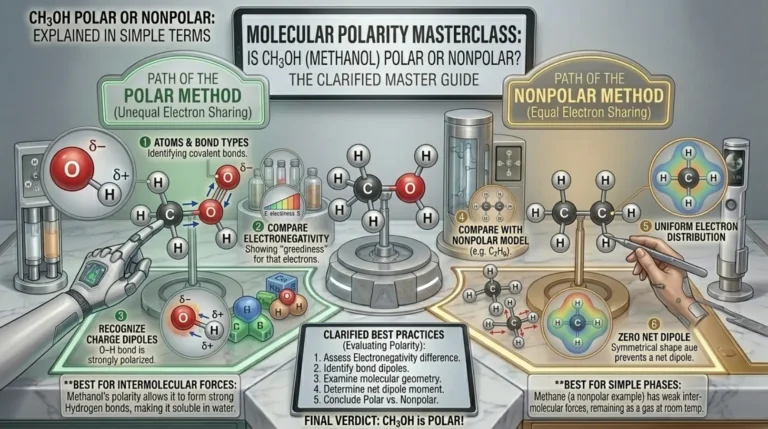
CH3OH polar or nonpolar is a common chemistry question among students and science learners. The simple answer is that CH3OH, also called methanol, is a polar molecule.
Many people become confused because methanol contains both carbon and hydrogen atoms. However, oxygen changes the molecule’s behavior.
Understanding polarity helps explain why substances dissolve, react, and mix with other materials.
In this guide, you will learn why CH3OH is polar, how molecular shape affects polarity, and where methanol appears in daily life.
The explanations use simple language and real examples. Whether you study chemistry or just want a quick answer, this article will help.
Quick Summary Box
- CH3OH is a polar molecule.
- CH3OH is also known as methanol.
- Oxygen creates an uneven charge distribution.
- The O-H bond is strongly polar.
- Methanol can form hydrogen bonds.
- CH3OH mixes easily with water.
- Its molecular geometry causes a net dipole moment.
- Therefore, CH3OH is not nonpolar.
What Is CH3OH?
CH3OH is the chemical formula for methanol.
It contains:
- One carbon atom (C)
- Four hydrogen atoms (H)
- One oxygen atom (O)
Chemists often call methanol the simplest alcohol.
Chemical Formula
CH3OH = Methanol
It belongs to the alcohol family because it contains an OH group.
Is CH3OH Polar or Nonpolar?
Answer: CH3OH Is Polar
Methanol has unequal electron distribution.
The oxygen atom attracts electrons more strongly than carbon and hydrogen.
As a result, one side of the molecule becomes slightly negative, while another side becomes slightly positive.
Because these charges do not cancel out, CH3OH becomes a polar molecule.
What Does Polar Mean?
A polar molecule has:
- Positive and negative ends.
- Uneven electron distribution.
- A measurable dipole moment.
Polar substances attract other polar substances.
Water is also polar. Therefore, methanol and water mix easily.
Why Is CH3OH Polar?
Several factors make methanol polar.
1. Oxygen Is Highly Electronegative
Oxygen pulls electrons toward itself.
This creates partial charges inside the molecule.
2. The O-H Bond Is Polar
The bond between oxygen and hydrogen creates strong polarity.
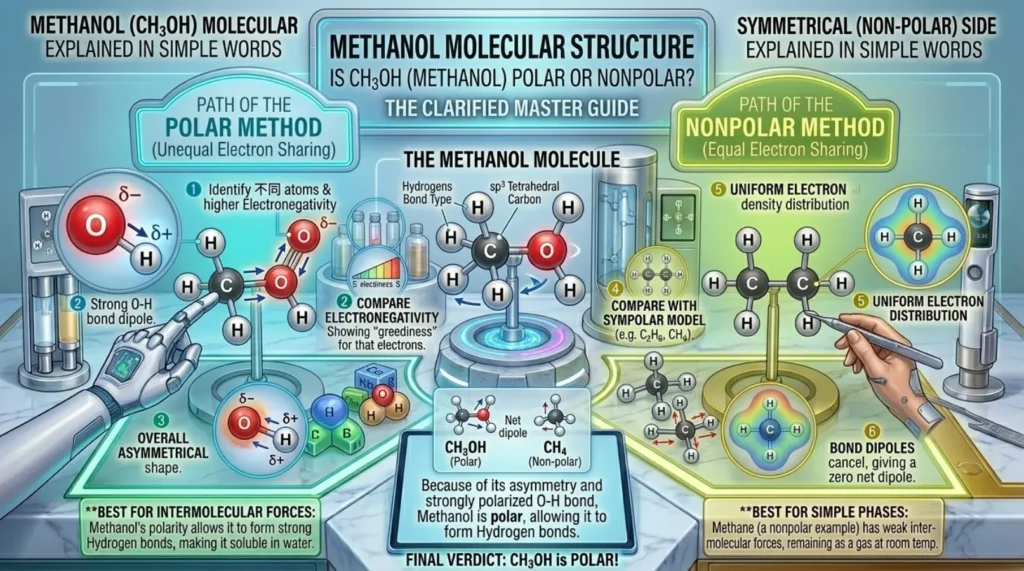
3. Molecular Shape Prevents Cancellation
The bond dipoles do not cancel each other.
Therefore, methanol has a net dipole moment.
Structure of CH3OH Explained in Simple Words
Methanol contains two main parts:
CH3 Group
The carbon and hydrogen portion has low polarity.
OH Group
The oxygen and hydrogen section has strong polarity.
The OH group dominates the entire molecule.
That is why CH3OH behaves as a polar compound.
Electronegativity and CH3OH
Electronegativity measures how strongly atoms attract electrons.
Relative Electronegativity Values
| Atom | Electronegativity |
|---|---|
| Hydrogen | 2.20 |
| Carbon | 2.55 |
| Oxygen | 3.44 |
Oxygen has the highest value.
Because of this difference, electrons move closer to oxygen.
This creates polarity.
CH3OH Polar vs Nonpolar Molecules Comparison
| Property | Polar Molecules | Nonpolar Molecules |
| Charge distribution | Uneven | Even |
| Dipole moment | Present | Absent |
| Mixes with water | Yes | Usually no |
| Hydrogen bonding | Often possible | Rare |
| Example | CH3OH, H2O | CH4, CO2 |
Examples
Polar Molecules
- CH3OH
- H2O
- NH3
Nonpolar Molecules
- CH4
- O2
- N2
Can CH3OH Form Hydrogen Bonds?
Yes.
Methanol forms hydrogen bonds because it contains an O-H group.
Hydrogen bonding gives methanol several properties:
- Higher boiling point
- Better water solubility
- Strong intermolecular attraction
Hydrogen bonding explains why methanol behaves similarly to water.
Real-Life Uses of Methanol
Methanol appears in many products.
Fuel
Methanol serves as an alternative fuel.
Antifreeze
Many industrial systems use methanol.
Solvent
Manufacturers use it to dissolve chemicals.
Chemical Production
Methanol helps produce plastics and formaldehyde.
Laboratories
Scientists frequently use methanol in experiments.
Why Does Polarity Matter?
Polarity affects:
- Solubility
- Boiling point
- Melting point
- Chemical reactions
- Intermolecular forces
Scientists use polarity to predict how molecules behave.
Without polarity, many chemical processes would work differently.
CH3OH and Water: Why Do They Mix?
The phrase “like dissolves like” explains this behavior.
Water is polar.
Methanol is polar.
Therefore, both substances attract each other and mix completely.
This attraction happens through hydrogen bonding.
Common Mistakes About CH3OH
Mistake 1: Assuming Carbon Makes It Nonpolar
Carbon alone does not determine polarity.
Oxygen strongly influences the molecule.
Mistake 2: Ignoring Molecular Shape
Shape affects whether dipoles cancel.
In methanol, they do not cancel.
Mistake 3: Confusing CH3OH With CH4
Methane (CH4) is nonpolar.
Methanol (CH3OH) is polar.
The OH group creates the difference.
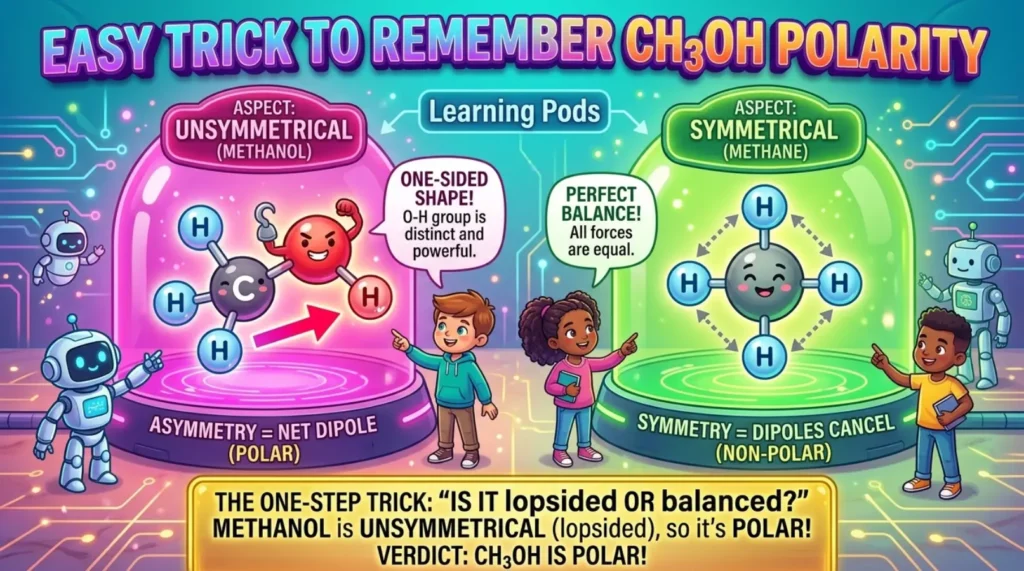
Easy Trick to Remember CH3OH Polarity
Remember this rule:
“OH Means Polar”
Most molecules containing an O-H group are polar.
Examples include:
- H2O
- CH3OH
- C2H5OH
This shortcut helps students answer polarity questions quickly.
Usage of Methanol in Daily Life
You may encounter methanol in:
- Windshield washer fluids
- Fuel additives
- Industrial cleaners
- Laboratory chemicals
- Manufacturing plants
Its polar nature helps it dissolve many substances.
Synonyms and LSI Keywords
Related Search Terms
- Is methanol polar?
- CH3OH polarity
- Methanol polar or nonpolar
- Molecular geometry of CH3OH
- Dipole moment of methanol
- Why is CH3OH polar?
- Methanol intermolecular forces
- Hydrogen bonding in CH3OH
Semantic Keywords
- Alcohol polarity
- Polar covalent bonds
- Electronegativity difference
- Molecular shape
- Hydrogen bond examples
Expert Insight
Chemistry experts determine polarity using:
- Bond polarity.
- Molecular geometry.
- Dipole moments.
Methanol consistently shows a net dipole moment.
Therefore, scientists classify CH3OH as a polar molecule.
Understanding polarity improves success in chemistry courses and exams.
Frequently Asked Questions
Is CH3OH polar or nonpolar?
CH3OH is polar.
Why is methanol polar?
Oxygen creates unequal charge distribution.
Does CH3OH dissolve in water?
Yes. Methanol mixes completely with water.
Can CH3OH form hydrogen bonds?
Yes. The O-H group allows hydrogen bonding.
Is methanol more polar than methane?
Yes. Methane is nonpolar, while methanol is polar.
Which bond causes polarity in CH3OH?
The O-H bond contributes most to polarity.
What type of intermolecular force exists in CH3OH?
Hydrogen bonding and dipole-dipole forces exist.
Is CH3OH a covalent compound?
Yes. Methanol contains covalent bonds.
Internal Linking Suggestions
Link this article to:
- Polar vs Nonpolar Molecules Explained
- Is H2O Polar or Nonpolar?
- CH4 Polar or Nonpolar?
- Hydrogen Bonding Examples
- Electronegativity Explained for Beginners
- Dipole Moment Definition
Conclusion
The answer to CH3OH polar or nonpolar is simple. CH3OH is a polar molecule.
Its oxygen atom attracts electrons strongly. This creates uneven charge distribution and a net dipole moment.
The O-H group also allows hydrogen bonding. Because of these features, methanol mixes easily with water and shows typical polar behavior.
Understanding polarity helps explain many chemical properties and reactions.
A simple rule can help you remember:
If a molecule contains an O-H group, it is usually polar.
Therefore, whenever someone asks, “Is CH3OH polar or nonpolar?”, the correct answer is polar.