No One or Noone is a common grammar question that confuses many English learners and writers. People often wonder which spelling is correct.
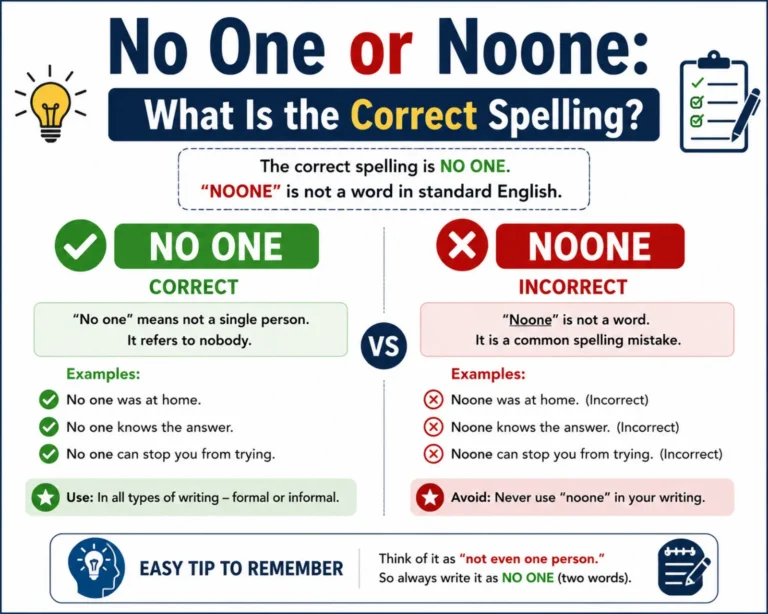
The short answer is simple. “No one” is correct, and “noone” is incorrect.
Even native speakers make this mistake because the words sound the same when spoken. However, English grammar follows specific spelling rules.
In this guide, you will learn the meaning of “no one,” see real examples, compare correct and incorrect forms, and avoid common writing mistakes.
By the end, you will know exactly when and how to use “no one” with confidence.
Quick Summary Box
- Correct form: No one
- Incorrect form: Noone
- “No one” means nobody or not a single person.
- “Noone” is not an accepted English word.
- Use “no one” in formal and informal writing.
- Synonyms include nobody, none, and not anybody.
- Remember: always write it as two separate words.
What Does “No One” Mean?
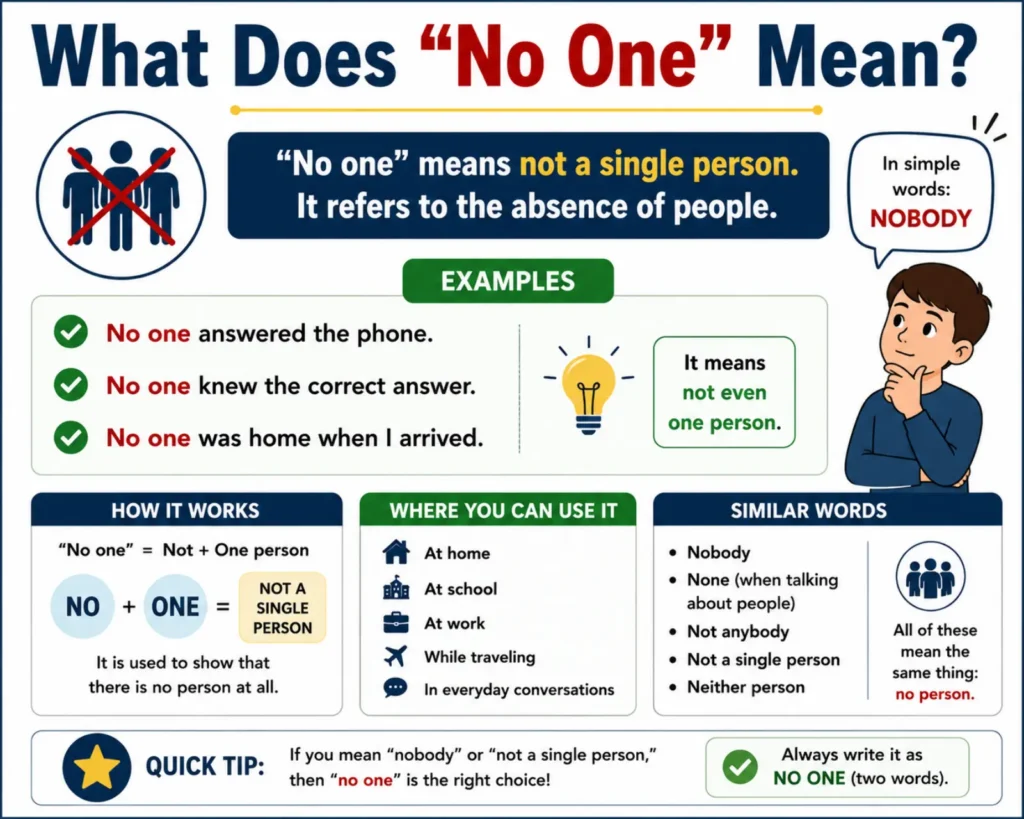
“No one” means not a single person.
It refers to the absence of people.
Examples
- No one answered the phone.
- No one knew the correct answer.
- No one was home when I arrived.
The phrase works the same way as “nobody.”
Is It No One or Noone?
The correct spelling is:
✅ No one
The incorrect spelling is:
❌ Noone
English dictionaries do not recognize “noone” as a standard word.
Correct Examples
- No one can replace you.
- No one saw the accident.
- No one expected the surprise.
Incorrect Examples
- Noone can replace you.
- Noone knew the answer.
Why Do People Write “Noone”?
Many people combine the words because they hear them spoken quickly.
Words like:
- Someone
- Anyone
- Everyone
are written as one word. Because of this pattern, writers sometimes assume “noone” should follow the same rule.
However, English grammar treats “no one” differently.
Simple Explanation of No One
Think of “no one” as:
No + one person
Together, they mean:
Not even one person.
Example
“There was no one in the office.”
Meaning:
“There wasn’t a single person in the office.”
No One vs Noone Comparison Table
| Feature | No One | Noone |
|---|---|---|
| Correct spelling | ✅ Yes | ❌ No |
| Found in dictionaries | ✅ Yes | ❌ No |
| Used in formal writing | ✅ Yes | ❌ No |
| Accepted in academic writing | ✅ Yes | ❌ No |
| Meaning | Nobody | None |
| Recommended usage | Always | Never |
Winner
Always use “no one.”
Real-Life Examples of “No One”
Here are examples from everyday situations.
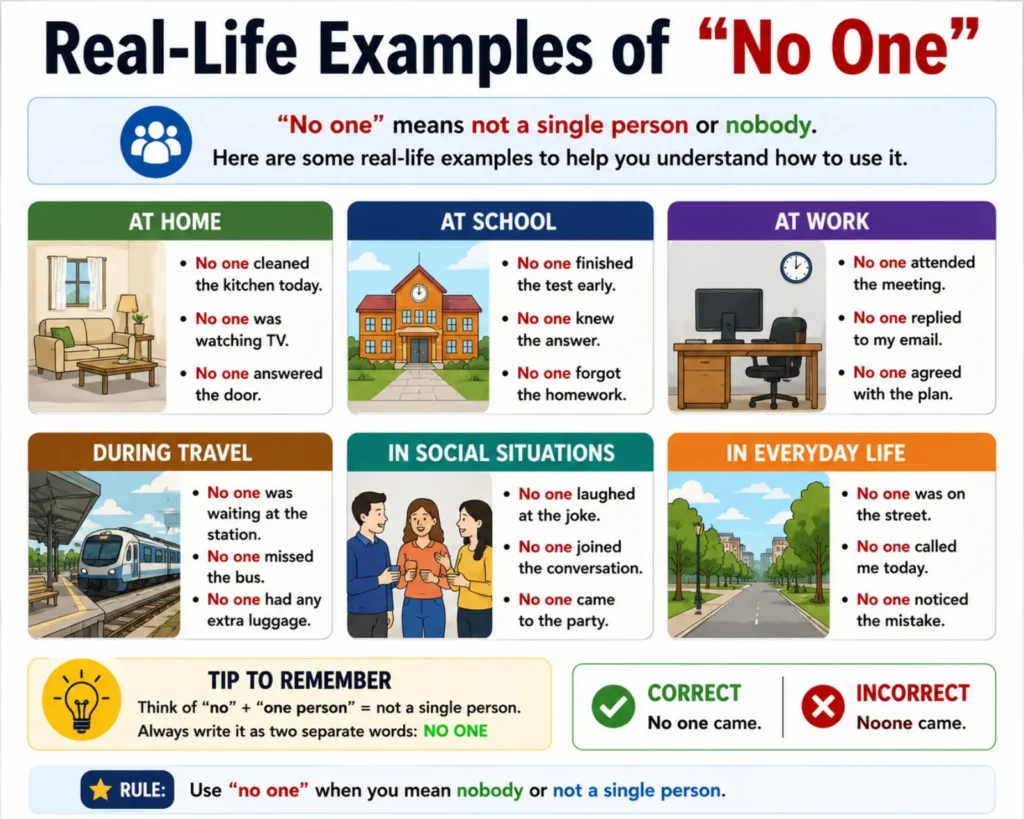
At Home
- No one cleaned the kitchen today.
- No one remembered my birthday.
At School
- No one finished the test early.
- No one forgot their homework.
At Work
- No one attended the meeting.
- No one replied to the email.
During Travel
- No one was waiting at the station.
- No one lost their luggage.
Common Mistakes People Make
1. Writing “Noone”
❌ Noone answered the door.
✅ No one answered the door.
2. Using Double Negatives
❌ No one didn’t come.
✅ No one came.
3. Confusing “No One” with “None”
“No one” refers to people.
“None” refers to people, things, or amounts.
Example:
- No one called me.
- None of the cookies remained.
When Should You Use “No One”?
Use “no one” when talking about people.
Examples
- No one understands me.
- No one wants to leave early.
- No one noticed the mistake.
You can use it in:
- Emails
- School assignments
- Blog posts
- Text messages
- Business writing
No One vs Nobody
Both words have the same meaning.
| No One | Nobody |
|---|---|
| More formal | Slightly casual |
| Two words | One word |
| Common in writing | Common in speech |
| Means not a single person | Means not a single person |
Examples
- No one called today.
- Nobody called today.
Both sentences are correct.
Synonyms and Related Words
These words have similar meanings:
Synonyms
- Nobody
- None
- Not anybody
- Not a single person
- Neither person
LSI Keywords
- no one meaning
- no one grammar
- no one or nobody
- correct spelling of no one
- is noone a word
- no one examples
- grammar mistakes in English
- English spelling rules
Tips to Remember the Correct Form
Remember These Tricks
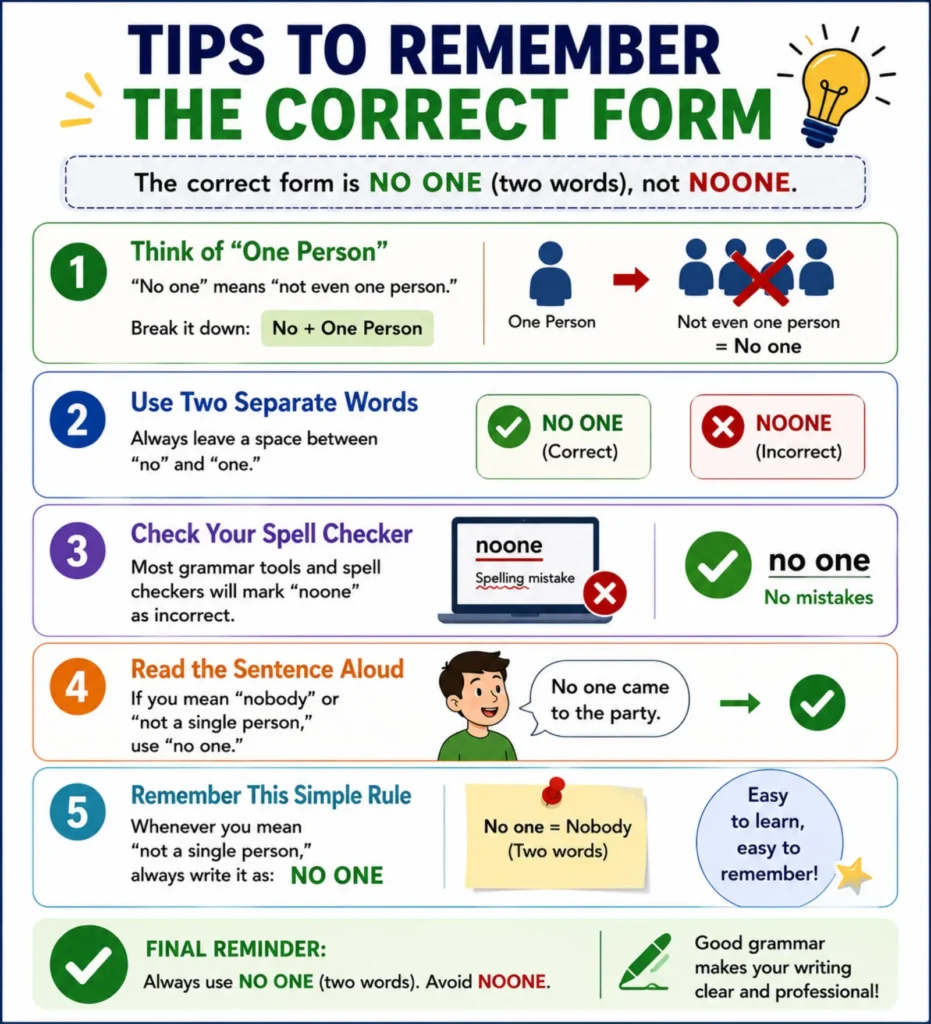
Think of “One Person”
“No one” means “not one person.”
Use Two Separate Words
Always leave a space between “no” and “one.”
Check Your Spell Checker
Most grammar tools highlight “noone” as incorrect.
Read the Sentence Aloud
If you mean “nobody,” use “no one.”
Usage of No One in Daily Life
People use “no one” every day.
Social Media
- No one expected that ending.
Conversations
- No one told me about the event.
News Reports
- No one was injured.
Business Emails
- No one has approved the proposal yet.
Because it sounds natural, the phrase appears in both formal and casual communication.
Expert Insight: Why This Grammar Rule Matters
Correct spelling improves readability and credibility.
Writers who use proper grammar appear more professional.
Search engines also favor well-written content.
Using “no one” correctly helps:
- Build trust with readers.
- Improve writing quality.
- Avoid embarrassing mistakes.
- Strengthen academic and professional communication.
Grammar experts agree that “noone” should never appear in standard English writing (FAQs)
Is “noone” a real word?
No. “Noone” is not an accepted English word.
Which is correct: no one or noone?
“No one” is correct.
Can I use “nobody” instead of “no one”?
Yes. Both words have the same meaning.
Why is “no one” two words?
English grammar treats it as two separate words.
Is “no one” formal?
Yes. It works well in formal and informal writing.
Does Microsoft Word mark “noone” as wrong?
Yes. Most grammar tools recognize “noone” as a spelling error.
What does “no one” mean?
It means not a single person.
Can I use “no one” in academic writing?
Yes. It is completely acceptable.
Internal Linking Suggestions
Consider linking this article to:
- Common English Grammar Mistakes
- Their vs There vs They’re
- Affect vs Effect
- Anyone vs Any One
- Nobody vs None
Conclusion
Understanding No One or Noone is easier than many people think. The correct form is always “no one” with a space between the words. The spelling “noone” is incorrect and should be avoided.
Whether you write emails, essays, blog posts, or social media captions, using the right spelling makes your writing clearer and more professional.
A simple rule can help you remember:
If you mean “not a single person,” always write “no one.”
Once you follow this rule, you’ll never confuse No One or Noone again