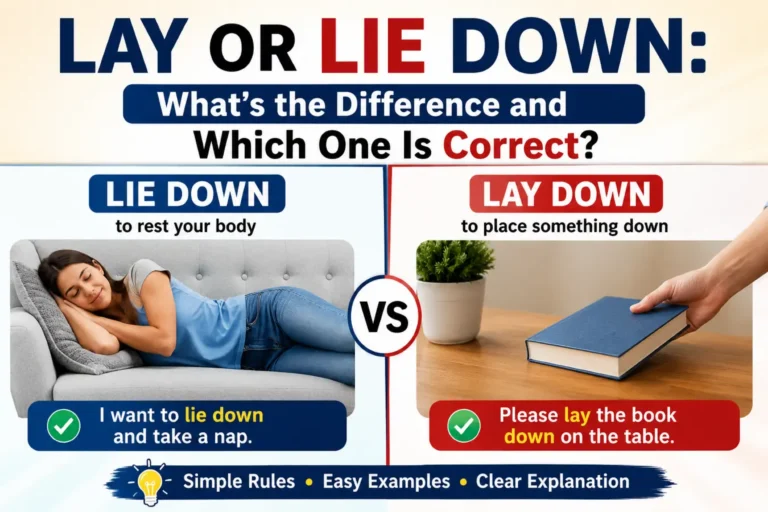
Lay or lie down is one of the most common grammar questions in English. Many people use these words incorrectly every day. The confusion happens because both words relate to resting or placing something.
However, lay and lie have different meanings. Using the wrong one can make your writing sound less professional. The good news is that the difference is simple once you understand it.
Quick Summary
Lie = Rest yourself.
Lay means to put or place something down.
Lie means to rest or recline.
Lay needs a direct object (something you place).
Lie does not need an object.
Correct examples:
I lay the book on the table.
I want to lie down after work.
Past tense:
Lay → Laid → Laid
Lie → Lay → Lain
Easy memory trick:
Lay = Place something.
What Does “Lay or Lie Down” Mean?
The phrase lay or lie down refers to two different actions.
Lie Down
“Lie” means to recline or rest your body.
Example:
- I want to lie down after work.
- The dog likes to lie down near the door.
Lay Down
“Lay” means to put or place something somewhere.
Example:
- Lay the keys down on the table.
- Please lay the blanket down carefully.
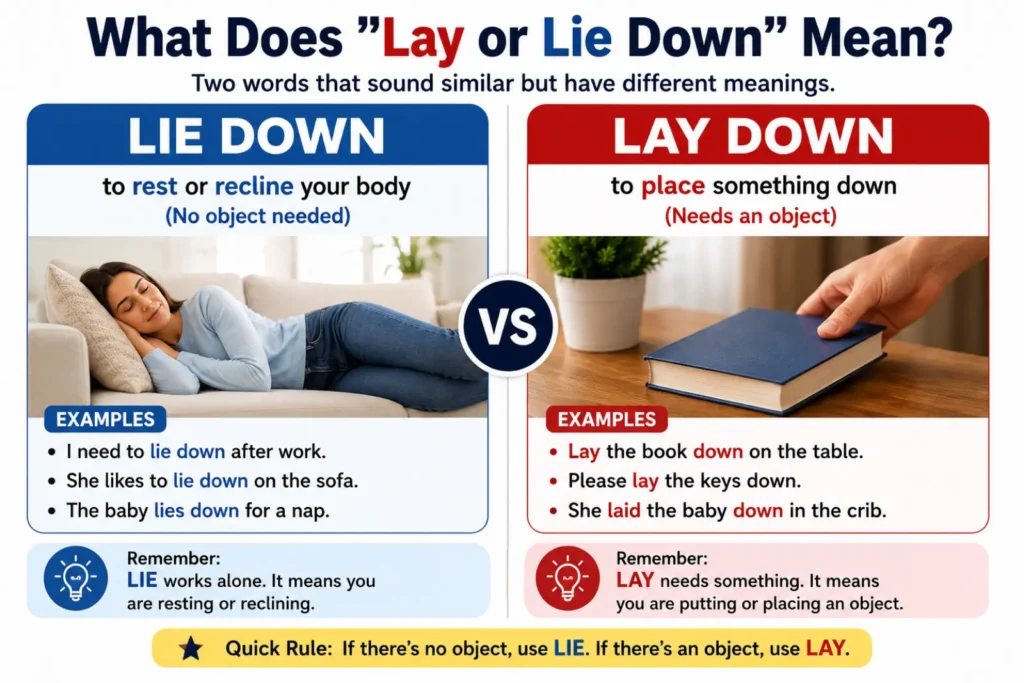
The key difference is simple:
Understanding the Difference Between Lay and Lie
Many people struggle with these words because they sound similar.
Here is the easiest rule:
Use “Lie” When No Object Exists
Examples:
- I will lie down.
- They lie down every afternoon.
- The cat lies down on the sofa.
Use “Lay” When an Object Exists
Examples:
- Lay the phone down.
- Lay the baby in the crib.
- Lay the papers on my desk.
Ask yourself:
Are you placing something?
If yes, use lay.
Lay vs Lie Comparison Table
| Feature | Lie | Lay |
|---|---|---|
| Meaning | To recline or rest | To place something |
| Needs an object? | No | Yes |
| Action performed on | Yourself | Another object |
| Example | I lie down. | I lay the book down. |
| Present tense | Lie | Lay |
| Past tense | Lay | Laid |
| Past participle | Lain | Laid |
Why Do People Confuse Lay and Lie?
Several reasons cause confusion.
Similar Meanings
Both words involve positioning something.
Confusing Past Tenses
The past tense of lie is lay.
Example:
- Today: I lie down.
- Yesterday: I lay down.
Meanwhile:
- Today: I lay the book down.
- Yesterday: I laid the book down.
This overlap creates mistakes.
Everyday Speech
Real-Life Examples of Lie Down
These examples show correct usage.
Home
- I need to lie down for a few minutes.
- She likes to lie down after dinner.
Work
- If you feel sick, lie down and rest.
the Doctor’s Office
- Please lie down on the examination table.
With Pets
- The puppy lies down when it hears its name.
Real-Life Examples of Lay Down
These examples show correct use of “lay.”
Home
- Lay your jacket on the chair.
- Lay the groceries on the counter.
At School
- Lay your notebook on the desk.
At Work
- Lay the documents on my table.
With Children
- Lay the baby in the crib gently.
Common Grammar Mistakes With Lay or Lie Down
Many people make these mistakes.
Incorrect
- I am going to lay down.
Correct
- I am going to lie down.
Why?
Incorrect
- Lie the book on the shelf.
Correct
- Lay the book on the shelf.
Why
Correct
- Yesterday I lay down for an hour.
Why?
The past tense of “lie” is “lay.”
Easy Trick to Remember Lay vs Lie
Use this simple memory trick.
LIE = Alone
The word lie works alone.
Example:
- I lie down.
No object appears.
LAY = Lay Something
The word lay needs something.
Example:
- Lay the blanket down.
If you can point to an object, use lay.
This trick helps many English learners remember the difference.
Verb Forms of Lay and Lie
Learning the verb forms reduces mistakes.
Lie (Recline)
| Tense | Form |
| Present | Lie |
| Past | Lay |
| Past Participle | Lain |
| Present Participle | Lying |
Examples:
Lay (Place Something)
| Tense | Form |
| Present | Lay |
| Past | Laid |
| Past Participle | Laid |
| Present Participle | Laying |
Examples:
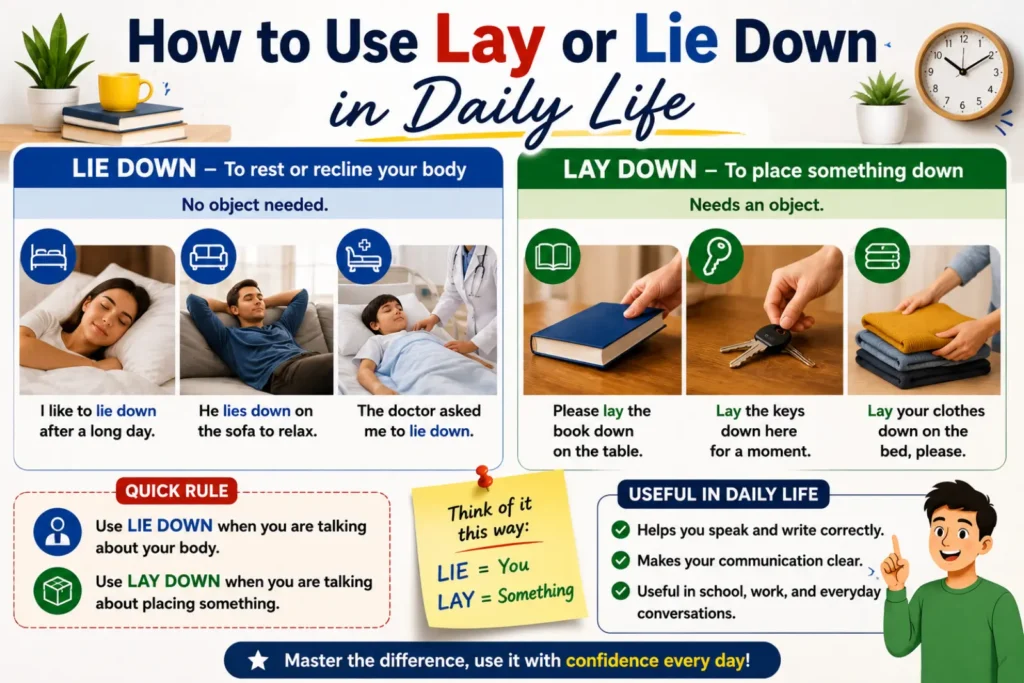
How to Use Lay or Lie Down in Daily Life
Understanding these verbs improves communication.
In Conversations
Correct grammar helps people understand you.
In School Writing
Teachers often check for grammar accuracy.
In Professional Emails
Clear language creates a professional image.
In Content Writing
Proper usage improves readability and credibility.
Synonyms and Related Terms
Using related words can improve writing variety.
Synonyms for Lie Down
- Recline
- Rest
- Stretch out
- Relax
- Lounge
Synonyms for Lay Down
- Place
- Put
- Set
- Position
- Arrange
Related Search Terms
Expert Insights: Why This Grammar Rule Matters
Grammar experts often highlight this topic because it appears frequently in everyday speech.
Correct usage helps:
- Improve writing quality
- Build professional credibility
- Increase reader trust
- Strengthen communication skills
Many people never learn the difference. Understanding it gives you an advantage in school, work, and writing.
Tips for Mastering Lay and Lie
Practice Daily
Create sentences using both words.
Look for Objects
Check whether an object follows the verb.
Read Carefully
Notice how books and articles use these terms.
Use Memory Tricks
Remember:
- Lie = alone
- Lay = place something
Review Verb Forms
Past tense mistakes happen most often.
(FAQs)
Is it correct to say “I need to lay down”?
Usually no.
The correct phrase is:
“I need to lie down.”
Why is lay the past tense of lie?
English developed over many centuries. Some verbs changed forms over time, creating this confusing pattern.
What is the easiest way to remember lay vs lie?
Remember:
- Lie = recline
- Lay = place something
If there is an object, use lay.
Is “lay down” ever correct?
Yes.
Use it when placing something.
Example:
“Lay the phone down.”
What is the past tense of lay?
The past tense of lay is laid.
Example:
“I laid the book on the table.”
What is the past tense of lie?
The past tense of lie is lay.
Example:
“Yesterday, I lay down for an hour.”
Do native speakers confuse lay and lie?
Yes.
Many native English speakers make mistakes with these verbs.
Which form appears more often in grammar tests?
Both forms appear frequently because they are commonly confused.
Conclusion
Understanding lay or lie down becomes easy once you know the basic rule. Use lie down when someone reclines or rests. Use lay down when placing an object somewhere. The biggest confusion comes from the unusual past tense forms, but practice helps quickly.
Remember the simple trick: lie works alone, lay needs something. When you check for an object, the correct choice becomes obvious. Whether you are writing emails, essays, blog posts, or everyday messages, using these words correctly improves clarity and professionalism.
Mastering this grammar rule may seem small, but it strengthens your communication skills. The next time you wonder whether to say lay or lie down, you will know exactly which one to choose.