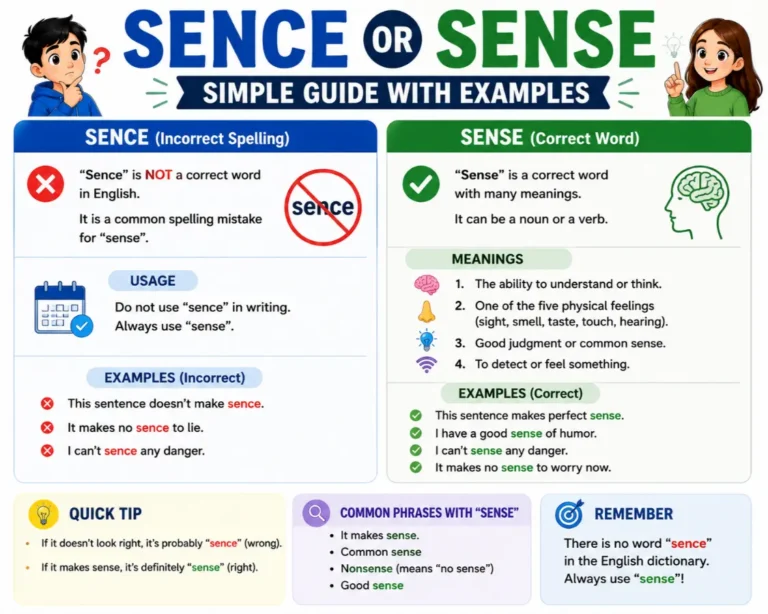
Sence or sense is a common question for English learners and writers. Many people type “sence” when they actually mean “sense.” This small spelling mistake can confuse readers and lower writing quality.
The correct word is sense. It has several meanings in English. It can describe understanding, feelings, or one of the five human senses.
This guide explains everything in simple words. You will learn the meaning of sense, how to use it, and why sence is incorrect. You will also see easy examples and helpful tips to remember the right spelling.
By the end of this guide, you will know exactly when to use sense with confidence.
Quick Summary
- Sense is the correct English word.
- Sence is a spelling mistake.
- Sense means understanding, feeling, or awareness.
- Sense also refers to the five human senses.
- Always use sense in speaking and writing.
- Remember: sense ends with -se, not -ce.
What Does Sense Mean?
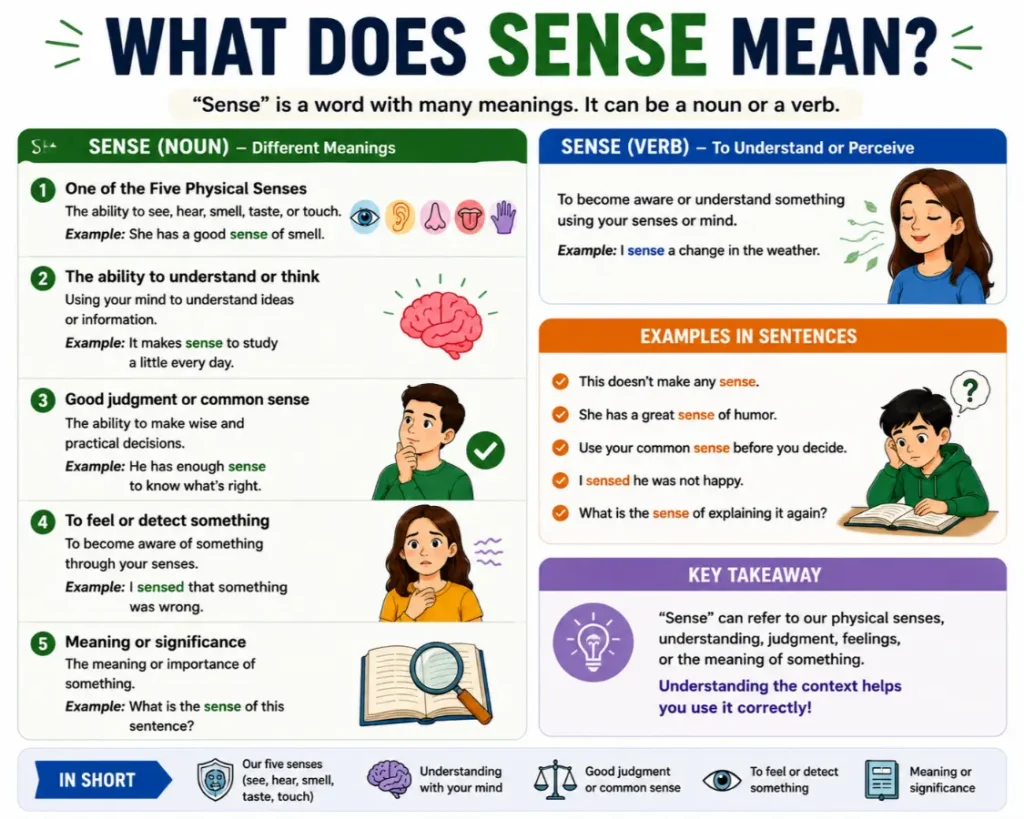
The word sense has more than one meaning. It is a useful word in everyday English.
It can mean:
- The ability to understand something.
- Good judgment.
- A feeling or idea.
- One of the five human senses.
Simple Definition
Sense means the ability to understand, feel, or notice something.
The Five Human Senses
People experience the world through five basic senses.
- Sight
- Hearing
- Smell
- Taste
- Touch
Example Sentences
- That idea makes perfect sense.
- She has a good sense of humor.
- I lost my sense of direction.
- Dogs have a strong sense of smell.
- Always use common sense.
Is Sence a Real Word?
No.
Sence is not a correct English word. It does not appear in standard English dictionaries.
Many people type sence by mistake because it sounds similar to sense.
Whenever you write sence, replace it with sense.
Incorrect Examples
Sence is important.
I have a good sence of humor.
This makes no sence.
Correct Examples
Sense is important.
✅ I have a good sense of humor.
✅ This makes no sense.
Sence or Sense: What’s the Difference?
The answer is simple.
| Word | Correct? | Meaning |
|---|---|---|
| Sense | ✅ Yes | Understanding, feeling, awareness, or one of the five senses |
| Sence | ❌ No | Incorrect spelling of sense |
Key Point
There is no difference in meaning because sence is simply a spelling error.
Always choose sense in school, work, emails, blogs, and social media posts.
Why Do People Spell Sense as Sence?
Many learners make this mistake for simple reasons.
Similar Pronunciation
Both spellings sound almost the same.
Fast Typing
People often type quickly and miss the correct spelling.
Learning English
New English learners may guess the spelling based on sound.
Autocorrect Problems
Sometimes typing tools do not catch every mistake.
Memory Tip
Think of this sentence:
Good sense helps you make good decisions.
Notice that sense always ends with SE.
How to Use Sense in Everyday English
The word sense appears in daily conversations.
Show Understanding
- Your explanation makes sense.
- The plan makes sense to everyone.
Talk About Good Judgment
- She has excellent common sense.
- Use your sense before making a decision.
Describe Feelings
- I have a sense that something is wrong.
- There was a sense of excitement before the game.
Human Abilities
- My sense of smell is very strong.
- His sense of hearing has improved.
Real-Life Examples of Sense
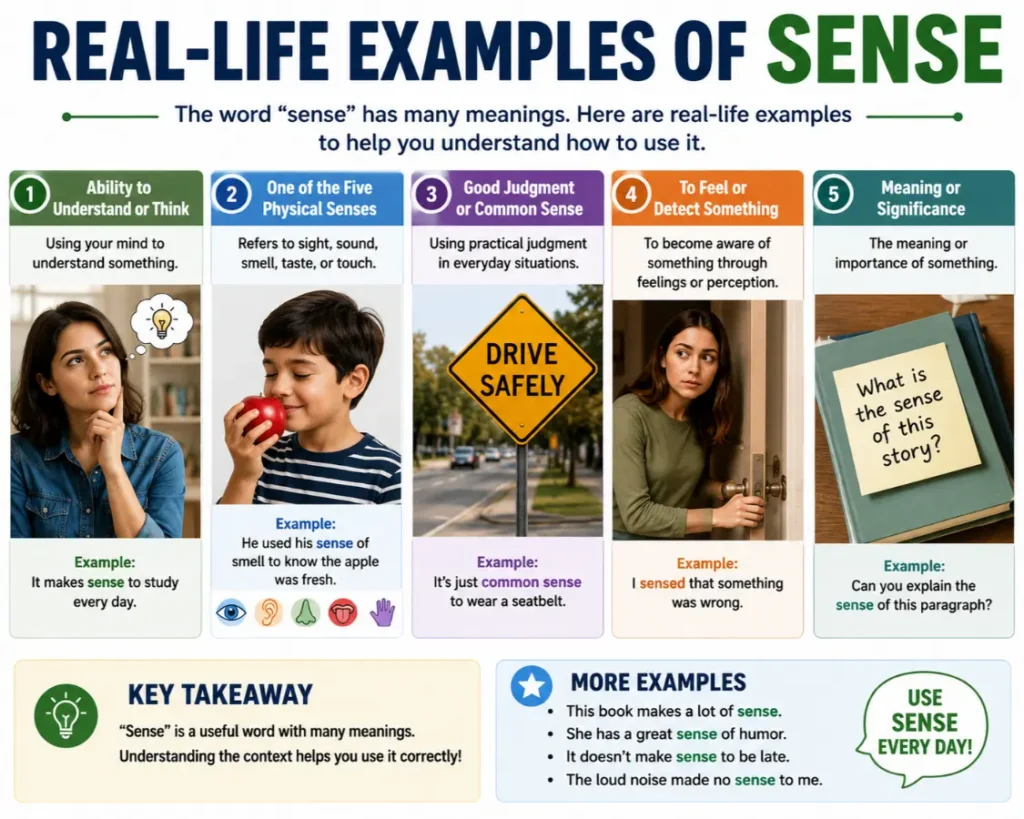
Here are easy examples from daily life.
At School
“This answer makes sense.”
At Work
“Please use common sense before sending the email.”
At Home
“My little brother has a great sense of humor.”
During Travel
“I lost my sense of direction.”
While Cooking
“My grandmother has an amazing sense of taste.”
In Sports
“A goalkeeper needs a strong sense of timing.”
These examples show that sense is useful in many situations.
Common Expressions with Sense
The word sense appears in many common English expressions. Learning these phrases helps you sound more natural.
| Expression | Meaning | Example |
|---|---|---|
| Common sense | Good judgment | Use common sense before crossing the road. |
| Make sense | Be easy to understand | Your answer makes sense. |
| Sense of humor | Ability to enjoy jokes | Sarah has a great sense of humor. |
| Sense of direction | Ability to find your way | I have a poor sense of direction. |
| Sense of responsibility | Feeling responsible | Good leaders have a strong sense of responsibility. |
| Sense of smell | Ability to smell | Dogs have an excellent sense of smell. |
| Sense of taste | Ability to taste | My cold affected my sense of taste. |
These expressions appear often in books, conversations, and workplaces.
Comparison Table: Sence vs. Sense
Many people search for “sence or sense” because they are unsure which spelling is correct.
| Feature | Sense | Sence |
| Correct English word | ✅ Yes | ❌ No |
| Found in dictionaries | ✅ Yes | ❌ No |
| Accepted in academic writing | ✅ Yes | ❌ No |
| Used in daily conversations | ✅ Yes | ❌ No |
| Means understanding or awareness | ✅ Yes | ❌ No |
| Correct spelling | ✅ Yes | ❌ Incorrect |
Quick Answer
If you are choosing between sence or sense, always use sense.
Common Mistakes People Make
Many writers repeat the same spelling mistakes.
Mistake 1: Writing “Sence”
❌ This makes no sence.
✅ This makes no sense.
Mistake 2: Using Sense Incorrectly
❌ I can sense of humor.
✅ I have a good sense of humor.
Mistake 3: Confusing Sense with Since
These words look similar but have different meanings.
Sense means understanding.
Since refers to time or a reason.
Example:
- I have lived here since 2020.
- That idea makes sense.
Tips to Remember the Correct Spelling
These tricks make the spelling easy to remember.
Remember the Ending
The word ends with SE.
Sen + se = Sense
Read More English
Reading books and articles helps you remember correct spelling.
Practice Writing
Write the word several times.
Practice makes spelling easier.
Use Spell Check
Modern writing tools often catch spelling mistakes.
Still, always proofread your work.
Learn Common Phrases
Remember expressions like:
- Common sense
- Makes sense
- Sense of humor
- Sense of direction
Seeing the word often improves memory.
Synonyms and Related Words
Depending on the sentence, sense can have different synonyms.
Synonyms for Understanding
- Understanding
- Meaning
- Logic
- Reason
- Judgment
Synonyms for Feeling
- Awareness
- Feeling
- Impression
- Perception
Related Words (LSI Keywords)
- sense meaning
- sense definition
- common sense
- makes sense
- sense of humor
- five senses
- spelling mistake
- English grammar
- English vocabulary
- correct spelling
- sence vs sense
- proper English usage
Using these related terms naturally helps improve SEO without overusing the main keyword.
Expert Insight
Professional writers know that small spelling mistakes can reduce credibility.
Search engines also value content that is clear and helpful.
Using the correct spelling improves readability and builds trust with readers.
If English is your second language, do not worry about occasional mistakes. The best way to improve is through regular reading and writing.
Remember one simple rule:
“Sense” is always correct. “Sence” is always incorrect.
This habit will improve your emails, assignments, blogs, and professional writing.
Frequently Asked Questions
1. Is “sence” a real English word?
No. Sence is a spelling mistake. The correct word is sense.
2. Which is correct: sence or sense?
Sense is the correct spelling.
3. What does sense mean?
Sense means understanding, awareness, feeling, or one of the five human senses.
4. Why do people write “sence”?
Most people spell it that way because it sounds similar to sense or because they type quickly.
5. How can I remember the correct spelling?
Remember that sense always ends with SE.
Practice using phrases like common sense and makes sense.
6. What are the five senses?
The five senses are:
- Sight
- Hearing
- Smell
- Taste
- Touch
7. Can I use “sence” in formal writing?
No.
Always use sense in essays, emails, business writing, and school assignments.
Conclusion
Many people search for sence or sense because the two spellings look similar. However, only sense is correct in English. The word can describe understanding, awareness, good judgment, or one of the five human senses.
The easiest way to avoid mistakes is to remember that sense always ends with “SE.” Practice using common expressions like “makes sense” and “common sense.” Reading and writing regularly will also strengthen your spelling skills.
The next time you wonder whether to write sence or sense, you will know the answer immediately. Choose sense every time to make your writing clear, accurate, and professional.