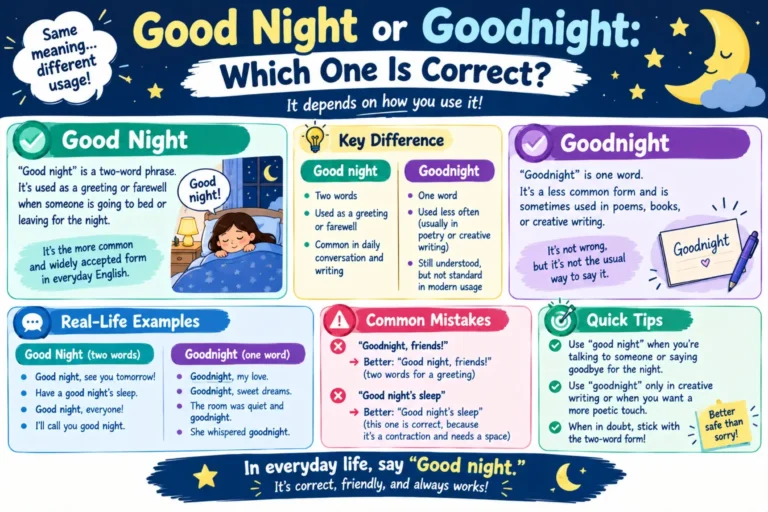
Good night or goodnight—which spelling should you use? The answer depends on how you use the phrase. “Good night” is the standard form when you say goodbye before sleep. It works as a polite farewell or wish. “Goodnight” also appears in English, but its use differs by context and style. Many people use both forms in texts and casual writing. However, knowing the difference can help you write more clearly. In this guide, you will learn when to use good night and goodnight. You will also see simple examples from daily life. By the end, you will know which form sounds natural in common situations. You will also learn about common spelling mistakes, related phrases, and useful grammar tips.
Quick Summary: Good Night or Goodnight?
- Good night is the standard phrase for saying goodbye before sleep.
- Goodnight can work as a noun, adjective, or informal expression.
- Use “Good night!” when wishing someone a pleasant night.
- Use “goodnight” in compounds such as “goodnight kiss” or “goodnight message.”
- In everyday speech, “Good night” is usually the safest choice.
- Both forms appear in modern English.
- Context determines which spelling works best.
What Does “Good Night” Mean?
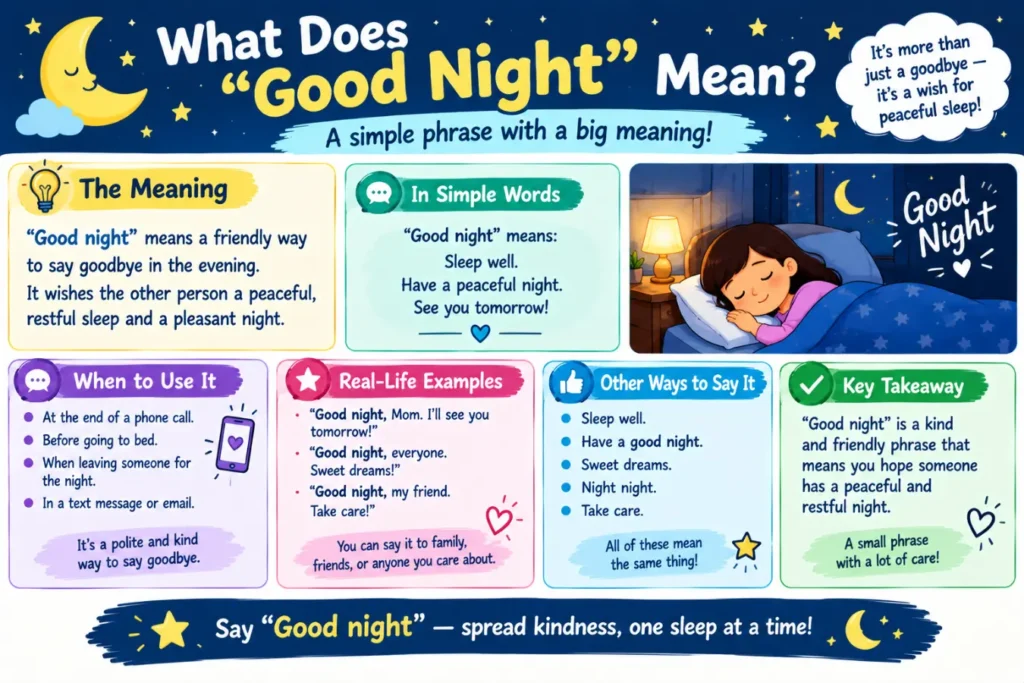
“Good night” is a phrase people use when ending an evening conversation.
It often means that you wish someone a pleasant night.
For example:
Good night! Sleep well.
You may say it to family, friends, coworkers, or someone you are dating.
The phrase usually appears when someone leaves or goes to bed.
It can also express warmth, care, or politeness.
For example:
- Good night, Mom.
- Good night, everyone.
- Have a good night.
- Good night. See you tomorrow.
The two words normally remain separate when they work as a farewell phrase.
What Does “Goodnight” Mean?
“Goodnight” is a closed form of the same expression.
It appears more often in informal writing and certain grammatical uses.
You may see it in compounds or as a noun.
Examples include:
- a goodnight kiss
- a goodnight message
- a goodnight hug
- a goodnight story
For example:
She gave her son a goodnight kiss.
Here, goodnight describes the kiss.
You can also find “goodnight” used as a noun in some dictionaries and styles.
For example:
He gave everyone a quick goodnight.
However, this use sounds less common than the phrase “good night.”
Good Night vs. Goodnight: What Is the Difference?
The main difference comes from grammar and usage.
Good night usually works as a phrase or farewell.
Goodnight often works as a compound word or noun.
Think of it this way:
| Form | Common use | Example |
|---|---|---|
| Good night | Farewell or wish | Good night! Sleep well. |
| Goodnight | Compound modifier | She gave me a goodnight kiss. |
| Goodnight | Noun in some uses | He said his goodnight. |
| Good night | Polite evening farewell | Have a good night. |
For most everyday messages, “Good night” is the best choice.
Is “Good Night” One Word or Two?
The safest standard answer is: “Good night” is usually two words when used as a farewell.
For example:
Good night, Sarah!
Good night and sweet dreams!
However, English also uses “goodnight” as one word in certain contexts.
For example:
He gave her a goodnight kiss.
The important point is not simply the spelling.
You should look at the role of the phrase in the sentence.
If you are saying goodbye before sleep, choose “Good night.”
If the word describes something related to saying goodnight, “goodnight” may work.
When Should You Use “Good Night”?
Use “good night” when you wish someone a pleasant night.
This is the most common everyday use.
Example 1: Talking to a friend
Good night! Talk to you tomorrow.
Example 2: Saying goodbye
Thanks for coming. Good night!
Example 3: Talking to your family
Good night, Dad. I love you.
Example 4: Ending a phone call
It was nice talking to you. Good night!
Example 5: Going to bed
I’m tired. Good night, everyone.
In each example, good night acts as a farewell phrase.
When Should You Use “Goodnight”?
Use “goodnight” mainly when it forms a compound or works as a noun.
For example:
She gave her child a goodnight kiss.
I sent him a goodnight message.
The book contains a sweet goodnight story.
Here, “goodnight” describes another noun.
This pattern appears often in casual English.
You may also see the one-word form in titles, product names, songs, books, and informal messages.
Still, you should not replace every use of “good night” with “goodnight.”
The context matters.
Good Night or Goodnight in Text Messages?
Text messages often use both forms.
However, “Good night” remains the clearest choice.
For example:
Good night ❤️
Good night! Sleep well.
Good night, talk tomorrow.
These messages sound natural and correct.
You may also see:
Goodnight ❤️
This form is common in casual texting.
It does not usually cause confusion.
However, formal writing benefits from the standard two-word form.
For example, an email might say:
Have a good night, and I look forward to speaking with you tomorrow.
A personal text can be much more relaxed.
Good Night or Goodnight in American English?
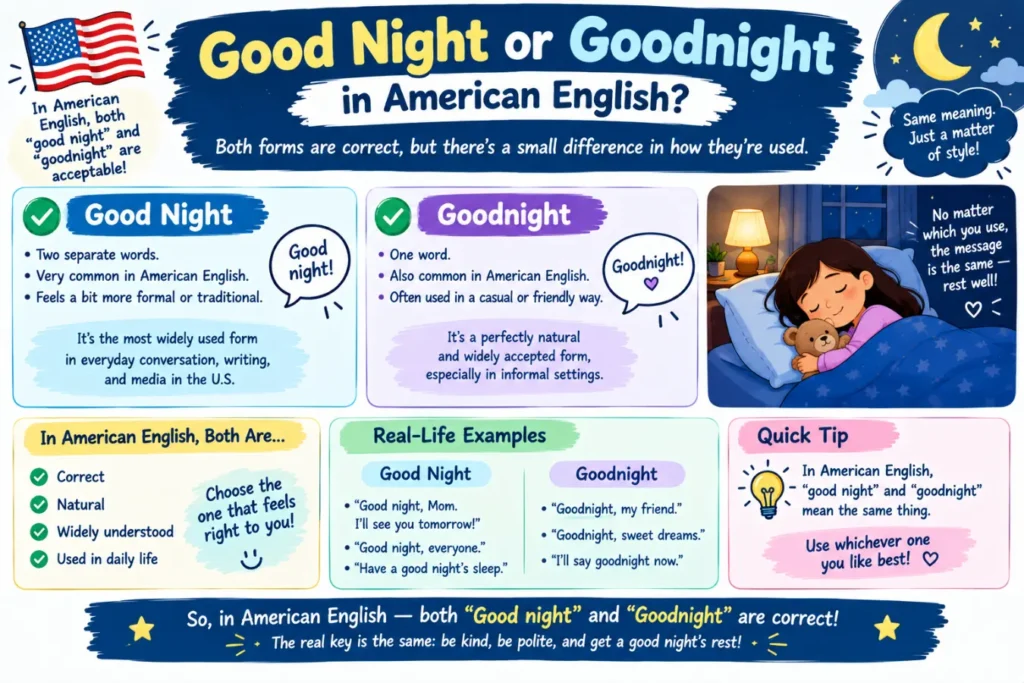
American English uses both forms.
However, “good night” remains the normal spelling when the phrase works as a farewell.
For example:
Good night, everyone.
American English also uses “goodnight” in compounds.
For example:
She gave him a goodnight kiss.
The same basic distinction works in many other varieties of English.
Style guides and dictionaries may differ slightly in how they classify the one-word form.
Therefore, context remains more important than a simple spelling rule.
Good Night or Goodnight in British English?
British English also uses “good night” as a common farewell.
For example:
Good night. See you tomorrow.
The one-word form also appears in British English.
You may find it in compounds and informal uses.
For example:
He gave her a goodnight kiss.
So, the difference does not depend only on American or British English.
The grammatical role of the expression matters more.
Real-Life Examples of “Good Night”
Here are simple examples you can use in daily life.
With family
Good night, Mom. Sleep well.
With a partner
Good night, love. Sweet dreams.
With a friend
Good night! I’ll message you tomorrow.
At the end of a party
Thanks for a great evening. Good night!
At work
Have a good night. See you in the morning.
In a social media message
Good night, everyone. See you tomorrow!
These examples all use “good night” as a farewell.

Real-Life Examples of “Goodnight”
The one-word version works well in compound expressions.
Goodnight kiss
She gave her daughter a goodnight kiss.
Goodnight message
I received a sweet goodnight message.
Goodnight story
Dad read a goodnight story to the children.
Goodnight hug
The child asked for a goodnight hug.
Goodnight routine
Reading is part of my goodnight routine.
In these examples, “goodnight” connects naturally with another word.
Common Mistakes to Avoid
Many English learners confuse these two forms.
Here are some common mistakes.
Mistake 1: Using “goodnight” as the default farewell
Some people write:
Goodnight, everyone!
This is common in casual communication.
Still, “Good night, everyone!” is the safer standard choice.
Mistake 2: Splitting compound expressions
A writer may use:
good night kiss
The more natural compound is:
goodnight kiss
The closed form helps show that the words work together as one modifier.
Mistake 3: Adding unnecessary punctuation
Avoid writing:
Good night!!!???
Unless the message is intentionally playful.
Simple punctuation usually looks cleaner.
Mistake 4: Confusing “good night” with “have a good night”
These phrases have slightly different structures.
Good night!
This usually ends a conversation.
Have a good night!
This expresses a wish for someone’s evening.
Both are correct.
Tips for Choosing the Correct Form
Use these simple rules to choose quickly.
Tip 1: If you are saying goodbye, use good night.
Good night. See you tomorrow.
Tip 2: If “goodnight” describes another noun, the one-word form often works.
goodnight kiss
Tip 3: In formal writing, prefer the clearer standard phrase.
Tip 4: In casual texting, both forms may appear.
Tip 5: Focus on the sentence rather than memorizing one spelling.
These tips can help you avoid most usage errors.
Synonyms and Related Phrases
English has many ways to express the same idea.
Useful alternatives include:
- Sleep well
- Sweet dreams
- Have a good night
- Rest well
- Good evening
- See you tomorrow
- Night!
- Night-night
- Pleasant dreams
- Sleep tight
Each phrase has a slightly different tone.
“Sleep well” sounds warm and friendly.
“Sweet dreams” sounds affectionate.
“Night!” sounds very casual.
“Have a good night” works well when someone continues their evening elsewhere.
These related phrases can also improve your vocabulary.
Good Night vs. Good Evening
“Good night” and “good evening” do not have the same use.
Good evening usually works as a greeting.
Good night usually works as a farewell.
For example:
Good evening, Mr. Khan.
You are greeting him.
Later, you might say:
Good night, Mr. Khan.
You are leaving.
This distinction is useful in both casual and formal conversations.
Expert Insights: Why the Difference Matters
Clear word choice improves communication.
The difference between good night and goodnight rarely changes the meaning.
However, correct usage makes your writing look more polished.
It also helps readers understand the grammatical role of the expression.
A useful editing rule is simple:
Use “good night” for the farewell. Use “goodnight” when it acts as a compound or noun.
Language changes over time.
Therefore, you may see both forms in books, websites, messages, and social media.
Do not treat every one-word use as a serious error.
Instead, consider the audience, sentence structure, and writing style.
For professional content, clarity should come first.
Frequently Asked Questions
Is “good night” correct?
Yes. “Good night” is the standard form when you say goodbye or wish someone a pleasant night.
Is “goodnight” grammatically correct?
Yes. “Goodnight” can be correct in compounds and some noun uses. Context determines the correct form.
Should I write “good night” or “goodnight” in a text?
Both appear in casual texts. “Good night” is the safest and clearest choice.
Is “goodnight” one word?
Yes, “goodnight” is used as one word in certain contexts. It often appears in compounds such as “goodnight kiss.”
Is “Goodnight” rude?
No. “Goodnight” is not rude. Tone depends more on the situation and surrounding words.
Which is more common: good night or goodnight?
“Good night” is the more standard form for a farewell. “Goodnight” has specific compound and informal uses.
Can I say “goodnight” to my boyfriend or girlfriend?
Yes. It is common in casual and affectionate messages. You can also say “Good night” or “Sweet dreams.”
What is the difference between “good night” and “goodnight”?
“Good night” usually works as a farewell phrase. “Goodnight” commonly works as a compound word or noun.
Conclusion
So, good night or goodnight? The best choice depends on how you use the expression. Use “good night” when you are saying goodbye before sleep. This is the clearest and most standard form. Use “goodnight” when it works as a compound, such as “goodnight kiss” or “goodnight message.” Both forms appear in modern English, especially in casual communication. However, you should not assume they are always interchangeable. When you are unsure, choose “good night” for a farewell. That simple rule works in most everyday situations. Good spelling makes your writing clearer, but context matters most. Once you understand this small difference, choosing the right form becomes easy.