
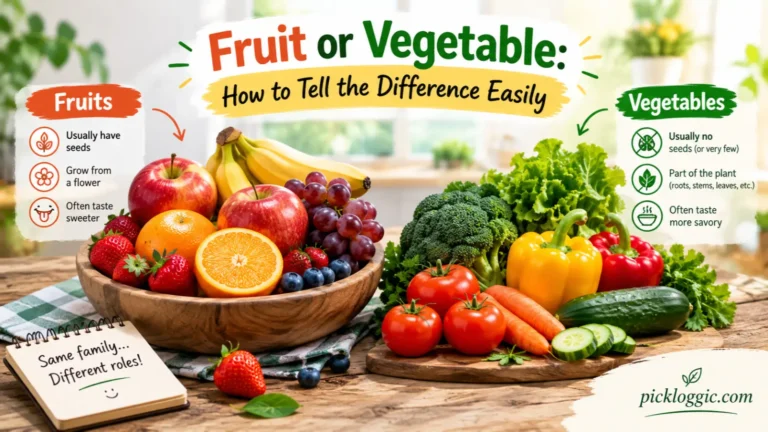
Fruit or vegetable, which one is correct when you look at foods like tomatoes, cucumbers, and peppers? The answer may surprise you. Some foods we call vegetables in the kitchen are actually fruits in botanical science. The difference depends on how they grow and which parts of a plant we eat.
Fruits usually develop from a flower’s ovary and often contain seeds. Vegetables can come from a plant’s roots, stems, leaves, flowers, or other parts. However, everyday cooking uses these terms differently. For example, people often call tomatoes vegetables because they work well in savory dishes.
Understanding the difference makes food choices and science lessons easier. In this guide, you’ll discover simple definitions, clear examples, a comparison table, and common classification mistakes.
Quick Summary: Fruit or Vegetable?
- Fruits usually develop from a flower’s ovary and often contain seeds.
- Vegetables include edible roots, stems, leaves, flowers, and other plant parts.
- Tomatoes, cucumbers, peppers, and eggplants are botanical fruits.
- Carrots, lettuce, celery, and potatoes are vegetables based on the plant parts we eat.
- Cooking classifies foods by taste and use, while botany classifies them by plant structure.
- A food can be a botanical fruit and a culinary vegetable at the same time.
What Is a Fruit?
A fruit is the mature ovary of a flowering plant, usually containing seeds. It develops after fertilization in many plants, although some fruits can form without fertilization.
Fruits help flowering plants protect their seeds and support seed dispersal. Animals may eat fleshy fruits and spread their seeds to new places.
Common examples include:
- Apples
- Oranges
- Bananas
- Grapes
- Peaches
- Tomatoes
- Cucumbers
- Bell peppers
Not every fruit tastes sweet. Tomatoes, cucumbers, and peppers are fruits because of how they develop from flowers.
Some fruits, such as bananas, usually contain tiny undeveloped seeds in the varieties sold for eating. Therefore, visible seeds are not always necessary for identifying a botanical fruit.
What Is a Vegetable?
A vegetable is an edible plant part that people commonly use in savory meals. Unlike the botanical definition of fruit, the word vegetable does not describe one specific plant structure.
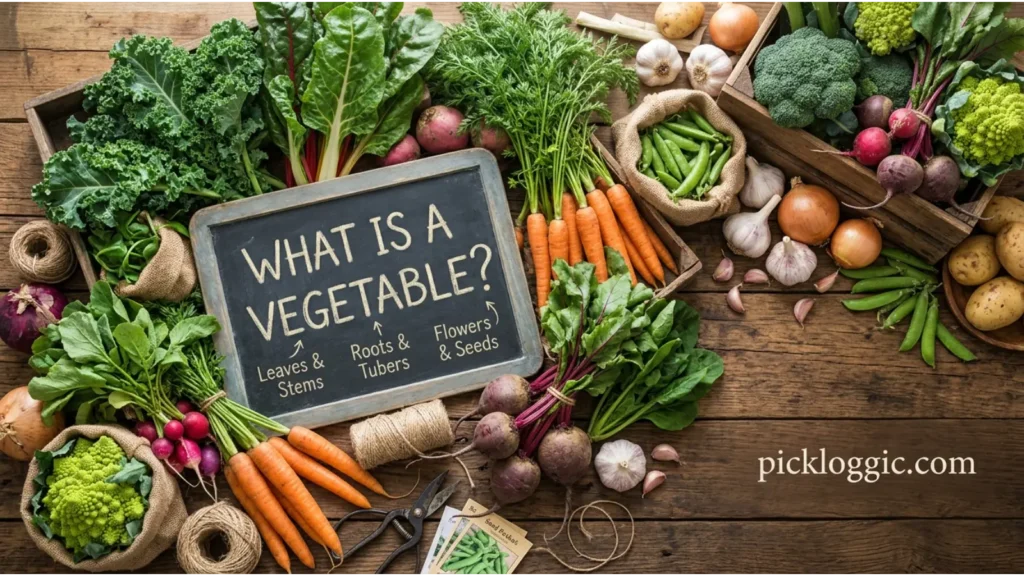
Vegetables can come from several parts of a plant.
- Roots: Carrots, radishes, and beets
- Leaves: Spinach, lettuce, and cabbage
- Stems: Celery and asparagus
- Flowers: Broccoli and cauliflower
- Tubers: Potatoes
- Bulbs: Onions and garlic
These plant parts serve different functions. Roots absorb water and nutrients, while leaves help plants make food through photosynthesis.
Some vegetables, such as broccoli, are flower structures. Others, such as potatoes, are underground stems called tubers.
This variety explains why vegetables do not share one simple botanical definition.
What Is the Difference Between a Fruit and a Vegetable?
The main difference comes from how botanists classify plant structures and how people use foods in cooking.
| Feature | Fruit | Vegetable |
|---|---|---|
| Meaning in botany | Develops from a flower’s ovary | Common culinary term for edible plant parts |
| Plant part | Usually the mature ovary, sometimes with related tissues | Roots, stems, leaves, flowers, and other parts |
| Seeds | Often contains or is associated with seeds | May contain seeds if the edible part is a botanical fruit |
| Taste | Often sweet, sour, or savory | Often savory, mild, or earthy |
| Common examples | Apples, grapes, tomatoes | Carrots, lettuce, potatoes |
| Typical use | Snacks, desserts, salads, and savory meals | Soups, salads, side dishes, and main meals |
Remember that taste does not determine botanical classification. A fruit can taste savory, and a vegetable can taste sweet.
Is a Tomato a Fruit or a Vegetable?
A tomato is botanically a fruit but commonly treated as a vegetable in cooking.
Tomatoes develop from the ovary of a flower and contain seeds. These features make them fruits according to botanical classification.
However, cooks usually use tomatoes in salads, soups, sauces, and savory dishes. Their flavor and culinary role explain why many people call them vegetables.
This distinction is useful in science classes and everyday conversations. If someone asks about botanical classification, call a tomato a fruit. If someone discusses cooking, calling it a vegetable is perfectly normal.
Is a Cucumber a Fruit or a Vegetable?
A cucumber is botanically a fruit because it develops from a flower and contains seeds. More specifically, botanists classify it as a type of fruit called a pepo, which has a firm outer rind.
In the kitchen, people usually treat cucumbers as vegetables. They add them to salads, sandwiches, and savory dishes.
Cucumbers belong to the same plant family as melons and squash. Their relationship helps explain why these foods share several botanical features.
The same basic distinction applies to zucchini and pumpkins. Although cooks often call them vegetables, botanists classify them as fruits.
Is a Potato a Fruit or a Vegetable?
A potato is a vegetable in culinary use, but its botanical structure is more specific. The edible potato is a tuber, which is a swollen underground stem.
Potatoes store energy that helps the plant grow. People eat them baked, boiled, mashed, roasted, or fried.
Potato plants can also produce small, green, tomato-like fruits above the ground. These botanical fruits are different from the edible tubers and are not suitable for ordinary consumption.
Potato tubers that turn green or develop sprouts also require care. Green areas can contain elevated levels of glycoalkaloids, so avoid eating green or bitter potatoes.
Is an Avocado a Fruit or a Vegetable?
An avocado is botanically a fruit. It develops from a flower’s ovary and contains a large seed.
Unlike many familiar fruits, avocados have a creamy texture and a mild, savory flavor. People often add them to toast, salads, sandwiches, and dips.
Their taste can make them seem more like vegetables. However, their plant structure determines their botanical classification.
Avocados are also rich in unsaturated fats and provide fiber. Their nutritional profile makes them a useful addition to many balanced eating patterns.
Is Corn a Fruit or a Vegetable?
Corn can fit different categories depending on the part and how people use it.
Each corn kernel is a botanical fruit called a caryopsis, in which the fruit wall is joined to the seed coat. However, people commonly treat fresh sweet corn as a vegetable.
Dried corn has different culinary uses. Depending on the variety and processing, people use it to make cornmeal, flour, and other grain products.
This example shows why context matters. Botanical classification describes plant structure, while culinary classification reflects food preparation and use.
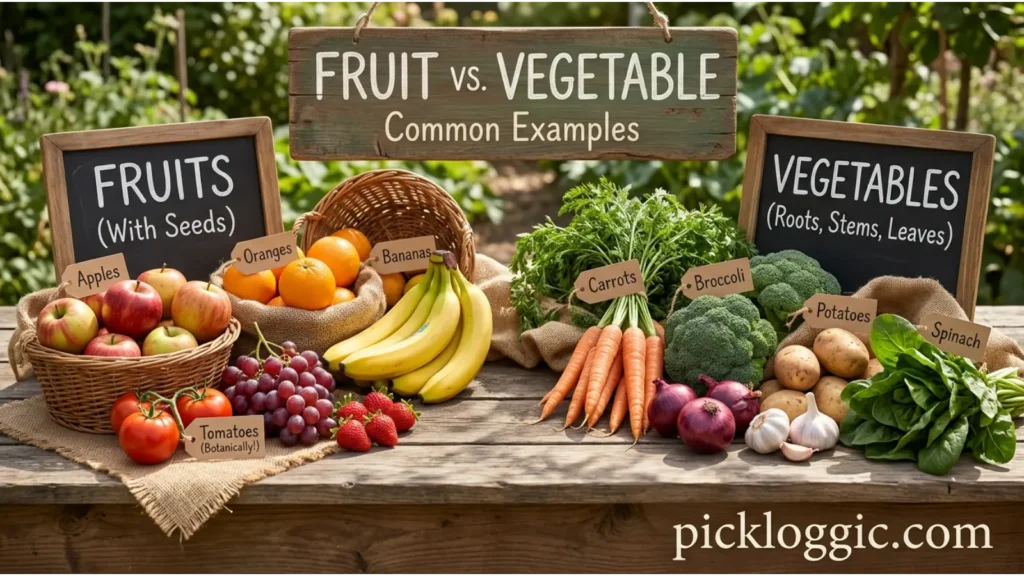
Fruit vs. Vegetable: Common Examples
The following examples help you identify foods by both botanical structure and everyday use.
| Food | Botanical Classification | Common Culinary Use |
|---|---|---|
| Apple | Fruit | Fruit |
| Orange | Fruit | Fruit |
| Tomato | Fruit | Vegetable |
| Cucumber | Fruit | Vegetable |
| Bell pepper | Fruit | Vegetable |
| Eggplant | Fruit | Vegetable |
| Pumpkin | Fruit | Vegetable |
| Zucchini | Fruit | Vegetable |
| Carrot | Root | Vegetable |
| Lettuce | Leaf | Vegetable |
| Broccoli | Flower structures | Vegetable |
| Celery | Leaf stalks | Vegetable |
| Potato | Stem tuber | Vegetable |
| Onion | Bulb | Vegetable |
| Sweet potato | Storage root | Vegetable |
Some foods also have specialized botanical classifications. For example, strawberries are accessory fruits, while raspberries are aggregate fruits. Both are commonly called fruits in everyday language.
Common Mistakes When Classifying Fruits and Vegetables
People often confuse botanical definitions with cooking habits. Here are some common mistakes to avoid.
- Assuming every fruit tastes sweet: Tomatoes and peppers are botanical fruits with savory uses.
- Calling every seed-bearing food a fruit: Seeds alone do not determine the classification of every edible plant part.
- Assuming vegetables grow underground: Many vegetables grow above ground, including lettuce, broccoli, and celery.
- Thinking cooking terms are scientifically wrong: Culinary language follows practical food use, not just plant anatomy.
- Confusing potatoes with roots: Potatoes are stem tubers, while sweet potatoes are storage roots.
- Assuming fruits must be eaten raw: Many fruits, including tomatoes and pumpkins, are commonly cooked.
To classify a food correctly, first decide whether you’re asking a botanical or culinary question.
How to Tell Whether a Food Is a Fruit or Vegetable
You can use a few simple steps to understand how a plant food fits each category.
Step 1: Look at how it grows. If the edible part develops from a flower’s ovary, it is generally a botanical fruit.
Step 2: Identify the plant part. Roots, leaves, stems, bulbs, and flower structures commonly fall under the culinary vegetable category.
Step 3: Consider the context. A science textbook may call a tomato a fruit, while a recipe may list it as a vegetable.
Step 4: Check specialized examples. Foods such as corn, strawberries, and potatoes have specific botanical structures that explain their classifications.
Step 5: Avoid relying on taste. Sweetness, bitterness, and savory flavor do not determine botanical classification.
These steps work well for common foods and make the difference easier to remember.
Why Does the Difference Between Fruit and Vegetable Matter?
Knowing the difference helps with science, gardening, cooking, and food education.
In botany, classification explains how plants reproduce and develop. Fruits usually protect seeds and can help spread them. Vegetables represent a wide range of edible plant structures.
In cooking, the distinction helps people describe flavors and choose ingredients. Tomatoes and peppers often work well in savory recipes, while apples and peaches commonly appear in desserts.
The difference can also help students understand plant anatomy. Recognizing roots, stems, leaves, flowers, and fruits makes plant biology easier to learn.
However, the distinction does not determine a food’s nutritional value. Both fruits and vegetables can provide vitamins, minerals, fiber, and other useful nutrients.
For a healthy diet, variety matters more than whether a food belongs to one everyday category or another.
Expert Insights: Botanical vs. Culinary Classification
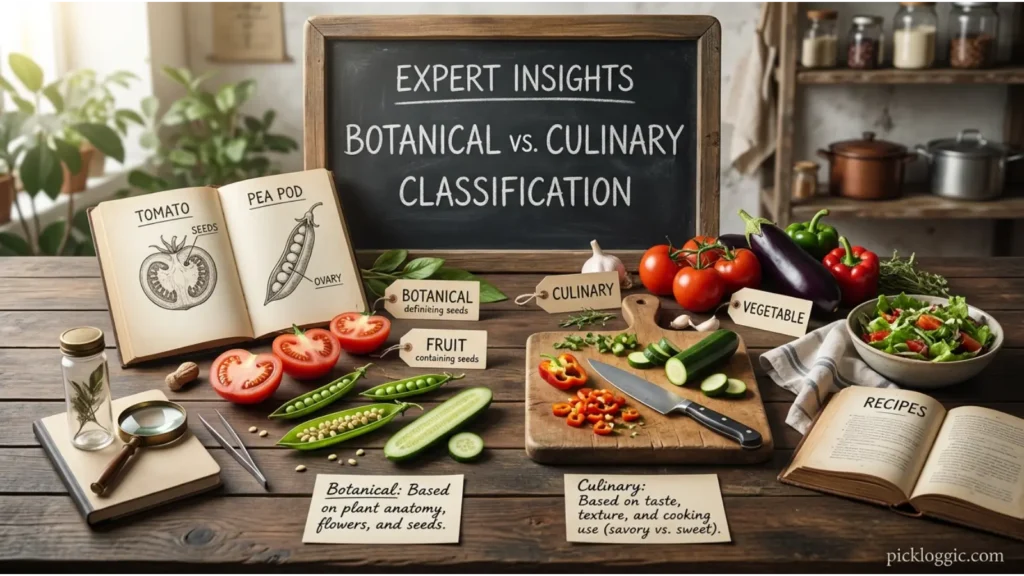
Botanists classify fruits by plant structure and development. Culinary traditions classify foods according to taste, texture, and use.
These systems answer different questions, so they can produce different labels without contradicting each other.
For example, a tomato meets the botanical definition of a fruit because it develops from a flower’s ovary. In cooking, people often group it with vegetables because of its savory flavor.
When explaining a food, state which classification you mean. This small detail prevents confusion and improves scientific accuracy.
For further learning, consult a reputable botany textbook or university plant-science resource. These sources can explain fruit development, seed formation, and the structures of edible plants.
FAQs:
1. Is a fruit or vegetable classification based on taste?
No. Botanical classification depends on plant structure and development. Culinary classification usually depends on flavor and how people use the food.
2. Is a tomato a fruit or vegetable?
A tomato is a botanical fruit because it develops from a flower’s ovary. People commonly use it as a vegetable in cooking.
3. Is a cucumber a fruit or vegetable?
A cucumber is botanically a fruit. However, people generally classify it as a vegetable in everyday meals.
4. Is a carrot a fruit or vegetable?
A carrot is a vegetable in culinary use. The edible part is a taproot that stores nutrients for the plant.
5. Is an avocado a fruit or vegetable?
An avocado is a botanical fruit. It develops from a flower and contains a large seed.
6. Is corn a fruit or vegetable?
A corn kernel is a botanical fruit called a caryopsis. Fresh sweet corn is commonly treated as a vegetable in cooking.
7. Can a food be both a fruit and a vegetable?
Yes, depending on the classification system. Tomatoes, cucumbers, peppers, and eggplants are botanical fruits that people commonly use as vegetables.
8. Which is healthier, fruits or vegetables?
Neither group is automatically healthier. Both can supply important nutrients, and eating a variety of fruits and vegetables supports a balanced diet.
Conclusion
The difference between fruit or vegetable becomes simple when you understand the two classification systems. Botanists classify fruits by how they develop, while cooks classify foods by their taste and use. This explains why tomatoes, cucumbers, peppers, and avocados are fruits in science but often appear among vegetables in recipes.
Vegetables include many plant parts, such as roots, leaves, stems, bulbs, and flowers. Carrots, lettuce, potatoes, onions, and broccoli are familiar examples.
Neither classification is wrong when used in the right context. The key is understanding what the question asks. For science, focus on plant structure. For cooking, consider how people prepare and serve the food.

