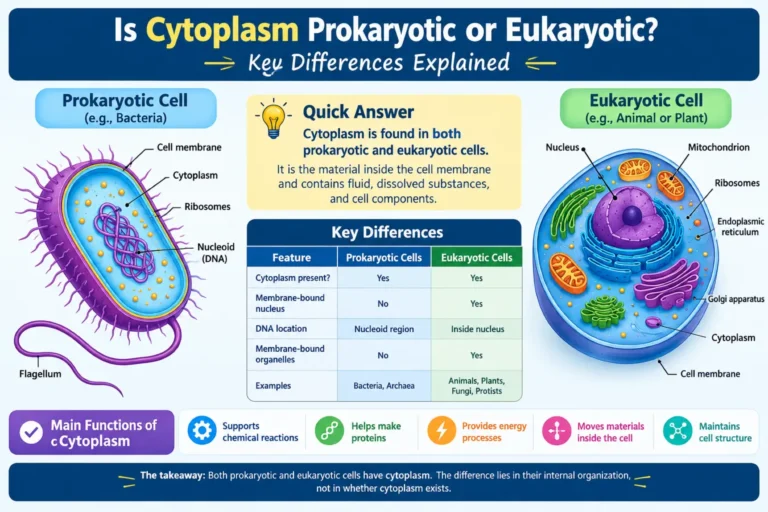
Is cytoplasm prokaryotic or eukaryotic? The answer is both. Cytoplasm exists in both prokaryotic and eukaryotic cells. It fills the space inside the cell membrane and supports many important life processes.
Prokaryotic cells include bacteria and archaea. They do not have a membrane-bound nucleus. Eukaryotic cells include animal, plant, fungal, and protist cells. They contain a nucleus and other membrane-bound structures.
So, what makes cytoplasm important in both cell types? It helps hold cell components in place and supports essential chemical reactions. However, cytoplasm can differ in organization between these two types of cells.
Understanding this concept makes cell biology easier to learn. It also helps explain how cells grow, use energy, and stay alive. Let’s explore the meaning, functions, examples, and differences in simple terms.
Quick Summary: Is Cytoplasm Prokaryotic or Eukaryotic?
- Cytoplasm is found in both prokaryotic and eukaryotic cells.
- It is the material inside the cell membrane, excluding the nucleus in the usual eukaryotic definition.
- It contains water, dissolved substances, and various cell structures.
- In prokaryotes, cytoplasm contains DNA in a region called the nucleoid, along with ribosomes.
- In eukaryotes, cytoplasm surrounds the nucleus and contains organelles.
- Cytoplasm supports chemical reactions, cell growth, and other vital activities.
- It is essential for normal cell function in both cell types.
Featured snippet answer: Cytoplasm is present in both prokaryotic and eukaryotic cells. It contains fluid, dissolved substances, and cell components that support essential cellular activities.
1. What Is Cytoplasm? Meaning and Definition
Cytoplasm is the material found inside a cell’s membrane. It includes the fluid portion and the structures suspended within it.
In most eukaryotic cells, the term refers to everything between the cell membrane and the nuclear envelope. The nucleus itself is not part of the cytoplasm.
Cytoplasm contains several important components:
- Cytosol: The fluid-like part of the cytoplasm.
- Ribosomes: Structures that build proteins.
- Dissolved substances: These include salts, sugars, and amino acids.
- Cell structures: These vary depending on the cell type.
- Cytoskeleton: A network of protein fibers found in eukaryotic cells and many bacteria.
Cytoplasm is not simply an empty space. It provides an environment where many chemical reactions take place.
It also helps substances move around the cell. These activities allow cells to grow, repair themselves, and perform their normal functions.
2. Is Cytoplasm Found in Prokaryotic Cells?
Yes, prokaryotic cells contain cytoplasm.
Prokaryotes include bacteria and archaea. These organisms usually have a simple cell structure compared with eukaryotes.
Their cells do not contain a membrane-bound nucleus. Instead, their DNA lies in a region called the nucleoid, which is located within the cytoplasm.
Prokaryotic cytoplasm contains:
- Water and dissolved nutrients.
- Ribosomes for protein production.
- Enzymes that support chemical reactions.
- DNA in the nucleoid region.
- Other molecules needed for survival.
For example, Escherichia coli (E. coli) is a bacterium with cytoplasm. Its cytoplasm supports protein production and many metabolic reactions.
Although prokaryotic cells lack a nucleus, they still perform complex life processes. Their cytoplasm plays a major role in keeping them alive.
Key point: Prokaryotic cells have cytoplasm even though they do not have a membrane-bound nucleus or typical membrane-bound organelles.
3. Is Cytoplasm Found in Eukaryotic Cells?
Yes, eukaryotic cells also contain cytoplasm.
Eukaryotes include animals, plants, fungi, and protists. Their cells have a nucleus enclosed by a membrane.
The cytoplasm occupies the space between the cell membrane and the nuclear envelope. It contains cytosol, organelles, and other cellular structures.
Examples of components found in eukaryotic cytoplasm include:
- Mitochondria, which produce much of the cell’s usable energy.
- Ribosomes, which make proteins.
- The endoplasmic reticulum, which helps produce and process proteins and lipids.
- The Golgi apparatus, which modifies and sorts many cellular products.
- The cytoskeleton, which supports cell shape and movement.
These structures perform different jobs. Together, they help the cell function properly.
For instance, a muscle cell needs energy to contract. Its cytoplasm contains structures and enzymes that support the processes required for this activity.
Plant cells also have cytoplasm. Their chloroplasts carry out photosynthesis, while other cell components perform different tasks.
Key point: Eukaryotic cells have cytoplasm, just like prokaryotic cells. Their internal organization is more compartmentalized.
4. What Does Cytoplasm Do in a Cell?
Cytoplasm performs several essential functions in both prokaryotic and eukaryotic cells.

1. Supports chemical reactions
Many cellular reactions occur in the cytosol. These reactions help cells break down nutrients and produce useful substances.

2. Helps make proteins
Ribosomes in the cytoplasm build proteins. Cells use these proteins for growth, repair, and many other activities.

3. Supports energy-related processes
Cytosol hosts glycolysis, an early step in glucose breakdown. Other energy-producing steps occur in different locations, depending on the cell.

4. Helps move materials
Cytoplasmic movement and cellular transport systems help distribute substances. In eukaryotes, the cytoskeleton also supports transport inside the cell.

5. Supports cell structure
Cytoplasm provides an environment for cellular components. In eukaryotes, the cytoskeleton helps maintain cell shape and organization.
Without cytoplasm, cells could not carry out the normal chemical activities needed for life.
5. Prokaryotic vs. Eukaryotic Cytoplasm: Comparison Table
Both cell types contain cytoplasm, but their internal structures differ.
| Feature | Prokaryotic cells | Eukaryotic cells |
|---|---|---|
| Cytoplasm present? | Yes | Yes |
| Membrane-bound nucleus | Absent | Present |
| DNA location | Mainly in the nucleoid | Mainly inside the nucleus |
| Ribosomes | Present | Present |
| Membrane-bound organelles | Absent | Present in typical cells |
| Internal organization | Generally less compartmentalized | More compartmentalized |
| Examples | Bacteria and archaea | Animals, plants, fungi, protists |
| Chemical reactions | Many occur in the cytosol | Occur in the cytosol and specialized compartments |
The main difference is not the presence of cytoplasm. Both cell types have it. The major difference is how they organize their internal components.
Prokaryotic cells carry out many processes without membrane-bound organelles. Eukaryotic cells use specialized compartments for many tasks.
For example, eukaryotic mitochondria carry out major steps in aerobic respiration. Bacteria perform their energy-related processes using different cellular arrangements, often involving the cell membrane.
6. Simple Examples of Cytoplasm in Real Life
You can understand cytoplasm more easily by looking at familiar cells.

Example 1: A bacterial cell
A bacterium contains cytoplasm with ribosomes, enzymes, and genetic material. These components help it grow and reproduce when conditions allow.

Example 2: A human cheek cell
This eukaryotic cell contains cytoplasm around its nucleus. Its cytoplasm supports protein production and other cellular activities.

Example 3: A plant cell
Plant cells contain cytoplasm, a nucleus, and other structures. Their chloroplasts perform photosynthesis, while the cytoplasm supports many other reactions.

Example 4: A yeast cell
Yeast is a single-celled fungus. Its eukaryotic cytoplasm supports metabolism, protein production, and other life processes.
These examples show that cytoplasm is a shared feature of very different living cells.
7. Cytoplasm vs. Cytosol: What Is the Difference?
Cytoplasm and cytosol are related terms, but they do not mean exactly the same thing.
Cytosol is the fluid portion of the cytoplasm. Cytoplasm includes the cytosol and the structures within it.
Think of cytoplasm as a workspace inside a cell. Cytosol is the fluid environment within that workspace.
| Feature | Cytoplasm | Cytosol |
|---|---|---|
| Meaning | Material inside the cell membrane, excluding the nucleus in eukaryotes | Fluid portion of the cell’s interior |
| Contains water | Yes | Yes |
| Contains dissolved molecules | Yes | Yes |
| Includes ribosomes and organelles | Yes, as part of its contents | Not as whole structures |
| Found in prokaryotes | Yes | Yes |
| Found in eukaryotes | Yes | Yes |
This distinction matters in biology. For example, glycolysis takes place in the cytosol, not inside a mitochondrion.
A common mistake is to use cytoplasm and cytosol as interchangeable words. They are closely related, but cytoplasm has a broader meaning.
8. How Is Cytoplasm Different in Prokaryotic and Eukaryotic Cells?
The basic role of cytoplasm remains similar in both cell types. However, the way cells organize their contents creates important differences.
In prokaryotic cells
Prokaryotic cells lack a membrane-bound nucleus. Their DNA occupies the nucleoid region within the cytoplasm.
They also lack the typical membrane-bound organelles found in eukaryotic cells. However, they still have organized internal structures and complex chemical processes.
In eukaryotic cells
Eukaryotic cells have a nucleus and several membrane-bound organelles. These structures divide many cellular tasks into separate compartments.
For example, mitochondria carry out major steps in cellular respiration. The endoplasmic reticulum helps produce and process certain proteins and lipids.
These differences make eukaryotic cells more compartmentalized. They do not mean that only eukaryotes have cytoplasm.
Remember: Cytoplasm is common to both groups. The presence of a membrane-bound nucleus helps distinguish eukaryotic cells from prokaryotic cells.
9. Common Mistakes About Cytoplasm
Students often confuse cytoplasm with other cell structures. Here are five mistakes to avoid.
Mistake 1: Thinking cytoplasm belongs only to eukaryotic cells.
Correction: Both prokaryotic and eukaryotic cells contain cytoplasm.
Mistake 2: Thinking cytoplasm is the same as the nucleus.
Correction: The nucleus is a separate structure found in eukaryotic cells. The cytoplasm lies outside its nuclear envelope.
Mistake 3: Believing prokaryotic cells have no DNA.
Correction: Prokaryotes have DNA, usually located in the nucleoid region. They simply lack a membrane-bound nucleus.
Mistake 4: Confusing cytoplasm with cytosol.
Correction: Cytosol is the fluid portion of cytoplasm. Cytoplasm also includes the structures suspended within it.
Mistake 5: Assuming cytoplasm is an empty liquid.
Correction: Cytoplasm contains molecules, enzymes, ribosomes, and other structures. It supports many vital cellular processes.
Avoiding these mistakes makes it easier to understand cell structure and compare different organisms.
10. Easy Tips to Remember Cytoplasm
Use these simple study tricks to remember the key facts.
- Tip 1: Remember “both.” Cytoplasm is present in both prokaryotic and eukaryotic cells.
- Tip 2: Separate the terms. Cytosol means fluid; cytoplasm includes the fluid and its suspended structures.
- Tip 3: Focus on the nucleus. Prokaryotes lack a membrane-bound nucleus, while eukaryotes have one.
- Tip 4: Link structure to function. Cytoplasm supports chemical reactions, protein production, and other cellular activities.
- Tip 5: Use examples. Bacteria, human cells, plant cells, and yeast cells all contain cytoplasm.
For a quick exam answer, write: “Cytoplasm is present in both prokaryotic and eukaryotic cells. It supports essential cellular reactions and contains various cell components.”
That statement covers the main concept clearly and accurately.
11. Why Does Cytoplasm Matter in Daily Life?
Cytoplasm may sound like a topic found only in textbooks. However, it helps explain many processes that affect everyday life.
Digestion and energy: Your cells use nutrients from food to support chemical reactions. Cytosol hosts glycolysis, which helps break down glucose and release energy.
Muscle movement: Muscle cells use energy to contract. Their cytoplasm contains the machinery and molecules needed to support this activity.
Plant growth: Plant cells use nutrients, make proteins, and grow through coordinated cellular processes. Cytoplasm provides the setting for many of these activities.
Fermentation: Yeast cells use metabolic pathways in their cytosol to process sugars. These processes help dough rise during bread-making.
Bacteria and health: Bacterial cytoplasm supports the reactions that allow bacteria to survive and multiply. Understanding bacterial cells also helps scientists develop medicines and study infections.
These examples show why cytoplasm matters beyond classroom biology. Its functions connect cell structure to energy use, growth, food production, and health.
12. Synonyms and Related SEO Keywords
The following terms can help readers explore this topic further. They also provide useful semantic coverage for a biology article.
| Term | Meaning |
|---|---|
| Cytosol | The fluid part of the cytoplasm |
| Cell interior | A general term for the inside of a cell |
| Intracellular fluid | Fluid within cells; its exact usage depends on context |
| Prokaryotic cytoplasm | Cytoplasm inside a prokaryotic cell |
| Eukaryotic cytoplasm | Cytoplasm inside a eukaryotic cell |
| Cell components | Structures and molecules that make up a cell |
| Cellular metabolism | Chemical reactions that sustain cell activity |
| Cell organization | The way a cell arranges its structures and functions |
These terms are related, but they are not all direct synonyms. Use each one according to its meaning.
Related search phrases include:
- Is cytoplasm present in all cells?
- Do prokaryotic cells have cytoplasm?
- Do eukaryotic cells contain cytoplasm?
- What is the function of cytoplasm?
- Difference between cytoplasm and cytosol
- Prokaryotic and eukaryotic cell differences
- Where is DNA found in prokaryotic cells?
- What is the role of cytoplasm in a cell?
Using related terms naturally helps readers find relevant information without repeating the same keyword too often.
13. Expert Insights: What Students Should Know
A strong understanding of cytoplasm starts with one important distinction: shared structures do not make two cell types identical.
Both prokaryotic and eukaryotic cells contain cytoplasm. However, they differ in their internal organization, genetic material arrangement, and use of membrane-bound compartments.
Keep these expert study points in mind:
- Do not define prokaryotes only by their size. The key distinction is their lack of a membrane-bound nucleus.
- Do not assume prokaryotes are simple in every way. They carry out many complex chemical processes despite lacking typical eukaryotic organelles.
- Understand where reactions happen. Glycolysis occurs in the cytosol, while many other reactions occur in specific locations.
- Use accurate definitions. In eukaryotic cells, cytoplasm generally excludes the nucleus itself.
- Compare structures and functions together. This approach helps explain why different cells organize their activities in different ways.
For SEO content quality, prioritize scientific accuracy, clear definitions, and helpful examples. Support biology claims with reputable educational resources, such as university biology textbooks and established open biology texts.
For WordPress, consider linking this article to related pages about cell organelles, prokaryotic cells, eukaryotic cells, and the difference between cytoplasm and cytosol.
14. Frequently Asked Questions (FAQs)
1. Is cytoplasm prokaryotic or eukaryotic?
Cytoplasm is found in both prokaryotic and eukaryotic cells. It supports chemical reactions and contains important cell components.
2. Do all cells have cytoplasm?
Yes. All typical living cellular organisms have cytoplasm, including bacteria, archaea, plants, animals, and fungi. Viruses are not cells and do not have cytoplasm of their own.
3. Do prokaryotic cells have cytoplasm?
Yes. Prokaryotic cells have cytoplasm containing cytosol, ribosomes, enzymes, and other molecules. Their DNA usually occupies a region called the nucleoid.
4. Do eukaryotic cells have cytoplasm?
Yes. Eukaryotic cells contain cytoplasm outside the nucleus. It includes cytosol and cellular structures, such as mitochondria and ribosomes.
5. What is the main function of cytoplasm?
Cytoplasm provides an environment for many chemical reactions. It also contains cell components that help with protein production, metabolism, growth, and other essential activities.
6. What is the difference between cytoplasm and cytosol?
Cytosol is the fluid portion of cytoplasm. Cytoplasm includes the cytosol and the structures suspended within it.
7. Is DNA found in the cytoplasm of prokaryotic cells?
Yes. Prokaryotic DNA is usually located in the nucleoid region within the cytoplasm. Some prokaryotes also contain smaller DNA molecules called plasmids.
8. Why do prokaryotic cells not have a nucleus?
Prokaryotic cells lack a membrane-bound nucleus. Their DNA remains in a nucleoid region instead of being enclosed within a nuclear membrane.
Conclusion: Is Cytoplasm Prokaryotic or Eukaryotic?
Cytoplasm is present in both prokaryotic and eukaryotic cells. It is an essential part of cell structure and supports many processes needed for life.
Prokaryotic cells, such as bacteria, contain cytoplasm but lack a membrane-bound nucleus. Eukaryotic cells, such as plant and animal cells, have cytoplasm surrounding their nucleus and containing various cellular structures.
The main difference lies in their internal organization, not in whether cytoplasm exists. Cytoplasm supports chemical reactions, protein production, metabolism, and other vital activities.
Remember that cytoplasm and cytosol are related but different terms. Cytosol is the fluid portion, while cytoplasm includes the fluid and its suspended structures.
The simplest takeaway is this: both prokaryotic and eukaryotic cells have cytoplasm. Understanding this fact makes it easier to learn about cell structure, organelles, and the differences between the two major cell types.