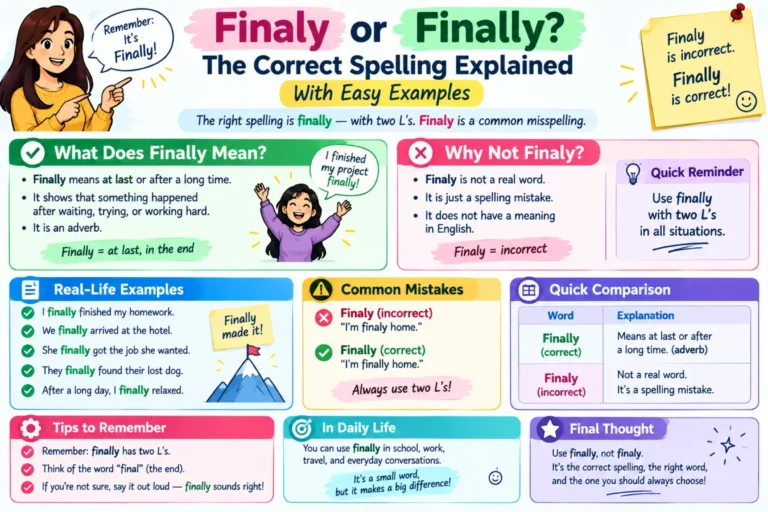
“Finaly or finally” is a common spelling question for English learners and writers. The correct spelling is finally.
Many people write “finaly” because the word sounds like it has one l in the middle. However, standard English uses two l’s before the final y. The word “finally” means something happens after a long wait, at the end, or as the last point.
Knowing the correct spelling can help you write clear emails, essays, messages, and social posts. It also helps you avoid a common spelling mistake.
In this guide, you will learn the meaning of finally, how to spell it, and how to use it correctly. You will also see simple examples and common mistakes.
By the end, you will know exactly when to use finally instead of “finaly.”
Quick Summary: Finaly or Finally?
- Finally is the correct English spelling.
- Finaly is a common spelling mistake.
- Finally means “at last” or “in the end.”
- The word has two l’s before the final y.
- You can use finally for time, order, or a final point.
- Example: “I finally finished my homework.”
- Remember: final + ly = finally.
What Is the Correct Spelling: Finaly or Finally?
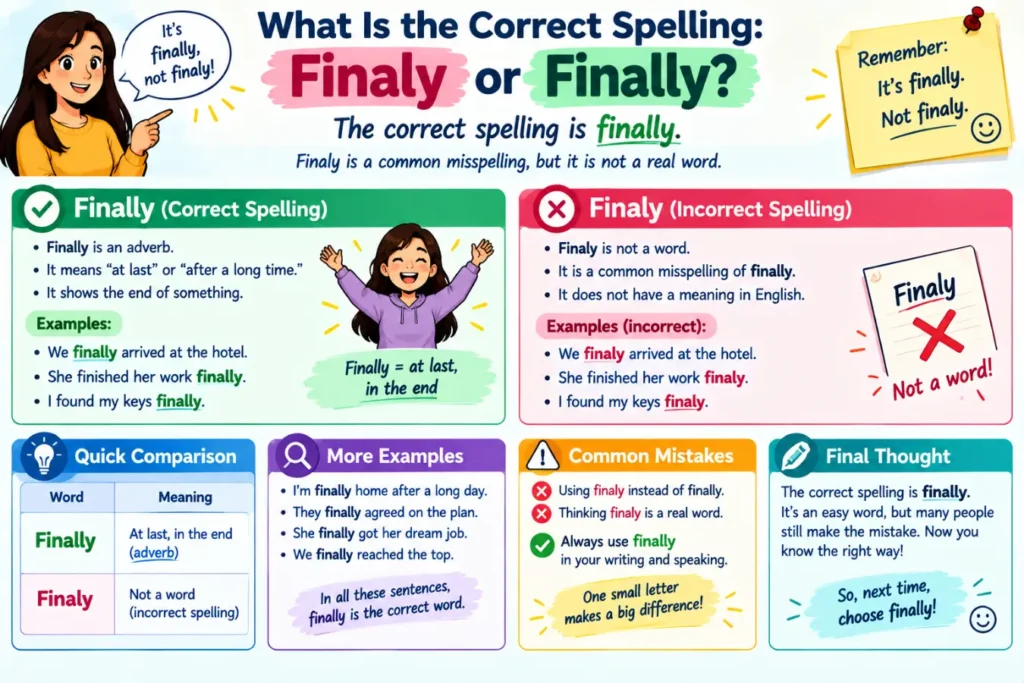
The correct spelling is finally.
“Finaly” is not the standard spelling in English. It usually appears because writers forget the second l.
The correct word contains two l’s:
F-I-N-A-L-L-Y
A simple way to remember it is to start with the word final.
Then add -ly:
final + ly = finally
This spelling rule makes the word easier to remember.
Correct
I finally found my keys.
Incorrect
I finaly found my keys.
The second sentence contains a spelling error.
What Does Finally Mean?
Finally is an adverb that usually means “at last,” “in the end,” or “as the last point.”
The exact meaning depends on the sentence.
For example:
She finally arrived home.
Here, “finally” means she arrived after some waiting.
Consider another example:
Finally, check your answer.
Here, “finally” shows the last step in a process.
So, finally can describe both time and order.
Finally Meaning in Simple Words
In simple English, finally means:
Something happens after waiting, after several events, or at the end.
For example:
We finally reached the station.
The speaker probably waited or traveled for some time before reaching the station.
Another example is:
Finally, I want to thank my parents.
Here, “finally” introduces the last point in a speech or list.
Therefore, the word can show completion, time, or the final point.
Why Do People Spell Finally as Finaly?
People often spell “finally” incorrectly because of its pronunciation.
The word may sound like the second l disappears during normal speech. This can make the spelling confusing.
Another reason involves the word final.
Some writers remember:
final + y
instead of:
final + ly
That creates “finaly.”
However, the correct structure is:
final + ly = finally
English contains many words where pronunciation does not perfectly match spelling. That makes regular spelling practice useful.
Finally vs Finaly: Comparison Table
| Feature | Finally | Finaly |
|---|---|---|
| Correct spelling | Yes | No |
| Standard English | Yes | No |
| Number of l’s | Two | One |
| Meaning | At last, in the end | No standard meaning |
| Use in formal writing | Yes | No |
| Example | I finally finished. | I finaly finished. |
The key difference is simple: finally has two l’s.
If you are writing an essay, email, article, or professional message, always use finally.
How to Use Finally in a Sentence
You can use finally in several common ways.
1. To show something happened after waiting
I finally got my exam results.
The results came after a period of waiting.
2. To show the end of a process
Finally, we completed the project.
The project ended after several steps.
3. To introduce the last point
Finally, remember to save your work.
The speaker gives the last instruction.
4. To show relief
We finally arrived at the hotel.
The speaker may feel relieved because the journey ended.
5. To show a long-awaited event
He finally called me.
The call happened after the speaker expected it for some time.
Real-Life Examples of Finally
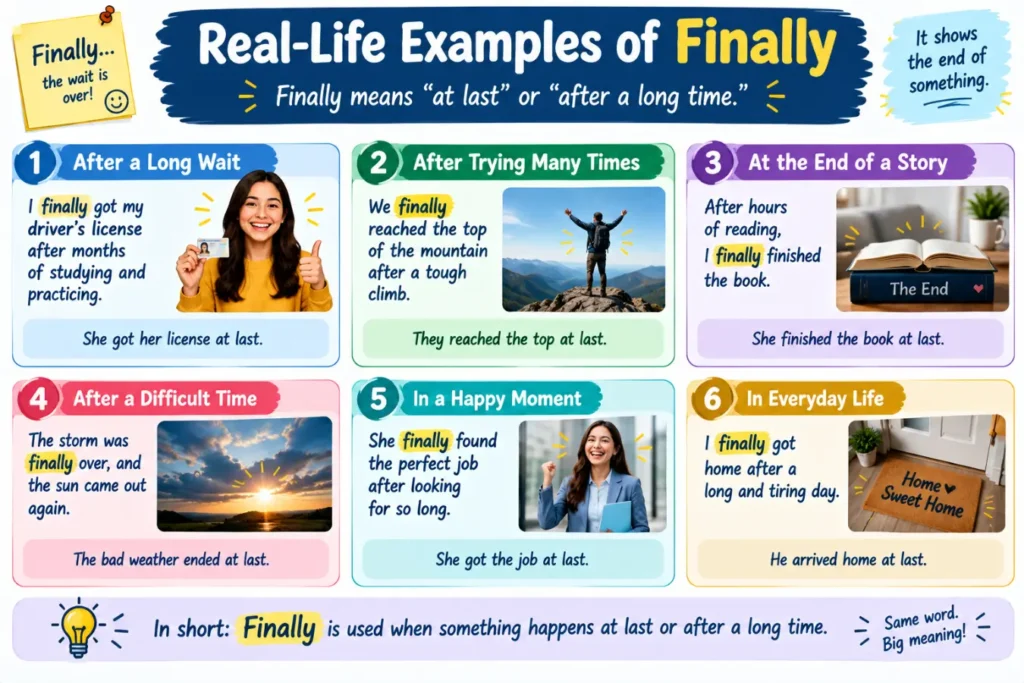
You will often see finally in everyday English.
Here are some natural examples:
- I finally finished my assignment.
- She finally answered my message.
- We finally found a parking space.
- They finally reached an agreement.
- He finally passed his driving test.
- The rain finally stopped.
- I finally understand the lesson.
- The bus finally arrived.
- Finally, let’s review the results.
- After hours of work, we finally finished.
These examples show how flexible the word can be.
It works in casual conversation, school writing, business communication, and formal documents.
Finally in Daily Conversation
People use finally very often in normal conversations.
For example, imagine a friend has waited for a bus for an hour.
They might say:
The bus finally arrived!
The word shows that the person waited for the bus.
Imagine another situation where someone finishes a difficult task.
They might say:
I finally finished it!
Here, “finally” expresses relief or satisfaction.
You can also use it when telling a story:
First, we had lunch. Then, we visited the museum. Finally, we went home.
In this example, “finally” shows the last event.
Where Should You Put Finally in a Sentence?
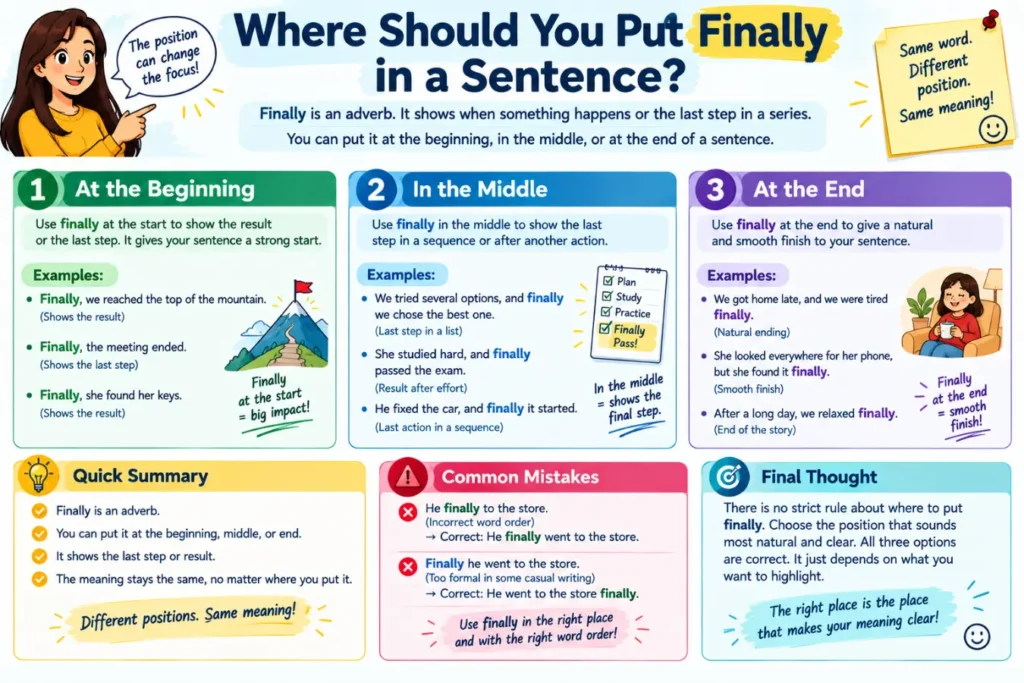
The position of finally can change depending on its purpose.
At the beginning
Use it to introduce a final point or event.
Finally, we reached the top.
Before the main verb
Use it to show that an action happened after waiting.
She finally called me.
After the verb “be”
He was finally ready.
At the end
You can also place it at the end for emphasis.
We finished the work finally.
However, this position may sound less natural in some contexts.
For everyday writing, these patterns are usually easy and natural:
Finally, + sentence
or
Subject + finally + verb
For example:
Finally, we went home.
We finally went home.
Common Mistakes With Finally
Spelling mistakes are the most common problem with this word.
Mistake 1: Writing “finaly”
Incorrect:
I finaly finished my work.
Correct:
I finally finished my work.
The correct spelling has two l’s.
Mistake 2: Confusing Finally With Final
“Final” and “finally” are related, but they have different roles.
Final is usually an adjective.
This is the final exam.
Finally is an adverb.
I finally completed the exam.
The first word describes a noun. The second describes an action or idea.
Mistake 3: Using Finally When You Mean Final
Incorrect:
This is the finally version.
Correct:
This is the final version.
Use final before a noun when you mean the last or completed version.
Use finally when you describe an action, event, or final point.
Mistake 4: Overusing Finally
Do not add “finally” to every sentence about an ending.
For example:
Finally, I finally finished the final task.
This sounds repetitive.
Instead, write:
I finally finished the last task.
Clear writing usually sounds more natural.
Final vs Finally: What Is the Difference?
The words final and finally come from the same idea, but they serve different grammatical roles.
| Word | Part of speech | Basic meaning | Example |
|---|---|---|---|
| Final | Adjective | Last or ending | This is the final test. |
| Finally | Adverb | At last or in the end | I finally passed the test. |
A quick test can help.
If the word describes a thing, you may need final.
The final decision
If the word describes how or when something happens, you may need finally.
She finally made a decision.
Synonyms and Related Words for Finally
Several words can have a similar meaning to finally.
Common alternatives include:
- At last
- In the end
- Eventually
- Lastly
- Ultimately
- At the end
- After all
- In conclusion
However, these words are not always interchangeable.
For example:
I finally found my wallet.
You could say:
I eventually found my wallet.
But “finally” often gives a stronger sense of relief or waiting.
Similarly:
Finally, we need to discuss the budget.
Here, “lastly” may work because it introduces the final point.
Choosing the right word depends on the sentence and meaning.
SEO and LSI Keywords Related to Finally
If you are researching this spelling question, you may also see these related searches:
- finaly or finally
- is finaly correct
- correct spelling of finally
- how to spell finally
- finally meaning
- finally definition
- final vs finally
- finally in a sentence
- finally spelling
- finally examples
- what does finally mean
- finaly meaning
- correct English spelling
- common English spelling mistakes
These phrases reflect different search intents.
Some people want the spelling. Others want the definition or usage.
A useful guide should answer all these questions clearly.
Tips to Remember the Spelling of Finally
Here are simple tricks that can help you remember the correct spelling.
Tip 1: Remember “final + ly”
Think of the word as two parts:
final + ly
This gives you finally.
Tip 2: Remember the double L
Say to yourself:
“Finally has two Ls.”
This quick reminder can prevent the most common spelling error.
Tip 3: Connect It With “final”
The word “finally” begins with the complete word “final.”
Then add -ly.
That gives:
final → finally
Tip 4: Practice One Sentence
Write this sentence several times:
I finally finished my work.
Seeing the correct spelling helps build visual memory.
Is “Finaly” Ever Correct?
No. “Finaly” is not the standard English spelling of the word.
If you mean “at last” or “in the end,” use finally.
For example:
We finally reached home.
Do not write:
We finaly reached home.
The second version contains a spelling error.
In standard English writing, finally is the correct choice.
Expert Insight: Why This Small Spelling Difference Matters
Correct spelling improves clarity and trust.
A single spelling mistake usually does not change the meaning of a sentence. However, repeated mistakes can make writing look less polished.
This matters more in professional settings.
Readers may judge articles, applications, emails, and business content by their accuracy.
For content creators, spelling also supports a better reading experience. Clear writing helps readers understand information quickly.
The best approach is simple:
Choose accuracy first, then focus on style.
For common spelling questions, give readers the direct answer early. Then explain the rule and show real examples.
That structure helps both readers and search engines understand the topic.
Frequently Asked Questions About Finaly or Finally
Is “finaly” a correct spelling?
No. “Finaly” is a common spelling mistake. The correct spelling is finally, with two l’s.
How do you spell finally?
Spell it F-I-N-A-L-L-Y. A useful memory trick is “final + ly.”
What does finally mean?
“Finally” usually means “at last,” “in the end,” or “as the last point.”
What is the difference between final and finally?
“Final” usually describes a noun, while “finally” describes an action, event, or final point.
For example, “the final exam” uses an adjective. “I finally passed” uses an adverb.
Can I use finally at the beginning of a sentence?
Yes. You can use “finally” at the beginning to introduce the last event or point.
Example:
Finally, we went home.
Is finally formal or informal?
“Finally” works in both formal and informal English. You can use it in conversations, emails, essays, reports, and professional writing.
What are synonyms for finally?
Common synonyms include “at last,” “eventually,” “in the end,” “lastly,” and “ultimately.” The best choice depends on the context.
Why do people spell finally as finaly?
People often forget the second “l” because of pronunciation or because they remember the word incorrectly. The correct form is finally.
Conclusion: Finaly or Finally?
When choosing between finaly or finally, always choose finally. The spelling “finaly” is incorrect in standard English.
The correct word has two l’s:
finally
It usually means “at last,” “in the end,” or “as the last point.” You can use it in everyday speech, professional writing, school assignments, and online content.
Remember the easiest spelling trick:
final + ly = finally
You can also remember that finally has two l’s.
If you are unsure while writing, check the word before publishing your sentence. One small spelling check can make your writing look much more polished.