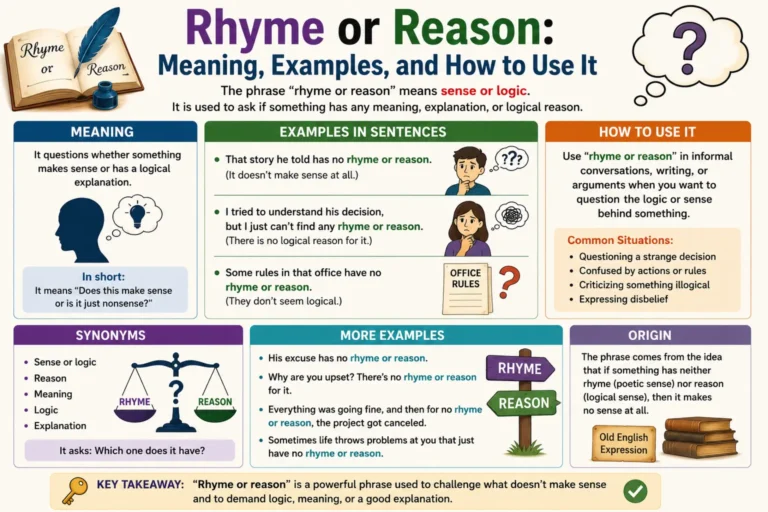
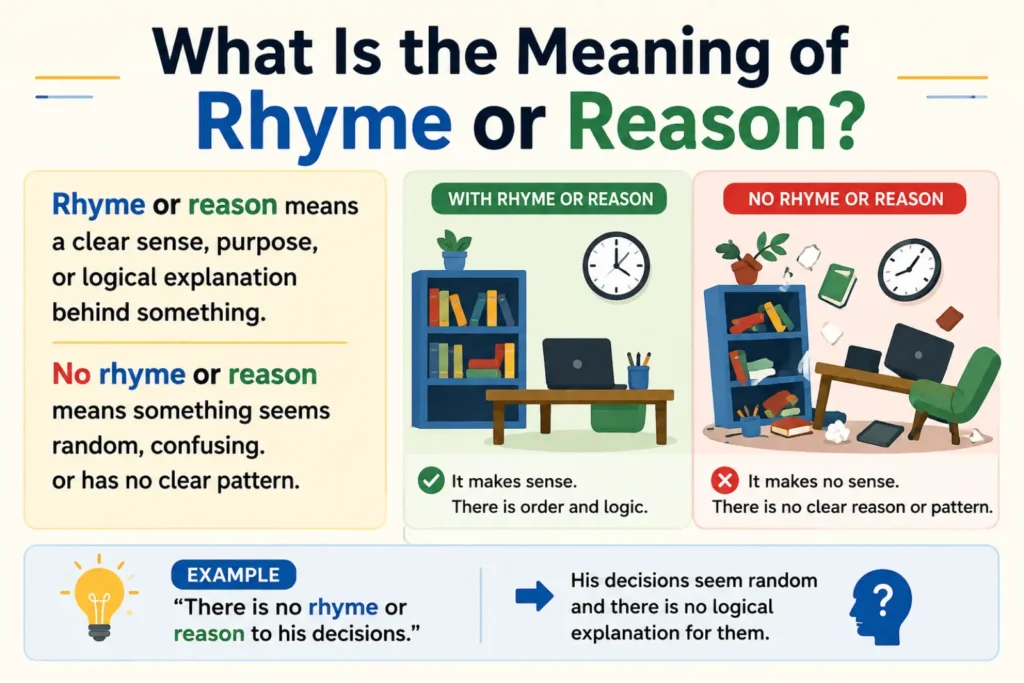
Rhyme or reason means a clear sense, purpose, or logical explanation behind something. People often use this phrase when actions or events seem random, confusing, or difficult to understand. For example, if someone keeps changing their plans without any clear explanation, you might say, “There is no rhyme or reason to their decisions.” The phrase does not usually refer to poetry or words that rhyme. Instead, it describes logic, order, or purpose. You can use it in everyday conversations, writing, and many different situations. Understanding the rhyme or reason meaning can help you speak and write English more naturally. In this guide, you will learn its definition, examples, synonyms, common uses, and simple tips for using this popular English idiom correctly.
Quick Summary: What Does Rhyme or Reason Mean?
- Rhyme or reason means logic, sense, or a clear purpose.
- No rhyme or reason means something seems random or has no clear pattern.
- The phrase usually describes confusing actions, choices, or events.
- It does not normally refer to poetry or actual rhyming.
- Example: “There is no rhyme or reason to his decisions.”
- Similar words include logic, sense, purpose, reason, order, and pattern.
- You can use the phrase in both casual and formal situations.
What Is the Meaning of Rhyme or Reason?
The rhyme or reason definition is simple.
It means a logical explanation, sensible purpose, or clear pattern behind something.
When something has “rhyme or reason,” you can understand why it happens.
When something has no rhyme or reason, it appears random.
For example:
“There is no rhyme or reason to her schedule.”
This means her schedule does not seem to follow a clear plan.
The phrase often appears with no.
The common expression is:
“There is no rhyme or reason to it.”
It means you cannot find a sensible explanation or pattern.
Rhyme or Reason Explained in Simple Words
Think of “rhyme or reason” as sense or logic.
Imagine someone puts winter clothes in the kitchen.
Then they put cooking tools in the bedroom.
You may wonder why they arranged everything that way.
You could say:
“There is no rhyme or reason to this arrangement.”
You mean that the arrangement makes no sense.
The phrase can also describe behavior.
For example, someone might change their plans every few minutes.
You cannot understand their choices.
You could say:
“There seems to be no rhyme or reason behind his decisions.”
Therefore, the phrase points to a lack of clear logic or purpose.
Where Did the Phrase “Rhyme or Reason” Come From?
The exact history of the phrase remains uncertain.
However, “rhyme” once carried meanings connected with number, order, or arrangement.
The word “reason” clearly relates to logic and sensible thought.
Over time, the two words became linked in English.
The phrase developed into an expression for order or logic.
Today, people rarely think about its original word meanings.
Instead, they understand rhyme or reason as a fixed English idiom.
This makes it an example of an idiomatic expression.
An idiom has a meaning that differs from the literal meaning of its words.
What Does “No Rhyme or Reason” Mean?
No rhyme or reason means there seems to be no sensible explanation or pattern.
This is the most common form of the expression.
Consider this example:
“The teacher changed the rules with no rhyme or reason.”
The speaker believes the rule changes seem random.
Another example:
“The prices seem to change with no rhyme or reason.”
Here, the speaker cannot see a clear pattern in the prices.
The phrase can describe almost anything that appears unpredictable.
It can refer to:
- Decisions
- Rules
- Behavior
- Events
- Arrangements
- Changes
- Choices
- Plans
- Patterns
- Systems
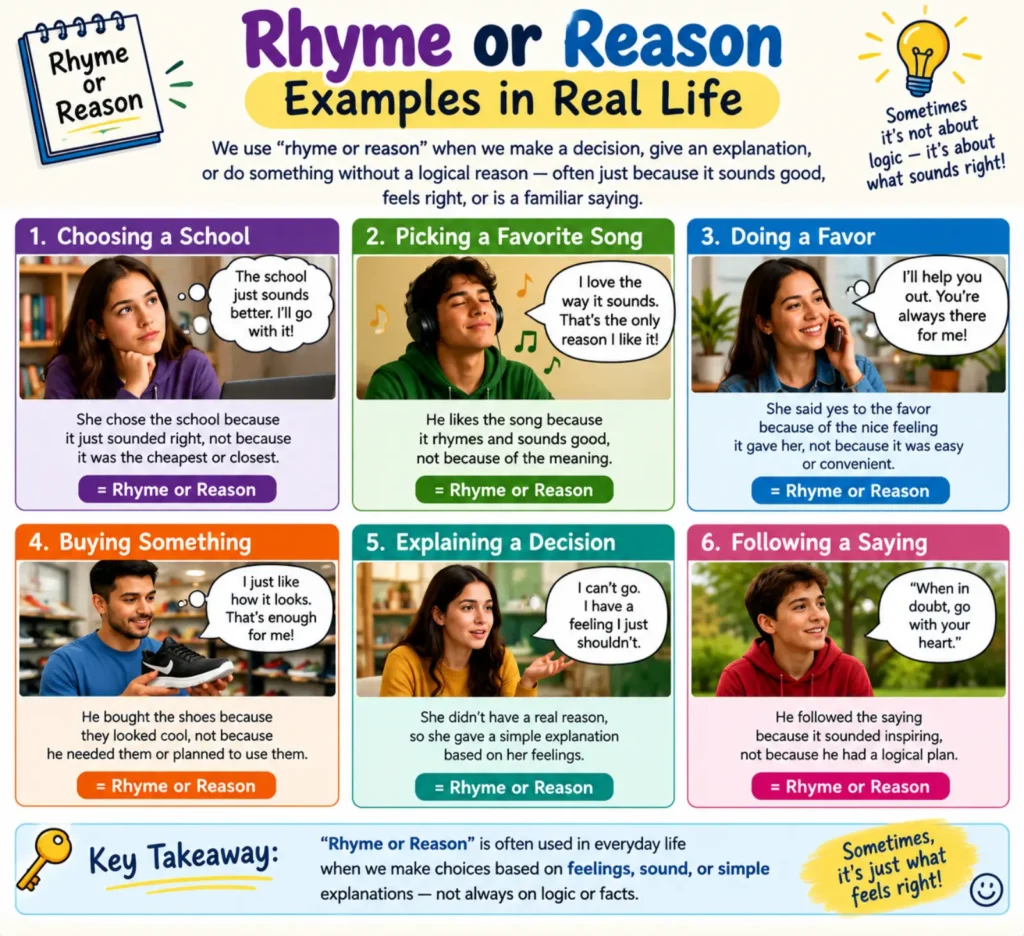
Rhyme or Reason Examples in Real Life
Real-life examples make this phrase easier to understand.
Example 1: A Messy Room
Your brother puts shoes under the bed.
He puts books in the kitchen.
Then he leaves clothes on the sofa.
You might say:
“There is no rhyme or reason to where he puts things.”
You mean his choices have no clear system.
Example 2: Changing Plans
A friend keeps changing dinner plans.
First, they want pizza.
Then they want burgers.
Five minutes later, they want pasta.
You could say:
“There is no rhyme or reason to these changes.”
Example 3: Business Decisions
A company changes its prices every week.
Customers cannot find a clear pattern.
A customer might say:
“The price changes seem to happen with no rhyme or reason.”
Example 4: Strange Rules
A workplace has several confusing rules.
Some rules make sense.
Others seem completely random.
An employee might say:
“There seems to be no rhyme or reason behind these rules.”
Example 5: Organizing Files
Someone saves computer files in random folders.
Important documents have no consistent location.
You might say:
“There is no rhyme or reason to this filing system.”
Rhyme or Reason vs. Logic: What Is the Difference?
These expressions have similar meanings, but they are not identical.
| Expression | Meaning | Example |
|---|---|---|
| Rhyme or reason | Sense, order, or purpose | “I see no rhyme or reason in his choices.” |
| Logic | A reasonable way of thinking | “Her argument has strong logic.” |
| Common sense | Practical and sensible judgment | “Use common sense before deciding.” |
| Purpose | The reason something exists or happens | “What is the purpose of this rule?” |
| Pattern | A repeated or noticeable structure | “I noticed a pattern in the results.” |
| Explanation | A reason that makes something clear | “Can you give me an explanation?” |
So, rhyme or reason works best when you discuss an underlying sense or pattern.
How to Use “Rhyme or Reason” in a Sentence
You can use the phrase in several sentence patterns.
Pattern 1: No rhyme or reason to something
“There is no rhyme or reason to his choices.”
This pattern works well when discussing decisions.
Pattern 2: No rhyme or reason behind something
“There is no rhyme or reason behind the new rules.”
This focuses on the reason behind an action.
Pattern 3: With no rhyme or reason
“The system changes with no rhyme or reason.”
This form describes random or unexplained changes.
Pattern 4: Find rhyme or reason
“I cannot find any rhyme or reason in the results.”
This focuses on trying to discover a pattern.
“Without Rhyme or Reason” Meaning
Without rhyme or reason means without a clear reason, purpose, or logical pattern.
It has almost the same meaning as with no rhyme or reason.
For example:
“The manager moved employees around without rhyme or reason.”
This suggests the manager’s decisions appeared random.
You can use this form when describing unexplained behavior or actions.
Another example is:
“The software sometimes shuts down without rhyme or reason.”
The speaker cannot identify why the software shuts down.
This phrase often carries a negative or critical tone.
Rhyme or Reason Synonyms and Related Words
There are many words and phrases with similar meanings.
Common synonyms
- Logic
- Sense
- Reason
- Purpose
- Order
- Pattern
- Method
- System
- Explanation
- Structure
Related phrases
- Makes sense
- Has a purpose
- Follows a pattern
- Has a logical basis
- Has a clear reason
- Seems random
- Makes no sense
- Has no clear pattern
However, these words do not always work as exact replacements.
For example, “logic” usually focuses on reasoning.
“Pattern” focuses on repeated behavior.
“Purpose” focuses on the reason for doing something.
“Rhyme or reason” can cover several of these ideas at once.
Common Mistakes When Using Rhyme or Reason
English learners sometimes misunderstand this idiom.
Here are the most common mistakes.
Mistake 1: Taking It Literally
The phrase does not usually mean poetry.
Someone may hear “rhyme” and think about rhyming words.
Instead, the phrase means sense, order, or logic.
Mistake 2: Using “Rhyme” Alone
“There is no rhyme to his decision” does not carry the same standard meaning.
Use the complete expression:
“There is no rhyme or reason to his decision.”
Mistake 3: Forgetting “No”
The phrase often appears as “no rhyme or reason.”
For example:
❌ “There is rhyme or reason to this.”
✅ “There is no rhyme or reason to this.”
Mistake 4: Using It for Every Logical Situation
The phrase often suggests confusion or a lack of an obvious pattern.
Do not use it simply because something has a reason.
For example, this sounds unnatural:
❌ “There is rhyme or reason for my carefully planned trip.”
Better:
✅ “There is a clear reason for my trip.”
Tips for Using Rhyme or Reason Naturally
Follow these simple tips to sound more natural.
1. Use It When Something Seems Random
The phrase works especially well for unexplained choices.
2. Use “No” for the Common Expression
“No rhyme or reason” is the most familiar form.
3. Focus on Logic or Pattern
Ask whether someone can understand the reason behind an action.
If not, the phrase may fit.
4. Do Not Overuse It
Use the idiom when it adds meaning.
Simple words such as “random” or “illogical” may work better sometimes.
5. Match the Tone
The phrase can sound mildly critical.
Use it carefully when describing another person’s decisions.
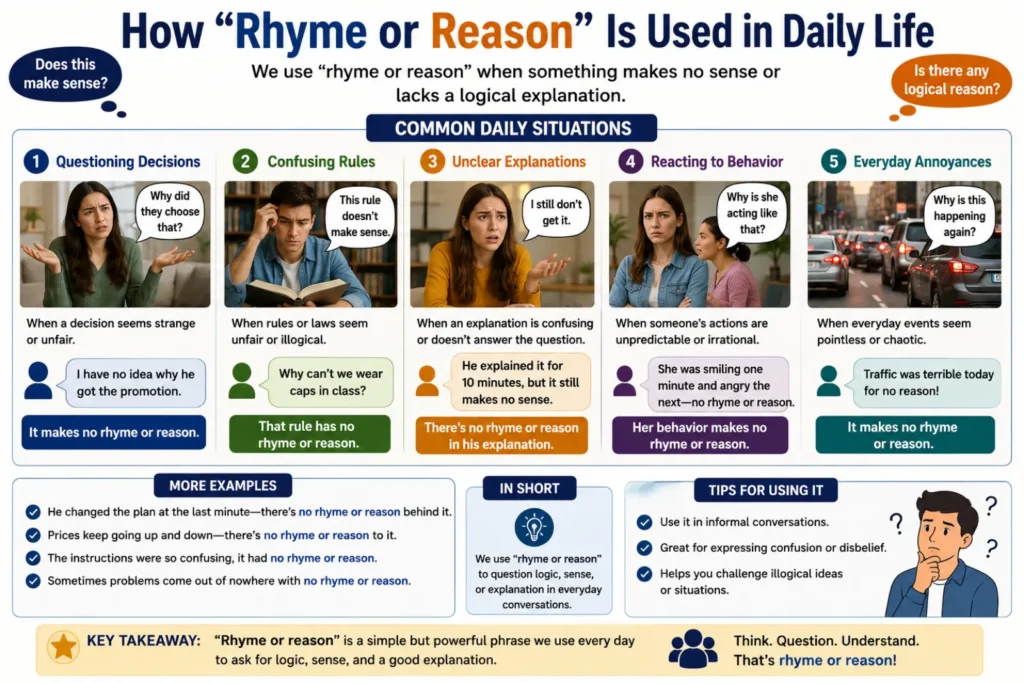
How “Rhyme or Reason” Is Used in Daily Life
You can hear this idiom in many everyday situations.
People may use it when talking about:
Shopping:
“The discounts seem to appear with no rhyme or reason.”
Traffic:
“Traffic jams happen here with no rhyme or reason.”
Weather:
“The weather seems to change with no rhyme or reason.”
Work:
“The meeting schedule changes with no rhyme or reason.”
Technology:
“My phone freezes with no rhyme or reason.”
Relationships:
“She sometimes changes her mind with no rhyme or reason.”
School:
“The teacher gives homework with no rhyme or reason.”
These examples show how flexible the phrase can be.
Is “Rhyme or Reason” Formal or Informal?
The phrase works in both everyday and professional English.
However, it sounds more natural in conversational writing.
For formal documents, you may sometimes choose clearer language.
For example:
Conversational:
“The changes seem to have no rhyme or reason.”
More formal:
“The changes appear to lack a clear rationale.”
Both sentences communicate a similar idea.
The first sounds more natural and conversational.
The second sounds more formal and technical.
Choose the version that matches your audience.
Expert Insight: Why This Idiom Matters
Strong English writing depends on understanding common idioms.
Idioms appear often in conversations, books, articles, interviews, and entertainment.
Knowing their meaning helps you understand English beyond individual words.
Rhyme or reason also gives writers a short way to describe confusing behavior.
Instead of saying:
“There is no clear logic or pattern behind this situation.”
You can say:
“There is no rhyme or reason to this situation.”
That makes the sentence shorter and more natural.
SEO and content tip
When writing about idioms, explain the phrase before giving complex details.
Use examples that match real search intent.
Also include related terms naturally, such as meaning, definition, examples, synonyms, usage, and sentence examples.
This structure helps readers find answers quickly.
Frequently Asked Questions About Rhyme or Reason
What does “rhyme or reason” mean?
Rhyme or reason means logic, sense, purpose, or a clear pattern behind something.
What does “no rhyme or reason” mean?
It means something appears random and has no obvious logic, purpose, or pattern.
Is “rhyme or reason” an idiom?
Yes. Rhyme or reason is an English idiomatic expression.
Its meaning does not normally relate to actual poetry or rhyming.
What is a synonym for “rhyme or reason”?
Depending on the context, synonyms include logic, sense, reason, purpose, order, pattern, and explanation.
How do you use “rhyme or reason” in a sentence?
You can say:
“There is no rhyme or reason to the way he organizes his files.”
This means his system does not seem logical or consistent.
Is “without rhyme or reason” correct?
Yes.
“Without rhyme or reason” means something happens without an obvious reason, purpose, or logical pattern.
What is the opposite of “no rhyme or reason”?
Possible opposites include logical, organized, systematic, purposeful, structured, and well-planned.
Does “rhyme or reason” refer to poetry?
Usually, no.
In modern English, the phrase normally refers to logic, sense, order, or purpose.
Conclusion
Rhyme or reason means logic, sense, purpose, or a clear pattern.
The phrase often appears as “no rhyme or reason.”
This version describes something that seems random or difficult to explain.
You can use it for decisions, behavior, rules, plans, systems, and everyday events.
For example, you can say, “There is no rhyme or reason to these changes.”
The phrase does not usually refer to poetry.
Instead, it works as a common English idiom.
Learning this expression can make your English sound more natural.
It can also help you understand native speakers more easily.
When something seems confusing or random, remember this simple phrase:
If you cannot see the logic, there may be no rhyme or reason.