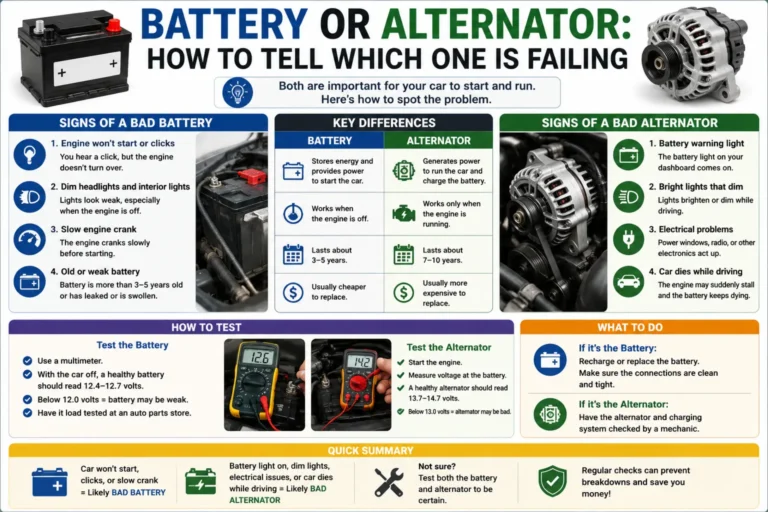
Battery or alternator problems can make your car hard to start or leave you stuck. Both parts play different roles in your car’s electrical system. The battery stores power and helps start the engine. The alternator produces power while the engine runs and helps recharge the battery. When either part fails, the symptoms can look very similar. You may notice slow starting, dim lights, warning lights, or repeated battery problems. This can make it hard to know which part needs attention. The good news is that a few simple signs can help you narrow down the problem. In this guide, you will learn how to tell the difference between a weak battery and a failing alternator.
Quick Summary
- The battery stores power and starts the engine.
- The alternator produces power while the engine runs.
- Slow starting often points to a weak battery.
- A battery warning light can point to a charging problem.
- Dim lights while driving may suggest an alternator issue.
- A bad alternator can leave a good battery without enough charge.
- A battery test and charging test can help confirm the problem.
- Replacing the wrong part can waste money.
- Professional testing can confirm the fault before replacement.
What Does Battery or Alternator Mean?
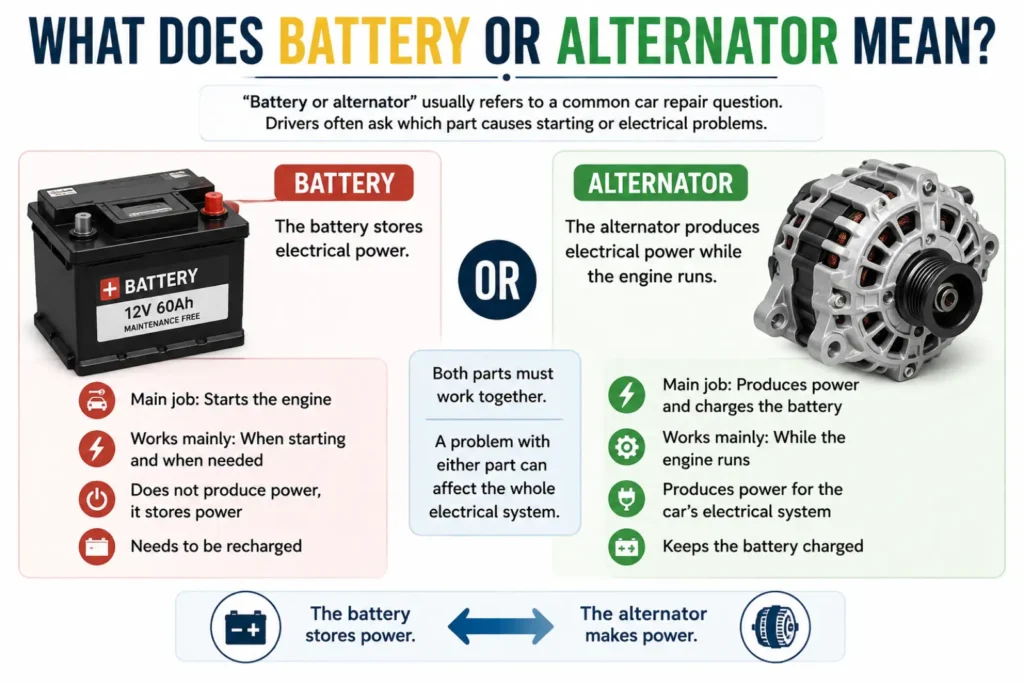
The phrase battery or alternator usually refers to a common car repair question.
Drivers often ask which part causes starting or electrical problems.
The battery provides stored electrical energy.
The starter uses that energy to turn the engine.
The alternator takes over after the engine starts.
It produces electricity and helps recharge the battery.
Think of the battery as a power bank.
Think of the alternator as the charger.
Both parts must work together.
A problem with either part can affect the whole electrical system.
What Does a Car Battery Do?
A car battery stores electrical energy.
Its main job involves starting the engine.
It also powers some electrical systems when the engine is off.
These systems include lights, locks, alarms, and some vehicle electronics.
When you turn the key or press the start button, the battery sends power to the starter.
A weak battery may not provide enough power.
Common signs include:
- Slow engine cranking
- Clicking when starting
- Interior lights becoming weak
- Electrical accessories losing power
- A car that struggles after sitting overnight
Cold weather can also make a weak battery perform worse.
What Does an Alternator Do?
The alternator creates electrical power while the engine runs.
It also helps keep the battery charged.
The engine turns the alternator through a belt.
The alternator then produces electricity for the vehicle.
That electricity supports systems such as:
- Headlights
- Dashboard electronics
- Air conditioning
- Audio systems
- Engine computers
- Safety systems
- Battery charging
A failing alternator may not provide enough power.
The car can then rely more heavily on the battery.
Eventually, the battery may become too weak to start the engine.
Battery vs Alternator: What Is the Difference?
| Feature | Battery | Alternator |
|---|---|---|
| Main job | Stores electrical power | Produces electrical power |
| Works mainly | During starting and when needed | Mainly while the engine runs |
| Starts the engine | Yes | No |
| Recharges itself | No | Helps recharge the battery |
| Common failure sign | Slow or difficult starting | Electrical problems while driving |
| Warning signs | Clicking or weak lights | Battery warning light or dim lights |
| Typical problem | Low stored power | Poor charging |
| Basic test | Battery load test | Charging system test |
The easiest way to remember the difference is simple.
The battery supplies stored power. The alternator supplies running power.
How Can You Tell If It Is the Battery?
A weak battery often causes starting problems.
The engine may crank slowly when you start the car.
You may hear repeated clicking instead of normal engine cranking.
Your lights may also look weaker than usual.
The problem may become worse after the car sits for several hours.
Another clue involves jump-starting.
If the car starts after a jump but struggles again later, the battery may be weak.
However, that does not prove the battery is bad.
A charging problem can also drain the battery.
That is why proper testing matters.
How Can You Tell If It Is the Alternator?
An alternator problem often appears after the engine starts.
You may notice dimming headlights or unusual electrical behavior.
The battery warning light may also appear on the dashboard.
Other possible signs include:
- Flickering lights
- Weak electrical accessories
- Electrical warning messages
- Stalling after driving
- Repeatedly dead batteries
- Strange noises from the engine area
A failing alternator may still allow the car to start.
The problem can develop as the vehicle continues running.
Eventually, the battery may lose its stored power.
Battery or Alternator: Real-Life Examples
Example 1: The Car Clicks but Does Not Start
You turn the key and hear clicking.
The engine does not crank normally.
This situation can point toward a weak battery.
However, other starting problems can cause similar symptoms.
A battery test can help confirm the cause.
Example 2: The Car Starts After a Jump
Your car starts after another vehicle provides a jump.
Later, the car becomes weak again.
This could mean the battery cannot hold a charge.
It could also mean the alternator fails to recharge the battery.
Testing both systems gives a better answer.
Example 3: Lights Become Dim While Driving
You notice the headlights becoming unusually dim.
The dashboard may also show a battery warning light.
This situation can suggest a charging system problem.
The alternator should receive proper testing.
Example 4: A New Battery Dies Quickly
You install a new battery.
Soon afterward, the vehicle develops another dead-battery problem.
Do not assume the new battery failed immediately.
A charging problem may prevent the alternator from keeping it charged.
A technician should test the charging system.

How to Test the Battery or Alternator
A basic electrical test can provide useful clues.
Many repair shops can test both systems.
A battery test checks the battery’s condition and starting ability.
A charging test checks whether the alternator produces enough electrical power.
A digital multimeter can also measure electrical voltage.
However, voltage alone does not always prove battery health.
A battery can show reasonable voltage but still fail under load.
Likewise, charging voltage can change with vehicle design and operating conditions.
Modern cars may use smart charging systems.
Therefore, avoid relying on one number alone.
Proper testing should consider the vehicle’s design and condition.
Common Mistakes When Diagnosing the Problem
Many drivers replace parts too quickly.
That approach can become expensive.
Mistake 1: Replacing the Battery Without Testing
A dead battery does not always mean a bad battery.
Another problem may have drained it.
Mistake 2: Blaming the Alternator for Every Dead Battery
An old battery can fail without an alternator problem.
The charging system still needs testing.
Mistake 3: Ignoring Loose Connections
Dirty or loose battery connections can reduce electrical flow.
Always check connections during diagnosis.
Mistake 4: Trusting One Symptom
One symptom rarely provides a complete answer.
Several problems can create similar signs.
Mistake 5: Ignoring the Warning Light
A battery-shaped warning light can signal a charging problem.
Do not ignore it for long.
Tips to Avoid Battery and Alternator Problems
Regular checks can reduce unexpected electrical problems.
Follow these simple tips:
- Keep battery connections clean.
- Check for loose electrical connections.
- Watch for dashboard warning lights.
- Replace an aging battery when testing shows weakness.
- Inspect the accessory belt when appropriate.
- Avoid leaving lights on when the engine is off.
- Test the charging system after repeated battery failures.
- Follow the vehicle maker’s maintenance schedule.
Your owner’s manual can provide vehicle-specific guidance.
Battery or Alternator in Daily Driving
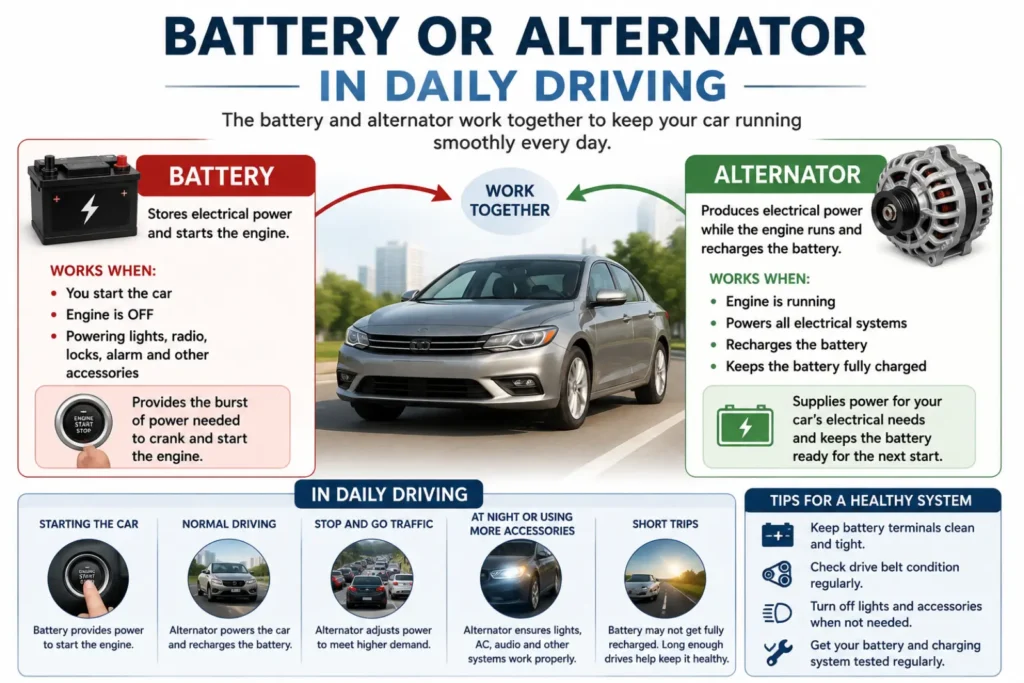
The battery and alternator work during nearly every trip.
The battery helps start your vehicle.
The alternator then supplies electrical power while the engine runs.
Your vehicle may also use more electrical power in certain conditions.
Examples include heavy traffic, cold weather, and frequent short trips.
Short trips can give the charging system less time to replace starting energy.
Older batteries may struggle more under these conditions.
Regular driving habits and proper maintenance can help.
Battery or Alternator: Synonyms and Related Search Terms
People use many different phrases when searching for this problem.
Useful related terms include:
- Car battery problem
- Bad battery symptoms
- Bad alternator symptoms
- Battery vs alternator
- Alternator charging problem
- Car will not start
- Car battery keeps dying
- Battery warning light
- Charging system problem
- Alternator failure signs
- Weak car battery
- Dead car battery
- How to test an alternator
- How to test a car battery
- Battery or alternator test
- Car electrical problems
These terms describe related problems without forcing the exact keyword repeatedly.
Expert Insights: Why Proper Diagnosis Matters
A professional diagnosis starts with symptoms.
Next, the technician checks the battery and charging system.
They may also inspect connections, cables, belts, and related components.
This approach helps prevent unnecessary part replacement.
A new battery cannot fix every charging problem.
Likewise, a new alternator cannot fix every starting problem.
The vehicle’s age and electrical design also matter.
Modern vehicles often use advanced charging controls.
That means simple assumptions may produce the wrong diagnosis.
Expert tip: Test the system before buying expensive replacement parts.
When Should You Get Professional Help?
Seek professional help when the problem keeps returning.
You should also get help if the vehicle stalls while driving.
A warning light combined with electrical problems deserves attention.
Professional testing becomes especially useful after installing a new battery.
If the new battery repeatedly loses power, investigate the charging system.
A technician can test the battery, alternator, starter, cables, and related systems.
This wider check can prevent repeated repairs.
Frequently Asked Questions
Is it the battery or alternator if my car will not start?
A dead battery can prevent starting.
However, an alternator problem can also drain the battery.
Testing both systems gives a more reliable answer.
How do I know if my alternator is bad?
Look for charging problems while the engine runs.
Possible signs include dim lights, warning lights, and repeated dead batteries.
A charging system test can confirm the problem.
How do I know if my battery is bad?
Common signs include slow cranking, clicking, and weak electrical power.
A battery load test can provide stronger evidence.
Can a bad alternator ruin a new battery?
Yes, a charging problem can leave the battery undercharged.
Repeated undercharging can reduce battery performance and life.
Can a bad battery damage an alternator?
A weak battery can increase charging demands.
However, many factors affect alternator wear.
Proper diagnosis remains important.
Will a car run with a bad alternator?
It may run for some time using stored battery power.
Eventually, the battery can lose enough power to stop the vehicle.
Should I replace the battery and alternator together?
Not usually.
Replace the failed component after proper testing.
Replacing both without evidence can waste money.
How long does a car battery last?
Battery life varies by vehicle, climate, driving habits, and battery type.
Regular testing can help identify weakness before failure.
conclusion
Understanding battery or alternator problems can save time and money.
The battery stores electrical power for starting and other needs.
The alternator produces power while the engine runs.
Both parts depend on each other during normal driving.
A slow start often points toward a battery issue.
Electrical problems while driving may suggest a charging issue.
Still, symptoms alone cannot always identify the failed part.
A proper battery and charging test gives a better answer.
You should also check connections and related components.
Avoid replacing expensive parts based on one symptom.
When problems return, get the full system tested.
The simple rule is easy to remember: the battery stores power, while the alternator